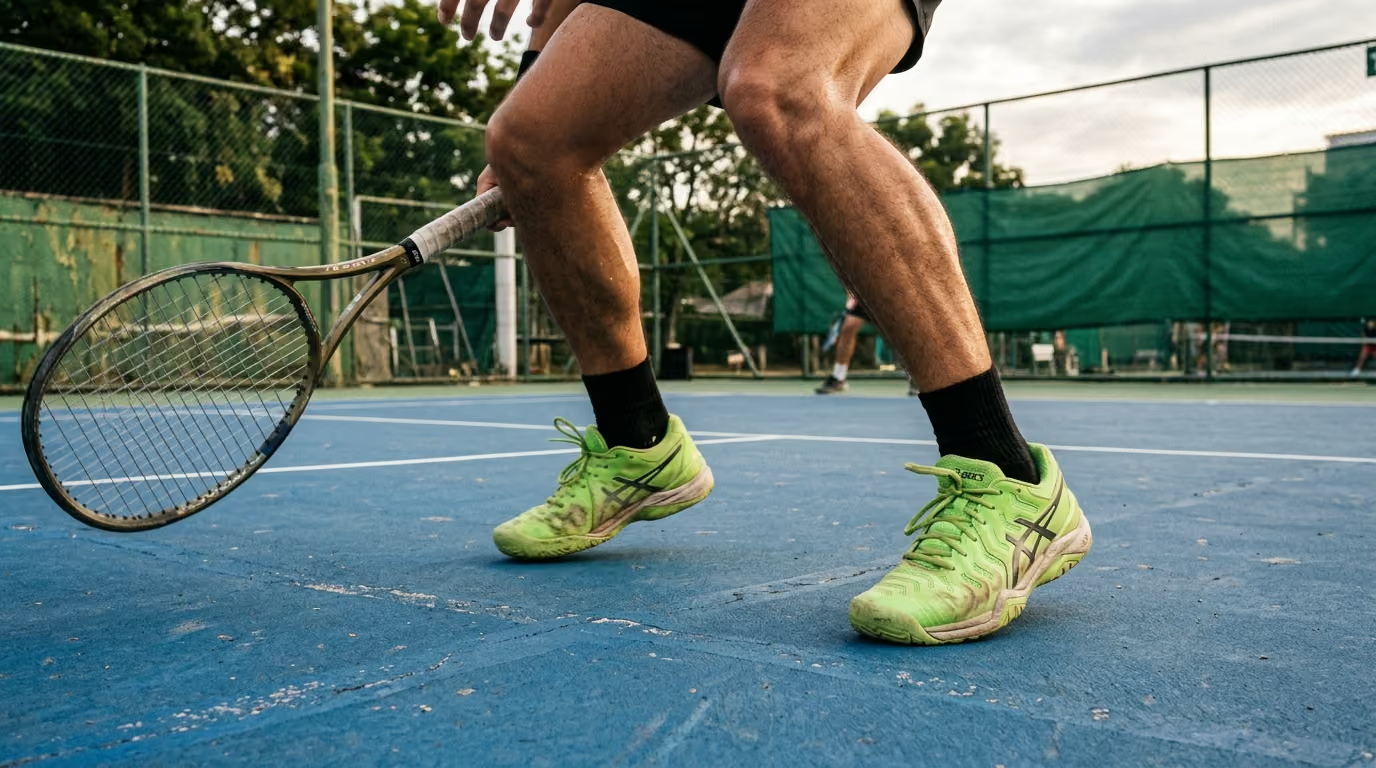
Racquet sports athletes can effectively choose and substitute exercises for training by focusing on movement patterns, force directions, and individual tolerance.




How to Choose and Substitute Exercises for Racquet Sports Training
How can you adjust your gym training when your favorite exercise causes court stiffness or joint irritation? Many players struggle to modify their gym programs without losing their hard-won physical adaptations. This detailed resource explains how to select and substitute exercises based on movement patterns, force directions, joint positions, and individual tolerance.
Choosing the right exercise for court sports requires looking at the physical stimulus instead of how closely a movement mimics a racket stroke. Substituting exercises intelligently means matching the joint angles, force directions, and muscle actions of the court without exceeding your physical tolerance. This approach keeps you on the court longer and builds athletic longevity.
To build a durable body for court sports, you must understand the difference between visual similarity and genuine physical adaptation. Many players make the mistake of choosing exercises because they look like tennis or pickleball strokes. For example, swinging a weighted cable attachment to mimic a tennis forehand is a common approach. However, research suggests that this visual mimicry can actually alter your real stroke mechanics. It also fails to load the targeted muscles through the proper range of motion.
According to a systematic review published by Kassiano and colleagues in 2022, systematic exercise variation can improve regional muscle growth and dynamic strength. However, the researchers also warned that excessive or random variation can compromise physical adaptation. Your body needs a consistent stimulus over time to adapt and grow stronger. This means your training should rely on a stable rotation of core movement patterns rather than constant, random changes.
The American College of Sports Medicine, also known as the ACSM, emphasizes individualization in resistance training prescription. Their guidelines highlight that strength development is best achieved through heavier loading, while power development requires moderate loads. Specifically, power work should use loads between 30 and 70 percent of your one-repetition maximum, combined with rapid concentric movement. When you substitute an exercise, your primary goal should be to preserve these specific loading zones and contraction speeds. Replacing a heavy strength movement with a light, unstable exercise completely changes the physical adaptation your body receives.
For a deeper understanding of program design, check our racquet sports strength training guide to learn about loading protocols.
To make smart exercise selections, you must first understand the specific physical demands of your sport. Racquet sports require repeated high-intensity efforts separated by brief, unpredictable recovery periods. These sports rely heavily on both your aerobic and anaerobic energy systems. However, the specific metabolic demands vary significantly between different racquet disciplines.
A systematic review on the physiological demands of racket sports shows that badminton generally produces the highest cardiovascular and metabolic demands. Squash also ranks very high in cardiovascular strain due to the continuous rally structure. In contrast, table tennis displays lower heart-rate and lactate responses than badminton, squash, and tennis. Tennis players must endure matches that can last several hours, involving hundreds of short, explosive bursts. This means your strength and conditioning program must build both high-power output and the capacity to repeat those efforts.
Injury statistics further emphasize the need for a targeted exercise selection framework. A review of tennis injury epidemiology shows that injury incidence ranges from 0.04 to 3.0 injuries per 1,000 hours played. The lower extremity accounts for approximately 31 to 67 percent of these injuries. The upper extremity accounts for 20 to 49 percent, while trunk injuries make up 3 to 21 percent. Another epidemiology review reported lower-limb injury rates of 23.0 per 1,000 match exposures, which significantly exceeds trunk and upper-limb rates.
Acute injuries occur most frequently in the lower limbs, particularly in the ankle, thigh, foot, and knee. Overuse injuries are more common in the upper limbs, especially among recreational players who may lack technical efficiency. The tennis serve is particularly stressful, generating supraphysiologic forces through the shoulder and elbow hundreds of times per match. Understanding these patterns helps you implement smarter injury prevention strategies for court athletes in your weekly gym routine.
Instead of following a rigid, unchanging list of exercises, you can use a systematic framework to analyze any sport movement. This process helps you select the best possible exercises and find suitable substitutes when needed. The National Strength and Conditioning Association, or NSCA, provides biomechanical guidance that forms the foundation of this analysis.
First, you must break down your sport into distinct, major movements. Avoid grouping all racquet sport actions into a single category. Instead, analyze specific actions like the split step, first-step acceleration, or diagonal lunging. You should also evaluate horizontal hitting, overhead smashing, and deceleration during recovery. For example, the tennis serve can be analyzed using a five-phase model consisting of the wind-up, early cocking, late cocking, acceleration, and follow-through.
Next, determine which primary movement patterns and planes of motion are involved. Court sports are multi-planar, meaning they occur in three dimensions. The sagittal plane dominates during linear acceleration, vertical jumping, and basic squatting. The frontal plane is highly active during lateral shuffling, lateral lunging, and side-to-side braking. The transverse plane controls trunk rotation, hip rotation, and shoulder rotation during groundstrokes.
Force direction is one of the most practical criteria for choosing a substitute exercise. You must determine whether you need to produce force vertically, horizontally, or laterally. For example, a barbell squat primarily produces vertical force, which is excellent for general leg strength. However, lateral lunges and skater jumps apply force laterally, which is more specific to court recovery movements. A good substitute should match the force direction of the original exercise to preserve the training effect.
Different exercises place varying demands on your joints depending on the angles involved. You must consider knee flexion, hip flexion, ankle dorsiflexion, and shoulder rotation. During the late-cocking phase of a serve, your shoulder reaches extreme abduction and external rotation. This position generates massive internal force and carries a high risk of injury. If you have limited shoulder mobility, you must select exercises that build strength without forcing your joints into painful, extreme ranges.
Exercises must also match the muscle contraction type required by the sport. Racquet sports require rapid concentric power to accelerate, but they also require immense eccentric control to slow down. For example, landing from a jump or stopping after a sprint requires your muscles to absorb force eccentrically. Dynamic movements rely on the stretch-shortening cycle, which combines rapid stretching and contracting. Your program should include concentric, eccentric, and isometric exercises to build a well-rounded physical foundation.
Finally, you must match the velocity of your exercises to your training goals. If your objective is maximal strength, you should choose stable exercises that allow you to lift heavy loads slowly. If your goal is speed-strength or power, you must select exercises that can be accelerated rapidly. This is where using a balanced strength program can help you select your exercises based on velocity rather than visual appearance. You can find more detail on this in our library of court performance resources.
To train effectively, you must stop viewing your body as a collection of isolated muscles. Racquet strokes are classic examples of kinetic-chain actions, where energy is transferred through linked segments of your body. In the tennis serve, energy is generated by your feet pushing against the ground. This force travels up through your legs, hips, trunk, shoulder, and arm, finally reaching the racquet.
Research indicates that approximately 54 percent of force development in the tennis serve comes from the legs and trunk. In contrast, only 25 percent of the force comes from the elbow and wrist combined. This means that a weak lower body or an unstable trunk will limit your racket speed. It also forces your upper body to work harder, increasing the risk of overuse injuries. The elbow functions primarily as a link to transfer this energy, not as an isolated power source.
During a typical serve, your elbow moves from 116 degrees of flexion to 20 degrees of flexion in just 0.21 seconds. Impact with the ball occurs very close to 35 degrees of elbow flexion. This incredibly fast movement requires precise proximal-to-distal sequencing. Your hips and trunk must rotate first, followed by your shoulder, elbow, and wrist. If your shoulder or core is weak, this sequence breaks down, placing excessive strain on your elbow joint.
Therefore, improving your upper-body performance should not simply mean doing more bicep curls or forearm extensions. Instead, your strength program must focus on building a strong kinetic chain. You must pair lower-body power with trunk stability and shoulder control. This holistic approach ensures that force is transferred smoothly without overloading any single joint. Incorporating court mobility and movement protocols can balance this load and keep the entire kinetic chain functioning efficiently.
A truly versatile training program does not rely on a rigid list of exercises. Instead, it uses a systematic substitution matrix based on movement patterns. This allows you to keep training even when you have limited equipment or minor joint irritation. Below are the primary movement patterns and how to substitute them intelligently.
The barbell back squat is a classic exercise for building lower-body strength. However, it requires significant spinal loading and shoulder mobility to hold the bar.
These alternatives preserve knee and hip extension while changing the spinal demand, balance requirement, and hand position.
The hinge pattern targets your posterior chain, including your glutes, hamstrings, and lower back. The traditional barbell deadlift is the standard hinge exercise, but it can be highly demanding on your central nervous system.
These movements preserve posterior-chain recruitment while changing spinal loading, balance demands, and grip requirements.
Lunging is a fundamental movement in all racquet sports, but dynamic lunging can be tough on sensitive joints. You should use a graded progression rather than jumping into high-speed lateral lunges.
These exercises preserve lower-body structural strength while changing the balance, velocity, and impact forces.
Overhead athletes must be cautious with heavy, fixed-barbell pressing. These movements can trap your shoulder blades and irritate your rotator cuff.
These exercises preserve pushing capacity while changing the freedom of your shoulder blades, body position, and rotational demand.
Pulling exercises are critical for balancing the high volume of forward-facing strokes in racquet sports. They build the muscles that slow down your arm after a powerful swing.
These variations preserve upper-back engagement while changing the balance requirements, axial loading, and shoulder angles.
Racquet sports require you to both produce rotation and resist unwanted rotation. You must select exercises that target these distinct physical qualities.
These movements preserve trunk engagement while changing the speed, directional demands, and stability requirements.
Strength training should support your court performance, not take away from it. To achieve this, you must learn to manage your training load and respect your individual joint tolerance. The International Olympic Committee, or IOC, consensus on load in sport emphasizes that training load must be monitored individually. Every player has a unique physical history, playing style, and recovery rate. Therefore, an exercise that works perfectly for one athlete might cause pain or fatigue for another.
You should monitor your pain closely during and after every training session. A good rule of thumb is that exercise discomfort should not exceed a mild level. If you experience sharp joint pain during an exercise, you should stop immediately and find a substitute. Furthermore, you must assess how your joints feel the next morning. Next-day swelling, stiffness, or a loss of physical function are clear signs that the training load was too high.
To minimize the risk of injury, the IOC consensus recommends making small, gradual changes to your training volume. In general, try to keep your weekly training load increases below 10 percent. This guideline applies to both your gym work and your on-court playing time. If you suddenly double your serving volume in a single week, you should reduce your upper-body training in the gym to compensate. Balancing your gym sessions with proper recovery science principles is vital to ensure long-term athletic longevity.
Managing your total physical exposure is especially critical during periods of high competition. Your shoulder muscles do not differentiate between a heavy gym press and a hard tennis serve. Both activities contribute to your overall muscle fatigue and tendon load. If your shoulder feels tired or stiff from playing, substitute high-stress upper-body movements with targeted mobility work. This strategy maintains your physical capacity without overloading vulnerable tissues.
While all racquet sports share some physical demands, they also have distinct differences that should influence your exercise selection. Understanding these nuances allows you to tailor your training and substitutions to your specific sport.
Tennis is played on a large court, which requires high-speed linear sprinting and deep deceleration. The tennis serve also places massive, repetitive demands on the shoulder and elbow joints.
To find more tennis-specific advice, you can read our curated tennis articles on performance and longevity.
Pickleball is played on a smaller court, which emphasizes rapid lateral reaction times and short, sudden bursts. The sport also involves a high volume of low-to-the-ground dink shots, requiring deep knee bend endurance.
Learn more about adapting your training by browsing our pickleball articles for competitive players.
Padel combines the lateral movement of pickleball with the frequent overhead play of tennis. The sport requires constant diagonal recoveries, rotation to play balls off the glass, and repeated overhead shots like the bandeja.
For additional strategies, look through our collection of padel articles focused on tactical movement.
Many court athletes make simple, avoidable mistakes when designing their strength programs. Recognizing these pitfalls can save you from wasted effort and unnecessary joint strain.
The most common mistake is assuming that an exercise must look like a sport movement to be effective. Swinging a heavy cable to mimic a forehand does not build sport-specific power. Instead, it can disrupt your actual stroke mechanics and place strange, unnatural shear forces on your shoulder. The best approach is to build general strength in the gym and practice your skills on the court.
Another frequent error is trying to fix performance issues with isolated muscle training. For example, a player with elbow discomfort might focus entirely on forearm curls. However, as we have learned, the elbow is simply a link in a larger kinetic chain. If your hips or core are weak, your elbow must work twice as hard to generate racket speed. Your program should focus on compound movements that integrate the entire body.
While exercise variation is important, rotating your exercises too frequently will hinder your progress. If you change your gym routine every week, your body never has time to adapt and get stronger. You will spend all your energy learning new movements instead of building real strength. A better strategy is to choose a solid set of exercises and stick with them for at least four to six weeks before making changes.
Many players focus entirely on exercises that build concentric power, such as fast jumps and heavy pushes. However, they completely ignore the eccentric phase of movement, which is crucial for stopping and changing direction. If you cannot absorb force, you will not be able to recover quickly to the center of the court. Ensure your program includes controlled step-downs and eccentric split squats to build this braking capacity.
While smart exercise substitution can help you manage minor aches, it is not a replacement for professional medical care. You must know when to step away from the gym and consult a qualified healthcare provider.
Seek immediate medical attention if you experience any of the following red flags:
If you experience these symptoms, consult a physical therapist or sports medicine physician. They can provide an accurate diagnosis and design a targeted rehabilitation plan. Do not attempt to work through severe pain, as this can turn a minor issue into a chronic, long-term injury. If you have questions about our research-led guidance, you can read more about Evercourts and our mission to keep athletes playing.
To put this knowledge into action, use this practical checklist to refine your training program this week. These simple steps will help you transition from rigid routines to a flexible, sustainable exercise system.
If you are looking for more structured guidance on improving your performance, visit our main resources for court athletes to view our full library of guides. Staying active and mobile is a lifelong journey, and smart exercise selection is your best tool for athletic longevity.
Follow Evercourts for practical insights on tennis, pickleball and padel performance, movement, recovery and healthy ageing. Stay connected for new articles, research-led guidance and ideas to help you play well and keep playing for years.


Read practical guidance for better movement, smarter preparation and a game that keeps working for you.
explore the Blog