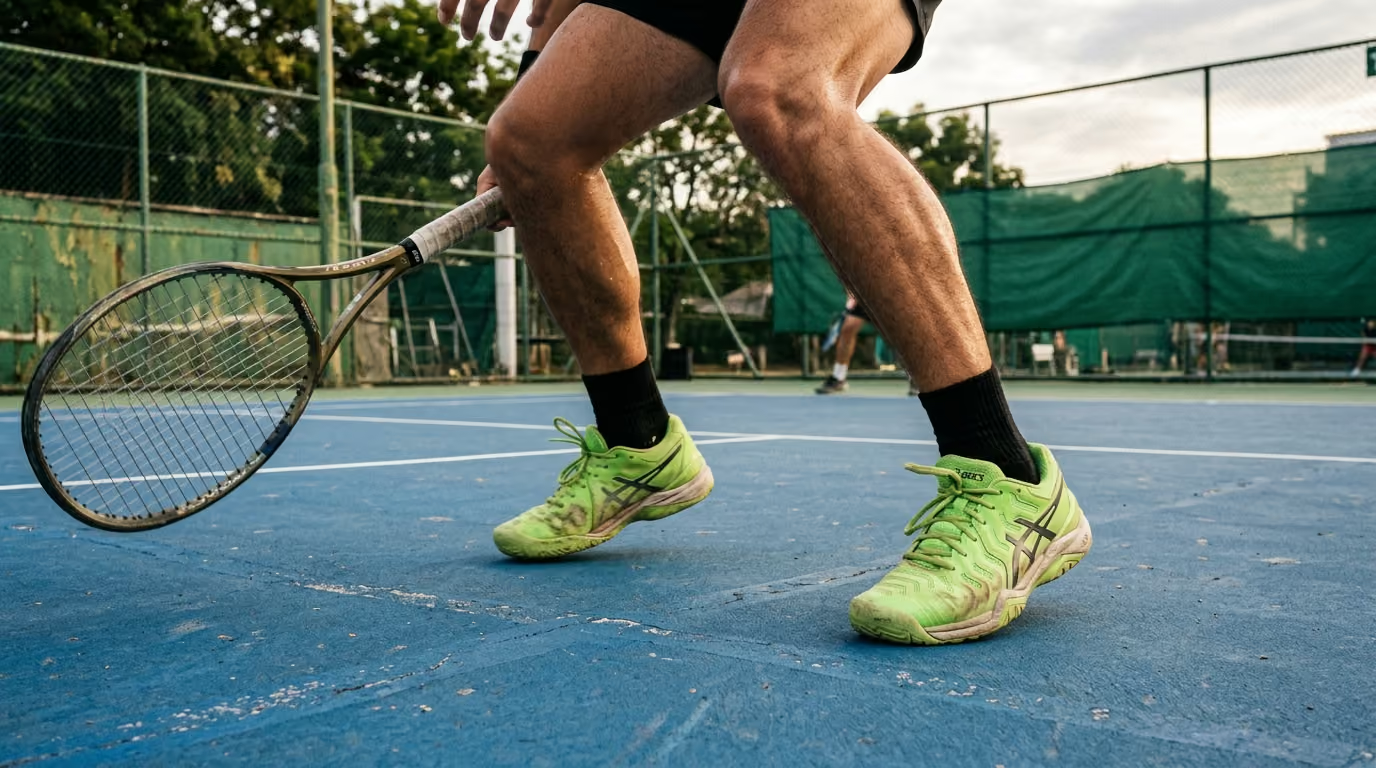
Players can maintain their passion for racquet sports while competing seriously by focusing on controllable variables and fostering a mastery climate.




Many players who transition from casual play to organized competition notice a shift in how they experience the sport. The activity that once provided stress relief and physical vitality begins to produce anxiety, self-criticism, and physical exhaustion. This shift often occurs because the standard for a successful session narrows down to a single outcome on the scoreboard. When winning becomes the sole measure of value, the daily process of playing becomes a source of tension rather than satisfaction.
To compete seriously without losing enjoyment, you must anchor your progress in variables you can control. Rather than measuring success by the scoreboard, build your competitive routine around specific movement habits and tactical decisions. This shift turns intense matches from stressful tests of your worth into absorbing challenges that support long-term participation.
Protecting your enthusiasm is not an alternative to being a serious competitor. It is the primary requirement for sustained development. By treating competition as an environment for learning and connection, you can maintain high standards while preserving the simple pleasure of striking a ball.
To understand why some players thrive under pressure while others burn out, we must look at the science of human motivation. A helpful starting point is Self-Determination Theory, a widely accepted psychological framework developed by researchers Edward Deci and Richard Ryan. This theory suggests that humans require three basic psychological needs to feel motivated and satisfied. These needs are autonomy, competence, and relatedness.
Autonomy refers to the feeling of personal ownership over your actions. In racquet sports, this means deciding how you want to play, which tournaments to enter, and what skills to practice. Competence is the feeling of being effective and seeing your abilities grow over time. Relatedness is the sense of belonging and connection with other people, including your doubles partners, opponents, and club members.
When a competitive environment supports these three needs, players experience intrinsic motivation. This means they play because the activity is inherently satisfying. Research shows that autonomy support is strongly linked to athlete well-being and lower levels of distress. A comprehensive meta-analysis of physical activity studies confirmed that autonomy support is a primary driver of healthy, self-driven motivation.
The climate of your local club or league also shapes your competitive experience. Sports psychologists divide competitive settings into mastery climates and ego climates.
In a mastery climate, success is defined by effort, personal improvement, and skill acquisition. In an ego climate, success is determined by social comparison, ranking, and defeating others. While an ego climate can cause performance anxiety, a mastery climate is associated with higher levels of enjoyment and commitment. You do not have to ignore rankings in a mastery climate. Instead, you view those rankings as useful benchmarks for your current skills rather than measures of your personal worth.
Furthermore, sport science shows that enjoyment is the single greatest predictor of whether an athlete continues playing. A long-term study on sport participation found that players who reported high levels of enjoyment were far less likely to drop out. This finding was supported by a systematic review of sport withdrawal, which identified a lack of enjoyment as a primary cause of dropout. Protecting your passion for the sport is not a soft option. It is a practical strategy for athletic longevity.
When you enjoy your sport, you are also more likely to enter a state of flow. Flow is a state of deep absorption where your attention is fully focused on the task at hand. Your thoughts quiet down, and you react naturally to the ball. Research on flow in sports shows that it is more common when you balance the difficulty of the challenge with your current skill level. When the challenge is too high, you feel anxious. When it is too low, you feel bored. Adjusting this balance is key to keeping the game engaging.
Finally, racquet sports offer profound physical and psychological advantages that extend beyond wins and losses. Regular play is associated with improved cardiovascular health, better bone density, and a lower risk of depression. A survey of court sport athletes showed that active players had well-being scores significantly higher than their non-playing peers. Additionally, a recent scoping review of tennis research highlighted positive associations with self-confidence and mental resilience. Losing a match does not diminish these significant health returns.
To put these psychological principles into action, you need concrete tools. You can apply these structured frameworks to your weekly matches and practice sessions. They help you organize your training, evaluate your performance, and protect your mental energy.
Standard post-match evaluations usually focus entirely on the final score. The five-scorecard model replaces this narrow view with a comprehensive assessment. After every match, score yourself from one to ten on five distinct areas.
The first area is the Result Scorecard. This is the objective outcome of the match, including the score and the ranking implications. It is a factual record of what happened on the scoreboard.
The second area is the Execution Scorecard. This measures how well you performed your target technical and tactical behaviors. For example, you might rate how consistently you hit your targets or maintained your footwork.
The third area is the Adaptation Scorecard. This evaluates how effectively you responded to changing conditions. This includes your adjustments to wind, court surfaces, or an opponent who changed their strategy.
The fourth area is the Experience Scorecard. This rates your levels of focus, absorption, and overall engagement during the match. It tracks whether you felt connected to the challenge or overwhelmed by frustration.
The fifth area is the Recovery Scorecard. This assesses your physical and emotional state after the match. It helps you determine if you can train sustainably in the coming week.
Using these five areas prevents a narrow loss from feeling like a total failure. It also prevents an uninspired win against a weak opponent from hiding poor tactical habits. You can learn more about structured approaches to match preparation by reviewing our resources for court athletes.
Many players struggle with goal-setting because they only focus on long-term outcomes. A sustainable competitive career requires a three-layer goal system. This system includes season goals, match goals, and point goals.
Season goals provide your overall direction. These might include playing in six tournaments, developing a more reliable second serve, or maintaining your physical health. These goals keep you focused on the big picture over several months.
Match goals translate your seasonal priorities into specific targets for a single day. For instance, you might set a goal to target your opponent's backhand during return games. These goals give you a clear tactical purpose regardless of the final score.
Point goals are the micro-behaviors you focus on during active play. Examples include performing a split step as your opponent strikes the ball, or taking a deep breath before serving. Point goals keep your mind anchored in the present moment.
This three-layer system is highly effective because it emphasizes variables you can control. Research on goal-setting in sports shows that process goals have a much larger impact on performance than outcome goals. While outcome goals have a small statistical effect, process goals help direct attention and reduce performance anxiety. Focusing on your point goals naturally improves your chances of achieving your outcome goals.
To manage your stress during a match, you must distinguish between different levels of control. You can divide your competitive environment into three categories. These are direct control, influence, and zero control.
You have direct control over your preparation, your warm-up quality, and your tactical choices. You control your breathing, your reaction to mistakes, and your physical effort. This is where you should direct the vast majority of your mental energy.
You have influence over your opponent's comfort, the tempo of the match, and the communication with your doubles partner. You cannot guarantee these outcomes, but your choices can sway them in your favor.
You have zero control over the final score, the weather, the court speed, or line calls. When you worry about these elements, you waste valuable focus. Recognizing these divisions helps you stay composed when external factors are difficult.
A resilient mental game relies on multiple sources of satisfaction. If you only enjoy winning, your relationship with the sport will remain fragile. You should build a diverse portfolio of positive experiences.
Mastery is the satisfaction of seeing your skills improve through deliberate practice. Challenge is the excitement of testing your limits against a tough opponent. Absorption is the quiet focus that comes from being fully present in a rally.
Expression is the fun of playing with your own unique style and physical strengths. Connection is the social bond you share with partners, opponents, and club members. Novelty is the interest generated by playing on a new court or trying a different format.
By cultivating all six of these areas, you protect your motivation. A tough loss can still be highly rewarding if it features great rallies, strong social connections, and valuable tactical lessons. You can read more about balancing competition with club life in our court life articles.
You do not have to play every match with the same high level of intensity. Think of your competitive drive as a dial with four distinct settings. You can adjust this dial based on your current physical and mental needs.
The Exploration setting is for learning, trying new shots, and observing your movement. This setting is ideal for casual hitting sessions and low-stakes practice games.
The Development setting is for practicing a specific tactical pattern under moderate pressure. You keep score, but the primary objective is executing the pattern rather than winning the point.
The Performance setting is for local league play and club matches. Here, you use your most reliable patterns and focus on playing clean, tactical points.
The Peak Competition setting is reserved for major tournaments or championship matches. This is where you test your limits and prioritize the scoreboard result. Using these different settings prevents mental fatigue and keeps practice interesting.
Monitor your relationship with the sport by checking your competitive state weekly. Use this simple traffic-light system to catch signs of burnout early.
Green indicates a healthy competitive state. You look forward to matches, experience normal pre-game nerves, and recover well physically. Your losses feel informative rather than devastating.
Yellow is a warning phase. You might feel frequent dread before playing, check your rankings constantly, or feel irritable with partners. You may also notice persistent physical fatigue or find yourself playing through minor aches.
Red represents a state of burnout. You feel emotionally exhausted, resent the sport, and experience a decline in your skills. Playing through injuries or feeling a loss of personal identity after a defeat are also common in this phase. If you find yourself in the red zone, you need to reduce your playing volume and consult a professional.
The physical demands, social structures, and tactical tempos of tennis, pickleball, and padel differ significantly. These variations affect how you manage your competitive mindset and maintain your love for the game.
Tennis is a sport of high physical isolation and significant court dimensions. In singles play, you are alone with your thoughts for several hours. The large court requires explosive movement, which can place heavy demands on your joints and aerobic system. Because points are separated by brief breaks, you have ample time to ruminate on mistakes.
To maintain your enthusiasm in tennis, you must manage your internal dialogue during those quiet moments between points. Using a consistent physical routine, such as adjusting your strings or focusing on your breathing, can stabilize your attention.
Because tennis has a high physical entry barrier, you must also prioritize your recovery to support healthy aging. For detailed advice on structuring your training for longevity, look through our healthy aging and athletic longevity resources.
Pickleball features a smaller court, lighter paddles, and high social density. Points are fast and characterized by rapid hand exchanges at the non-volley line. Because players stand close to each other, the social environment is highly immediate. It is common to play multiple matches with different partners in a single afternoon.
The challenge in pickleball is often managing the high volume of social interactions and rapid rating changes. With the popularity of digital rating systems, players can easily become obsessed with minor rating movements.
To keep pickleball fun, balance your competitive rating matches with social play. Focus your attention on the physical sensation of clean contact and soft control in the transition zone, rather than your dynamic rating. You can find more strategies for organizing your play in our pickleball articles.
Padel is a fast-paced doubles sport played within an enclosed glass court. The presence of walls creates complex geometric puzzles and long, strategic rallies. Because you always play with a partner, the quality of your personal relationship is central to your success. The sport demands constant verbal communication and tactical adjustments after every bounce.
To preserve your enjoyment in padel, you must treat your partnership as a collaborative project. Blaming a partner for errors or arguing about strategy quickly drains the fun from the sport.
Focus on building shared process goals with your partner, such as moving together relative to the ball. Celebrating good teamwork and maintaining a supportive tone will help you navigate tough matches. For more insights on padel tactics and lifestyle, see our collection of padel articles.
Even experienced players can fall into habits that undermine their competitive satisfaction. Recognizing these common pitfalls can help you adjust your training.
A frequent mistake is assuming that enjoying your sport means you must not care about winning. Some players believe that to be serious, they must be miserable, tense, and self-critical on the court.
However, sport science shows that positive emotions actually expand your visual field and improve your tactical flexibility. When you enjoy the challenge, you are more creative and resilient under pressure. Seriousness and enjoyment are not opposites, they are complementary.
Many players try to overcome match anxiety by repeating empty positive phrases to themselves. They tell themselves they will win, or that they are the better player, without any tactical foundation.
When things go wrong on the court, this superficial optimism quickly crumbles. A better approach is to rely on clear, actionable process cues. Focus on where you want to place your serve, or how early you want to prepare your racquet, rather than forcing yourself to feel confident.
While pressure training is valuable, simulating tournament conditions in every single practice session can lead to mental fatigue. If every point you play is evaluated, you will never feel comfortable experimenting with new techniques.
You need periods of play where mistakes are treated as useful data points rather than failures. Designate specific practice sessions for exploration, where the scoreboard is completely ignored.
Analyzing your performance immediately after a tough loss is usually a mistake. When you are tired, disappointed, and physically depleted, your evaluation will be distorted by emotion.
You are likely to focus entirely on your errors and overlook the positive aspects of your play. Wait at least one hour, or even until the next morning, before analyzing your performance. This cooling-off period allows you to be objective and constructive.
Your mental relationship with competition has a direct impact on your physical body. High levels of competitive anxiety and frustration trigger the release of stress hormones like cortisol.
This chemical response increases muscle tension, which can impair your coordination and fluid movement on the court. Chronic stress also degrades your sleep quality, which is the most critical element of physical recovery.
When you learn to view competition as an absorbing challenge rather than a threat, your nervous system remains balanced. Your muscles stay relaxed, your movement economy improves, and you consume less physical energy during long rallies.
This reduction in physical stress lowers your risk of overuse injuries and speeds up your recovery between matches. For a deeper look at the relationship between stress, movement, and physical health, read our player health articles.
To see how these concepts apply in real life, let us examine several common player profiles. These examples show how simple adjustments can restore enjoyment to your competitive schedule.
This player wins most of their matches but feels intense anxiety throughout every point. They criticize themselves for every minor mistake and feel relieved, rather than happy, when the match ends. They view practice sessions as chore-like preparation for the next ranking event.
The solution for this player is to introduce non-negotiable process goals. They should set a rule that they cannot perform any technical analysis for one hour after a match.
They should also add one social, non-ranking session to their weekly schedule. This helps them reconnect with the physical sensation of playing without the pressure of a result.
This player has excellent skills in practice but struggles in formal matches. They equate losing with being exposed as incompetent. To protect their ego, they avoid playing against stronger opponents and choose overly safe tactics that limit their growth.
To help this player, we can introduce a "brave decision" metric. Instead of scoring their play based on wins, we score them on whether they took constructive risks.
Did they attack a short ball when the opportunity arose? Did they stick to their tactical plan when they fell behind? This shifts the focus from avoiding mistakes to displaying courage.
This player loves casual social games but feels terrified when entering local tournaments. The formal atmosphere, unfamiliar opponents, and spectator presence make them feel anxious and clumsy.
This player benefits from a graduated competitive pathway. They should start with short, timed practice sets with familiar friends.
Next, they can progress to a low-stakes club ladder before entering larger tournaments. Having a clear point-level routine, like checking their strings between points, helps keep their attention on the court.
This player has played the same tournaments and practiced the same drills for years. Their results are stable, but they feel bored and uninspired. Their motivation is declining, and they find themselves skipping sessions.
This player needs structured variety to restore their enthusiasm. They can try playing doubles if they usually play singles, or switch to a different court surface.
Learning a completely new tactic, like a serve-and-volley pattern, can also stimulate their interest. Research shows that introducing novelty is an excellent way to renew motivation. You can find more ideas for refreshing your routine in our better play articles.
While self-management strategies are highly effective, there are times when you should consult a professional. If you experience persistent joint pain, muscle strains, or chronic fatigue, seek guidance from a qualified physical therapist or sports medicine physician. Playing through physical pain is a common cause of athletic burnout and can lead to long-term tissue damage.
Similarly, if competitive play causes persistent anxiety, sleep disturbances, or feelings of worthlessness, consider speaking with a licensed sports psychologist. These professionals can provide personalized cognitive strategies to help you manage pressure.
Remember, the goal of competition is to enrich your life, not to damage your physical or mental health. If you are looking for structured guidance on healthy athletic development, visit our injury prevention resources.
To help you apply these principles to your play this week, here is a practical checklist.
By building these habits, you can enjoy the challenge of competition while preserving your love for your sport. For more detailed guides and community discussion, visit the Evercourts blog.
Follow Evercourts for practical insights on tennis, pickleball and padel performance, movement, recovery and healthy ageing. Stay connected for new articles, research-led guidance and ideas to help you play well and keep playing for years.


Read practical guidance for better movement, smarter preparation and a game that keeps working for you.
explore the Blog