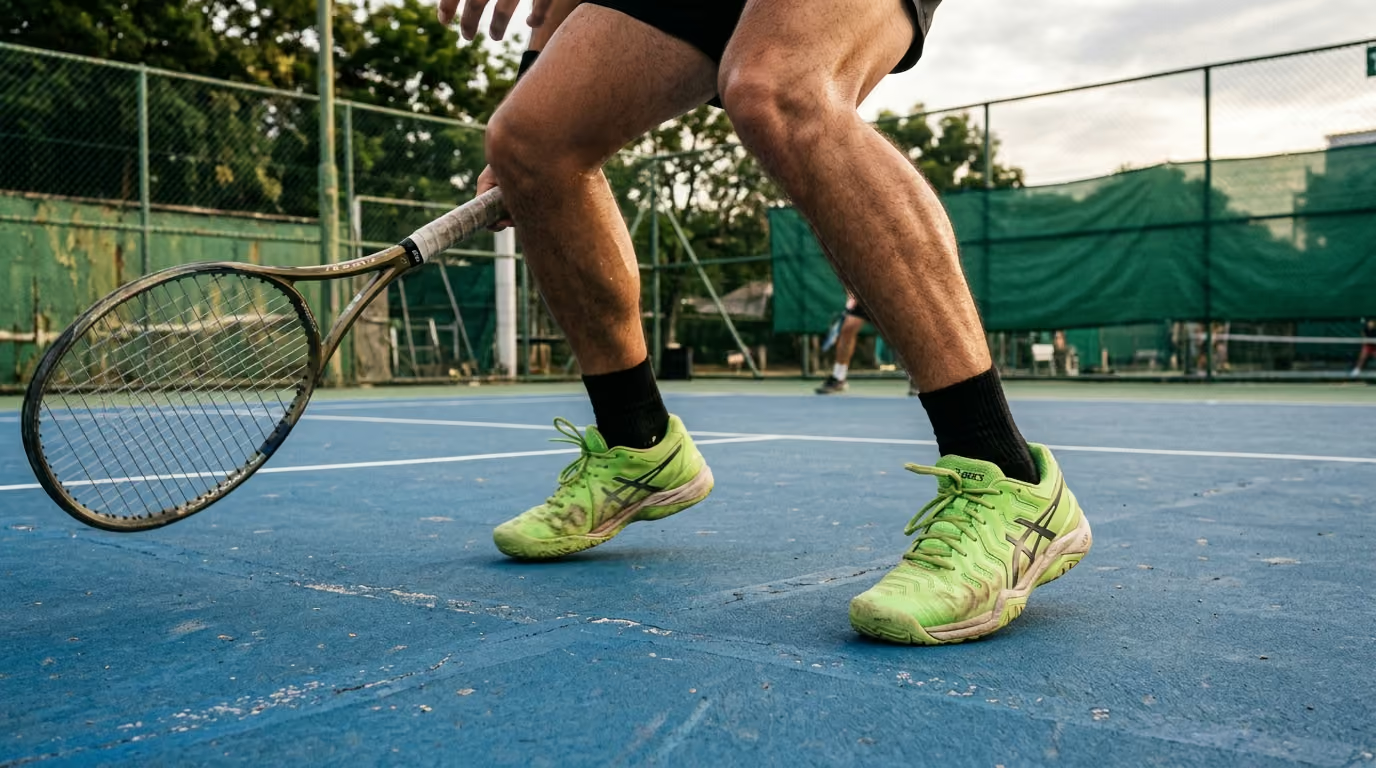
While many believe intense court training requires exhaustion, managing intensity allows for skill development and joint preservation without constant physical overload.




To many recreational and competitive racquet sports players, high quality training means pushing to the point of exhaustion. There is a common belief that if you do not leave the court completely spent, you did not work hard enough. This viewpoint is not only incorrect, but it also increases your risk of chronic physical issues.
Controlling court intensity means adjusting variables like running distance, ball pace, and recovery time while keeping the tactical and technical demands of the game realistic. By dialing down the purely physical costs of play, you can practice decision-making and shot selection without overloading your joints. This systematic approach preserves physical health and lets you enjoy your favorite sport for many years.
When you manage your physical output on the court, you are not taking the easy way out. Instead, you are choosing to practice with a clear purpose. This guide will show you how to separate physical fatigue from skill development, allowing you to train smarter, recover faster, and play better.
To manage your effort on the court, you must first understand what intensity actually means. It is much more than how fast your heart is beating or how much you are sweating. In court sports like tennis, pickleball, and padel, intensity is a combination of several different physical and mental demands.
Sports scientists divide the demands of exercise into two main categories, known as external and internal loads. External load is the physical work you perform on the court. This includes the distance you run, the number of balls you hit, and the number of times you change direction. It also includes the force of your deceleration when you stop to hit a shot.
Internal load is how your body reacts to that physical work. It includes your heart rate, your rate of breathing, and how tired your muscles feel. It also includes your level of mental fatigue and stress. Two players can perform the exact same external work but experience very different internal loads. A player who is tired, dehydrated, or returning from a break will have a much higher internal load than a well-rested player.
Court intensity is not a single setting. It is helpful to break it down into five distinct types of stress that affect your body during play:
By understanding these categories, you can see that a session can be highly demanding without requiring constant sprinting. You can turn down the mechanical intensity while keeping the technical and tactical intensity high. This is the key to preserving your joints while still improving your skills.
To plan your court time effectively, you need to understand how training volume, density, and workload interact. Volume refers to the total amount of work you do, usually measured in minutes of play, games completed, or shots hit.
Density refers to how closely your play sessions are packed together. For example, playing three singles matches in one weekend is a high-density schedule. Playing those same three matches over two weeks is a low-density schedule. Density also applies to the rest you take during a practice session. Hitting twenty balls with five seconds of rest between shots is much more dense than taking thirty seconds of rest between each shot.
Workload is the total stress accumulated over a given period, such as a day or a week. You can calculate your workload for any session using a simple formula recommended in USTA training materials. You multiply the total duration of your session in minutes by your rate of perceived exertion, which is measured on a scale of zero to ten.
For example, a gentle technical practice that lasts sixty minutes with an exertion rating of three results in a workload score of 180 units. A highly competitive singles match that lasts ninety minutes with an exertion rating of eight results in a workload score of 720 units. This shows why competitive play is so much more taxing on your body than structured technical practice. Managing these numbers is essential for maintaining your athletic longevity resources.
To control your training load, you must be able to measure it. Fortunately, you do not need expensive lab equipment to track your court intensity. Simple, practical tools can give you all the information you need to make smart decisions.
The rate of perceived exertion, or RPE, is one of the most reliable ways to measure internal load. At the end of every session, ask yourself a simple question: "How hard was that session overall?" Rate your effort on a scale of zero to ten, where zero is sitting on a chair and ten is a maximal effort that leaves you completely exhausted.
The American College of Sports Medicine, or ACSM, defines moderate exercise as an RPE of three to four. Vigorous exercise falls between an RPE of five and seven. Anything above seven is considered high-intensity work that requires significant recovery time.
To get a better picture of your physical stress, you can break your RPE down into different areas:
Tracking these numbers in a simple journal can help you spot patterns over time. If your leg RPE is consistently high but your breathing RPE is low, your training may be causing high mechanical stress without much cardiovascular benefit. This information allows you to adjust your drill design to protect your lower body.
The talk test is a simple, zero-technology way to monitor your intensity in real time. According to the ACSM, the talk test is an excellent way to estimate your exercise intensity without using a heart rate monitor.
If you can speak in full, comfortable sentences while playing, you are working at a moderate intensity. If you can only speak a few words before needing to catch your breath, you have crossed into vigorous intensity.
The talk test is highly useful because it is not affected by outside factors that can distort heart rate data. Factors like heat, dehydration, caffeine, and stress can all cause your heart rate to rise. The talk test bypasses these variables, giving you an accurate reading of your current physiological state. It is a fantastic tool for keeping technical drill sessions in a submaximal, controlled zone.
While fitness trackers have made it easy to monitor heart rate, this metric has some limitations in court sports. Tennis, pickleball, and padel are intermittent sports characterized by short bursts of high-intensity movement followed by periods of rest. Because your heart rate takes time to catch up to your physical effort, it often lags behind your most demanding actions.
The ACSM suggests that moderate intensity corresponds to 64% to 75% of your maximum heart rate. Vigorous intensity ranges from 76% to 95% of your maximum. However, you should not rely blindly on simple formulas like subtracting your age from 220 to find your maximum heart rate. These formulas are general estimates and can be highly inaccurate for individual athletes.
Instead, use heart rate as one of several signals. If your heart rate stays high during rest periods, it may mean your body is struggling to recover. This is a clear sign that you should turn down the intensity dials of your session.
Your ability to handle court intensity depends heavily on your daily physical readiness. Tracking sleep, morning stiffness, and general fatigue will help you decide how hard to play on any given day.
Our team has experienced this connection firsthand. I used to think a tough conditioning block was the only way to improve my court endurance. Then I started tracking my sleep. I noticed that on days I slept less than six hours, my reaction time at the net was noticeably sluggish, and I felt gassed by the second set. Prioritizing consistent rest did more for my late match stamina than any extra sprints ever did. Recovery is the true foundation of performance.
If you wake up with stiff joints, a higher resting heart rate, or low motivation, your physical capacity is reduced. On those days, you should focus on low-impact technical drills rather than high-intensity competitive games. This keeps you moving without overloading an already stressed system.
Court sports do not require a steady, continuous effort like running a marathon. Instead, they are defined by intermittent demands. You perform a series of short, explosive movements, recover for a brief period, and then repeat the process.
Research into tennis physiology shows that match play is a series of near-maximal efforts mixed with moderate and low-intensity recovery periods. A typical point lasts between five and ten seconds, followed by fifteen to twenty-five seconds of rest. During a single match, a player may perform hundreds of short sprints, quick stops, and explosive rotations.
Because of this structure, your body relies on both aerobic and anaerobic energy systems. The anaerobic system provides the explosive power needed to chase down a ball and strike it with force. The aerobic system works during rest periods to help your body recover before the next point begins.
This intermittent nature means that you do not need to make every drill highly intense to get a training benefit. You can improve your court performance by focusing on your movement quality and decision-making during moderate-intensity play. This is a cornerstone of our injury prevention guides.
To prevent injury and promote healthy aging, you must manage how quickly you increase your physical work. Sports scientists use a concept called the acute-to-chronic workload ratio to monitor this progress.
Your acute workload is the total work you did this week. Your chronic workload is the average weekly work you did over the past four weeks. USTA workload guidance suggests that keeping this ratio between 0.8 and 1.3 is ideal for preventing injury and helping your body adapt to training.
If your ratio rises above 1.5, your risk of injury increases significantly. This often happens when a player suddenly increases their playing hours, enters a tournament, or starts playing consecutive days without preparation. This ratio is not a medical guarantee, but it is an excellent planning guide to help you make gradual progression choices.
Scientific reviews of masters athletes show that you can maintain a high level of physical performance as you age. While some natural decline in aerobic capacity and muscle mass occurs over time, systematic training can slow this process significantly.
Experts recommend that older athletes combine aerobic exercise, resistance training, flexibility work, and balance exercises. Healthy aging does not mean you must avoid high-intensity work entirely. Instead, it means you should be highly selective about when and how you apply that intensity.
Useful intensity includes brief speed drills with full recovery, progressive strength training, and challenging balance work. Unplanned intensity includes chasing balls out of position, playing through pain, or drilling to the point of structural failure. By eliminating unnecessary physical costs, you can keep training hard where it actually matters.
To control your intensity on the court, you should view it as a series of adjustable dials rather than a simple on-off switch. By turning down the dials that cause the most physical wear, you can keep practicing your skills without overloading your body.
You can control your physical exertion by changing your movement speed during drills. Instead of sprinting at full speed to every ball, practice controlled, balanced movement. Focus on small adjustment steps and establishing a strong foundation before you hit. This reduces the force placed on your knees, ankles, and lower back.
The distance you must run to hit the ball has a massive impact on your mechanical load. You can adjust this dial by playing in a smaller space, such as a half-court or a three-quarter court. By reducing the court size, you can still practice your strokes and target selection while cutting your running distance in half.
High-velocity incoming balls force you to react quickly, which increases mechanical strain. You can turn this dial down by using cooperative feeds or playing with slower balls. This gives you more time to prepare, improves your stroke quality, and reduces the impact force on your shoulder, elbow, and wrist.
When you must make complex decisions under time pressure, your mental and emotional intensity rises. You can adjust this dial by using structured drills where your shot direction is predetermined. This allows you to focus purely on stroke mechanics and movement quality without the mental stress of open play.
Adding a score to any game naturally increases competitiveness and causes players to push past their physical limits. You can reduce this pressure by playing modified games. For example, you can play points without keeping score, or use task-based scoring where you earn points for hitting specific targets rather than winning the rally.
The density of your practice has a major effect on how tired you get. You can control this dial by changing the amount of rest you take between drills or points. Instead of rushing into the next rally, take an extra ten to fifteen seconds to catch your breath and reset your posture. This helps keep your heart rate in a comfortable zone.
This dial refers to the physical stress caused by emergency movements, such as deep lunges, overhead reaches, and sudden stops. You can reduce these actions by agreeing with your partner to concede balls that are out of reach. By letting go of low-percentage recovery shots, you avoid the heavy braking forces that can lead to joint issues.
Different playing formats place different physical demands on your body. By applying specific strategies to each format, you can control your court intensity without losing the quality of your practice.
Singles play requires the highest physical effort because you must cover the entire court on your own. It involves deep recovery runs, constant directional changes, and high cardiovascular demand. However, you can make singles practice much more manageable with a few simple adjustments.
First, try using a three-quarter court. This format closes off the wide alleys, allowing you to experience realistic baseline play with far less running. Second, start your rallies from a neutral feed instead of a full serve and return sequence. This eliminates the physical cost of serving and returning, which are often the most demanding movements in the game.
Another great strategy is the "two-ball reset" rule. During a baseline rally, agree to stop and reset after a high-quality four-shot exchange. This allows you to practice point construction and shot depth without extending every rally into a grueling, physical struggle.
Doubles reduces your running distance, but it increases the speed of play and the demand for fast reactions. The physical strain of doubles is often mechanical, involving quick lateral steps, explosive overhead reaches, and sudden lunges at the net.
To control intensity in doubles, focus on structured "plus-one" patterns. Practice the serve and the subsequent shot, then stop the play. This allows you to train your court positioning and communication without playing out long, chaotic points.
You can also rotate positions frequently with your partner. If you feel your legs tiring, spend a few games at the baseline playing a steady, controlled game. Let your partner take the net position where reaction speeds are faster. This shared responsibility is a key benefit of doubles play, especially when managing your physical energy.
Drills are where physical intensity can easily get out of hand because repetitions are high and rest is often neglected. To keep your drills productive and low-cost, you should categorize them into three intensity zones:
When organizing your on-court training, aim for short, focused blocks of twenty to thirty minutes, as suggested in USTA coaching manuals. Take a complete break for hydration and rest between each block. If you notice your stroke quality or movement balance deteriorating, stop the drill immediately. Continuing to practice while fatigued only reinforces poor movement habits.
Here is a simple example of how to structure a low-cost, high-quality technical practice:
This format provides a high number of quality repetitions while keeping your physical fatigue to a minimum.
While tennis, pickleball, and padel share many similarities, they each place unique physical demands on your body. To manage your intensity effectively, you must understand the specific challenges of your chosen sport.
Tennis is played on a large court, which means your mechanical and cardiovascular demands are naturally high. The heavy weight of a tennis ball also increases the stress on your wrist, elbow, and shoulder.
To manage intensity in tennis, you must be highly selective about your movement. Focus on efficient footwork, such as using smooth split-steps and gravity-assisted first steps to get moving. This is much more efficient than using raw muscle power to chase down every ball.
When practicing your strokes, use a relaxed, rhythmic swing rather than trying to hit the ball with maximum power. Let the racquet do the work for you. This approach not only saves physical energy, but it also improves your control and consistency on the court. For more resources on developing efficient court movement, see our mobility and movement guides.
Pickleball is played on a much smaller court, which reduces your total running distance. However, the game features very high repetition rates and rapid reaction demands, especially during exchanges at the kitchen line. The constant bending, dinking, and lunging place a unique mechanical stress on your knees and lower back.
To control intensity in pickleball, focus on masterly positioning rather than explosive lunges. By staying balanced and low in your stance, you can reach most shots with a simple, single-step adjustment. This eliminates the need for sudden, jerky movements that can strain your joints.
You should also manage your play frequency. Because pickleball is easy to learn and highly social, many players tend to play for several hours at a time, multiple days a week. Research shows that playing more than two hours per session, or playing on consecutive days, significantly increases your injury risk. Set clear limits on your session times and protect your recovery days.
Padel is a fast-growing sport played in an enclosed glass court. The presence of the walls means that the ball stays in play much longer, resulting in extended rallies and continuous movement. The game also involves high rotational demands to track wall rebounds, along with a large number of overhead shots.
To manage your intensity in padel, you must learn to use the glass to your advantage. Instead of rushing to hit every ball before it bounces, let the ball pass you and hit it as it rebounds off the back wall. This approach gives you more time to prepare, reduces your running distance, and lets you play from a more balanced position.
Additionally, be selective with your overhead shots. Striking a padel smash requires significant core rotation and shoulder extension. Instead of trying to end every point with a powerful overhead, use controlled, placement-focused shots like the bandeja or vibora. These strokes keep you in a strong position on the court while saving valuable shoulder and core energy. For more tailored insights, check out our padel articles section.
To master the art of intensity control, you must overcome several common misconceptions that hold many players back.
This is perhaps the most common training mistake. Many players judge the value of their practice by how tired they feel afterward. In reality, technical and tactical learning occurs best when your nervous system is fresh and your body is not fatigued. Hitting fifty balls with high focus and perfect balance is far better for your game than hitting two hundred balls while gasping for breath and losing your posture.
While doubles requires less running, it should not be treated as a purely low-intensity format. The sudden, explosive reactions required at the net can place a high mechanical load on your calf muscles, Achilles tendons, and shoulder joints. If you play doubles without a proper warm-up or on fatigued legs, you run a high risk of acute muscle strains.
Wearable devices are excellent for tracking aerobic fitness, but they cannot measure the mechanical stress placed on your joints. A session spent performing deep, heavy lunges at the net may keep your heart rate relatively low, but the mechanical cost to your knees and lower back is incredibly high. Always combine your heart rate data with your leg RPE and joint comfort levels.
Repetition is essential for building muscle memory, but only if those repetitions are performed with good quality. Once fatigue causes your technique to break down, any extra repetitions you perform will only reinforce bad habits. It is far better to stop a drill early than to practice poor movement patterns.
Healthy aging does not mean you should retire to a life of gentle, slow hitting. Your body needs a physical challenge to maintain its muscle mass, bone density, and balance. The key is to apply high effort strategically, such as performing brief speed bursts with full recovery, rather than exposing yourself to long, uncontrolled, and chaotic play.
Managing your court intensity has a direct effect on how well your body recovers between sessions. By planning your training load carefully, you can prevent chronic fatigue and keep your muscles and joints healthy for the long term.
When you perform a high-intensity session, your muscle fibers experience tiny micro-tears, and your joint tissues absorb significant impact forces. This is a natural part of training, but your body needs time to repair this damage.
USTA sports science materials recommend allowing at least 48 hours of recovery between sessions that place heavy demands on the same muscle groups. For very high-intensity training, this recovery window can extend up to 72 hours. If you play hard on consecutive days, you do not give your tissues enough time to rebuild, which leads to chronic tissue degradation and injury. Learn more about the biology of recovery in our recovery science articles.
A rest day does not have to mean sitting on the couch doing nothing. You can help your body recover by engaging in active rest. This involves low-impact activities that increase blood flow to your muscles without adding joint stress. Good examples of active recovery include:
By alternating high-intensity court days with active recovery days, you maintain your physical capacity without overloading your body.
Environmental factors like heat and humidity are powerful intensity multipliers. A practice session that feels easy in cool weather can place an immense physical strain on your body on a hot, humid day.
According to USTA hydration guidelines, you should arrive at the court well-hydrated. Drink water consistently throughout your session rather than waiting until you feel extremely thirsty. If you play for longer than sixty minutes, switch to an electrolyte-containing sports drink. This helps replace the vital salts lost through your sweat, preventing muscle cramps and maintaining your concentration on the court.
While controlling court intensity is a highly effective way to manage your physical health, it is not a substitute for professional medical care. You must learn to listen to your body and recognize the signs that indicate you need help.
It is normal to experience some mild muscle soreness after a challenging practice session. This is known as delayed onset muscle soreness, or DOMS, and typically resolves within forty-eight hours.
However, you should never ignore true pain. Pain is your body's alarm system, warning you that structural damage has occurred or is about to occur. If you experience any of the following symptoms, you should consult a qualified healthcare professional, such as a physiotherapist or sports medicine physician:
If you have a chronic medical condition, such as cardiovascular disease, osteoarthritis, or a history of joint replacement, you should work closely with your healthcare provider. They can help you design a safe, personalized exercise program that respects your physical limitations.
Do not attempt to push through persistent pain or use pain-masking medications to get through a match. This approach only hides the symptoms while allowing the underlying damage to worsen. A professional assessment will help you find the root cause of your pain and guide you safely back to the court.
When returning to the court after a break, your stroke skills may still be sharp, but your muscles and joints will have lost their tolerance for high-impact movement. Start by reducing both your playing volume and density.
Begin with thirty-minute sessions of cooperative, controlled hitting twice a week. Keep the movement distance short and avoid competitive scoring. Gradually increase your court time by ten to fifteen percent each week, ensuring you have at least forty-eight hours of rest between sessions. Only introduce full competitive play once you can complete structured drills without any joint discomfort.
Heat and humidity place a massive extra demand on your cardiovascular system. Your heart must pump more blood to your skin to help cool your body, which leaves less oxygen and energy for your working muscles. This raises your internal load and makes a moderate-intensity session feel highly vigorous.
To manage this, reduce your playing time, take longer rest breaks in the shade, and drink fluids with electrolytes. If conditions are extreme, modify your drills to keep movement stationary, or move your session to an indoor, air-conditioned court.
Yes, having osteoarthritis does not mean you have to give up the sports you love. The key is to manage your impact loads and build strong supporting muscles around your joints.
Choose softer playing surfaces whenever possible, such as clay or specialized acrylic courts. Focus on efficient, balanced movement rather than explosive, sudden stops. Use the intensity dials to keep your competitive play structured, and always allow ample recovery time between matches. Working with a physical therapist to build a targeted strength routine will also help protect your joints on the court.
The biggest challenge during a tournament is the cumulative physical and mental load. To survive a multi-day event, you must preserve your energy at every opportunity.
Keep your pre-match warm-up short and focused, using it only to raise your body temperature and activate your muscles. During the match, use between-point routines to lower your heart rate and focus your mind. Concede low-percentage recovery shots when a point is practically lost. After your match, focus immediately on recovery by hydrating, eating a balanced meal, and doing some gentle mobility work rather than spending extra time hitting on the practice courts.
Follow Evercourts for practical insights on tennis, pickleball and padel performance, movement, recovery and healthy ageing. Stay connected for new articles, research-led guidance and ideas to help you play well and keep playing for years.


Read practical guidance for better movement, smarter preparation and a game that keeps working for you.
explore the Blog