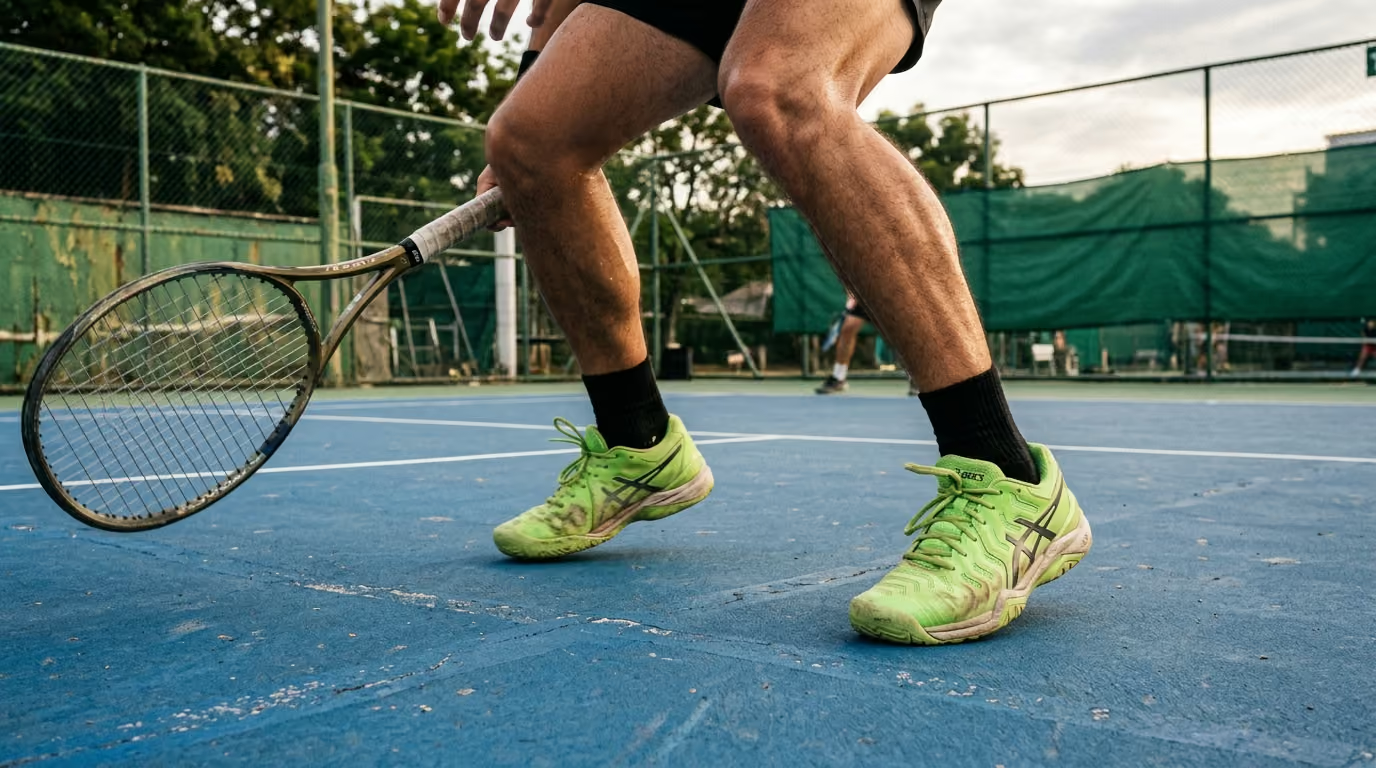
A multi-year racquet sports competition plan connects long-term skill development, tournament scheduling, physical conditioning, and lifestyle into a sustainable pathway.




Imagine signing up for five tournaments over a single summer. You feel highly motivated during the first tournament, but by the third event, a familiar stiffness creeps into your shoulder. Your movement slows, your concentration wavers, and you find yourself struggling through matches you expected to win. By autumn, you are dealing with a persistent tendon issue and a sense of mental exhaustion.
This common scenario highlights the danger of planning your competitive season week by week. A successful multi-year competition plan connects long-term skill development, tournament scheduling, physical conditioning, and lifestyle constraints into a sustainable pathway. Instead of chasing immediate rating points, it prioritizes systematic progression and physical durability. This approach ensures you can compete at your highest level while protecting your long-term health.
A multi-year competition plan is not a rigid list of tournaments. It is a dynamic roadmap designed to support your development over several seasons. To build a plan that lasts, you must base your decisions on your personal capacity rather than external pressures.
Many competitive players build their calendars around prestigious events or rating milestones. However, long-term athletic preparation requires you to match your schedule to your developmental needs rather than your chronological age or current rating.
The Canadian Long-Term Athlete Development framework illustrates this by dividing athletic progress into distinct stages, such as learning to train, training to compete, and remaining active for life. For adult competitive players, this means your tournament schedule should match your physical capacity and technical skill level.
Before registering for any event, you should identify what technical, tactical, or physical limit is currently holding you back. Your chosen tournaments should expose or develop that specific capacity. If a tournament does not serve a clear developmental purpose, it may simply add unnecessary fatigue to your season.
Rating and ranking systems are useful tools for tournament entry and seeding. The World Tennis Tour provides structured entry-level professional pathways, while pickleball organizations rely on systems like DUPR to organize balanced competitive brackets.
However, these ratings are rolling snapshots of your recent match results. They do not represent your overall athletic potential or your personal value.
To maintain motivation, your multi-year plan should track several forms of progress simultaneously. You should evaluate your technical execution, physical durability, emotional regulation, and lifestyle balance alongside your official rating. This multi-dimensional scorecard ensures that a temporary decline in your rating does not cause you to abandon your developmental plan.
A sustainable competitive pathway requires you to balance long-term direction with short-term flexibility. Your plan should outline a three-to-five-year direction, a one-year strategic objective, and a seasonal training block.
At the same time, you must establish frequent feedback loops to adjust your plan based on real-world evidence. Periodization literature emphasizes that competitive schedules must include preparatory, competitive, and transition phases.
Treat your schedule as a series of hypotheses. You assume that a specific training volume and tournament frequency will lead to performance gains. You then test this hypothesis through weekly training logs, match reviews, and physical assessments.
To build a plan that spans multiple years, you must understand how training and competition loads affect your body. Scientific research provides valuable guidelines for structuring your schedule without risking overtraining or injury.
Research in high-performance racquet sports indicates that injury risk is closely tied to how you distribute your playing hours. A study of competitive junior tennis players found an injury rate of 3.5 injuries per 1000 hours of practice.
The study also revealed that sudden increases in training workload significantly increase injury risk. Specifically, rapid increases in weekly workload are associated with a higher likelihood of tissue irritation and joint pain.
This does not mean you should avoid hard training. Instead, it suggests you must progress your playing volume gradually. Tracking your weekly hours of practice, match play, and physical conditioning helps you avoid dangerous workload spikes.
Many players believe they must commit exclusively to one racquet sport to achieve high-level success. However, consensus statements from the American Orthopaedic Society for Sports Medicine (AOSSM) show that early specialization is not required for long-term athletic achievement.
In fact, focusing too early on a single sport is associated with higher rates of overuse injuries and mental burnout. Engaging in multiple sports or varied physical activities builds a broader motor foundation.
For adult players, this research supports maintaining physical variety. Practicing different movement patterns helps distribute physical stress across multiple joint systems. You can gradually increase your sport-specific commitment as your physical capacities grow.
Doubles play introduces unique physical and psychological demands that require careful planning. Research indicates that doubles performance is not merely the sum of two players' singles ratings.
Instead, successful doubles play relies heavily on team-specific skills, communication, and shared tactical patterns. Furthermore, study data shows that your partner’s performance directly influences your emotional state during a match.
Poor partner performance is frequently linked to elevated levels of anger and anxiety. Conversely, a supportive and consistent partner helps maintain emotional stability. Your competitive plan must account for these interpersonal factors to ensure your doubles partnerships remain sustainable.
To translate long-term planning principles into a concrete calendar, you can use the PATH model. This structured framework helps you profile your current abilities, set clear priorities, and schedule appropriate events.
The first step of the PATH model is to document your current athletic status. This profile must go beyond a simple list of your favorite shots. It should paint an honest picture of your competitive readiness across four major domains.
Once you have completed your profile, you must choose a small number of focal points for the upcoming season. Attempting to improve every aspect of your game at once usually leads to frustration.
Select two or three high-value objectives that will have the greatest impact on your performance. For example, you might focus on improving your transition from defense to attack.
Alternatively, your priority might be building the physical stamina required for three-set matches. Clearly stating these priorities prevents you from getting distracted by short-term rating fluctuations.
With your priorities defined, you can select tournaments that match your specific developmental needs. If your goal is to practice a new tactical pattern, select lower-stakes local events where you can experiment without pressure.
If your goal is to test your emotional regulation, choose highly competitive matches against unfamiliar opponents. Avoid entering tournaments simply because they are nearby or easy to join. Every event on your calendar should serve at least one of your seasonal priorities.
The final step of the model is to schedule formal reassessments throughout the year. Do not wait for an injury or a long losing streak to force a review of your plan.
Set calendar reminders to evaluate your progress at the end of each training block or competitive phase. Use these check-ins to determine if your current tournament density is appropriate. You can then adjust your training volume, recovery protocols, or event selection for the next phase.
Relying solely on ratings to measure your progress is a common planning mistake. To build a sustainable competitive pathway, you should implement a layered goal system that covers four distinct levels of achievement.
Directional goals describe your broad athletic journey and help you maintain a sense of purpose. For an adult player, a directional goal might be transitioning into a highly competitive doubles specialist.
Another directional goal could be maintaining your competitive schedule while managing a busy career. These long-term aspirations keep you grounded when short-term match results do not go your way. They help you focus on the bigger picture of athletic longevity rather than weekly rating updates.
Outcome goals focus on measurable competitive benchmarks. These include qualifying for a specific tournament tier, reaching a target rating bracket, or achieving a certain win percentage.
While outcome goals are useful for tracking your competitive standing, they should never be your sole focus. Because you cannot control the performance of your opponents, outcome goals can sometimes create unnecessary stress. Use them as general checkpoints rather than daily measures of success.
Performance goals focus on what you must execute on the court during a match. Examples include landing seventy percent of your first serves or successfully attacking the short ball during transitions.
Performance goals are highly valuable because they remain largely within your control. They give you a clear tactical focus during high-pressure moments. Tracking these goals helps you evaluate your level of play independently of whether you won or lost.
Process goals describe the daily, highly controllable behaviors that support your development. These include completing your warm-up routine before every match, logging your training hours, and maintaining a consistent mobility and movement program.
Process goals form the foundation of your entire physical preparation. When you focus on executing your daily habits, you create the conditions for sustainable, long-term improvement.
Building a balanced annual calendar requires you to categorize your tournaments by purpose. This strategic approach ensures you have enough time for training, performance, and recovery.
Avoid treating every tournament on your calendar as a high-stakes event. Instead, assign a specific role to each competition to help manage your physical and mental energy.
Organizing your calendar into structured tiers helps you allocate your physical and emotional resources. It ensures you do not waste energy on low-priority events.
These tournaments are your highest priority for the season. You should schedule dedicated training blocks before these events and plan for full recovery afterward. You should only target two or three Tier 1 events per year.
These events offer valuable ranking points or highly competitive matches. They help you build match fitness and secure entry into your target tournaments. You should enter these events with a clear performance focus.
These competitions provide an opportunity to test your skills under match conditions without the pressure of a high-stakes environment. Use Tier 3 events to build confidence in your tactical adjustments or to develop a new partnership.
These are local, low-travel matches that fit easily into your regular training week. They provide valuable match play without disrupting your recovery or work schedule.
When scheduling your tournaments, pay close attention to geographical proximity and match density. Traveling long distances can increase physical fatigue and disrupt your sleep patterns.
Building travel clusters, which involve playing multiple events in the same region, can minimize logistical stress. It is also essential to use court performance strategies to balance your competitive weeks with dedicated training blocks. This balanced scheduling ensures you do not enter important tournaments in a state of chronic fatigue.
While the core principles of planning apply to all racquet sports, the physical demands and tournament structures differ significantly. You must tailor your multi-year plan to the specific demands of your chosen sport.
Tennis is characterized by highly unpredictable match durations and significant physical loading. A single match can last anywhere from one hour to over three hours, depending on the format and scoring system.
This structural variability requires a highly conservative approach to tournament scheduling. You must build significant recovery windows into your calendar to protect your joint health.
Furthermore, transitioning between different court surfaces, such as clay and hard courts, places unique demands on your body. Changing surfaces alters your sliding patterns and joint loading, which increases the risk of lower-limb irritation.
Because of these factors, tennis players require longer preparatory phases to build joint durability. You should check out injury prevention resources to learn how to prepare your body for these specific demands.
Pickleball tournaments often feature a highly compressed schedule compared to tennis. Players frequently compete in multiple matches within a single day, often switching between singles, doubles, and mixed doubles.
This high match density places a unique premium on your cardiovascular recovery and nutritional planning. While individual games are shorter, the cumulative physical load of a multi-day tournament can be very high.
Your training must focus on rapid lateral movement, quick reactions, and deceleration capacity. When scheduling pickleball events, you must account for the physical toll of consecutive multi-match days. Ensure your calendar includes dedicated recovery weeks after intense tournament weekends to prevent overuse injuries.
Padel is a fast-growing racquet sport that combines elements of tennis and squash. The game is played inside an enclosed glass court, which requires continuous tactical adjustments and rapid changes of direction.
The physical demands of padel are characterized by a high volume of overhead shots and explosive lateral movements. This repetitive overhead loading places significant stress on your shoulder rotator cuff and elbow joints.
Consequently, your physical preparation must prioritize upper-body mobility and scapular stability. Your multi-year plan should also account for the highly collaborative nature of padel. Because every match is played in a doubles format, your competitive schedule must align closely with your partner's availability and physical capacity.
In doubles-dominated sports like padel and pickleball, your partner is a critical component of your competitive success. You must treat your partnership as a collaborative system that requires its own planning and maintenance.
When choosing a long-term partner, look beyond their current rating or individual stroke quality. A highly rated player may not be the ideal match if their playing style or communication patterns conflict with yours.
To perform effectively under pressure, you and your partner must develop clear, simple communication protocols. Establish shared terms for court movement, target zones, and tactical adjustments.
It is also highly beneficial to agree on structured between-point routines. A simple physical gesture, such as a paddle tap or a quick word of encouragement, helps reset your focus after an error. This consistent communication builds trust and helps mitigate the negative emotional effects of individual mistakes.
A common mistake in recreational and competitive racquet sports is changing partners impulsively after a poor tournament result. Developing a cohesive doubles team requires time, shared practice, and mutual adjustment.
A 2025 scoping review of elite doubles teams highlighted that structured practice and partner familiarity are essential for high performance. Before committing to a partner, agree on a trial period of three to four tournaments.
Evaluate your partnership based on the quality of your communication and tactical execution rather than match outcomes alone. This structured approach helps you build stable, long-term partnerships that support your development.
Maintaining your physical health over multiple seasons requires a systematic approach to load management. You must monitor how your body responds to training and competition to avoid overtraining and injury.
To manage your physical load effectively, you should record your training and match hours. Simple tracking methods can provide valuable insights into your physical stress.
One practical tool is the Session Rating of Perceived Exertion (sRPE). After each session, multiply the duration of the workout in minutes by your subjective rating of its intensity on a scale of one to ten.
This simple calculation gives you an arbitrary workload score for each training day. Tracking these scores helps you identify sudden increases in training volume or intensity. This data allows you to make informed adjustments to your schedule before physical fatigue leads to injury.
Many overuse injuries occur when a player rapidly increases their weekly playing hours. This can happen when you transition from a light training phase directly into back-to-back tournaments.
To protect your joints and connective tissues, keep your weekly workload increases gradual. If you plan to compete in a high-density tournament, prepare your body by slowly building your match volume in the preceding weeks.
Additionally, ensure your annual plan includes dedicated training blocks where you focus on physical conditioning rather than competition. This structured approach allows your tissues to adapt to the physical demands of high-level play.
A comprehensive competition plan must include structured transition phases designed for physical and mental recovery. A transition phase is not a period of complete inactivity.
Instead, it is an opportunity to engage in low-intensity movement, corrective strength work, and mobility exercises. You can review recovery science resources to design effective active recovery blocks.
These phases help reduce chronic muscle tension, support joint health, and restore your mental motivation. Prioritizing structured recovery ensures you can begin your next training block feeling refreshed and resilient.
Even well-intentioned players can fall into common scheduling traps. Recognizing these pitfalls helps you protect your long-term athletic development.
It is easy to become obsessed with incremental changes in your DUPR or tennis rating. This obsession can lead to playing too many matches in an effort to defend or improve your standing.
However, ratings can fluctuate due to many factors, including partner performance, draw variations, and physical fatigue. Focusing on short-term rating changes often leads to scheduling decisions that compromise your training time and physical recovery.
The Correction: Shift your focus to tracking your performance and process goals. Trust that consistent execution of your technical and physical habits will lead to long-term rating improvements.
Playing tournaments weekend after weekend can feel exciting, but it leaves little time for skill development or physical conditioning. Without dedicated training blocks, your technique can stagnate and minor physical issues can develop into chronic injuries.
Continuous competition can also lead to mental exhaustion, which reduces your performance quality.
The Correction: Build a balanced calendar that alternates competitive phases with structured training blocks. Use these training phases to work on technical changes, build physical strength, and allow your body to recover from match play.
Some players commit exclusively to a single racquet sport or a single competitive format very early in their athletic journey. For example, you might decide you are solely a singles tennis player or a right-side padel specialist before you have fully developed your skills.
This narrow focus can limit your motor development, increase your risk of overuse injuries, and restrict your future competitive options.
The Correction: Maintain physical variety by playing multiple formats or exploring different racquet sports when appropriate. This broad athletic foundation supports healthy aging and enhances your overall court performance.
To keep your multi-year plan on track, you must establish clear guidelines for when to modify your schedule. Using a systematic review process helps you make objective decisions during the season.
After every major tournament, take time to complete a structured match review. Avoid making decisions immediately after a tough loss, as emotional frustration can cloud your judgment.
Instead, wait a day or two before evaluating your performance against your seasonal goals. Answer these three core questions to guide your next training phase.
To remove emotion from your scheduling decisions, implement a simple stoplight system based on your physical health and training consistency.
While self-monitoring is valuable, some physical symptoms require professional medical evaluation. You should consult a qualified healthcare provider, such as a physical therapist or sports medicine physician, if you experience any of the following warning signs:
Seeking professional guidance early helps you address minor issues before they become significant setbacks, protecting your long-term ability to enjoy the sports you love.
To help you put these principles into practice, use the following structured templates to design your competitive pathway.
Use this template to outline your long-term developmental journey over three seasons.
Rate each potential tournament from 1 (poor) to 5 (excellent) across these critical domains to determine if it belongs on your calendar.
Score Interpretation: If a tournament scores fifteen or higher, it is a strong fit for your plan. If it scores below ten, you should consider replacing it with a local match or a dedicated training block.
Follow Evercourts for practical insights on tennis, pickleball and padel performance, movement, recovery and healthy ageing. Stay connected for new articles, research-led guidance and ideas to help you play well and keep playing for years.


Read practical guidance for better movement, smarter preparation and a game that keeps working for you.
explore the Blog