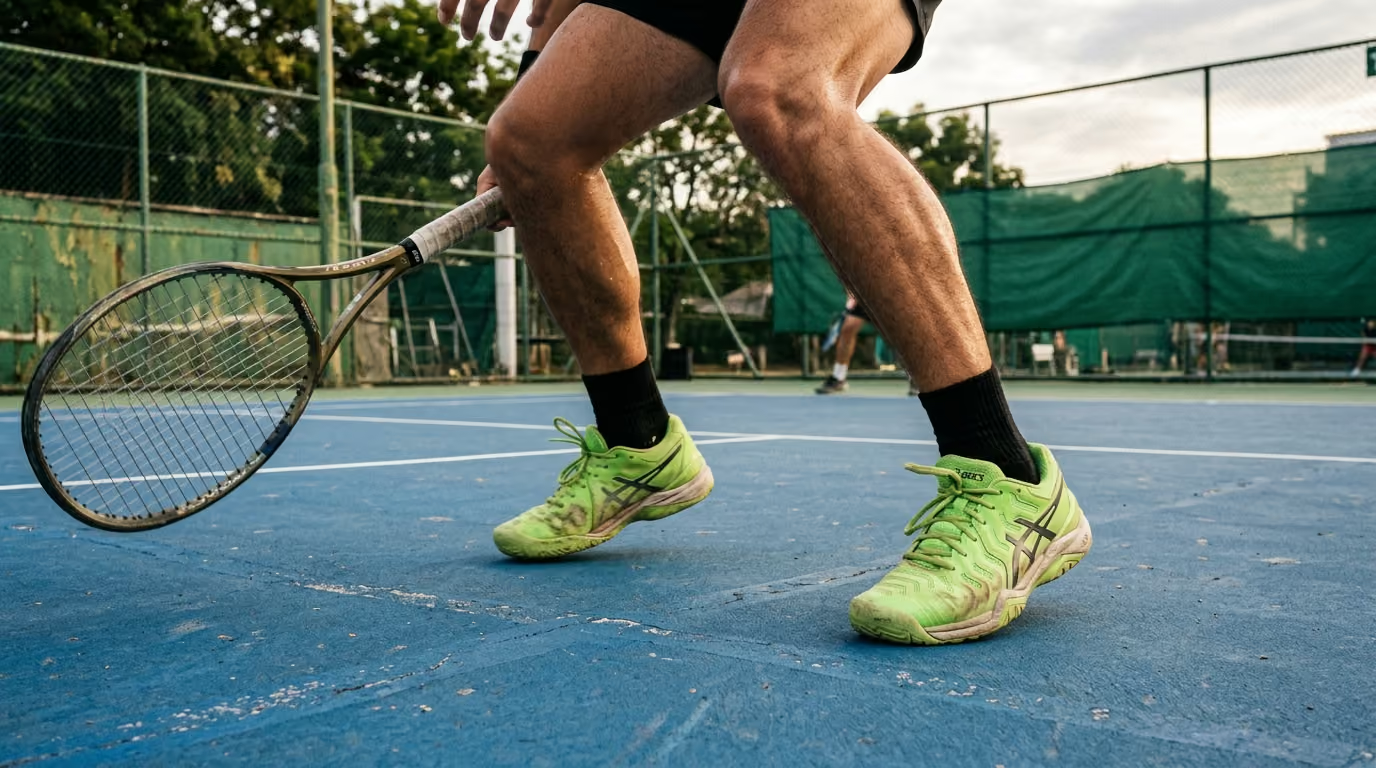
A well-designed sport-specific mobility program provides the usable movement capacity needed to protect joints and improve stroke mechanics for racquet sports.




You step onto a cold court on a Tuesday evening, ready for a challenging match. Within ten minutes, your lower back feels locked, your shoulders resist your overhead swings, and your hips feel stiff. This familiar stiffness is not an inevitable consequence of playing hard or getting older.
Designing a sport-specific mobility program requires identifying the active range of motion your specific racquet sport demands and matching it to your individual physical limitations. By pairing targeted joint mobilization with strength and control exercises, you can build usable movement capacity that transfers directly to court performance. This systematic approach ensures you spend your training time on exercises that actually protect your joints and improve your stroke mechanics.
Many court players use the terms mobility and flexibility interchangeably. However, they represent distinct physical qualities that affect how you move on the court. Flexibility refers to the passive extensibility of your muscle tissue and the range of motion available when an external force moves your limb. This passive range can be measured while you are lying relaxed on a treatment table.
In contrast, mobility is the ability to actively access, control, and use your range of motion during athletic tasks. True mobility requires muscle strength, coordination, balance, and joint stability. If you have excellent passive hip flexibility but lack the strength to balance during a deep lunge, you do not have functional court mobility.
For a court athlete, the objective is never to achieve maximum flexibility across all joints. Instead, you need sufficient, usable, and controllable range of motion in the specific positions required by your sport. Having too much passive range without muscle control can actually make your joints vulnerable to stress. This is why we focus on building active range of motion that directly supports your movement on the court.
Our team has observed that players who focus solely on passive stretching often experience recurring joint discomfort. Their muscles can tolerate being pulled, but their joints cannot handle the high impact of a sudden direction change. To move well and protect your tissues, you must train your muscles to produce and absorb force at the end of their available range. This integration of movement and control is what keeps you playing safely for years. You can learn more about our approach to physical preparation by visiting our about Evercourts page.
Current sports science shows that static stretching alone is not an effective way to prevent injuries. A landmark systematic review by Lauersen and colleagues analyzed multiple exercise interventions for sports injury prevention. The researchers discovered that stretching programs showed no significant protective effect against acute or overuse injuries. In contrast, strength training and proprioceptive exercises reduced injury rates substantially.
This finding does not mean you should ignore your range of motion. It means that stretching must be integrated with strength and motor control to be useful. When we look at racquet sports, injuries often occur when a joint is forced into a position it cannot actively stabilize. If you lack the strength to absorb landing forces, your soft tissues must bear the excessive load.
The scientific literature also highlights that joint tightness is not always a simple structural limitation. Your nervous system often restricts joint movement to protect you from positions where you lack strength. When you build strength in your end-range positions, your nervous system often allows you to move more freely. This is why active mobility training is more effective for long-term joint health than passive stretching.
Research on court movement also reveals that fatigue alters how your joints move during a long match. As your muscles tire, your joint coordination begins to degrade. This degradation reduces your active control and places higher stress on your ligaments and cartilage. A sport-specific program must prepare your joints to maintain their stability even when you are exhausted.
Court strokes are not isolated joint movements. Every stroke you hit relies on a kinetic chain that transfers energy from the ground up through your body. During a tennis serve or a padel overhead, the energy begins in your feet, travels through your knees and hips, rotates through your trunk, and exits through your shoulder, elbow, and wrist. If any link in this chain is restricted, other joints must work harder to compensate.
For example, a player with a painful shoulder may actually have a restriction in their upper back or hips. Research on the tennis serve indicates that trunk inclination, shoulder elevation, and hip rotation are all closely linked to stroke mechanics. If your thoracic spine cannot rotate, your shoulder must over-rotate to create power. Over time, this compensation pattern can lead to shoulder impingement or rotator cuff irritation.
Similarly, restricted ankle motion can affect how your knees and hips handle landing forces. When your ankle cannot bend forward sufficiently, your body compensates by turning the foot outward or collapsing the knee inward. This mechanical compensation increases the shear stress on your knee joint during lateral movements. To build a highly effective routine, you must look at your body as an integrated movement system.
In our experience, addressing these systemic connections is the fastest way to resolve chronic court stiffness. When we help a player improve their hip rotation, their lower back discomfort often vanishes without any direct back exercises. By focusing on how energy moves through your entire body, you can improve both your movement comfort and your hitting power. For a deeper look at physical preparation, explore our injury prevention resources.
To avoid generic routines that do not address your actual court demands, we use a simple programming formula. This framework ensures your training matches your personal profile and playing schedule.
$$\text{Mobility Need} = \text{Sport Demand} \times \text{Player Exposure} \times \text{Individual Limitation} \times \text{Control Requirement}$$
Let us break down each component of this formula so you can apply it to your weekly schedule. The sport demand is the movement signature of your chosen game, which includes typical lunging angles, running directions, and stroke patterns. Player exposure refers to your weekly playing volume, court surface, and competitive level. Individual limitations are the specific joint restrictions or past injuries you carry, while the control requirement is the strength needed to manage those positions.
Using this formula prevents you from wasting time on unnecessary exercises. A recreational doubles player who plays twice a week requires a different mobility strategy than a competitive singles player training daily. By assessing each variable, you can create a highly efficient routine that fits your lifestyle. You can find more targeted advice on structured athletic routines by browsing our mobility and movement resources.
Before selecting specific exercises, you must identify where your body actually needs assistance. You can perform several simple movement tests at home or on the court without any specialized equipment. These tests help you determine whether your limitations are due to range of motion, muscle control, or strength.
This test measures your ankle dorsiflexion, which is critical for deep lunges and low court positions. Stand facing a wall with your big toe placed about four inches from the baseboard. Keep your heel flat on the floor and attempt to touch your knee to the wall. If your heel lifts or your knee collapses inward, move your foot closer and retest. Compare both sides to see if one ankle is significantly stiffer than the other.
Sit on the floor with your right leg bent at a 90-degree angle in front of you, and your left leg bent at a 90-degree angle to the side. Try to sit completely upright without leaning to one side or using your hands for support. Slowly rotate your torso over your front leg, then reverse the position to test your other side. This movement assesses your active hip internal and external rotation, which are essential for lateral court movement.
Start on your hands and knees on the floor. Place one hand behind your head and gently rotate your elbow and upper back toward the ceiling, keeping your hips steady. Note how far you can rotate your upper torso without shifting your pelvis. Repeat on the opposite side to identify any rotational imbalances between your left and right sides. If one direction feels blocked, your upper back rotation is restricted.
Once you have completed these tests, classify your findings into specific categories. If you cannot reach the desired position even when relaxing, you have a structural mobility restriction. If you can reach the position with help but cannot hold it actively, you have a control or strength restriction. This classification allows you to choose the exact exercises that will help you improve. For a broader look at physical preparation, explore our injury prevention resources.
A complete mobility program should be structured into three distinct layers to maximize its effectiveness. Each layer serves a specific purpose in your weekly schedule and preparation routine.
Your warm-up should prepare your joints and muscles for the immediate demands of playing. Avoid long static stretches before you step on the court. Research shows that holding static stretches for more than sixty seconds can temporarily reduce muscle power and explosive speed. Instead, use dynamic movements that raise your body temperature and gently challenge your range of motion.
Begin with light jogging, skipping, or side-to-side shuffling for three minutes. Follow this with dynamic ankle circles, hip sweeps, and arm swings. Finish your warm-up with sport-specific footwork, such as split steps and shadow swings, to prepare your nervous system for the speed of play. This transition ensures your muscles are warm and ready for explosive movements.
This is the core of your training program, performed once or twice a week away from your match play. Here, you focus on building strength and control at the end of your joint ranges. This session should include unilateral strength work, balance drills, and controlled deceleration patterns.
These exercises teach your body how to absorb and redirect the forces you encounter during a match. This layer is crucial for long-term joint durability and athletic longevity. You can perform these exercises with your body weight, light dumbbells, or resistance bands.
After your match or practice session, your focus shifts to calming your nervous system and maintaining muscle length. This is the ideal time to use longer-duration static stretches. Hold each stretch for thirty to sixty seconds while focusing on deep, slow breathing.
Target the muscles that work hardest during play, such as your calves, hip flexors, adductors, and the back of your shoulders. This down-regulation phase helps reduce muscle tension and initiates the recovery process. Regular post-play stretching also helps preserve your joint range of motion over years of consistent play. To understand more about post-match recovery strategies, visit our recovery science resources.
While all racquet sports share common physical demands, each sport has a unique movement signature. Your mobility program must reflect these differences to prepare you for the specific loads of your game.
Tennis requires a combination of high-velocity overhead serves, wide lateral movements, and rotational groundstrokes. The tennis serve creates extreme forces on your shoulder and lower back during the late-cocking phase. Therefore, tennis players must prioritize thoracic extension, shoulder rotation, and lateral hip loading.
Your tennis program should focus heavily on maintaining internal rotation in your dominant shoulder. It should also include exercises that build hip rotation to support open-stance groundstrokes. These movements allow you to generate power from your legs rather than placing excessive stress on your arm. For more tennis-specific guidance, read our tennis articles.
Pickleball is played on a smaller court, which reduces long sprints but increases the demand for rapid, low movements. Players spend a significant amount of time in a deep crouch near the non-volley zone line. This constant low position requires exceptional ankle dorsiflexion, deep hip flexion, and adductor strength.
Because pickleball points can be fast and reactive, players must also have excellent wrist and forearm control. Your pickleball routine should emphasize deep squats, lateral hip shifts, and active calf mobility. These exercises help you stay low comfortably without rounding your lower back. For additional pickleball insights, explore our pickleball tips.
Padel is a fast-paced game that involves playing balls off the surrounding walls and glass. This requires frequent turning, backing up, and twisting to track unpredictable rebounds. Padel players also execute a high volume of overhead lobs, such as bandejas and víboras, which require shoulder endurance and core stability.
I remember finishing a tough two hour padel match on a cold Tuesday night and waking up the next morning feeling like my lower back was locked in concrete. For a long time, I just accepted this as the price of playing hard in my forties. But once I started spending just ten minutes on targeted hip mobility before heading to the club, the stiffness almost completely vanished. It taught me that we do not have to accept pain as a default state of athletic aging. For more padel performance strategies, check out our padel articles.
Many recreational players make simple errors when designing or executing their mobility routines. Recognizing these mistakes can save you time and prevent unnecessary joint irritation.
The most common error is performing passive stretching as your entire warm-up. Sitting on the court floor stretching your hamstrings before a match does not prepare your body for rapid movement. In fact, it can temporarily reduce your muscle power and agility. Always save long static stretches for after your session when your body is cooling down.
To fix this, shift your pre-match routine toward dynamic movements that mimic the patterns of your sport. Focus on light movement, leg swings, and shadow strokes to prepare your muscles. This approach prepares your nervous system for the high-velocity demands of play.
Another frequent mistake is chasing excessive range of motion without building the strength to control it. Having flexible hips is useless if your knees collapse during a deep lunge. Every mobility exercise you perform should be paired with a control or stability drill. This combination ensures your joints remain stable and protected under the high forces of match play.
Always prioritize movement quality over the depth of your stretch. If you feel your alignment slipping or your body shaking excessively, reduce the range of motion. Building strength in a smaller, controlled range is much safer than moving poorly through a wider range.
Consistent mobility training does more than improve your court movement. It also plays a vital role in managing fatigue and preserving your joint health as you age. When your joints move through their full, natural ranges, force is distributed evenly across your muscles and tendons. This balanced loading reduces the risk of localized overload and overuse conditions like tendinopathy.
Furthermore, active mobility training promotes healthy joint circulation and tissue hydration. Moving your joints through their complete range helps distribute synovial fluid, which lubricates your cartilage and supplies nutrients to the joint. This process is essential for maintaining joint health and preventing the gradual stiffness often associated with healthy aging.
By investing in your movement quality, you also reduce the metabolic cost of playing. When your body moves efficiently, your muscles do not have to work as hard to overcome internal resistance. This efficiency keeps you feeling fresher during long matches and speeds up your recovery time afterward. You can read more about maintaining your physical capabilities over time by visiting our healthy aging and athletic longevity resources.
While a structured mobility program can help manage general stiffness and improve movement, it is not a substitute for medical care. You should never use stretching or self-mobilization to treat undiagnosed pain or injury. If you experience persistent, sharp, or worsening pain, you should consult a qualified healthcare provider.
Key warning signs that require professional evaluation include joint swelling, clicking or locking that is accompanied by pain, and symptoms that wake you up at night. You should also seek professional guidance if your movement limitations are accompanied by a sudden loss of strength or balance. A physical therapist or sports medicine specialist can provide an accurate diagnosis and create a safe, targeted recovery plan.
Remember that pain is a signal from your nervous system that something requires attention. Continuing to stretch or push through painful movements can worsen an underlying issue and keep you off the court longer. Working with a professional ensures you address the root cause of your symptoms and return to playing safely. If you have questions about how to integrate professional care with your training, you can contact us for guidance.
You should return to this programming guide whenever you increase your weekly playing volume, transition to a new court surface, or recover from a minor setback. As your body adapts to consistent training, your physical needs will change, requiring you to adjust your selection of drills and exercises. Keeping your program aligned with your current physical state is the best way to maintain your athletic performance over time.
With a thoughtful, needs-based approach to your movement, you can continue to enjoy the fast-paced challenges of your favorite racquet sports for many years to come.
Follow Evercourts for practical insights on tennis, pickleball and padel performance, movement, recovery and healthy ageing. Stay connected for new articles, research-led guidance and ideas to help you play well and keep playing for years.


Read practical guidance for better movement, smarter preparation and a game that keeps working for you.
explore the Blog