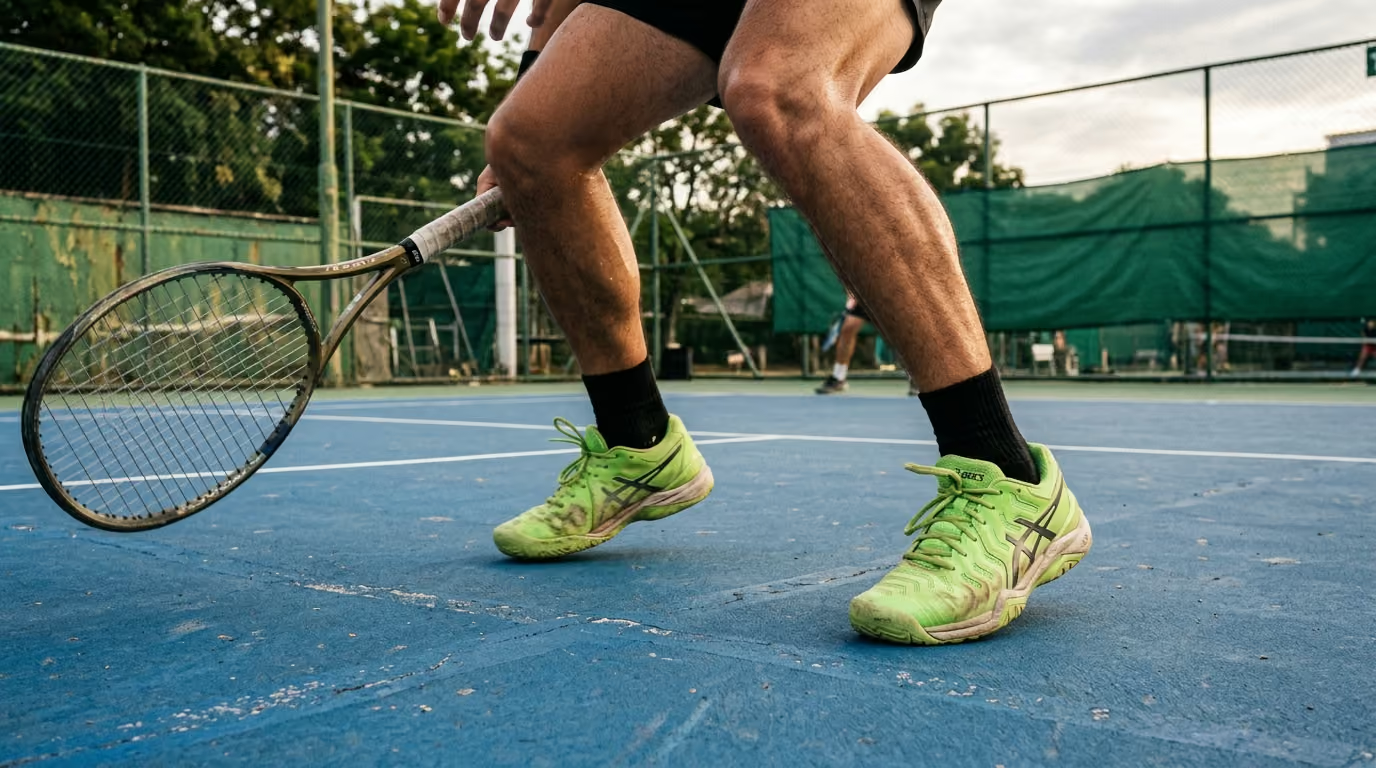
A point-construction plan for competitive racquet sports involves a five-phase rally cycle, offering a structured decision hierarchy to improve winning probabilities.




A point-construction plan is not a collection of spectacular winners. It is also not a rigid sequence of shots that you must hit in a strict, unyielding order. Instead, a successful plan is a structured decision hierarchy designed to improve the probability of winning rallies. It tells you what to protect, what opportunity to create, which targets are acceptable, and how your choices should change according to the score.
To develop a point-construction plan, you must establish a pre-determined decision hierarchy for the start, development, and completion of every rally. This plan replaces vague confidence goals with observable behaviors, such as hitting specific targets, managing court positioning, and executing high-probability recovery routes. By prioritizing high-percentage choices based on the score and your opponent's position, you can make disciplined decisions under match pressure.
Transitioning from emotional reactions to tactical decisions is the first step toward long-term court success. When you play with a clear framework, you remove the stress of deciding what to do in the middle of a fast rally. This comprehensive guide outlines the scientific foundations of point play, details a universal five-phase rally cycle, and provides sport-specific adjustments for tennis, pickleball, and padel.
Tactical decision-making is not just a theoretical concept. It is a measurable skill that directly influences physical execution. Sports science research demonstrates that a player's ability to read court situations determines how well they perform their physical strokes.
Research in squash shows that stronger players are much better at reading the game context before selecting their shots. A study published in the International Journal of Performance Analysis in Sport evaluated control, decision-making, and execution as distinct aspects of athletic performance. The researchers reported that higher-level players show better tactical reading and stronger technical-tactical application.
Crucially, the data revealed that correct tactical decisions are positively associated with better execution quality. When you make the correct tactical choice, your body is in a more predictable position, which statistically increases the likelihood of a successful physical stroke. Conversely, a poor tactical decision often forces you to hit from a compromised position, which degrades your technical execution.
Further squash research on elite players identified six distinct situation-awareness clusters. These clusters range from defensive shots played under heavy pressure to attempted winners when the opponent is out of position and the player is under little pressure. Expert players do not hit random shots. They match their stroke selection to their current situation-awareness cluster.
This finding applies directly to all racquet sports. If you are under pressure, your priority is to buy time and restore court balance. If you are in a neutral position, your goal is to maintain length and wait for a weak reply. You should only attempt an attacking shot when your opponent's position and the court geometry justify the risk.
In tennis, point construction begins with the serve-and-return interaction. Research from 116 men's singles matches at the French Open found that flat serves were used most frequently, at 57.6 percent of all first serves. On the slow clay surface, flat serves directed down the T were associated with more points won than topspin or slice serves.
The same study found that topspin serves produced a high percentage of points won when used as first serves. The second-serve strategy predominantly used topspin toward the T in the deuce court and wide in the ad court. This research demonstrates that even elite players rely on highly structured, high-probability serving patterns rather than random variation. The serve is a tool used to set up the next shot, known as the serve-plus-one pattern.
Sports science also defines match pressure mathematically through point importance. Point importance is the change in match-winning probability created by winning rather than losing the current point. A study of professional tennis reported that performance under pressure is not uniform across players. The analysis found substantial variation in point importance, showing that some athletes experience significant performance changes as points become more consequential.
By having a pre-planned decision hierarchy, you protect yourself from the emotional fluctuations caused by high-importance points. Instead of trying to feel confident, you focus on executing a specific, measurable behavior. This systematic approach is a core element of competitive court strategy, helping players maintain their performance levels as they navigate the natural progression of a match.
A successful point-construction plan operates as a continuous five-phase cycle. This cycle repeats during every rally, guiding your movement, shot selection, and recovery.
The starting phase is about initiation and control. Before the ball is put into play, you must assess the environment, the score, and the opponent's positioning. The starting objective is almost never to win the point immediately. Instead, the goal is to begin the rally in a stable state that makes your next decision easier.
If you are serving, this means choosing a serve location that sets up your preferred next shot. If you are returning, it means neutralizing the server's advantage and hitting to a large, safe target. You must accept that a conservative start that gets you into the rally is always better than an aggressive miss on the first ball.
After the opening shot, you must immediately assess your physical state and court position. Ask yourself if you are balanced and whether you are inside, on, or behind your ideal court position. You must also read your opponent's balance and the quality of your own shot.
If you are late, stretched, or off-balance, your immediate priority is to stabilize the rally. You do this by hitting with height, depth, and centrality to buy yourself recovery time. Attempting an aggressive shot when you are off-balance is a low-percentage choice that usually results in an unforced error or an easy counterattack for your opponent.
Once the rally is stable, you can begin to create a positional advantage. You create this advantage by changing one major variable at a time. This variable could be lateral direction, depth, pace, height, or spin.
A practical rule for recreational and competitive players is to avoid changing multiple variables simultaneously. For example, if you decide to hit a sharp angle, do not also try to hit the ball with maximum pace and minimal net margin. Instead, use a deep, heavy shot to move your opponent wide, then use the next ball to attack the open space. This step-by-step approach keeps your risks low while steadily building pressure.
A conversion opportunity exists when your opponent produces a short, weak, or high ball that allows you to step forward. At this moment, you transition from creating an advantage to finishing the point. However, finishing the point still requires disciplined percentage play.
Your attack should be selected according to your opponent's available recovery routes. For instance, you might hit behind a running opponent who is rushing to cover the open court. Your target should still be large enough to offer a reliable margin for error. A successful attack relies on placement, timing, and court positioning rather than raw physical power.
Every shot you hit must include an immediate recovery instruction. You must know where to move, what reply to expect, and which part of the court to protect before your opponent even makes contact with the ball. A point plan that only specifies the outgoing shot is incomplete and dangerous.
As soon as the ball leaves your strings or paddle, you must physically recover to the appropriate position. This movement resets the cycle, preparing you to stabilize, create, or convert on the next ball. This constant movement loop is a fundamental aspect of efficient court mobility and movement patterns.
While the five-phase cycle is universal, the physical demands, court dimensions, and equipment of each sport require specific tactical adjustments. Understanding these differences allows you to tailor your plan to your chosen game.
Tennis is characterized by a large court, a bouncing ball, and significant physical distance between players. The primary objective of tennis point construction is to control the baseline and exploit court geometry. Because the court is wide, lateral movement is highly demanding.
Your serve plan should be built around first-serve percentage, return quality, and the serve-plus-one pattern. You should track your first-serve percentage closely, aiming for a reliable rate that prevents your opponent from attacking. Your first-ball pattern after the serve must be explicit. For example, you might hit a wide serve to open up the court, then target your first forehand deep into the vacant space.
When returning, the USTA recommends a high-percentage return against a first serve, including deep crosscourt returns or targets through the middle of the court. Against a weaker second serve, you can step inside the baseline and use depth and spin to gain an immediate advantage. An ITF Coaching Review recommendation also emphasizes targeting the opponent's weaker side, often the backhand, with more than 80 percent consistency.
Pickleball is played on a much smaller court, which changes the time dynamics and the importance of net positioning. In pickleball, the primary goal of point construction is to transition safely to the non-volley zone line, also known as the kitchen line. The team that occupies the kitchen line first holds a significant statistical advantage.
Because of the two-bounce rule, the serving team begins the point at a positional disadvantage. The serving team's point-construction plan must focus heavily on the third-shot decision. You must decide whether to hit a third-shot drop to bounce the ball in the opponent's kitchen, allowing you to move forward, or a third-shot drive to force a weak volley.
Once all four players are at the kitchen line, the point transitions into a dink rally. Here, point construction requires extreme patience. You must use soft, low dinks to move your opponents laterally, waiting for them to lift the ball above net height. Only when the ball is lifted should you attempt a speed-up or an overhead smash.
Padel is played in an enclosed glass court, which introduces unique rebound dynamics and changes how you create space. In padel, the net players hold the attacking position, while the players at the back of the court are in a defensive position. Point construction is a continuous battle to win and maintain the net.
The serving team starts at the net, using the serve and first volley to maintain their positional advantage. The receiving team must use the lob to force the net players backward. If you hit a high, deep lob that bounces near the back glass, the opponents must retreat, allowing you to transition forward and take the net.
In padel, raw power is often punished because a hard smash that does not leave the court will bounce off the back wall, giving the defenders an easy counterattack. Instead, net players must use the bandeja or vibora, which are controlled, spinning overheads designed to keep the ball low and deep. Point construction in padel is about wearing down the opponents through patience, court positioning, and clever use of the walls.
For players who also participate in other wall or net sports, point construction remains highly systematic. In badminton, which features rapid exchanges and a rally-point scoring system, top players focus on reaching the shuttle early and close to the net. The doubles framework prioritizes serve placement, quick interception, and preventing the opponents from attacking the third shot.
In squash, point construction is heavily dependent on the T-position in the center of the court. Players must maintain depth and length to push their opponent behind them, only attacking the front of the court when they have established clear physical dominance. Both sports highlight the importance of contextual reading, where physical execution is entirely guided by your position relative to the ball and your opponent.
A mature point-construction plan is highly sensitive to the score. You cannot play the same way at 40-0 as you do at break point. Score awareness allows you to allocate your physical and tactical risks logically.
Early scores in a game, such as 0-0 or 15-0, are low-leverage moments. These points provide an excellent opportunity to gather information about your opponent without risking the entire match. You can use these moments to test specific patterns and observe the results.
During these points, you might want to observe how your opponent handles a body serve or whether their backhand breaks down under high, heavy spin. You can also test their movement by forcing them to change directions repeatedly. The information you gather during low-leverage scores will guide your tactical choices when the pressure increases later in the set.
Scores such as 30-30, 30-15, or deuce are medium-leverage moments. The outcome of these points has a significant mathematical impact on your probability of winning the game. At these scores, you must abandon experimentation and return to your most reliable patterns.
Choose a pattern that has a clear intention, a large primary target, and a predictable next ball. For example, if your most reliable pattern is a wide serve followed by a deep forehand to the open court, execute that pattern. Avoid the temptation to try something new or spectacular simply because you feel anxious. Rely on your established training and keep your targets large.
High-leverage scores include break points, game points, set points, and match points. These are the moments of maximum pressure, where a single mistake can alter the entire course of the match. Your objective at these scores is to minimize unforced errors while still playing with clear tactical purpose.
Ask yourself what pattern you have executed successfully most often during your training. Choose a plan with a known execution history and a generous margin for error. Instead of chasing a tiny sideline target, aim for a large zone that forces your opponent to hit one more difficult ball. Let your opponent take the high-risk options while you maintain positional discipline and depth.
To make these concepts practical, consider how your targets should shift during a typical service game.
Your serving and returning patterns form the foundation of your point-construction plan. If these patterns are weak or disorganized, you will spend the rest of the rally playing defense.
A practical serving plan should classify locations by their tactical purpose rather than speed alone. Each location sets up a specific type of reply, allowing you to anticipate your next shot.
Your return plan should distinguish clearly between first serves and second serves. You must choose one of three specific return intentions before the server hits the ball.
Even the most analytical players can fall into common tactical traps during a match. Recognizing these errors allows you to correct them before they cost you games.
Many recreational players believe that percentage play means hitting the ball slowly, softly, and down the middle of the court. This is a dangerous misconception. Percentage play actually means choosing the option that maximizes your expected point value after accounting for all risks.
An aggressive, heavy shot directed at a large target can be excellent percentage play. For example, hitting a deep, powerful forehand three feet inside the baseline is far safer than hitting a soft, short ball that lands in the middle of the court. The short, soft ball gives your opponent an easy attack, which reduces your overall probability of winning the point. True percentage play combines physical authority with sensible target selection.
Another frequent error is judging your tactical decisions based on a single result. If you hit a low-percentage drop shot from behind your own baseline and it happens to land for a winner, you might assume it was a good decision. It was not. It was a poor decision that enjoyed a lucky physical outcome.
If you repeat that low-percentage decision ten times, you will likely lose the point eight times. You must separate decision quality from execution quality during your post-match analysis. If you make a smart tactical choice but miss the shot physically, you should encourage yourself to make the same decision next time. If you make a terrible tactical choice but win the point, you must recognize the error and avoid repeating it.
To help visualize this distinction and conduct a healthy post-match evaluation, you can classify your important points into four distinct categories.
This classification framework prevents you from learning the wrong lessons from isolated results. If you consistently find yourself in Category 2, your tactics are sound, but you need to spend more time on strength and conditioning guidelines or technical drills to improve your physical execution. If you find yourself in Category 3, you are surviving on luck or weak opposition, and your tactical choices will eventually fail you against stronger players.
Developing a clear point-construction plan does more than improve your score. It also has a profound impact on your physical well-being, fatigue levels, and long-term athletic longevity.
Most court-related injuries do not occur during smooth, predictable movements. Instead, they happen during emergency decelerations, sudden changes of direction, and desperate lunges. These violent physical actions are often the result of poor court positioning and late tactical reading.
When you play with a clear point-construction plan, you anticipate your opponent's replies and recover to the correct position early. This structured movement allows you to reach the ball in balance, reducing the need for emergency brakes and high-risk lunges. By avoiding these erratic movements, you protect your joints, tendons, and muscles from acute strains and chronic wear. For more information on protecting your body during competitive play, examine our resources on court-related injury prevention.
Vague, emotional play is physically exhausting. When you do not have a plan, every shot requires a fresh decision, which drains your mental energy. Mental fatigue leads to slower reaction times, poorer coordination, and a general decline in movement quality as the match progresses.
A pre-established decision hierarchy automates your choices on the court. This mental clarity preserves your cognitive energy, keeping you sharp and focused during long matches. Additionally, systematic movement conservation ensures that you run fewer unnecessary miles, reducing overall muscular fatigue and preserving your physical resources for the final set. To learn more about managing physical stress and optimization, explore the principles of sports recovery science.
By reducing physical and mental wear, structured point construction supports your journey toward healthy aging. It allows you to continue enjoying the competitive thrill of racquet sports for many years to come. Maintaining your physical capabilities is much easier when your mind is doing the heavy lifting on the court.
While a structured tactical plan can reduce physical stress, it cannot cure existing injuries or structural damage. You must remain highly sensitive to your body's warning signs on the court.
If you experience persistent joint pain, swelling, sharp twinges during movement, or a feeling of instability in your knees, ankles, shoulders, or elbows, you must stop playing immediately. These symptoms indicate a physical issue that requires professional attention rather than a tactical workaround. Do not try to play through pain or mask symptoms with medication, as this can turn minor tissue strains into chronic, debilitating conditions.
Consult a qualified healthcare provider, such as a physical therapist or sports medicine physician, to get a precise diagnosis. They can help you address the root cause of your physical limitations and guide your return to safe, pain-free play. For more guidance on maintaining your long-term physical well-being, check out our articles on court athlete health.
Do not assume that hitting closer to the lines or using sharper angles is the correct answer. A faster opponent will run down those high-risk shots and exploit the open court you leave behind. Instead, move them with changes of depth, height, and pace. Deep, heavy shots through the middle of the court restrict their running room and limit their ability to use their speed. Force them to hit from uncomfortable, cramped positions rather than giving them an open track to run on.
When your strokes are unreliable, you must shrink your targets and simplify your tactical menu. Avoid high-risk plays, low net-clearance targets, and complex multi-shot patterns. Focus entirely on hitting deep, central shots that require minimal technical precision but still keep your opponent behind the baseline. Let your tactical discipline keep you in the match while you work to find your physical rhythm.
Difficult outdoor conditions require you to increase your physical margins for error. Increase your net clearance, target larger zones inside the lines, and favor spin over raw pace. Identify which direction the wind is blowing and adjust your tactics accordingly. For example, when playing with the wind at your back, focus on spin and control to prevent the ball from flying long. When playing against the wind, use more physical power and depth to keep your opponent pinned back.
When you are leading, your priority is to maintain pressure through discipline. Do not try to end rallies early or play with unnecessary elegance, as this gives your opponent free momentum. Force them to earn every single point. When you are trailing, avoid the urge to play with desperate, high-risk urgency. Instead, increase your tactical pressure by improving the depth of your first attack and making sure you execute every recovery route with absolute focus.
Follow Evercourts for practical insights on tennis, pickleball and padel performance, movement, recovery and healthy ageing. Stay connected for new articles, research-led guidance and ideas to help you play well and keep playing for years.


Read practical guidance for better movement, smarter preparation and a game that keeps working for you.
explore the Blog