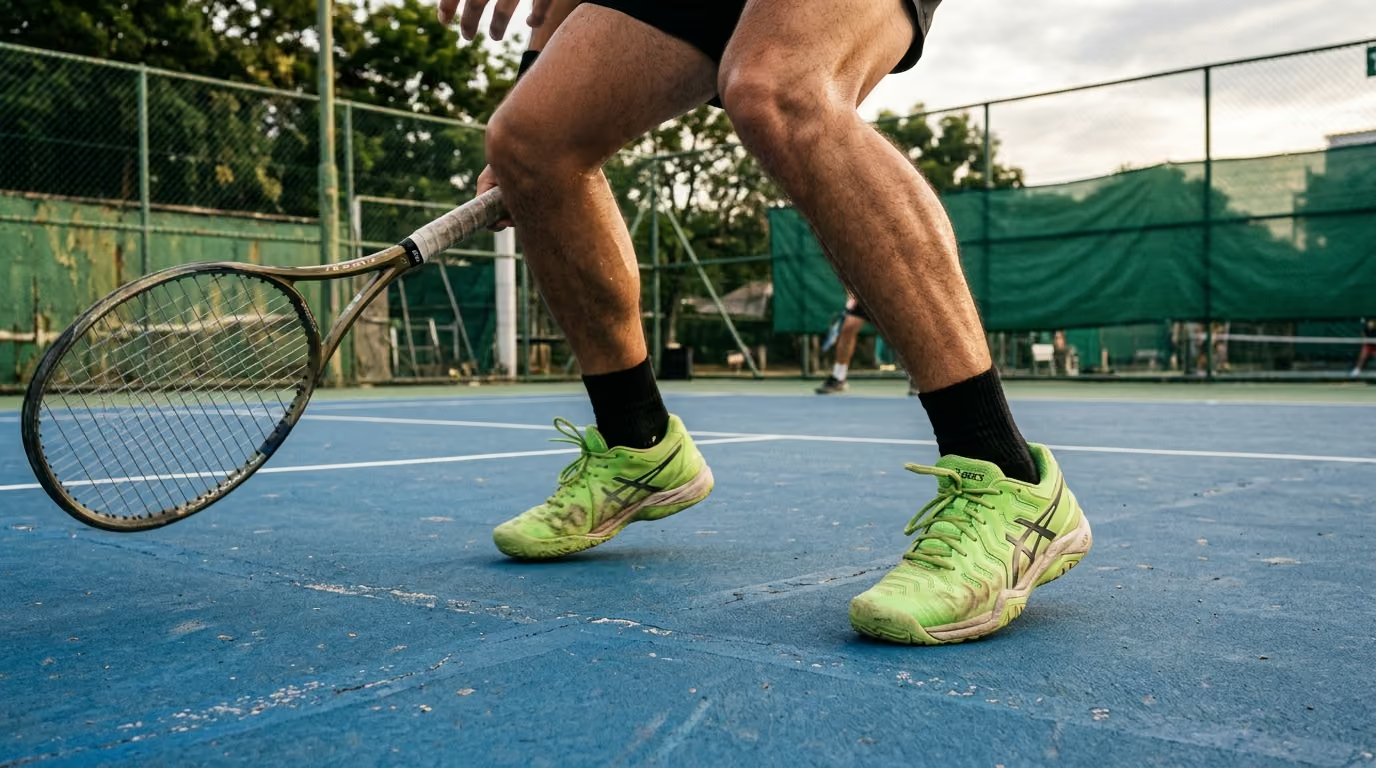
While many racquet-sports players assume harder training is always better, a recovery log helps balance training stress with targeted recovery for smarter decisions.




Many court athletes believe that harder training is the only path to better performance. They add extra sprints, play extra sets, and push through joint stiffness. In our experience, this approach often leads to plateaus and chronic fatigue rather than progress.
Our team used to think a tough conditioning block was the only way to improve court endurance. Then we started tracking sleep and general recovery metrics. We noticed that on days we slept less than six hours, reaction time at the net was sluggish, and we felt exhausted by the second set. Prioritizing consistent rest did more for late-match stamina than any extra sprints ever did.
A recovery log is a decision-support system designed to track training load and daily recovery metrics to reveal trends over time. It helps racquet-sports players adjust training volume, identify potential readiness issues, and avoid non-functional overreaching without obsessing over daily fluctuations. By learning to balance training stress with targeted recovery, you can make smarter training decisions and protect your athletic longevity.
To make a recovery log work, you must first understand the relationship between training load and physical adaptation. Every swing, sprint, and split-step sends a signal to your body to adapt and grow stronger. This signal is called training load, and it is the total stress imposed by training and competition. Proper management of this stress is essential for adaptation and performance, while also reducing the risk of illness and injury.
According to a comprehensive consensus statement published in the International Journal of Sports Physiology and Performance, training load must be divided into external and internal components. External load represents the actual work you complete on the court or in the gym. This includes session duration, the number of sets played, or the total reps completed during a strength workout. External load tells you what you did, but it does not reveal how much that work cost your body.
Internal load represents the physiological and psychological stress your body experiences in response to that external work. A ninety-minute practice on a cool spring morning will feel very different from the same practice in high humidity. Your internal load is influenced by your sleep, nutrition, stress levels, and current training status. If you only track minutes on the court, you are missing half the picture.
One of the most valuable insights your log can provide is the divergence between external and internal load. If you perform a routine baseline drill but your perceived effort is unusually high, your internal and external loads have diverged. This divergence is a signal to investigate your recovery status. It does not prove a specific medical issue, but it does show that your body is working harder than usual to complete standard tasks.
Many racquet-sports players track their training by counting the days they play each week. This method is too simple because it treats a light coaching session the same as a intense tournament match. To build a useful log, you must record enough detail to distinguish different types of court stress. This helps you monitor your training load without requiring expensive wearable technology.
The session-RPE method is a highly validated way to calculate internal training load. You multiply the total duration of your training session by your rating of perceived exertion on a simple scale from one to ten. A score of one represents complete rest, while ten represents a maximal, exhausting effort. The formula is straightforward: session load equals session RPE multiplied by duration in minutes.
For example, a ninety-minute technical practice at a moderate effort of five results in a session load of 450 arbitrary units. A forty-five-minute competitive singles match at an intense effort of eight results in 360 arbitrary units. This calculation demonstrates why tracking minutes alone is inadequate. By recording session RPE, you capture both the volume and the intensity of your work.
Research shows that session RPE correlates strongly with more complex heart-rate monitoring methods. A consensus review indicates individual correlations between session RPE and heart-rate-zone scores range from 0.75 to 0.90 in court-based environments. This method is highly reliable when you record your score consistently about thirty minutes after your session ends. This delay prevents a hard final sprint from skewing your perception of the entire workout.
You must also separate your court-specific load from your general fitness work. A return-to-play case study published in the Journal of Orthopaedic and Sports Physical Therapy demonstrated that total training load can sometimes hide dangerous spikes in sport-specific stress. In that study, a player experienced a shoulder injury after a sudden increase in tennis-specific work, even though their total weekly training volume remained stable.
Furthermore, a study of competitive adolescent tennis players in the British Journal of Sports Medicine revealed that sudden spikes in court workload are closely tied to shoulder complaints. Each additional workload spike in tennis training or match-play was associated with a hazard-rate ratio of 1.26 for a shoulder complaint and 1.26 for a shoulder injury. This highlights the importance of using targeted injury prevention strategies by tracking hits and serves separately from running or gym sessions.
Sleep is the cornerstone of athletic recovery and physical adaptation. When you sleep, your body releases growth hormone, repairs damaged muscle tissue, and consolidates technical skills learned on the court. Consistent sleep loss affects your reaction time, split-second decision-making, and general motivation. Your recovery journal should track both the quantity and the perceived quality of your rest.
Systematic reviews of athletic sleep interventions have highlighted the powerful impact of sleep extension on performance. A review published in Sports Medicine found that extending sleep duration produced the most beneficial effects on subsequent physical performance among all interventions examined. Another review in the journal Sleep Medicine reinforced that sleep extension and planned naps are the most effective strategies for reducing athletic fatigue.
To track sleep effectively without becoming obsessive, record your approximate time asleep and a subjective quality score. Use a simple one-to-five scale to rate how refreshed you feel upon waking. If you slept for eight hours but woke up three times, your quality score will reflect that disruption. Note any factors that might have influenced your sleep, such as late-night matches, travel, caffeine intake, or work stress.
Sleep should never be viewed as a simple pass-or-fail metric. A single night of poor sleep before a big match is unlikely to ruin your performance. However, several consecutive nights of shortened sleep will accumulate into a significant recovery debt. By tracking these trends in your recovery science resources log, you can identify when a sleep deficit is beginning to affect your movement on the court.
Your physical recovery is not just about your cardiovascular system. Your muscles, joints, and tendons take a beating during the rapid changes of direction required in racquet sports. To protect your athletic longevity, you must monitor localized soreness and distinguish it from actual pain. A global "body soreness" score is rarely detailed enough to be useful.
We recommend tracking soreness by specific anatomical locations. Note whether the discomfort is in your hitting shoulder, your elbow, your lower back, or your Achilles tendon. Use a simple scale to rate the intensity of the sensation. It is also important to note whether the soreness is symmetrical or concentrated on your dominant side.
A critical step in your recovery log is distinguishing between benign muscle soreness and potentially serious joint pain. Diffuse, symmetrical muscle soreness is a normal response to challenging training. It usually peaks two days after a hard session and gradually fades. Localized joint or tendon pain that worsens with movement is a warning sign that requires attention.
Your log should also record subjective psychological variables like mood, stress, and motivation. A study of Australian football players published in the Journal of Strength and Conditioning Research showed that subjective wellness ratings are highly sensitive to training changes. Their ratings of fatigue, muscle soreness, and stress responded quickly to weekly training manipulations. When your mental stress is high, your body has fewer resources available to recover from hard physical workouts.
Your recovery journal does not need to become a calorie-tracking spreadsheet. Compulsive calorie counting often leads to anxiety and food restriction, which can compromise your recovery. Instead, your log should focus on the adequacy and consistency of your fueling habits. You want to ensure your body has the energy it needs to repair tissue and replenish glycogen stores.
For active court players, nutrition tracking should focus on the timing of your meals. Record whether you ate a carbohydrate-rich meal before your training session. Note if you consumed carbohydrates during long matches that extended past sixty minutes. The International Society of Sports Nutrition recommends consuming thirty to sixty grams of carbohydrates per hour during prolonged, high-intensity exercise.
Post-session recovery meals are equally important for restoring muscle glycogen. If you have less than four hours before your next match, your recovery needs to be rapid. The International Society of Sports Nutrition recommends consuming about 1.2 grams of carbohydrate per kilogram of body weight per hour. Alternatively, you can consume 0.8 grams of carbohydrate per kilogram combined with 0.2 to 0.4 grams of protein to support muscle repair.
Hydration is another critical variable to track, especially when playing in hot or humid conditions. You can record your hydration status simply by noting your urine color in the morning or tracking body weight changes before and after play. If you lose more than two percent of your body mass during a match, you are under-hydrated. Recording these patterns helps you adjust your fluid and electrolyte intake for future sessions.
A recovery log is only useful if you actually fill it out. Many athletes start with a complex, multi-page journal and abandon it after a single week. To prevent this, design a simple routine that takes less than two minutes a day. The best way to build this habit is to attach it to existing parts of your daily schedule.
Your logging routine should be divided into two brief check-ins. The first entry occurs shortly after you wake up, when your sleep and morning wellness are fresh in your mind. The second entry occurs thirty to sixty minutes after your training session, once your heart rate has returned to baseline. This split keeps your data accurate and prevents you from forgetting important details.
Your morning entry should capture your baseline state. Keep it focused on subjective ratings that take seconds to complete. You can use a physical journal on your nightstand or a simple note-taking app on your phone. Consistent timing is key to establishing an accurate baseline for your daily physical readiness.
Your post-session entry should focus on the work completed and how it felt. Write down the duration of your session, your RPE, and any notable physical sensations. Record whether you experienced any joint pain during play or if your movement felt sluggish. This quick habit helps you connect your training decisions directly to your physical recovery.
While all racquet sports share common movement patterns, each sport places unique physical demands on your body. A tennis player covers larger distances and hits with greater rotational force. A pickleball player performs constant low-amplitude squats and rapid reflex volleys. A padel player deals with frequent overheads and complex movements off the glass walls. Your recovery log must reflect these sport-specific differences to help you achieve better play and remain injury-free.
Tennis requires a high volume of maximal accelerations, decelerations, and rotational force. The serving motion is particularly taxing on the shoulder, upper back, and abdominal muscles. In your tennis log, you should track your serving volume separately from your total hit count. A sudden increase in serves can trigger shoulder irritation, even if your total court time remains unchanged.
Pickleball is played on a smaller court, but it requires highly repetitive, short-range movements. The bent-over posture required for dinking puts consistent stress on the lower back and hips. Pickleball players should pay close attention to lower back stiffness and knee soreness in their logs. Tracking the number of games played in a single day is often more useful than tracking total hours on court.
Padel combines the overhead demands of tennis with the rapid changes of direction of squash. The ball rebound off the glass walls requires constant turning, backward running, and rotational adjustments. Padel players should carefully log calf tightness, Achilles tendon soreness, and shoulder fatigue from frequent overhead smashes. Recording the court temperature is also useful, as ball speed and rally length change dramatically in hot conditions.
The primary purpose of a recovery log is to help you identify patterns, not to make you anxious about minor fluctuations. Your body is a complex biological system, and day-to-day variations in your metrics are completely normal. A single night of poor sleep or a temporary spike in muscle soreness is not a crisis. You should look for consistent trends that develop over several days.
To avoid over-analyzing your data, establish your own personal baselines before making major training adjustments. Spend two to three weeks logging your normal training and recovery without changing your routine. This baseline data helps you understand what is normal for your body. You will learn how much sleep you typically need and what level of soreness is expected after a tough match.
We recommend using a simple traffic-light system to translate your logged data into actionable training decisions. This system categorizes your physical readiness into three distinct states. It helps you make objective decisions on the court without letting your emotions override your physical reality.
Avoid using rigid, universal cutoffs to guide your training. A training-monitoring review warns against using arbitrary rules like "a ten percent change in heart rate variability requires a rest day." These generic thresholds do not account for individual differences or normal measurement errors. Your log should be used to support your intuition, not to replace your common sense.
You must also avoid confusing correlation with causation in your analysis. If you experience a poor serving session after a night of bad sleep, it is tempting to blame your sleep directly. However, several other factors could have influenced your performance. A challenging workday, a change in wind conditions, or a minor technical error could also be the cause. Use your log to identify interesting associations rather than assuming you have found absolute proof.
To ensure your physical progress, use your recovery data to guide your strength and conditioning program. If your log shows consistent lower back stiffness after long singles matches, you may need to focus more on core stability and hip mobility. If your shoulder feels fatigued after serving, you might need to strengthen your rotator cuff muscles. Your log provides the real-world evidence you need to build a targeted fitness program.
To help you understand how to use your recovery log in real-world scenarios, let us look at six common case patterns. These examples show how to interpret your metrics and make sensible adjustments to your training schedule.
You complete three challenging on-court training sessions in a single week. Your sleep duration remains close to your baseline, your appetite is strong, and your mood is stable. Your session RPE matches your planned effort, and you have no joint pain.
You complete a routine ninety-minute practice session that usually feels like a five out of ten on the RPE scale. Today, however, you rate the session an eight. Your sleep has been short for three consecutive nights, and your motivation to train is low. Your stroke consistency and footwork quality also deteriorated during the second half of the session.
Your total weekly training minutes look completely normal, and you feel generally fresh. However, you recently reduced your gym workouts and significantly increased your serving and match-play volume. You now notice persistent, localized soreness in your hitting shoulder, even though your general fatigue score is low.
You lose a close three-set match against a tough opponent in windy conditions. Your morning log showed excellent sleep, normal motivation, and no physical soreness. Your warm-up felt sharp, and your session RPE was exactly what you expected for a long match.
Your log shows a steady decline in sleep quality, a drop in appetite, and persistent muscle soreness across your entire body. Your motivation to play has plummeted, and you feel irritable both on and off the court. Your session RPE is consistently high during warm-ups, and you are struggling to complete basic technical drills.
You find yourself checking your sleep scores multiple times a day and feeling anxious about minor deviations from your baseline. You cancel a scheduled hitting session because your morning readiness score was slightly lower than usual. You begin restricting your food intake to try and force a specific metric to change.
To get the most value from your recovery log, you need a structured way to review your data. Looking at your metrics every day can cause you to miss the bigger picture. Instead, set aside a few minutes once a week and once a month to analyze your trends. This routine helps you make informed, long-term adjustments to your training program.
During your weekly review, look for relationships between your training inputs and recovery outputs. Ask yourself which sessions produced the highest RPE scores and whether your internal load matched your plans. Check if any specific drills or matches triggered localized joint soreness. Note how your sleep quality responded to late-night matches or travel days.
During your monthly review, look for broader, recurring patterns in your training log. You might notice that your serve quality always declines after three consecutive days of playing singles. Or you might see that your footwork is consistently sharper when you get at least seven and a half hours of sleep. These insights allow you to design a highly personalized training schedule.
You can also use your log to run simple "natural experiments" to improve your recovery. Instead of changing five different habits at once, make one small adjustment to your routine for two weeks. For example, you could add thirty minutes to your nightly sleep window or consume a carbohydrate snack immediately after long matches. Use your log to see if this single change improves your energy, soreness, or performance.
A recovery log is a powerful tool for self-reflection and training adjustment, but it has clear limitations. It is designed to help you make healthy choices, not to diagnose medical conditions or manage serious physical injuries. If you experience persistent, abnormal physical or psychological symptoms, you must seek professional help.
Consult a qualified healthcare provider or sports medicine specialist if you experience any of the following warning signs:
A professional assessment is essential for protecting your long-term health and athletic longevity. Use your recovery log to provide your doctor or physical therapist with a clear history of your training load and symptoms. This detailed record is incredibly valuable for helping them make an accurate diagnosis and design an effective treatment plan.
Keeping a recovery log does not require endless hours or complicated technology. By spending just two minutes a day tracking your training, sleep, soreness, and stress, you can make smarter decisions that keep you performing at your best for years to come.
Follow Evercourts for practical insights on tennis, pickleball and padel performance, movement, recovery and healthy ageing. Stay connected for new articles, research-led guidance and ideas to help you play well and keep playing for years.


Read practical guidance for better movement, smarter preparation and a game that keeps working for you.
explore the Blog