
Two weeks of detraining can reduce intermittent-recovery performance and repeated-sprint ability in athletes, but a modest maintenance program can preserve fitness.




Many players believe that a break from the court is a quick slide into physical decline. They think that unless they are hitting balls or running baseline sprints, their hard-earned conditioning will vanish. This belief often leads to a cycle of anxiety, followed by frantic, unstructured home workouts that do more harm than good. In reality, an off-court break is a valuable opportunity to build athletic longevity.
Maintaining racquet-sport fitness off the court requires preserving your aerobic base, lower-body strength, and movement control through structured, low-impact exercise. Rather than trying to copy court movements exactly, you can protect your joints by targeting the underlying physical systems. This balanced approach ensures you can return to play safely without experiencing a major setback in performance.
Racquet sports are highly intermittent and acyclic in nature. Unlike distance running or cycling, they do not require one continuous pace. Instead, matches combine brief, intense efforts with short recovery periods. Research shows that tennis matches commonly last between 60 and 90 minutes. However, competitive matches can range from approximately one hour to five hours depending on the format and level.
During these matches, individual points are brief. Studies report average point durations of 5.2 seconds for men. For women, the average point duration is 7.1 seconds. These short, explosive rallies are followed by recovery periods between points, games, and sets. This structure means that a simple cardiorespiratory routine is not enough to keep you fit for court play.
If you only focus on steady cardio, you may lose the ability to accelerate, stop, and change direction. Conversely, strength training alone will not prepare your cardiovascular system for the recovery demands of a long match. Understanding how your body loses these adaptations is crucial. You can find specialized guidance on managing these physical demands in our strength and conditioning resources.
Detraining is the partial loss of training adaptations when your physical activity is reduced. The effects of detraining are not uniform. Different physical qualities decline at different rates. This rate depends on your age, fitness history, and whether you stop all activity or only sport-specific movement.
A systematic review published in the British Journal of Sports Medicine examined training cessation. The review found that both short-term and long-term breaks negatively affect your VO2max. However, the researchers reported no significant additional decline in VO2max when the break lasted more than 30 days. This indicates that detraining is not a simple linear countdown.
For younger, highly trained athletes, short breaks may have a smaller impact. One study of adolescent male athletes found that three weeks of complete rest did not reduce muscle thickness or strength. However, we cannot generalize these results to older adults or injured players.
Another study showed that two weeks of detraining reduced intermittent-recovery performance and repeated-sprint ability in trained athletes. After returning to training, the athletes needed two weeks of high-intensity aerobic training to recover their intermittent endurance. They needed three weeks to restore their repeated-sprint performance.
A modest maintenance program can preserve your physical qualities far better than total rest. It allows you to maintain your cardiorespiratory base while protecting your tendons and muscles. This scientific understanding should shape your off-court routine.
When you cannot get on the court, you should not try to recreate your sport exactly. A home program cannot reproduce ball tracking, opponent anticipation, or racket timing. Instead, you should focus on quality preservation. By maintaining the underlying physical systems, you prepare your body for a seamless return.
You can organize your training around six key athletic qualities to preserve your performance base.
Aerobic capacity is your ability to use oxygen during sustained or repeated activity. Your VO2max is a primary indicator of cardiorespiratory fitness. In racquet sports, a strong aerobic base supports recovery between points, games, and intense rallies.
If you lose aerobic fitness, you will tire more quickly during long matches. This fatigue can lead to poor court positioning and technically inaccurate movements. To keep your aerobic system active, choose joint-friendly options. Brisk walking, incline walking, stationary cycling, and swimming are excellent choices.
The anaerobic system contributes to short, explosive actions on the court. Serves, jumps, rapid accelerations, and forceful strokes rely on this energy system. These actions involve high energy expenditure over very short periods.
You can train this system off the court without high-impact stress. Use short hill walks or intervals on a stationary bicycle. If you are healthy, perform medicine-ball throws or fast step-ups. For older adults, power training should focus on fast movement intent within a safe range of motion.
Strength is your ability to produce force against resistance. You need strong quadriceps and glutes for lunging, pushing off, and decelerating. Your calves and feet must handle repeated elastic movements. Strong hamstrings help you brake and protect your knees.
General exercise guidance from health organizations recommends strengthening all major muscle groups at least two days per week. You can do this at home with minimal equipment. Use exercises like squats, split squats, step-ups, and glute bridges. For the upper body, use push-ups, resistance band rows, and external rotation exercises.
Power is the ability to produce force quickly. It is different from maximum strength. You may be strong in a slow movement but struggle to react to a short ball. To preserve power, you must practice moving quickly under control.
You do not need to perform high-impact jumps to train power. Try performing sit-to-stands with a fast upward phase. Use low step-ups with a focus on speed. Controlled resistance band punches and rapid heel raises also target this quality safely.
Many players focus on moving forward but neglect braking. On the court, the ability to slow down is critical. You must lower your center of mass, control your knees, and redirect your force. Poor deceleration is a common cause of injury.
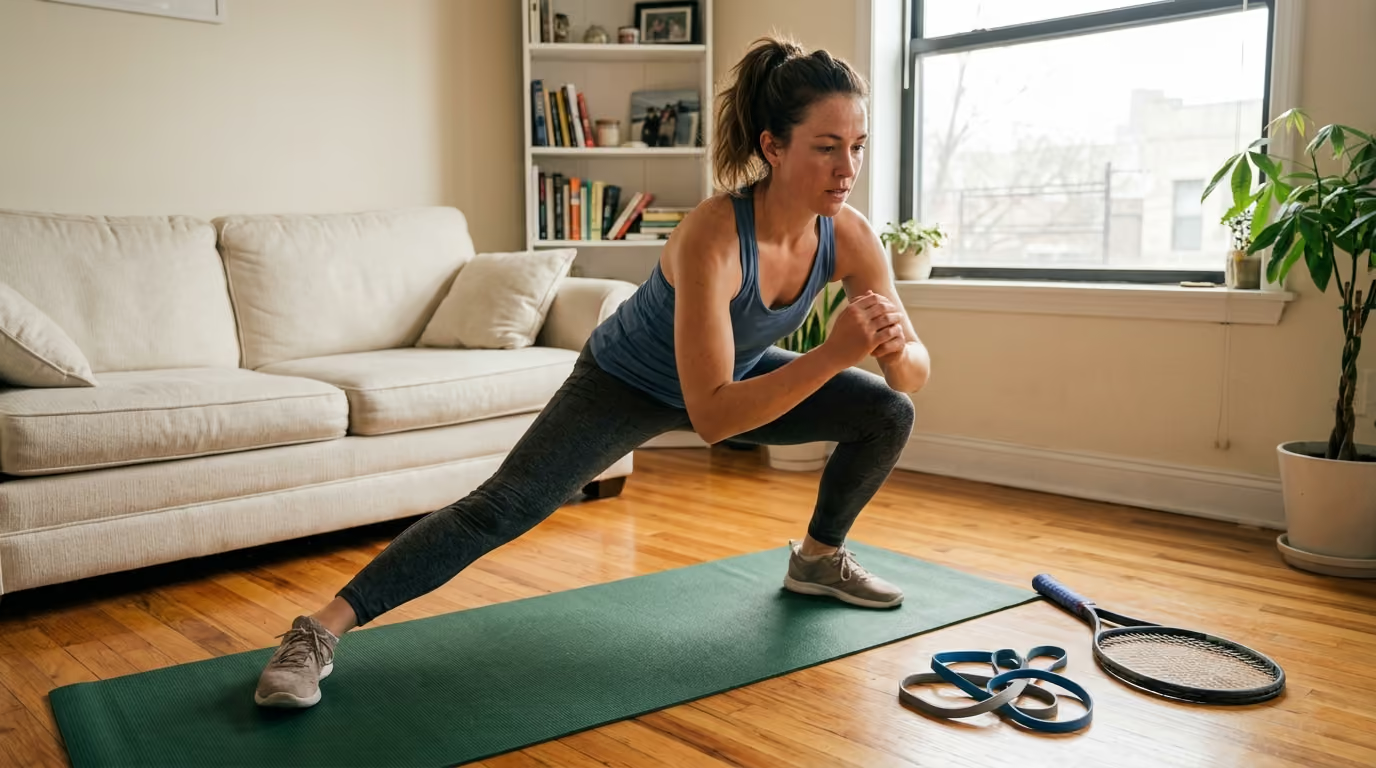
You can practice deceleration in small indoor spaces. Use step-and-stick patterns where you step forward or laterally and hold a balanced position. Perform slow, controlled lunges to marked targets on the floor. These drills should be done at a speed that allows for stable landings.
Balance is the ability to maintain your body position while stationary or moving. Proprioception is your awareness of your body in space. Health guidelines recommend that older adults perform balance training at least three days per week. Research shows that balance exercise programs can reduce the risk of falls and support functional capacity.
Mobility is your usable range of motion under control. Focus on ankle dorsiflexion, hip rotation, thoracic spine rotation, and shoulder health. Use active movements rather than aggressive, passive stretching. Keep your movements comfortable and avoid forcing painful ranges. These movement systems are crucial for maintaining athletic longevity as we age.
To make this practical, you need a flexible weekly routine. This routine should distribute the six qualities across different days. It must allow for sufficient recovery while keeping your physical systems active.
Below is a balanced weekly model designed for off-court fitness.
This schedule balances cardiovascular work, strength training, and movement control. You can adjust the intensity based on your fitness level.
Begin this session with a gentle warm-up. Perform each exercise with focus on form.
This session builds your recovery capacity. You can use a stationary bicycle, an elliptical machine, or an incline treadmill.
Perform these exercises in a clear space. Always keep a stable wall or countertop nearby for safety.
This session emphasizes lateral stability and fast muscle recruitment.
This session mimics the coordination of court play without the impact of hitting.
The physical demands of racquet sports are not identical. Tennis, pickleball, and padel place unique stresses on your body. Understanding these differences allows you to adapt your home program.
Tennis involves covering a larger court surface. This requires longer acceleration phases and higher-velocity running. The serve also places significant demands on your shoulder and spine.
When training off the court, tennis players should focus on hip extension and trunk rotation. Ensure you maintain shoulder mobility, specifically in external rotation. Use resistance bands to strengthen your rotator cuff. Add incline walking to your routine to build the stamina needed for long matches. You can find helpful preparation advice in our tennis movement guides.
Pickleball is played on a smaller court, but it requires rapid, short steps. Players spend a lot of time in a low, crouched stance near the non-volley zone. This requires excellent endurance in the quadriceps and glutes.
To stay fit for pickleball, focus on low-amplitude lateral movements. Side steps with resistance bands are highly beneficial. Work on deep knee-bend control with squats and wall sits. Reaction time and hand-eye coordination are also vital, so practice simple ball-tossing drills against a wall. For more tailored movement drills, visit our pickleball-specific training tips.
Padel involves a high volume of overhead shots and quick turns. The presence of walls means players must react to unexpected ball angles. This requires constant rotational changes and rapid lunging.
Padel players should prioritize thoracic spine mobility and core rotational strength. Pallof presses and rotation stretches are excellent home choices. Lunges in multiple directions help prepare your hips for wall play. Focus on ankle stability to handle the constant changes in direction. Read more about court movement in our padel court strategies.
Applying these principles depends heavily on your specific situation. Reviewing common case patterns can help you tailor your off-court routine.
A recreational player cannot access outdoor courts for three months due to winter weather. This player has no injuries but wants to maintain baseline conditioning.
The priority for this player is preserving the aerobic engine and maintaining lower-body power. They should perform two strength sessions and two aerobic interval sessions each week. Once a week, they should include a shadow-court session to keep footwork patterns sharp. When returning to the court in the spring, they should start with shorter hitting sessions to let their tissues adapt.
A player experiences a sudden increase in work hours, limiting their court time. They are sitting for long periods and feel increasingly stiff.
According to health guidelines, replacing sedentary time with physical activity of any intensity provides health benefits. This player should focus on movement accumulation throughout the day. They can perform short mobility breaks every two hours. They should aim for two brief home strength sessions per week. On weekends, they can complete a longer brisk walk or cycling session to maintain aerobic capacity.
An older player wants to stay fit during a court closure but must avoid high-impact jumping and deep lunging.
This player should choose joint-friendly options recommended by health organizations. Stationary cycling is excellent for cardiovascular fitness without joint impact. They should perform supported sit-to-stands to maintain leg strength. Single-leg balance training should be done near a sturdy countertop for safety. They should progress gradually and modify exercises if joint discomfort increases. You can find more support for managing these changes in our healthy aging and athletic longevity tips.
An athlete is recovering from a mild shoulder strain and cannot perform serves or overhead hits.
This player can still train their lower body and cardiorespiratory system. They should focus on walking, cycling, and lower-body strength exercises. They can perform core training and single-leg balance work. They must avoid exercises that provoke shoulder pain. They should follow their clinician's guidance for specific shoulder rehabilitation.
A competitive player takes a two-week vacation with no access to a court.
Research shows that a two-week break can reduce repeated-sprint performance. This player should perform short, high-intensity intervals on a stationary bicycle to preserve anaerobic power. They should include bodyweight strength circuits to maintain muscle activation. Upon returning, they should spend the first few sessions on technical hitting before playing competitive matches.
Many players make predictable mistakes when they cannot play on the court. These errors can lead to injuries or poor conditioning. By recognizing these pitfalls, you can keep your training productive.
Many players replace court time with long, slow jogs or bike rides. While this supports general health, it does not prepare you for court movement. Steady cardio neglects the deceleration, lateral movement, and strength required for racquet sports.
Correction: Combine your aerobic sessions with at least two weekly strength sessions. Include short movement control drills to keep your footwork sharp.
Some players try to recreate court fatigue by doing random, high-intensity workouts. These sessions often lead to excessive soreness or tendon irritation. They do not improve your movement quality.
Correction: Use structured intervals with planned rest periods. Focus on movement quality rather than training to exhaustion.
Players often practice moving fast but ignore how they stop. In court sports, most injuries occur during deceleration or sudden changes of direction. If you only practice accelerating, you are missing half of the equation.
Correction: Include "step-and-stick" drills in your home routine. Practice landing softly and holding your balance for two seconds.
Attempting single-leg exercises on unstable surfaces or near hazards is risky. A fall at home can set your play back far longer than a weather delay.
Correction: Perform balance exercises on a flat, solid floor. Always keep a sturdy chair or countertop within arm's reach.
When the break ends, players often jump straight into competitive matches. They expect their bodies to handle the same intensity as before the break. This sudden increase in load is a primary cause of muscle strains and tendon pain.
Correction: Return to play gradually. Start with shorter hitting sessions and limit your competitive matches in the first week back.
An off-court break can be an excellent time to focus on recovery. It allows your joints and tendons to rest from the high impact of court play. However, you must still manage your overall recovery during this period.
According to the Centers for Disease Control and Prevention, low-impact activities place less stress on the body. They reduce physical loading and protect your joints. Activities like walking, cycling, and swimming are joint-friendly and support healthy aging.
If you are experiencing mild joint stiffness, do not stop moving entirely. The CDC recommends starting with small amounts of low-impact activity. You should progress gradually and modify your exercises if your symptoms increase. Choosing safe environments is key to maintaining consistency.
Your tendons require consistent loading to stay healthy. Complete rest can actually make tendons more sensitive to load when you return. Performing controlled, low-impact strength work keeps your tendons resilient. This is why a structured home routine is far better than total inactivity.
You do not need a sports science laboratory to track your fitness off the court. Simple, repeatable self-tests can help you monitor your progress. These tests are not diagnostic tools, but they offer useful feedback.
Find a standardized indoor step or use a stationary exercise bicycle. Measure your heart rate after three minutes of steady, moderate stepping or cycling. Sit quietly and measure how much your heart rate drops in one minute. A faster recovery indicates a more efficient aerobic system.
Use a standard kitchen chair for the sit-to-stand test. Count how many times you can stand up and sit down in 30 seconds. Keep your arms crossed over your chest. Track this number over time to ensure your lower-body strength is preserved.
Stand near a wall for safety and lift one foot off the floor. Time how long you can maintain your balance without touching the wall or moving your standing foot. Aim for 30 seconds on each side. If you notice a major difference between your left and right leg, focus more on the weaker side.
Perform a lateral step-and-stick test. Step quickly to the side, land on one foot, and hold your balance for three seconds. Observe whether your knee buckles inward or your torso tilts excessively. Consistent practice should make this landing feel stable and effortless.
While a home exercise program is highly beneficial, it is not a substitute for medical care. You must pay attention to how your body responds to exercise. If you are returning from an injury, your training must be guided by a professional.
The return-to-sport consensus literature shows that recovery is a graded continuum. It is not a simple yes or no decision. It involves assessing your symptoms, range of motion, strength, and confidence.
Consult a qualified healthcare provider if you experience any of the following warning signs:
A healthcare professional can provide a personalized diagnosis and treatment plan. This ensures you can return to your favorite racquet sports safely and enjoy them for years to come. If you have questions about our resources, feel free to visit our contact page.
An off-court break does not have to stall your progress or diminish your enjoyment of your sport. By applying these structured, research-backed strategies, you can protect your movement quality and keep your athletic longevity intact.
Follow Evercourts for practical insights on tennis, pickleball and padel performance, movement, recovery and healthy ageing. Stay connected for new articles, research-led guidance and ideas to help you play well and keep playing for years.


Read practical guidance for better movement, smarter preparation and a game that keeps working for you.
explore the Blog