
Recovery monitoring for athletes involves tracking subjective signals like session intensity, sleep quality, and muscle soreness to gauge readiness and prevent injuries.




Recovery monitoring is not about buying the latest electronic tracker or staring at a sleep score on a smartphone screen. True recovery management is a practical system of checking how your body responds to the physical demands of court play. It is an active decision-making process that helps you balance the stress of training with your body's natural capacity to adapt and perform.
By tracking a few simple signals, you can remove the guesswork from your weekly schedule. This manual provides a low-tech framework to measure your readiness, adjust your court sessions, and protect your physical health over time.
You can monitor recovery accurately by tracking five subjective signals every day: session intensity, sleep quality, muscle soreness, psychological stress, and warm-up performance quality. When you record these metrics consistently, they provide a sensitive measure of your internal physical state. This simple approach allows you to adjust your training schedule and prevent overuse injuries without using expensive or complicated tracking technology.
A low-cost tracking system relies on understanding the relationship between the work you perform on the court and how your body reacts to that work. By logging your physical and mental responses, you gain a clear picture of your readiness for the next match.
Many court athletes believe they need high-tech sensors to understand their physical state. However, sports science research shows that your own subjective feedback is often more accurate than data from a wearable device.
A comprehensive review published in the British Journal of Sports Medicine examined subjective and objective measures of athlete well-being. The researchers analyzed data across multiple sports to see which indicators responded best to changes in training load. They found that self-reported well-being measures reflected training load with greater sensitivity and consistency than objective measures.
When athletes faced sudden increases in training volume, their subjective scores for fatigue, sleep quality, and muscle soreness dropped immediately. Conversely, when training loads were reduced, these subjective scores improved predictably. Objective markers, such as heart rate and blood markers, often remained unchanged or showed inconsistent patterns. This means your personal rating of how you feel is a highly reliable indicator of your physical limits.
To monitor recovery properly, you must distinguish between external load and internal load. This distinction is a cornerstone of modern sports science. A consensus statement on athlete monitoring from the International Journal of Sports Physiology and Performance defines external load as the physical work you perform during a session. This includes match duration, miles run, or the number of balls hit.
In contrast, internal load represents the physiological and psychological stress your body experiences as a result of that work. Common internal-load measures include heart rate, lactate levels, and perceived exertion. Two players can complete the exact same external workout but experience completely different internal loads. A player who is recovering from poor sleep or dealing with high work stress will experience a much higher internal load than a well-rested player.
One of the most validated tools for measuring internal load is the Session Rating of Perceived Exertion, or session RPE. Developed by sports scientists, this method requires you to rate the intensity of an entire session on a scale from 1 to 10. You then multiply this rating by the duration of the session in minutes.
Research published in the Journal of Strength and Conditioning Research has shown that session RPE is a highly reliable tool. A review of 36 studies confirmed its validity across different sports, ages, and fitness levels. The researchers found strong correlations between session RPE scores and complex heart-rate monitoring data. This simple calculation gives you an accurate measurement of your training load without requiring any heart-rate monitors.
In recent years, some coaches have promoted the acute-to-chronic workload ratio as a precise tool to predict injury. This ratio compares your training load over the last seven days to your average load over the past 28 days. While the concept of avoiding sudden spikes in training is useful, sports scientists warn against treating this ratio as a perfect formula.
A systematic review of workload studies found that while sudden spikes in training load are associated with injury risk, there is no single safe threshold. A separate methodological critique highlighted conceptual problems and noise in these calculations. Therefore, you should use workload trends as a general guide rather than a strict rule. If your weekly playing time suddenly doubles, you should simply pay closer attention to your recovery signals.
Sleep is one of your most powerful recovery assets, and the scientific evidence of its impact is clear. A systematic review and meta-analysis examined how sleep loss affects athletic performance across various physical domains. The analysis revealed significant declines in endurance, explosive power, maximum strength, and movement speed after sleep loss. Additionally, sleep-deprived athletes reported a much higher rating of perceived exertion during exercise.
Sleep loss also impairs your mental focus and decision-making on the court. A review on sleep and cognitive performance in sports reported that sleep restriction leads to slower reaction times, reduced accuracy, and poorer tactical judgment. For a tennis, pickleball, or padel player, this means a lack of sleep will directly hurt your shot selection and court coverage.
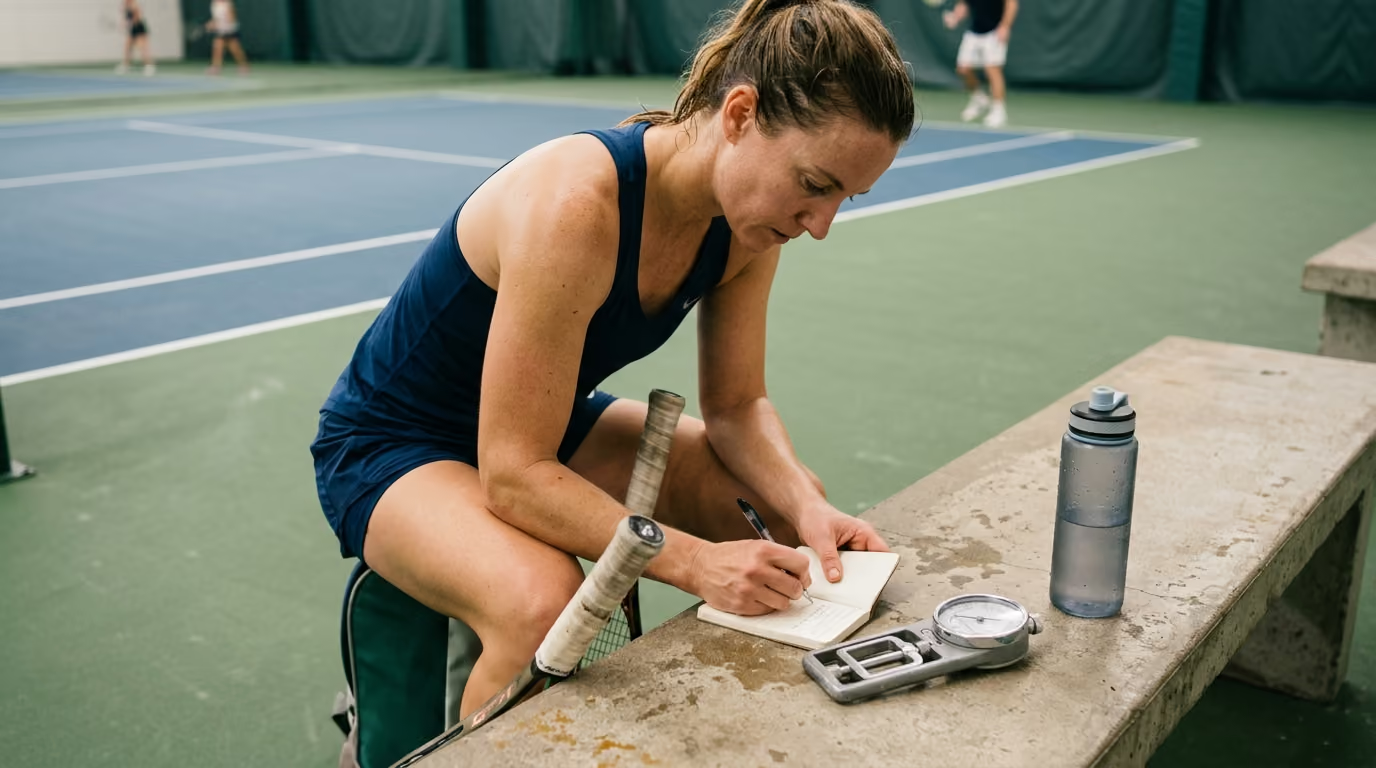
To apply these scientific principles on the court, you need a structured method to track your daily signals. This system does not require spreadsheets or apps. A simple notebook kept in your gear bag is all you need to record your metrics.
Every morning, take two minutes to rate the following five metrics on a scale of 1 to 5. Consistent tracking is key to finding your personal baseline.
After every practice session or match, wait about 15 to 30 minutes. This delay prevents your rating from being influenced by how you felt during the very last point of the session. Rate the intensity of the entire session using the Borg Category-Ratio 10 scale:
Once you have your rating, multiply it by the total duration of the session in minutes. This gives you your session load in arbitrary units.
For example, if you play a moderately intense singles match for 90 minutes and rate the intensity as a 6, your calculation is:
90 minutes x 6 RPE = 540 load units
If you practice light serves and returns for 45 minutes and rate it as a 3, your calculation is:
45 minutes x 3 RPE = 135 load units
Record this number in your notebook after every session. Over time, you will see how different match formats and training drills affect your total load.
To make this data actionable, use a simple traffic-light system to determine your training plan for the day. This step ensures you match your physical demands to your actual readiness.
To learn more about optimizing your recovery during the critical hours after play, read our guide on recovery science resources.
While the five-signal recovery model works for all court athletes, the specific physical demands of each sport require different monitoring priorities. Understanding these differences helps you identify where fatigue is likely to accumulate.
Tennis involves long matches with unpredictable durations, played on hard, unforgiving court surfaces. The sport requires significant rotational power for groundstrokes and puts high vertical loads on your joints during the serve.
When monitoring recovery for tennis, your primary physical signals will be rotational core soreness, shoulder fatigue, and lower-back stiffness. The high impact of hard courts also causes systemic lower-limb fatigue. A three-hour singles tennis match can produce exceptionally high session RPE scores. This requires you to prioritize sleep and hydration to restore muscle glycogen and repair tissue damage.
Pickleball is played on a smaller court, which reduces the total distance you run. However, the game requires rapid, constant acceleration and deceleration. The low bounce of the ball forces players into deep lunges and low crouches near the kitchen line.
For pickleball players, recovery monitoring should focus heavily on the lower kinetic chain. You must pay close attention to soreness in the calves, Achilles tendons, and knees. The rapid paddle movements also place high repetitive stress on the elbow and wrist. If you notice your reaction times slowing during your warm-up, it is a clear sign that your central nervous system is fatigued from fast-paced dink rallies.
Padel is a fast-paced game played on a synthetic turf surface with glass walls. The sport involves constant changes of direction, frequent overhead smash attempts, and rapid transitions from defending to attacking.
Our team has noted that padel players suffer from high overhead shoulder fatigue and lower-back strain due to the frequent bending and twisting required to play balls off the glass. On a personal note, I remember finishing a tough two hour padel match on a cold Tuesday night and waking up the next morning feeling like my lower back was locked in concrete. For a long time, I just accepted this as the price of playing hard in my forties. But once I started spending just ten minutes on targeted hip mobility before heading to the club, the stiffness almost completely vanished. It taught me that we do not have to accept pain as a default state of aging.
By combining recovery tracking with targeted mobility and movement resources, court athletes can enjoy their sport for years without chronic stiffness.
Many dedicated court players make simple mistakes when trying to manage their recovery. These errors can lead to chronic fatigue, plateaus in performance, and avoidable injuries.
The most common error is treating normal training soreness and structural pain as the same signal. Delayed onset muscle soreness is a normal response to challenging physical work. It is usually diffuse, symmetrical, and improves once you warm up.
Focal pain, however, is localized to a specific tendon, joint, or muscle group. It is often one-sided and worsens as you continue to play. If you ignore localized pain because your overall wellness score is high, you risk turning a minor strain into a chronic injury. This mistake directly threatens your long-term athletic longevity.
Many players use smart rings or sports watches that generate a daily recovery percentage. These devices use algorithms based on heart rate variability and sleep movement. While this data can be interesting, it is not infallible.
In our experience, players often feel great but choose to skip a fun match because their watch gave them a low recovery score. Conversely, some players ignore deep muscle soreness and high mental fatigue because their device claimed they were fully recovered. You should always trust your physical sensations and warm-up quality over any algorithm.
Your body does not separate the physical stress of a tennis match from the mental stress of a difficult work week. High psychological stress raises your resting heart rate, increases muscle tension, and impairs your sleep quality.
When you ignore non-training stress, you underestimate your total internal load. This oversight can lead to a state of non-functional overreaching, where your performance drops and your susceptibility to illness increases. By including a simple stress rating in your daily check, you can protect your health and support healthy aging and athletic longevity resources.
To learn more about protecting your joints and muscles as you age, explore our dedicated injury prevention resources.
A recovery monitoring system is designed to guide your daily training choices. It is not a diagnostic tool and should never replace professional medical advice.
You should consult a physical therapist, athletic trainer, or physician if you experience any of the following warning signs:
For more information on finding balanced coaching advice and injury prevention strategies, visit the Evercourts homepage.
A single night of short sleep will not ruin your fitness or cause an immediate injury. If you must play the next day, extend your warm-up to ensure your joints are lubricated and your nervous system is awake. Focus on matching your training load to your current state by choosing a low-intensity practice rather than a demanding competitive match. Prioritize an afternoon nap or an earlier bedtime the following night to pay back your sleep debt.
Yes, this system is highly beneficial for recreational players who only play two or three times a week. Tracking your wellness signals on your non-playing days helps you identify how long it takes your body to recover from a hard match. If you notice that your muscle soreness lasts for three days after a singles match, it suggests you need to improve your physical conditioning or adjust your post-match nutrition.
Your rating is subjective, so there is no single correct answer. The key is consistency within your own scale. Do not worry about what your playing partner would rate the session. If a practice felt like a 7 to you, then it was a 7. Over a few weeks of tracking, your ratings will naturally calibrate, allowing you to see clear patterns in your physical response to different court activities.
Follow Evercourts for practical insights on tennis, pickleball and padel performance, movement, recovery and healthy ageing. Stay connected for new articles, research-led guidance and ideas to help you play well and keep playing for years.


Read practical guidance for better movement, smarter preparation and a game that keeps working for you.
explore the Blog