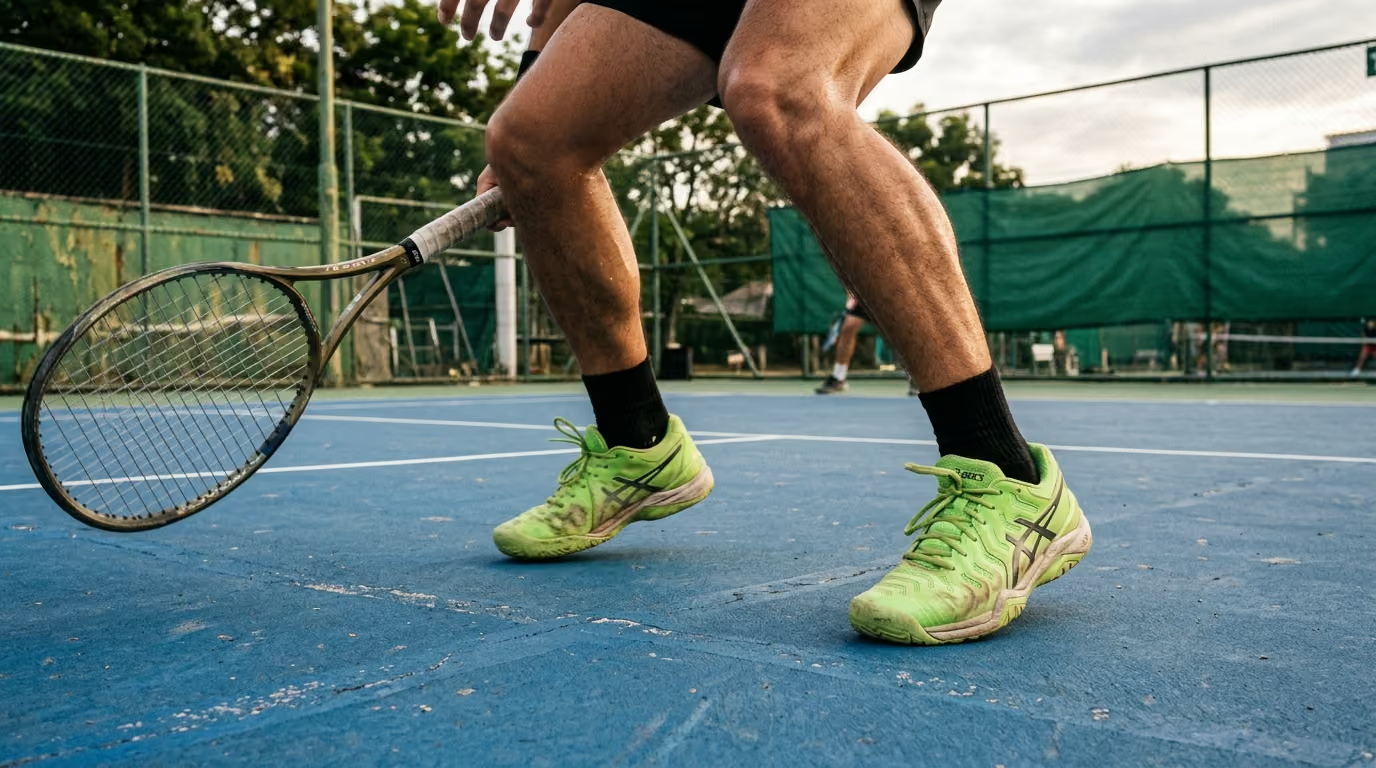
Five tactical levers can be adjusted on nearly every shot of a rally to dismantle a physically superior athlete in racquet sports.




When you step onto the court against an opponent who is faster, stronger, and more explosive, it is easy to feel defeated before the first ball is served. Many players try to match this athleticism by running faster, hitting harder, and taking riskier shots. This approach usually leads to rapid fatigue, high error rates, and quick defeats.
To defeat a physically superior opponent, you must refuse to compete with their greatest athletic advantages. Instead, you must manipulate the time, space, rhythm, targets, and point length of the match to force a decision-making contest rather than a physical track meet. By shifting the battlefield from raw physical execution to tactical problem-solving, you can neutralize athletic dominance and dictate the terms of play.
This comprehensive playbook is designed to help adult recreational and competitive racquet sports players achieve athletic longevity. We will break down the tactical concepts that allow you to compete intellectually and systematically. These strategies apply directly whether you are trying to improve your performance on the court or searching for practical ways to manage your physical resources during competition.
An athletic opponent has many physical weapons. They may reach your best shots easily due to superior foot speed. They might overpower you with heavy groundstrokes, or they may possess a deep reserve of endurance.
Trying to beat this player at their own high-tempo game is a losing proposition. Your primary goal is to alter the conditions under which their physical variables matter. If you can make them hesitate, change directions unexpectedly, or hit from uncomfortable body positions, their raw athleticism loses its utility.
To do this, we look at the game through a strategic framework that prioritizes control over power. We must understand how to manipulate the environment of the match. When we shift the focus toward structured variation, the superior athlete is forced to think rather than react. This transition is essential for players prioritizing healthy aging and athletic longevity resources to keep playing for decades.
In our experience, players who rely solely on physical exertion eventually run into a wall against younger or more explosive opponents. Our team has observed that the most successful veteran players rely on tactical maturity. They view the court as a series of geometry problems rather than a test of physical strength.
To dismantle a physically superior athlete, you must master five primary variables. You can adjust these five levers on nearly every shot of the rally.
Time is the amount of preparation and reaction time available to either player on the court. You can change time by striking the ball earlier on the rise, using flat trajectories, or utilizing higher, deeper defensive shots.
Against a fast opponent, your goal is to deny them preparation time. By taking the ball early, you force them to react before they can fully recover their court position.
Against a powerful opponent, your goal is often the opposite. You must absorb their pace by using high-margin shots that give you sufficient recovery time.
Understanding when to take time away and when to grant yourself time is the foundation of court management. Defensive height creates safety, while early contact creates pressure.
Space refers to the opponent’s available court area and the distance they must travel to make their next contact. You can manipulate space by hitting with wide angles, deep targets, or short drop shots.
However, aiming for the wide open court is not always the best option against a fast runner. Hitting directly at their body, hip, or shoulder can be much more effective.
A ball directed behind a moving opponent is also highly disruptive. This tactic forces them to stop their momentum, turn, and hit from an unbalanced stance.
Controlling space means understanding recovery patterns. You should target the space they are vacating rather than simply the space that is currently empty.
Rhythm is the expected pattern of speed, height, bounce, and spin within a rally. A physically gifted player is highly comfortable when they receive predictable balls at a constant height and pace.
Disrupting this rhythm requires structured unpredictability. You can alternate between heavy topspin and low slices.
You can mix high, deep lob-style shots with sudden short angles. This variance prevents the athlete from timing their movements perfectly.
Rhythm disruption is not random hitting. It is a deliberate strategy where you understand the purpose of each change while keeping your opponent guessing.
A target is the specific zone where you intend the ball to land to achieve a particular tactical goal. You should classify your targets by their intended purpose during the rally.
Neutralizing targets are high-percentage areas, such as deep down the middle, that prevent your opponent from attacking. Movement targets are designed to make your opponent run.
Contact-quality targets focus on the opponent's body or feet to make clean contact difficult. Finishing targets are used only after you have successfully displaced your opponent.
By choosing your target based on the state of the rally, you avoid donating cheap unforced errors. You make your opponent work hard for every point.
Point length is the number of shots exchanged in a single rally. You can treat this as a tactical variable that you can actively influence.
If your opponent is much fitter and possesses superior endurance, you may want to shorten points using first-strike tactics. If your opponent is impatient or has technical flaws, extending the rally can expose those weaknesses.
A mixed distribution of point lengths is often the most effective approach. This keeps the opponent from settling into a comfortable physical groove.
By controlling the length of the points, you manage your own physical energy. This is a critical component of match play as we age.
Before you play a match, you should map out the physical and technical profile of both players. This prevents you from playing a reactive game.
To map the matchup, compare yourself and your opponent across six physical and technical dimensions. This helps you identify where to direct your tactical focus.
During the warm-up and the first three games of a match, perform a quick diagnostic test of your opponent. This helps you gather actionable tactical data.
First, test their movement. Hit one ball deep, then one ball short, and notice how quickly they change directions.
Second, test their contact quality. Observe which height, spin, or body location produces their weakest return.
Third, test their decision-making. Observe whether they become impatient under pressure, or if they continue to make smart choices when they are tired.
To apply these findings, use the classic four-step movement cycle on every shot. This structured approach helps you stay calm and position yourself optimally.
First, read the opponent’s balance, racket preparation, and contact point. This tells you where the ball is going before it crosses the net.
Second, respond by selecting your tactical intention. Decide whether to neutralize, attack, or defend based on your reading.
Third, react by executing your stroke smoothly while adapting to the incoming ball. Ensure you maintain a high margin of safety.
Fourth, recover immediately to a position that protects your court. Remember that recovery is an active part of the stroke cycle, not a separate action.
To understand why these tactical adjustments work, we can look at data from sports science and elite match analysis. The numbers show that physical dominance can be neutralized by smart play.
In a detailed analysis of elite tennis matches at Wimbledon, researchers Fitzpatrick, Stone, Choppin, and Kelley studied the relationship between rally length and winning. They analyzed data from 211 men's matches and 209 women's matches between 2015 and 2017.
Their research revealed that points lasting between zero and four shots accounted for approximately 66% of women’s points and 72% of men's points. Players who won more points in this short-rally category won the match in roughly 90% of cases.
However, this does not mean that every player should immediately attempt to hit winners on the first shot. This finding describes elite grass-court tennis, where serve and return patterns dominate.
On slower surfaces or in other racquet sports, extending the rally can be highly effective. A study of four Grand Slam tournaments found that medium and long rallies were won at higher percentages than short rallies under certain conditions. This demonstrates that rally length must be adapted to your specific match context.
In squash research, analysts compared the distance covered by winners and losers during rallies. The study showed that in short, very short, and medium rallies, the losers covered significantly more distance than the winners.
In contrast, long rallies showed much smaller differences in movement distance. The researchers concluded that winners controlled the court geometry early. They forced the losers to move more during the critical phases of the rally.
This principle translates directly to tennis, pickleball, and padel. Your goal is not to run less at all costs. Your goal is to make your opponent run farther and harder than you do.
A systematic review of research on attentional focus in racquet sports analyzed how players direct their minds. The research compared an internal focus on body parts to an external focus on targets or ball flight.
The review found that external-focus strategies consistently improved motor-skill learning and movement efficiency. This was particularly true for recreational and intermediate players.
Directing your attention to the target or the ball trajectory reduces muscular tension. It allows you to execute smooth, efficient strokes under physical pressure.
Fatigue research shows that physical tiredness does not just make you slower. It actively degrades your technical execution and decision-making.
Fatigue is associated with reduced stroke efficiency, lower first-serve velocity, and a higher rate of unforced errors. It also slows down footwork patterns, leaving players unable to reach balls they easily returned earlier.
By forcing a superior athlete to run and make complex decisions, you accelerate their physical and mental fatigue. This levels the playing field as the match progresses.
To develop these skills, you must practice them under realistic conditions. Isolated technical drills are rarely sufficient to build tactical intelligence. We recommend using a game-based approach that mimics the pressures of real competition.
For players looking to structured training methods, our court performance resources offer excellent frameworks. These practice games help you learn how to manipulate the five tactical levers automatically.
Constraint-based training involves altering the rules of practice games to force you to discover tactical solutions. This method helps you focus on external cues.
These structured drills are designed to build specific tactical habits that you can use against superior athletes.
Play points where you only record and score the first three contacts of the rally. The server must focus on hitting a high-percentage body serve. The returner must focus on hitting a deep, central return to neutralize the point. The server’s next shot must be directed either to the open court or behind the returner's recovery. This drill teaches both players how to establish early control of the rally.
In this drill, you can only win a point if you force your opponent to change directions at least twice before the rally ends. This prevents you from hitting low-percentage winners on the first shot. It teaches you how to build a point systematically. You learn to move your opponent laterally and vertically before looking for a finishing target.
Start the point with the underdog player in a highly defensive position. The defender's only goal is to hit a high-margin, deep ball to reset the point. The defender wins the point if they can successfully hit three consecutive neutralizing shots. This drill builds mental resilience and teaches you how to defend with margin.
When you face specific types of athletic opponents, you need a concrete tactical plan. Here are five practical matchup patterns designed to neutralize distinct physical advantages.
The faster counterpuncher is exceptionally quick, loves to retrieve balls from deep positions, and rarely misses when balanced. They rely on your impatience to win points.
Your plan is to target their body and hip early in the point to restrict their swing. Avoid hitting predictable crosscourt patterns, which allows them to run in a comfortable rhythm.
Instead, use deep balls directed behind their recovery path. Make them stop and start their momentum before you attempt to open up the court.
Only attack the open space once you have forced a short, unbalanced reply. Your key metric is how often you make them hit while changing directions.
The tall, powerful player dominates with a strong serve, a high contact point, and explosive groundstrokes. They are highly dangerous when allowed to strike balls between waist and shoulder height.
Your plan is to target their feet, hips, and low contact zones to force them to bend. Use low, dipping slice trajectories that make them hit the ball from below the net.
When returning their serve, direct your balls deep and through the center of the court to eliminate their angles. Use defensive lobs selectively when they approach the net, especially if they are moving forward quickly.
Your key metric is how often you force them to strike the ball from below knee height. This removes their ability to generate heavy downward power.
The younger, high-energy opponent plays at an exceptionally high tempo, loves physical exchanges, and thrives on momentum. They want to make the match a test of endurance.
Your plan is to vary the tempo of every exchange to break their physical rhythm. Use high, slow balls followed by low, skidding slices to test their patience.
Avoid engaging in emotional contests or trying to match their explosive energy after a long rally. Maintain a calm, deliberate pace between points within the rules.
Your key metric is whether their error rate increases during extended decision sequences. Make them solve complex tactical problems rather than simple physical ones.
The consistent opponent has a very low unforced error rate, excellent rally tolerance, and few obvious technical flaws. They wait for you to make a mistake.
Your plan is to avoid donating cheap errors by trying to hit spectacular winners. Instead, attack their movement and decision-making by changing the direction of the ball early in the rally.
Use deep, high-margin shots to push them back, then bring them forward with a short slice or drop shot. Create physical pressure through depth and court position rather than raw speed.
Your key metric is how many forced errors you can induce through smart positioning. You must accept that winning points against this player will require multiple tactical phases.
The superior server dominates the match with their first serve and immediate first-strike attacks. They win easy points and build quick momentum.
Your plan is to treat first-serve returns as damage limitation and second-serve returns as your primary opportunity. For more ideas on how to manage these situations, see our guide to serve returns in racquet sports on the main blog.
According to data from elite men's tennis, first-serve effectiveness averages around 69% on clay and 75% on grass. In contrast, second-serve effectiveness drops to around 55% across all surfaces.
Use a compact swing and a deep, central target to block first-serve returns back safely. On second serves, take a more aggressive position to pressure their next contact.
While the core principles of time, space, and rhythm apply to all racquet sports, their physical application differs based on the rules, court dimensions, and equipment of each sport. For sport-specific guides, you can visit our dedicated pages for tennis articles, pickleball articles, and padel articles.
Tennis is played on a large court with a heavy, pressurized ball that bounces high. This environment rewards baseline depth, explosive lateral movement, and serve dominance.
Against a superior athlete in tennis, you must use court depth to protect yourself. Use high topspin to push your opponent behind the baseline, which gives you more time to recover.
Slices are highly effective in tennis because they keep the bounce low. This forces tall or fast players to bend and lift the ball.
The serve and return are the most critical phases for establishing control. If you can neutralize the serve, you can prevent the superior athlete from dominating the point early.
Pickleball is played on a compact court with a non-pressurized plastic ball and solid paddles. The presence of the non-volley zone, or kitchen, creates a unique physical dynamic.
In pickleball, raw power is easily neutralized by smart positioning at the kitchen line. If you face a fast, hard-hitting opponent, use soft dinks to keep the ball low in the kitchen.
This forces them to hit upward, which allows you to attack their next shot. Avoid getting into fast hand-speed battles at the net unless you have a clear tactical advantage.
Use deep, looping return shots to keep the serving team pinned to the baseline. This gives you time to establish your position at the net first.
Padel is played in an enclosed glass court where the ball can be played off the walls. This feature completely changes the value of raw speed and power.
If a powerful opponent hits a heavy smash, you can let the ball pass you and play it easily off the back glass. The glass acts as a natural equalizer for speed.
Against a faster opponent in padel, the lob is your most important defensive and offensive weapon. A high, deep lob forces your opponents off the net and allows you to transition forward.
Use slow, dipping shots to the opponent's feet as they transition from the back of the court to the net. This forces them to volley upward from an uncomfortable position.
Even when players understand these concepts, they often fall back into bad habits under the pressure of competition. Recognizing these common pitfalls is the first step toward avoiding them.
This is the most common mistake made by competitive players. When an opponent hits a fast ball, our natural instinct is to hit the next ball even harder.
Accepting this high-speed, high-intensity exchange plays directly into the superior athlete’s strengths. You must have the discipline to slow the ball down, increase your net clearance, and reset the point.
Remember that you cannot run faster than a sprinter or hit harder than a powerhouse. You must win by making them play from uncomfortable positions.
Many players believe that playing aggressively means aiming close to the lines or hitting low-percentage winners. This approach simply donates free points to your opponent.
True tactical aggression means taking time away, attacking the body, or directing the ball behind your opponent’s recovery. It does not require you to take unnecessary risks.
You can play highly aggressive, pressure-inducing tennis while maintaining a wide margin of safety from the net and lines. Focus on forcing errors rather than hitting spectacular winners.
Using drop shots and short angles is an excellent way to move a fast opponent. However, executing these shots when your opponent is balanced and standing near the net is a recipe for disaster.
Short tactics only work when you have first forced your opponent deep or out of position with heavy depth. If they are balanced, they will reach the short ball easily and attack it.
Always use depth or body targeting to compromise your opponent's balance before you attempt to play a short ball. This timing is critical for success.
If you discover that your opponent has a weaker backhand, it is tempting to hit every single ball to that side. However, a good athlete will quickly adapt to this predictable pattern.
They will begin running around their backhand to hit forehands, or they will stand further over to protect that side. The target is no longer a weakness if it becomes completely predictable.
To exploit a weakness, you must first open up the court by hitting to their strong side. This forces them to move and exposes the weak stroke under physical pressure.
Understanding the physical demands of playing against a superior athlete is essential for maintaining your physical capabilities over time. When you play smarter, you change the physiological load on your body.
Tactical play reduces the number of maximum-effort sprints you must make during a match. By using high-margin depth and smart recovery positions, you prevent yourself from being pulled into extreme defensive scrambles. This helps minimize the micro-tears in muscle tissue that lead to severe post-match soreness.
However, playing a highly tactical game increases your cognitive load. You must constantly read your opponent, analyze patterns, and adjust your targets. This mental focus can lead to central nervous system fatigue, which requires structured recovery between sessions.
In our experience, managing your physical resources on the court is just as important as your off-court physical preparation. I remember finishing a tough two hour padel match on a cold Tuesday night and waking up the next morning feeling like my lower back was locked in concrete. For a long time, I just accepted this as the price of playing hard in my forties.
But once I started spending just ten minutes on targeted hip mobility before heading to the club, the stiffness almost completely vanished. It taught me that we do not have to accept pain as a default state of aging. Combining this physical preparation with smart tactical choices is the key to athletic longevity.
While tactical maturity can help you manage your physical resources, it cannot cure structural injuries or chronic pain. You must be able to distinguish between normal match fatigue and signs of physical damage.
If you experience sharp, localized pain during movement, swelling in your joints, or stiffness that does not improve after 48 hours of rest, you should consult a qualified healthcare provider. Do not attempt to play through pain or mask it with anti-inflammatory medications.
A certified sports physiotherapist or orthopedic specialist can help you identify movement limitations that may be contributing to your discomfort. They can design a targeted strength and mobility program to keep you playing safely for years to come.
To begin applying this tactical playbook to your own game, focus on these five actionable steps this week:
To learn more about our commitment to helping adult court athletes play better and move well, you can read more about Evercourts and our research-led guidance. If you have questions about specific strategic patterns or physical preparation, please feel free to contact us directly.
Follow Evercourts for practical insights on tennis, pickleball and padel performance, movement, recovery and healthy ageing. Stay connected for new articles, research-led guidance and ideas to help you play well and keep playing for years.


Read practical guidance for better movement, smarter preparation and a game that keeps working for you.
explore the Blog