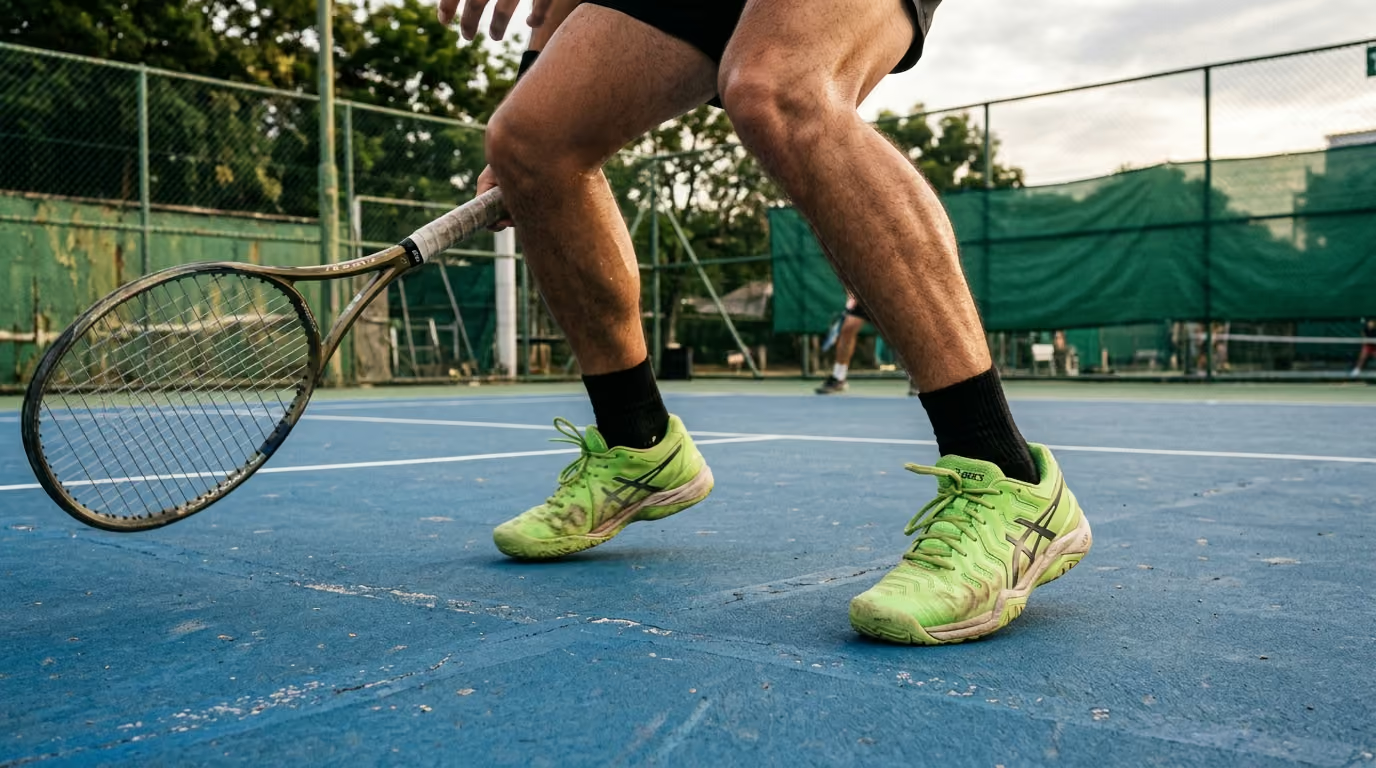
Maintaining speed and power in racquet sports as athletes age requires specific high-intensity training to preserve fast-twitch muscle fibers and neural efficiency.




Preserving physical performance on the court is not about chasing the raw capabilities of a teenager. It is about maintaining the specific movement qualities that keep you competitive, balanced, and durable as the years pass. True court speed is a combination of explosive force, efficient deceleration, and rapid reaction times. It is a trainable skill that you can protect and develop over time.
To maintain speed and power as you age, you must regularly challenge your muscles with high-intensity strength work, progressive plyometrics, and targeted acceleration drills. This approach ensures your nervous system continues to recruit fast-twitch muscle fibers, while structured deceleration training preserves your ability to stop and change direction safely. By focusing on movement quality and adequate recovery, you can maintain your athletic longevity and continue playing competitive racquet sports for years to come.
Many players believe that getting older means they must inevitably become slow and passive. While physiological changes do occur, a well-structured training program can significantly slow down these declines. By focusing on smart, court-specific preparation, you can keep your movement sharp and your joints comfortable.
As athletes age, their physical work capacity changes due to a variety of physiological shifts. The most notable change is the gradual loss of muscle mass, known as sarcopenia. This decline is not uniform across all muscle types. It primarily affects Type II, or fast-twitch, muscle fibers. These fibers are responsible for rapid, explosive movements like sprinting to a drop shot or jumping for an overhead.
Research on masters sprinters shows that sprint performance declines by approximately five to six percent per decade. This research, published in journals studying aging athletes, highlights that the loss of power is closely tied to a reduction in fast-twitch fiber size. Interestingly, the underlying contractile speed of the remaining muscle does not slow down significantly. Instead, the muscle simply loses its total capacity to produce high amounts of force in short timeframes.
Another major factor is the reduction in neural drive. Your brain communicates with your muscles via motor units. As you age, the recruitment of these motor units can become less efficient. The rate of force development, which is how quickly you can turn on your muscles, often declines faster than your maximum strength. This explains why an older player might still be able to squat a heavy load in the gym, but struggle to take a rapid first step on the clay or hard court.
Tendons also change with age. They tend to lose their natural elasticity and become more compliant or stiff in ways that reduce performance. A healthy, youthful tendon acts like a spring. It stores elastic energy during a split step and releases it to help you spring in a new direction. As tendon health changes, this stretch-shortening cycle becomes less effective. The athlete must rely more on active muscle contraction, which requires more energy and feels noticeably slower.
Physical activity alone is not enough to stop these changes. Studies comparing active older adults with sedentary individuals show that active people maintain much higher levels of function. However, even active individuals experience some power decline if they only play their sport. To protect your fast-twitch fibers, you must perform activities that specifically recruit them. Implementing a structured strength and conditioning program is the most effective way to protect your muscles and maintain your speed.
To train effectively, we must first break down what speed and power actually mean on the court. Court speed is not straight-line track speed. A tennis, pickleball, or padel player rarely sprints more than ten meters in a single direction. Instead, court speed is a collection of shorter, highly specialized physical qualities.
Maximum strength is the greatest amount of force your muscles can produce against a resistance. Relative strength is how strong you are compared to your body weight. If you have low relative strength, your body represents a heavy load that is difficult to move quickly. Building a strong foundation of maximum strength gives you a larger reservoir of force to draw from when you push off the ground.
Rate of force development is the speed at which you can express your strength. In racquet sports, you often have less than two-tenths of a second to make a movement decision and execute it. If you have excellent maximum strength but a slow rate of force development, you will feel sluggish on your first step. Training must include exercises that teach the body to produce force with explosive intent.
Deceleration is the ability to absorb force and bring your body to a controlled stop. In racquet sports, deceleration occurs constantly. You must sprint to a ball, stop your momentum to hit a stable shot, and then recover. Deceleration requires high levels of eccentric strength, where your muscles contract while they are lengthening. If your braking power is weak, your brain will limit your acceleration to protect your joints from damage.
Change-of-direction speed is the ability to alter your movement path in a pre-planned manner. Reactive agility adds a cognitive component, where you must change direction in response to a stimulus, such as an opponent's shot. For older athletes, maintaining reactive agility is essential. It requires a tight connection between your visual system, your brain, and your feet.
To train power safely as you age, you need a logical framework. You cannot jump directly into maximal sprints and deep jumps without preparation. A classic four-layer model provides a safe path for athletic longevity. Focusing on healthy aging and athletic longevity requires a shift from sheer training volume to movement quality.
The first layer focuses on preparing your tendons, muscles, and joints to handle high forces. This involves high-repetition, low-impact movements that build local endurance and improve blood flow. Key exercises include bodyweight lunges, calf raises, tibialis anterior raises, and simple balancing tasks. This layer creates a physical shield that protects you from injury during harder training.
Once your tissues are resilient, you can begin building your force-producing capacity. This layer utilizes progressive resistance training with heavier loads. Exercises like barbell squats, trap-bar deadlifts, and split squats are highly effective. You do not need to lift dangerous weights. Instead, use a weight that challenges you in the six to ten repetition range, performing each movement with perfect control.
The third layer introduces speed to your strength. Here, the focus shifts to moving moderate loads as fast as possible. You can use medicine balls, light resistance bands, or your own body weight. The goal is to move the load with maximum speed and explosive intent. Examples include light kettlebell swings, medicine ball slams, and low-amplitude vertical jumps.
The final layer translates your gym strength and velocity into actual court movements. This is where you practice split steps, short three-meter accelerations, crossover recovery steps, and open-stance hitting positions. These drills should be performed on a court surface whenever possible. They teach your nervous system how to use your new physical capacities during a match.
Below is an outline of how to organize these training qualities within a weekly schedule:
To preserve your explosive qualities, you must perform movements that require rapid coordination. Jumps and medicine ball throws are highly effective tools for older court athletes. They allow you to train power without the complexity of heavy barbell lifts.
Jumping, or plyometric training, is often feared by older athletes. However, a systematic review of plyometrics for older adults shows that these exercises are safe and highly effective when programmed correctly. You must progress from force absorption to force production.
Begin with snap-downs to train force absorption. Stand tall on your tiptoes with your arms reaching toward the ceiling. In one fast motion, pull your hips back, swing your arms down, and drop into a quarter-squat position, landing quietly with your feet flat. This teaches your muscles and tendons how to catch your body weight safely. Perform two sets of five repetitions, focusing on a silent and stable landing.
Once you can land with perfect balance, progress to low-amplitude bilateral jumps. Pogo hops are an excellent starting point. Keep your knees relatively stiff and bounce up and down using only your ankles and calves. Imagine you are jumping rope on a soft surface. This exercise builds elastic stiffness in your Achilles tendon, which is vital for a quick split step. Perform two sets of ten light bounces, resting fully between sets.
The next stage introduces lateral and single-leg movements. Skater bounds are highly specific to the side-to-side demands of racquet sports. Stand on your right leg, push off laterally to your left, land softly on your left leg, and hold your balance for two seconds. This movement strengthens your gluteus medius and prepares your ankles for lateral court changes. Keep the bounds short and focus on stability before trying to jump further.
Medicine ball throws are an exceptional way to build upper-body and rotational power. Unlike weightlifting, you can accelerate the ball through the entire movement and release it. This eliminates the need to slow down at the end of the range of motion, which protects your shoulder and elbow joints.
Start with the rotational scoop toss. Stand perpendicular to a solid concrete wall, holding a light medicine ball of four to six pounds. Hold the ball near your back hip, step forward with your lead foot, and swing your arms to toss the ball underhand against the wall. This drill teaches you to transfer force from your back leg, through your hips and core, and into your upper body. Perform three sets of five throws per side.
Progress to the split-step rotational throw. Stand facing the wall, perform a light split step, immediately step to the side, and throw the ball with a chest pass or rotational motion. This links your footwork directly to your upper-body power expression. Keep the ball light so that you can maintain high speed. If the ball feels heavy or slows you down, reduce the weight immediately.
Sprinting is the ultimate expression of human speed, but it carries risk if done incorrectly. For older court athletes, sprinting must be treated as a highly precise coordination drill rather than an exhausting conditioning tool. Your target is first-step quickness and acceleration, not building lactic acid.
Your sprint training should focus on distances of three to ten meters. This mirrors the actual demands of point play, where longer runs are rare. Before sprinting, always perform a thorough warm-up that includes walking lunges, high knees, and light skipping to prepare your hamstrings and calves.
A highly effective starting drill is the falling start. Stand with your feet together, lean forward from your ankles, and when you feel you are about to lose your balance, sprint forward for five meters. This lean naturally forces your body into an efficient acceleration angle. Perform three to five efforts, resting for a full minute between each sprint to ensure your nervous system recovers completely.
Once you master falling starts, progress to the lateral push-off sprint. Stand in a athletic court stance, push hard off your outside foot, and accelerate laterally for three meters before turning your hips to run forward for another three meters. This drill directly translates to recovering from a wide ball. Keep your focus on pushing the ground away from you rather than taking small, frantic steps.
Because high-intensity decelerations happen more frequently than accelerations in court sports, you must train your brakes. If you cannot stop, you cannot hit a balanced shot. For more specialized guidance on protecting your movement systems, check our injury prevention resources for court athletes.
Begin with the jog-to-stop drill. Jog forward at half-speed, and on a whistle or visual cue, bring yourself to a complete stop within three steps. Lower your hips as you stop, bend your knees, and keep your chest upright. Do not allow your knees to cave inward or your lower back to round excessively. This posture uses your large gluteal and quadricep muscles to absorb the impact rather than placing it on your knee joints.
Progress to the lateral shuffle-to-stick. Perform two fast lateral shuffles, and on the third step, plant your outside foot firmly and hold a deep, stable athletic stance for two seconds. This teaches your knee and ankle to handle lateral forces. It also strengthens your adductors and groin muscles, which are commonly strained during sudden changes of direction.
While all racquet sports share a need for speed, each sport has unique physical requirements. Understanding these differences allows you to customize your training to match the specific sport you play.
Tennis requires athletes to cover a larger court area compared to other racquet sports. Players must frequently sprint ten meters to track down deep groundstrokes or drop shots. To excel here, review our comprehensive tennis articles to refine your preparation.
Tennis players must focus on:
Your strength program should prioritize lateral lunges and heavy single-leg split squats to build the eccentric capacity needed to survive these wide, deep court runs.
Pickleball is played on a much smaller court, which dramatically reduces the need for long sprints. The physical demand shifts toward extremely quick reactions, short lateral adjustments, and maintaining a low, athletic crouch at the kitchen line. For practical tactical and physical tips, read our pickleball articles.
Pickleball players should focus on:
Your training should emphasize low-amplitude agility ladder work, lateral band walks, and holds in a deep squat position to build endurance in your thighs and hips.
Padel is played in an enclosed glass court, which introduces complex movement patterns. Players must move forward, backward, diagonally, and jump to hit overhead shots like the smash, vibora, or bandeja. To understand these dynamic movement systems, browse our collection of padel articles.
Padel players must focus on:
Include overhead medicine ball stomps and backward-moving diagonal agility drills in your weekly plan to meet these unique spatial demands.
When training for speed, older players often fall into predictable patterns that limit their progress or cause unnecessary wear and tear. Avoiding these mistakes is crucial for your long-term success.
Many players believe that to get faster, they need to run long distances or do high-repetition circuit training. This is a mistake. Long, slow cardio trains your slow-twitch muscle fibers and can actually decrease your explosive power. Speed is trained when you are fully rested. If you are breathing heavily and sweating profusely during a speed drill, you are training endurance, not power. Keep your sprints short and your rest periods long.
Some older players avoid lifting heavy weights because they fear injury. However, research shows that progressive resistance training with meaningful loads is highly safe and effective for older adults. If you only lift light weights for high repetitions, you will not recruit your fast-twitch motor units. You must safely challenge your muscles with weights that feel heavy to trigger the hormonal and neurological adaptations required to preserve your power.
Performing high volumes of jumping without proper landing mechanics is a recipe for tendon and joint irritation. More is not better when it comes to plyometrics. A few high-quality, quiet landings will train your nervous system far better than fifty noisy, uncontrolled jumps. Always prioritize the quality of the movement over the quantity.
Your choice of footwear and the surface you train on have a massive impact on the forces transmitted through your joints. Training on concrete in worn-out running shoes can cause joint pain. Always wear court-specific shoes that offer lateral support and proper grip. If possible, perform your speed and plyometric training on grass, clay, or a wooden court surface to reduce joint impact.
Power training is highly demanding on your central nervous system and your connective tissues. As you age, your recovery systems operate more slowly. This means you must manage your training load with high precision to avoid chronic fatigue or overuse injuries.
High-intensity training sessions should always be followed by forty-eight to seventy-two hours of lighter activity or rest. If you perform heavy deadlifts on Monday, do not perform intensive plyometrics or play a competitive match on Tuesday. Your tendons and nervous system require more time to recover than your muscle tissue. Spacing your hard sessions out allows your body to adapt and grow stronger rather than breaking down over time.
For an extensive collection of recovery advice, visit our dedicated recovery science resources. You will find research-led guidance on managing soreness, sleep, and training transitions.
Tendons do not have a rich blood supply, which means they heal and adapt slowly compared to muscles. When you start power training, your muscles will often feel stronger before your tendons are ready to handle the increased load. To protect your tendons, increase your training intensity gradually over several weeks. If you experience persistent morning stiffness in your Achilles or patellar tendons, it is a sign that your training volume is too high and needs to be reduced.
While a structured training plan is highly beneficial, you must listen to your body and recognize when a physical issue requires professional guidance. Pain is an important signal that should not be ignored or masked with medication.
You should consult a qualified physical therapist or sports medicine physician if you experience any of the following warning signs:
A professional can help identify underlying biomechanical issues and design a personalized rehabilitation plan. For more information about our educational approach to court-sport longevity, read about Evercourts and our commitment to research-led guidance.
Yes, but you must modify your exercises to protect your joints. Focus on isometric holds, limited-range squats, and quiet landings on soft surfaces. Avoid deep, explosive knee-bending movements under heavy loads. Always consult your doctor before starting a new exercise program if you have a diagnosed joint condition.
For most older athletes, one or two dedicated power sessions per week are sufficient. This allows you to stimulate your fast-twitch muscle fibers without overwhelming your recovery capacity. Ensure you have at least two days of lighter activity or rest between your power training days.
Compression garments can support blood flow and reduce muscle vibration during movement. While they will not directly increase your speed or power, many athletes find they help reduce muscle soreness and improve the perception of recovery after a hard training session.
Clay courts and structured artificial turf with sand infill are much gentler on your joints than traditional hard courts. These surfaces allow for a small amount of sliding, which naturally reduces the peak deceleration forces placed on your knees and hips. If you must play on hard courts, ensure your shoes have excellent cushioning and are replaced regularly.
Follow Evercourts for practical insights on tennis, pickleball and padel performance, movement, recovery and healthy ageing. Stay connected for new articles, research-led guidance and ideas to help you play well and keep playing for years.


Read practical guidance for better movement, smarter preparation and a game that keeps working for you.
explore the Blog