
A comprehensive approach to recovery from serving and overhead work allows athletes to manage workloads, build tissue capacity, and protect joints across racquet sports.




You wake up the morning after a challenging three-set match and reach for your morning coffee. A sharp tightness grabs the back of your shoulder, while your lower back feels stiff and unyielding. Many players accept this post-match soreness as an unavoidable tax for playing racquet sports. However, addressing this discomfort requires looking beyond basic stretching to examine how we manage our training volume and physical preparation.
Recovery from serving and overhead work is fundamentally a load-management and capacity-building challenge, not a simple flexibility issue. To fully recover, you must monitor your overall hitting volume, systematically distribute physical stress across the entire kinetic chain, and progress training intensity carefully over time. Passive stretching alone will not restore muscle strength or prepare tendons for the rapid deceleration required on the court.
To keep playing for years to come, we must treat overhead recovery as an active process. This guide provides a practical, research-backed framework to help you manage overhead workloads, build tissue capacity, and protect your joints across tennis, pickleball, and padel.
To recover effectively, you must first understand the intense physical demands of the overhead motion. The overhead stroke is one of the most complex movements in sports. It requires your entire body to work as a single, coordinated system to generate power and control the ball.
The serve is not an isolated shoulder movement. It is a kinetic-chain activity that starts at the feet and ends at the racket or paddle. Movement begins when your feet push against the court surface to create ground reaction force. This force travels upward through your knees, hips, trunk, shoulder, elbow, and wrist.
Research shows that the leg, hip, and trunk link develops approximately 51 percent of the total kinetic energy during a tennis serve. This segment also accounts for about 54 percent of the total force. If your lower body cannot generate or transfer this energy, your upper limb must compensate. This compensation increases the stress on your shoulder and elbow joints, which can lead to rapid fatigue.
We can break down the serving motion into five distinct phases. Each phase places unique demands on your muscles and connective tissues.
The preparation phase begins with the toss and the initiation of the backswing. During the cocking phase, your shoulder moves into extreme abduction and external rotation. This position stretches the chest and anterior shoulder muscles, storing elastic energy.
The acceleration phase happens rapidly as your trunk rotates forward and your arm whips toward the ball. Next comes the deceleration phase, which is often the most physically taxing part of the motion. Your posterior rotator cuff muscles must contract eccentrically with immense force to slow down your rapidly moving arm. Finally, the follow-through phase allows your body to dissipate the remaining kinetic energy safely.
As your serving speed increases, the physical load on your shoulder and elbow rises. This relationship means that simply counting your total number of serves is not enough. Ten maximal, high-velocity serves place a completely different demand on your body than ten easy, technical serves.
To manage your physical recovery, you should categorize your overhead sessions into three distinct exposure levels. Technical practice focuses on low-speed accuracy and rhythm. Performance exposure represents your typical match-play intensity. Maximal exposure includes high-speed or high-effort serves, especially when you are tired or under pressure.
Effective recovery depends on your ability to balance training loads. Sports scientists divide these demands into external and internal workloads. Managing both is essential for maintaining your physical capacity over time.
External load represents the physical work you perform on the court. For racquet sport athletes, this is the actual volume of hitting you complete. You can track this load through several simple, practical metrics:
According to the Bern Shoulder Injury Consensus, you should estimate your applied load by looking at repetition numbers, the intensity of each hit, and how that work is distributed across your joints.
Internal load describes how demanding that external work is for your specific body. It reflects your physiological and psychological response to the physical stress. The same training session can create very different internal loads for two different players. Your response depends on your age, current strength, technique, sleep quality, and recent stress levels.
You can monitor your internal load by tracking these key indicators:
To protect your joints, you must pay attention to both your acute and chronic workloads. Acute workload refers to your recent physical exposure, usually measured over a single week. Chronic workload describes your historical training volume, typically averaged over the previous four weeks.
While some older sports science models used strict mathematical formulas to predict injury risk, modern recovery science views these metrics as descriptive tools. A sudden, massive jump in your weekly volume can strain your body's ability to adapt. Comparing your current week of play to your typical monthly average helps you spot training spikes before they cause issues.
For years, standard recovery advice for overhead athletes focused almost exclusively on flexibility and resting. Modern research, however, reveals a much more dynamic picture of how our bodies adapt to court demands.
When a player experiences mild shoulder or elbow stiffness, the default response is often to stop moving entirely. While temporary rest is sometimes necessary for acute injuries, prolonged inactivity can actually decrease your joint capacity. Connective tissues like tendons require progressive loading to maintain their strength and elasticity.
The 2025 clinical practice guidelines for rotator cuff tendinopathy emphasize active recovery over complete rest. The consensus among sports physical therapists is that controlled, non-painful movement helps restore tissue tolerance. Active exercise promotes local blood flow, supports collagen synthesis, and helps maintain the coordination of your stabilizing muscles.
Many players train the muscles that accelerate the arm, such as the chest and anterior shoulder. However, research suggests that the muscles responsible for slowing the arm down are often the first to fatigue. Your infraspinatus, teres minor, and scapular retractors must work eccentrically during the deceleration phase of every overhead stroke.
If these posterior muscles lack endurance, your shoulder joint can slide slightly out of its optimal alignment during high-speed movements. This micro-instability can lead to irritation of the rotator cuff tendons. True recovery must include building the eccentric strength of these decelerating muscles so they can tolerate repeated matches.
Abrupt changes in training volume are closely linked to joint complaints on the court. The Bern Consensus Statement indicates that large weekly increases in shoulder-specific work can elevate your risk of joint strain. For example, a sudden sixty percent increase in hitting volume compared to your previous four-week average is a major warning signal.
In studies of competitive youth athletes, sudden spikes in tennis training or match play were directly associated with increased rates of shoulder complaints. These findings apply to adult recreational players as well. Building a stable physical foundation requires gradual, progressive changes in your play duration and intensity.
Your recovery process should begin the moment you walk off the court. Implementing a structured post-match routine helps transition your nervous system from a high-stress state into a state of rest and repair.
Do not walk straight from a high-intensity match to your car. Spend three to five minutes performing a low-intensity active cool-down. Gentle arm swings, light torso rotations, and slow walking help lower your heart rate gradually. This light movement keeps blood circulating through your working muscles, which assists in clearing metabolic waste products.
Next, perform gentle, active mobility movements rather than intense, static stretching. Focus on opening up your chest and upper back. A simple standing chest opener or a gentle wall-supported thoracic rotation can help counteract the forward-hunched posture of match play. Keep these movements comfortable and pain-free.
The day after a heavy serving session, your body needs gentle movement to restore joint mechanics. Complete a short, ten-minute active recovery routine at home. This session should focus on light mobility for your thoracic spine, hips, and shoulders.
Start with a quadruped cat-cow stretch to gently move your spine through flexion and extension. Follow this with a half-kneeling thoracic rotation to restore rotation in your middle back. Finally, perform some light, non-weighted shoulder circles to encourage healthy joint lubrication. This active approach is highly effective for reducing next-day stiffness.
No recovery tool can replace the restorative power of high-quality sleep. During deep sleep, your body releases growth hormone, which is essential for repairing micro-damage in muscle and tendon tissues. Aim for seven to nine hours of consistent sleep, especially after long matches.
Hydration also plays a critical role in tissue health. Your tendons and ligaments are largely made of water, and dehydration can make these structures less compliant. Drink water consistently before, during, and after your matches to support optimal tissue recovery and joint lubrication.
To play racquet sports over the long term, you must build robust physical capacity in your shoulder complex. This requires a balanced approach to strength and conditioning that targets both your rotator cuff and your scapular stabilizers.
Isometric exercises involve contracting a muscle without moving the joint. They are excellent for the early stages of recovery or for calming down a grumbling tendon. Isometrics can help reduce pain and improve muscle activation without placing high dynamic stress on your shoulder.
To perform a standing shoulder external rotation isometric, stand next to a wall or door frame with your elbow bent at ninety degrees. Place the outside of your wrist against the wall. Gently press your wrist outward into the wall, holding the contraction for thirty seconds. Repeat this three to five times at a moderate effort level, ensuring you do not experience pain.
Your scapula, or shoulder blade, acts as the foundation for your arm movement. If your scapula does not move smoothly, your rotator cuff muscles must work much harder. Building strength in your lower trapezius and serratus anterior is key for healthy injury prevention on the court.
The scaption raise is an excellent exercise for scapular health. Stand with your feet shoulder-width apart, holding light dumbbells at your sides. Raise your arms upward and slightly outward at a thirty-degree angle, forming a "Y" shape with your body. Stop at shoulder height, pause for a second, and slowly lower your arms back down.
Closed-chain exercises are movements where your hand remains in contact with a fixed surface. These drills are highly effective because they encourage the stabilizing muscles around your shoulder to co-contract. This co-contraction improves joint stability and motor control.
A simple wall slide is a great closed-chain exercise. Place your forearms against a wall with a light resistance band looped around your wrists. Maintain slight outward pressure against the band to activate your posterior shoulder. Slowly slide your forearms up the wall as far as comfortable, then slide them back down under control.
Because the serve relies on your entire body, recovering from overhead work requires maintaining your trunk and lower-body mobility. In our experience, neglecting the hips and spine is a primary reason why shoulder stiffness persists.
I remember finishing a tough two hour padel match on a cold Tuesday night and waking up the next morning feeling like my lower back was locked in concrete. For a long time, I just accepted this as the price of playing hard in my forties. But once I started spending just ten minutes on targeted hip mobility before heading to the club, the stiffness almost completely vanished. It taught me that we do not have to accept pain as a default state of aging.
Your thoracic spine, or middle back, must rotate and extend to create space for your arm during an overhead stroke. If your middle back is stiff, your lower back and shoulder must overextend to compensate. This compensation is a common source of both shoulder impingement and lower-back strain.
To improve this area, perform the thread-the-needle stretch. Start on your hands and knees in a tabletop position. Reach one arm up toward the ceiling, opening your chest to the side. Then, slide that same arm underneath your body, resting your shoulder gently on the floor. Hold this position for several deep breaths, then switch sides to balance your mobility and movement patterns.
Your hips are the primary generators of rotational power during the serve. Specifically, your lead hip must rotate efficiently to allow your body to face the net after impact. Restricted hip mobility forces your lower back to twist excessively, which can lead to next-day core and back fatigue.
The 90/90 hip stretch is a highly effective way to restore internal and external hip rotation. Sit on the floor with your front leg bent at ninety degrees in front of you. Bend your back leg at ninety degrees behind you. Keep your spine tall and gently lean forward over your front thigh until you feel a comfortable stretch in your hip.
Your core muscles do not just create movement, they also prevent unwanted movement. During a serve, your core must resist excessive arching of your lower back, a pattern known as extension. Developing this stability protects your spine and creates a solid platform for force transfer.
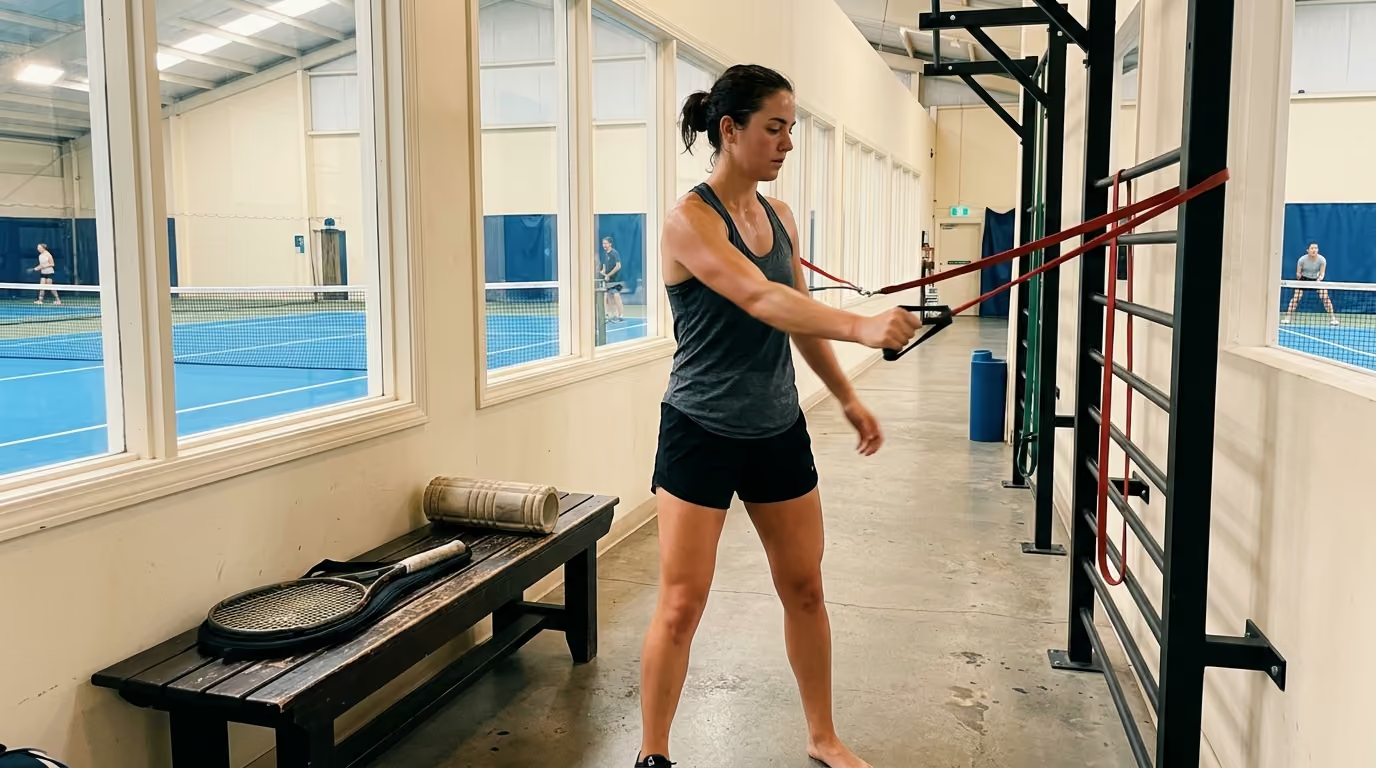
The Pallof press is a premier exercise for training this stabilization. Stand sideways to a cable machine or resistance band anchor. Hold the band in both hands at the center of your chest. Press the band straight out in front of you, resisting the temptation to let your torso twist toward the anchor point. Hold for two seconds, then return your hands to your chest.
While all racquet sports involve overhead hitting, the physical demands of each sport are quite distinct. Tailoring your recovery strategies to your specific sport is essential for achieving the best results.
Tennis features the most extreme overhead motion of the three sports. The tennis serve requires a full kinetic chain action, combining maximal shoulder external rotation with high-speed deceleration. Because the court is large and the net is high, players must use massive leg drive and spinal extension to generate competitive ball speeds.
For tennis players, recovery must prioritize the posterior shoulder decelerators and thoracic extension. Because tennis rackets are relatively heavy, the wrist and elbow also absorb significant impact forces. Your post-match routine should focus on restoring internal rotation of the shoulder and releasing tension in the forearm pronators.
Pickleball is played on a much smaller court, and the overhead strokes are typically shorter and faster. While you rarely hit with the absolute velocity of a tennis serve, pickleball requires rapid, repetitive overhead adjustments. The paddle is short and light, but the plastic ball does not compress, creating a stiff impact that travels up the arm.
Pickleball players often experience fatigue in the forearm, elbow, and anterior shoulder. Because the game is played close to the kitchen line, you must react quickly to high balls, often hitting without a full kinetic chain setup. Recovery for pickleball should focus on restoring wrist mobility, elbow health, and quick lateral hip movement.
Padel is characterized by a very high volume of overhead work. Because of the court walls and the defensive nature of the game, players use several different overhead variations. These include the bandeja, a defensive overhead tray shot, the vibora, a sliced overhead, and the classic power smash.
These shots require padel players to hold their arms above shoulder height for extended periods. This constant overhead positioning places a heavy endurance demand on the shoulder stabilizers and the lateral obliques. Padel recovery must focus on restoring thoracic rotation, maintaining lateral hip mobility, and refreshing the rotator cuff muscles that stabilize the shoulder during slice and spin adjustments.
Many dedicated court athletes make simple training errors that slow down their recovery. Recognizing these common pitfalls is the first step toward improving your physical longevity.
It is normal to experience mild, generalized muscle soreness after a long match or a hard practice block. This is known as delayed onset muscle soreness, and it typically peaks twenty-four to forty-eight hours after exercise. This normal training response should not be confused with a structural joint injury.
If your soreness is equal on both sides, resides primarily in the muscle bellies, and improves with gentle movement, it is likely standard fatigue. There is no need to panic or stop training entirely. Understanding this distinction helps you maintain your training momentum while supporting your body's natural adaptation process.
While normal muscle soreness is harmless, playing through sharp, localized, or escalating pain is highly risky. Continuing to perform high-speed overhead strokes when a tendon is actively irritated can lead to chronic tendinopathy. Tendons have a limited blood supply, meaning they require careful load management to heal.
If you feel a sharp pinch in your shoulder during the cocking phase, or a burning sensation in your elbow at impact, stop serving immediately. You can often continue with non-provocative groundstrokes or light conditioning. Ignoring these clear warning signs is a primary cause of prolonged court absences.
Many players track their training volume simply by counting the total number of hits or the minutes spent on the court. However, this approach ignores the critical factor of movement intensity. Hitting fifty practice serves at fifty percent effort is structurally very different from hitting fifty first serves at maximum speed.
When tracking your play, always make note of your intensity levels. If you have a session focused on high-speed serving, you must allow for more recovery time afterward. Balancing high-intensity days with low-intensity technical days is a cornerstone of intelligent load management.
If you have taken a break from playing due to fatigue or minor soreness, you should not jump straight back into competitive match play. Instead, use a structured progression to safely rebuild your tolerance for overhead work.
Begin your return by restoring comfortable joint mobility without any high-speed impacts. Focus on gentle shoulder circles, thoracic rotations, and active stretching. You can also perform shadow swings, mimicking your serving motion slowly without a ball or racket in your hand.
This stage helps your nervous system feel comfortable with the overhead range of motion. It also allows you to check for any residual stiffness or discomfort before adding actual hitting forces. Spend two to three days in this stage, ensuring all movements are completely pain-free.
Once shadow swings are comfortable, reintroduce light hitting on the court. Focus entirely on your rhythm, balance, and leg-to-arm coordination. Keep your hitting speed low, aiming for about fifty percent of your maximum effort.
Limit your total volume to fifteen or twenty serves during this initial session. Focus on using your legs and trunk to initiate the movement, rather than relying solely on your arm. Take generous rest breaks between hits, and monitor how your shoulder feels the following morning.
If you experience no next-day soreness from Stage 2, you can begin to increase your practice volume. Keep your hitting intensity moderate, around sixty to seventy percent of your maximum speed. Slowly increase your total serve count to thirty or forty repetitions.
Spread these hits across your training session rather than doing them all at once. For example, hit ten serves, play some easy groundstrokes, and then hit another ten serves. This approach prevents early fatigue of your stabilizing muscles, protecting your joints as you rebuild endurance.
With a solid volume foundation established, you can safely reintroduce higher-speed serves. Begin your session with a thorough warm-up, then perform five to ten high-effort serves. Monitor your technique closely to ensure your mechanics do not degrade under higher forces.
Keep the total volume of high-intensity hits small during this phase. If you experience any shoulder tightness or loss of accuracy, stop the high-speed work and return to easy technical hitting. Always prioritize movement quality over raw speed.
The next step is to test your shoulder under match-like conditions. This means serving under pressure, hitting after movement, and managing game-like fatigue. Start by playing short, non-consequential practice games or half-court matches.
Serving during a match is different from practice because you cannot always control when you must hit. Monitor how your shoulder responds to serving after long rallies. Ensure you maintain your lower-body drive even when you begin to feel tired.
You are now ready to return to unrestricted competitive play. Continue to monitor your weekly hitting volume, and maintain your shoulder and core conditioning routines. Remember that building lasting joint capacity is an ongoing process that requires consistent attention.
Keep a basic log of your weekly matches and high-intensity practice sessions. If you notice a sudden jump in your play schedule, proactively schedule extra rest days or focus on low-intensity movement. This proactive approach is the ultimate key to supporting your healthy aging and athletic longevity.
To help you apply these concepts, let us look at five common physical patterns that players frequently experience on the court.
You have been practicing your serve diligently, hitting over a hundred balls a day. Recently, you notice that your ball speed is dropping, your toss is becoming inconsistent, and your shoulder feels increasingly heavy. You do not have sharp pain, but the movement feels sluggish.
This pattern indicates classic neuromuscular fatigue. Your stabilizing muscles are tired, which alters your coordination and joint loading. The best management strategy is to temporarily cut your serving volume in half, focus on low-intensity technical work, and allow your muscles time to recover and adapt.
After a two-month winter break, you return to the court and play a grueling three-hour competitive match. The next morning, you experience deep, diffuse soreness across the back of your shoulder and upper back.
This soreness is a direct result of a rapid workload spike. Your body was not prepared for the sudden volume of eccentric deceleration forces. To manage this, avoid high-speed serving for several days, perform gentle active mobility drills, and plan a more gradual return to play for your next match.
You notice that your shoulder and elbow feel exhausted after just ten minutes of play, while your legs and hips feel completely fresh. When you watch a video of your play, you see that you stand very upright and do not bend your knees during the serve.
Your hitting mechanics are arm-dominant, meaning you are not utilizing your kinetic chain. To address this, work on your leg drive and trunk rotation. Temporarily reduce your serving speed and focus on initiating the swing from your lower body to distribute joint forces more evenly.
Your shoulder feels fantastic during your warm-up and for the first twenty serves of your practice. However, as your session continues, a dull, pinching sensation begins to develop in the front of your shoulder. The discomfort disappears after a few hours of rest.
This pattern suggests an endurance deficit in your rotator cuff or scapular stabilizers. As these muscles tire, they lose their ability to keep your shoulder joint centered, leading to mild joint irritation. Focus on building your shoulder endurance with high-repetition, low-load conditioning exercises.
You have recently recovered from a minor shoulder strain and have no pain during daily activities. However, when you try to hit a high-speed serve, your arm feels weak, and you cannot control the ball's placement.
Being pain-free is not the same as being ready for competition. Your shoulder may have healed, but you have likely lost strength and coordination during your time away from the court. Follow the progressive return-to-serving framework to safely rebuild your high-speed capacity.
While mild stiffness and muscle fatigue are normal parts of training, certain physical signs indicate that you should consult a qualified healthcare provider. Do not attempt to work through these symptoms on your own.
Seek professional medical assessment if you experience any of the following warning signs:
An experienced sports physical therapist or physician can provide an accurate diagnosis and create a customized rehabilitation plan. Early intervention is often the key to preventing a minor issue from becoming a chronic, play-limiting condition.
When to revisit this resource: Review this guide whenever you are planning to increase your weekly play volume, returning to court after an extended break, or starting to experience persistent shoulder or elbow stiffness after your matches.
Taking care of your body off the court is the best way to ensure you can continue to enjoy the fast-paced, rewarding world of racquet sports for many seasons to come.
Follow Evercourts for practical insights on tennis, pickleball and padel performance, movement, recovery and healthy ageing. Stay connected for new articles, research-led guidance and ideas to help you play well and keep playing for years.


Read practical guidance for better movement, smarter preparation and a game that keeps working for you.
explore the Blog