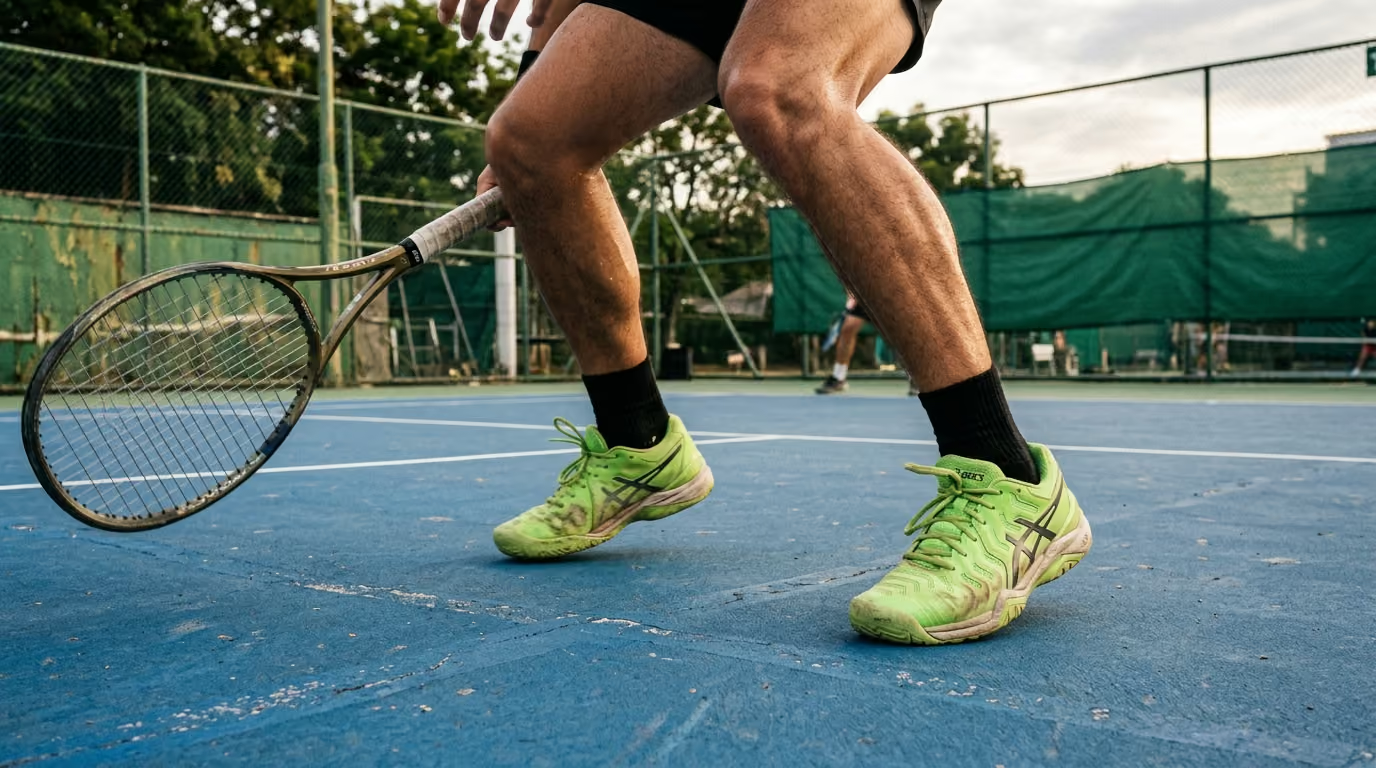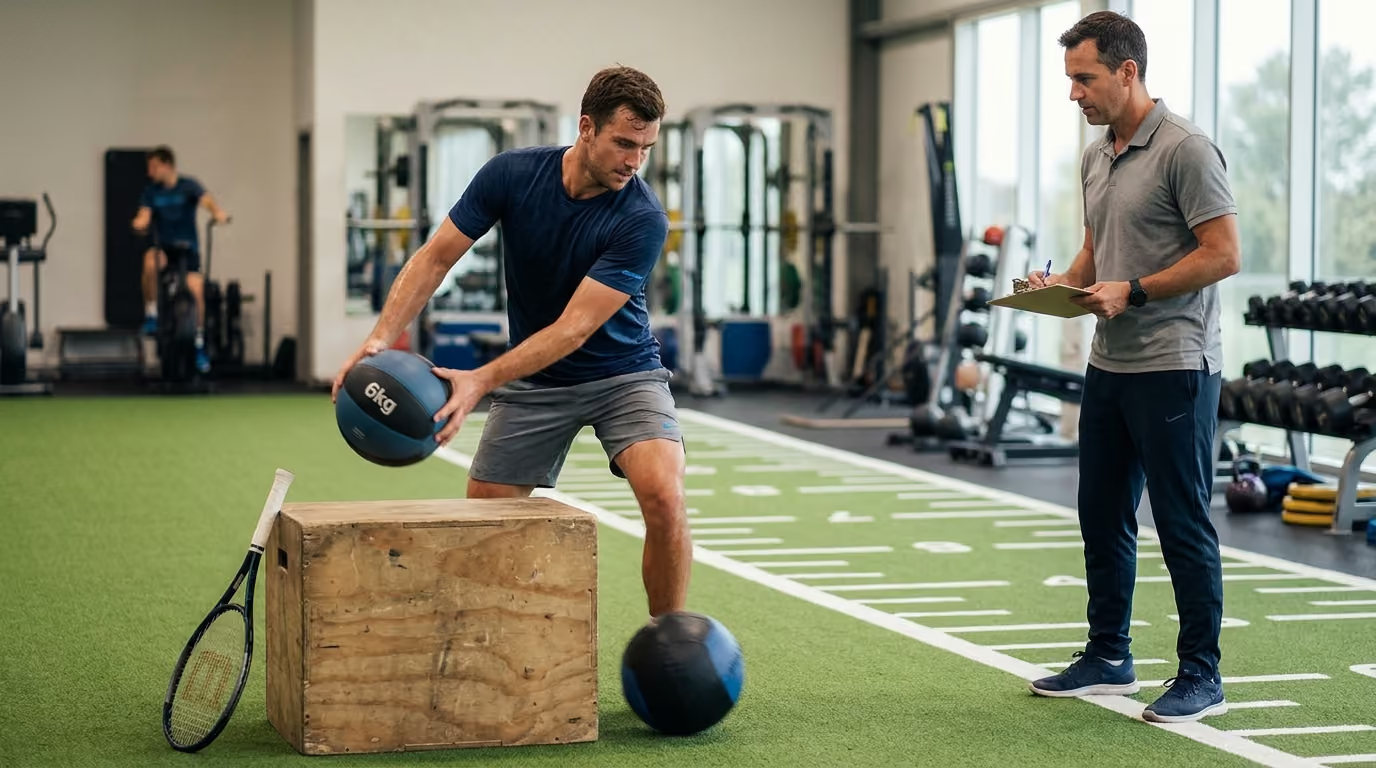

When preparing for a match, organizing off-court workouts effectively ensures peak performance and injury prevention for racquet sport athletes.




How should you organize your off-court workouts to build power and protect your body without compromising your next match? To structure an effective racquet-sport strength and conditioning session, you must arrange exercises in order of neural demand and movement complexity. By placing highly coordinated exercises like speed, agility, and power work first, you can execute them while your central nervous system is fresh. Following these with compound strength movements, localized accessory exercises, and sport-specific conditioning ensures you build athletic longevity without excessive fatigue.
Court sports place unique physical demands on the human body. A tennis match, for example, is not a continuous endurance run. Instead, it consists of repeated, high-intensity efforts separated by brief recovery periods.
According to systematic reviews of tennis match play, a best-of-three-set match lasts approximately 1.5 hours for competitive players. During this time, the average rally duration is only 4 to 7 seconds. The actual playing time is relatively low compared to the total match duration. However, the actions performed during those active seconds are exceptionally demanding.
These actions require rapid acceleration, sudden braking, and explosive rotational forces. The energy systems that support this activity must be highly developed.
The alactic, or ATP-PC, system provides the immediate energy for a three-step sprint, a heavy serve, or a rapid overhead. The anaerobic glycolytic system supports longer rallies that extend past 15 seconds. Meanwhile, the aerobic system works continuously to replenish energy stores between points, games, and sets.
Research shows that the work-to-rest ratio varies across court surfaces. For instance, hard-court play features work-to-rest ratios from 1:3.5 to 1:5.6. Clay-court play involves longer rallies and a work-to-rest ratio closer to 1:2.0. These differences mean that clay-court athletes require higher fatigue tolerance, while hard-court players require greater starting speed.
These constant directional changes and rotational swings expose the body to significant stress. Epidemiological reviews report that lower-extremity injuries are highly common, representing up to 56% of tennis injuries. The ankle is the most common site of acute injury, followed by the wrist, knee, foot, and shoulder.
Overuse injuries of the lumbar spine and shoulder are also common. An abrupt increase in training volume is a strong predictor of these issues. Therefore, any structured strength and conditioning programs designed for court athletes must balance performance preparation with physical protection.
To maximize the benefits of your off-court training, you must prioritize exercise quality. You should never design a session based solely on creating fatigue.
The central nervous system must be fully awake and unwearied for complex skills. If you perform explosive jumps or agility runs at the end of a workout, your technique will degrade. This increases your risk of injury and limits your power development.
A logical session sequence ensures that you train each athletic quality at the optimal time. The standard framework for a racquet-sport session includes several distinct phases.
You begin with a readiness assessment and a general warm-up. You then transition to dynamic mobility, movement preparation, and speed drills.
After these preparation phases, you perform power exercises while your muscles are completely fresh. Once the power work is complete, you move to primary strength lifts.
You then target specific weaknesses with accessory work. Finally, you perform energy-system conditioning and finish with a recovery-focused cooldown.
The American College of Sports Medicine, or ACSM, recommends this type of sequencing for balanced athletic development. Their resistance-training guidelines indicate that power training requires high movement velocity and adequate rest.
If you mix heavy strength lifts and high-speed jumps without a plan, you will compromise both qualities. The sequencing framework separates these demands, allowing you to train with high intent during every single phase of your workout.
Every workout should begin with a brief readiness assessment. Take two minutes to check your current physical and mental state.
Assess your muscle soreness, joint stiffness, and sleep quality. Consider your recent on-court matches and any upcoming competition.
If you feel highly fatigued, you should reduce the training volume for that day. This simple check helps you train productively without overworking your system.
After the readiness check, move into a general warm-up. This phase should last 5 to 10 minutes.
The goal is to raise your core body temperature and increase local blood flow. You can use a stationary bike, an easy jog, or light skipping.
Avoid static stretching during this phase. Instead, use rhythmic, low-intensity movements that mimic court actions.
Next, perform mobility and movement preparation exercises for 5 to 10 minutes. This phase targets the specific joint ranges required on the court.
Focus on ankle dorsiflexion, hip rotation, thoracic spine mobility, and shoulder function. A stiff ankle or a tight hip forces your lower back to twist excessively during a stroke.
You can use the following dynamic mobility sequence to prepare your body:
Finish your preparation with active movement drills. These drills bridge the gap between general mobility and high-speed court play.
Perform wall acceleration marches to practice proper shin angles. Execute light lateral shuffles and split-step timing drills.
Keep these drills short, lasting no more than 5 seconds per repetition. They should make you feel reactive and quick, not exhausted.
Power is the rate at which you can apply force. In racquet sports, power is critical for explosive first steps, high-jumping overheads, and fast trunk rotations.
To develop this quality, you must move light to moderate loads with maximal speed. The ACSM suggests using loads between 30% and 70% of your one-repetition maximum for power development.
The key is the intent to move the weight as fast as possible during the concentric, or lifting, phase. This training improves your rate of force development.
Your power training should also target the stretch-shortening cycle. This is the body's natural spring-like mechanism.
When you land from a jump or brake before a shot, your tendons store elastic energy. You must train your body to release this energy rapidly.
Plyometric exercises are excellent for this purpose. You should progress these exercises from low-intensity to high-intensity options:
You must also train rotational power. Racquet strokes are highly rotational, transferring energy from the ground through the trunk to the arm.
Use medicine-ball throws to train this kinetic chain transfer. Focus on medicine-ball scoop tosses, shot-put throws, and overhead slams.
Perform these exercises for 2 to 5 sets of 3 to 5 repetitions. Rest for 2 to 3 minutes between sets to maintain maximal speed and coordination.
Once your power work is complete, transition to your primary strength lifts. High relative strength is essential for court athletes.
It allows you to accelerate quickly, stop suddenly, and maintain a stable body position during deep lunges. Strength training also increases the structural tolerance of your tendons and bones, which supports healthy aging and athletic longevity on the court.
Your strength program should feature a balance of bilateral and unilateral exercises. Bilateral lifts, like the trap-bar deadlift or front squat, build overall force-producing capacity.
Unilateral lifts, like split squats and single-leg Romanian deadlifts, are highly specific to court play. When you slide for a ball or push off for a volley, you are working on one leg.
Ensure your primary strength block includes both knee-dominant and hip-dominant patterns. Knee-dominant lifts, such as squats, strengthen the quadriceps and patellar tendons.
Hip-dominant lifts, like Romanian deadlifts and hip thrusts, target the gluteals and hamstrings. These muscles are vital for acceleration and deceleration.
For maximal strength development, use moderate to heavy loads. The ACSM recommends using loads around 80% of your one-repetition maximum for 3 to 5 sets of 3 to 6 repetitions.
Ensure you leave 1 or 2 repetitions in reserve during your sets. Training to absolute muscular failure is unnecessary and creates excessive fatigue that can ruin your on-court performance.
Always prioritize perfect form over the weight on the bar.
Accessory exercises target the small muscle groups that protect your joints from repetitive stress. While compound lifts build general strength, accessory work addresses the unique physical vulnerabilities of racquet athletes.
Focus on the shoulder, the elbow, the hip, and the lower leg. These areas suffer the most wear and tear from serving, hitting, and lunging.
The shoulder is a primary area of concern for racquet players. The repeated overhead motion of serving can create muscle imbalances around the scapula.
Use side-lying external rotations, face pulls, and serratus wall slides to keep your shoulder stable. These exercises ensure the shoulder blade moves smoothly over the rib cage.
The wrist and forearm also require targeted training. Tennis elbow, or lateral epicondylalgia, is a frequent chronic issue for recreational players.
Perform wrist extensions, wrist flexions, and pronation-supination exercises with a light dumbbell. This strengthens the forearm tendons and helps them absorb the impact of the ball hitting your racket.
Do not ignore the lower leg and foot. Strong ankles reduce the risk of lateral ankle sprains on the court.
Incorporate standing calf raises, seated calf raises, and tibialis raises into your routine. Additionally, use the Copenhagen plank to strengthen your adductor muscles.
This exercise builds strength along the inner thigh, helping you decelerate safely during lateral lunges.
Conditioning for court sports should reflect the specific energy systems used during match play. Avoid long, slow jogging sessions, as they do not prepare you for the explosive nature of the sport.
Instead, use high-intensity interval training, or HIIT, to develop your conditioning. Your conditioning sessions should fall into two distinct categories based on your training goals.
The first category is alactic speed-repeat conditioning. This training focuses on your ability to produce maximal speed with minimal drop-off.
Perform short sprints of 5 to 8 seconds, followed by 30 to 60 seconds of passive rest. This long rest allows your muscles to replenish their ATP-PC stores.
Repeat this for 2 to 3 sets of 4 to 6 repetitions. This protocol mimics the short, explosive rallies common on hard and grass courts.
The second category is anaerobic tolerance conditioning. This training helps your body handle the lactic acid accumulation that occurs during exceptionally long rallies.
Perform 15 to 30 seconds of intense, multidirectional movement, followed by 40 to 80 seconds of recovery. Repeat this for 2 to 3 sets of 6 to 8 repetitions.
This type of conditioning is highly beneficial for clay-court players who face extended rally times.
You can perform this conditioning on the court, on a stationary bike, or on a rowing machine. Using a bike or rower is an excellent way to build aerobic capacity without adding extra impact to your joints.
Always assess your weekly on-court volume before adding intensive conditioning. If you are already playing several matches a week, you do not need much extra conditioning in the gym.
While tennis, pickleball, and padel share similar movement patterns, they have distinct physiological differences. Your strength and conditioning session should reflect the specific sport you play.
A tennis player requires a different physical focus than a padel player. Understanding these differences allows you to customize your training program.
Tennis players compete on a large court, which requires high top-end speed and long acceleration distances. The serve is a massive part of the game, creating substantial stress on the shoulder and lower back.
Therefore, tennis players must focus on rotational power, linear acceleration, and shoulder robustness. Their strength programs should prioritize unilateral leg strength and back-to-front upper-body balance.
Pickleball is played on a much smaller court, meaning players rarely reach top-end speed. Instead, the sport demands exceptional reaction speed, low-stance isometric strength, and rapid lateral shuffling.
The shoulder experiences less overhead stress, but the elbow and wrist remain highly vulnerable. Pickleball players should focus on ankle stability, knee health, and forearm strength.
Their lower-body work should emphasize holding deep, athletic positions for extended periods.
Padel involves a high density of lateral and rotational movements. The court walls create unpredictable ball paths, requiring constant, split-second adjustments.
Padel players perform a large volume of overhead shots, placing high demands on the shoulder complex. Their conditioning should emphasize lateral agility and rapid deceleration.
Their strength training should prioritize hip stability, core rotation, and scapular control to handle the constant turning and reaching.
Badminton features high movement density and repeated vertical jumping. Badminton players must focus on landing mechanics, calf strength, and deep diagonal lunging.
Squash is a continuous, high-speed game with very short rest periods. Squash players require exceptional anaerobic tolerance, rotational capacity, and single-leg strength to handle repeated corner lunges.
Table tennis requires precise trunk control and rapid, short-range lateral movement. Table tennis athletes should focus on hip mobility, calf reactivity, and high coordination.
You can structure your workouts in several ways depending on your schedule. Use these templates to organize your training sessions.
These templates contain no markdown tables, making them easy to read on any device.
This template is perfect for tournament weeks, busy schedules, or when you are already playing several court sessions.
This is your default workout structure for normal training weeks during the off-season or preparation phase.
This template is designed for well-trained athletes during a dedicated preparation phase, far away from major tournaments.
To get the most out of your training, you must manage your weekly physical load. A common mistake is trying to train with high intensity in the gym and on the court simultaneously.
This pathway often leads to overtraining and injury. Instead, you must periodize your program based on your playing calendar.
During the general preparation phase, your court play is typically low. This is the perfect time to build muscle mass, increase absolute strength, and develop aerobic capacity.
Your strength sessions should feature higher volume and moderate intensity. You can perform 3 full-strength sessions per week during this block.
As you approach a competitive season, shift your focus toward speed and power. Reduce your overall strength-training volume.
Replace heavy, slow lifts with explosive jumps, medicine-ball throws, and court-specific movement drills. Your gym workouts should make you feel fast and springy.
Limit your strength training to 2 sessions per week during this phase.
During the tournament season, your primary goal is to maintain your physical qualities while minimizing fatigue. Your on-court play will provide plenty of conditioning.
In the gym, perform short, low-volume maintenance sessions. A 30-minute workout once or twice a week is sufficient.
Focus on joint robustness, light power work, and basic strength maintenance.
To prevent injury, monitor your acute-to-chronic workload ratio. This ratio compares your training volume over the last week to your average volume over the last month.
Avoid sudden, drastic spikes in your playing time or lifting volume. A gradual progression of 5% to 10% per week is much safer and more sustainable.
This careful progression supports long-term joint health and athletic longevity.
To understand how to apply these training principles, consider these common player profiles and their tailored solutions.
This player has two matches per week and several on-court practices. They have very little time for off-court workouts and worry about being too sore to play.
Their solution is the short maintenance session. They train twice a week for 30 minutes, immediately after a light practice or on a rest day.
They use low-volume compound movements like the trap-bar deadlift. They perform minimal eccentric leg work to avoid delayed onset muscle soreness.
This approach preserves their strength and power without compromising their match-day performance.
This athlete can squat heavy weights but struggles to reach drop shots on the court. They feel heavy and slow during lateral transitions.
Their solution is to shift their focus from heavy strength to rate of force development. They reduce their heavy lifting volume by 50%.
They replace these sets with contrast training. They perform a heavy front squat followed immediately by an explosive vertical jump.
They also add split-step reaction drills and short, 5-meter accelerations to their warm-ups. This trains their nervous system to apply their strength rapidly on the court.
This player faces long rallies and grueling matches on clay. They often lose energy and performance quality during third-set tiebreakers.
Their solution is to build specific anaerobic tolerance. In the gym, they use longer conditioning intervals on a stationary bike or rower.
They perform 30-second high-intensity intervals followed by 90 seconds of active recovery. They also increase the volume of their single-leg strength work, like split squats.
This prepares their quadriceps and glutes for the constant, deep lunges required on clay.
This recreational player suffers from persistent outer elbow pain. The pain is worst during backhands and serves.
Their solution is to adjust their upper-body training while strengthening the forearm. They replace barbell exercises with neutral-grip dumbbell lifts to reduce forearm rotation stress.
They avoid heavy pull-ups, using supported cable rows instead. They add slow, controlled eccentric wrist extensions to their accessory block.
They also work with a coach to check their racket grip size and stroke mechanics.
Many court athletes make simple, avoidable mistakes in their off-court training. Recognizing these errors is the first step toward improving your performance.
Running long distances at a slow pace is a common training mistake. While a basic aerobic base is helpful, slow running trains your muscles to move slowly.
It does not prepare your tendons for the rapid braking forces of a hard court. Replace some of your long runs with structured interval training and short sprint repetitions.
You should not leave every workout feeling completely exhausted. If you cannot walk or swing a racket the next day, your gym session was too intense.
The goal of strength and conditioning is to support your court play, not to ruin it. Track your recovery and ensure you are leaving enough energy for your matches.
Many traditional gym programs focus entirely on bilateral, forward-facing movements. Exercises like the bench press, back squat, and deadlift are valuable, but they do not cover all court demands.
Racquet sports require you to move sideways, twist, and balance on one leg. Ensure your program includes lateral lunges, single-leg deadlifts, and rotational exercises.
While weight machines have their place, they do not require you to stabilize your own body. Free weights, cables, and bodyweight exercises force your core and stabilizer muscles to work together.
This coordination is essential for transferring force from your legs to your racket. Use free weights and cable machines for the majority of your strength work.
A structured strength session is only effective if your body can recover from it. What you do after your workout determines how well your muscles adapt and repair.
Understanding how your training impacts your tissues can help you manage your recovery time effectively.
The primary driver of muscular soreness is eccentric muscle action. This occurs when a muscle lengthens under load, such as when you lower yourself during a squat or brake during a sprint.
This action creates microscopic tears in your muscle fibers, leading to delayed onset muscle soreness. This soreness usually peaks 24 to 48 hours after a session.
To support muscle repair, prioritize hydration and nutrition. Drink water to replace the fluids lost through sweat during your workout.
Consume a source of high-quality protein and carbohydrates within two hours of finishing your session. This provides your body with the building blocks it needs to rebuild muscle tissue and replenish energy stores.
Your cooldown is also a valuable tool for recovery. An active cooldown helps your heart rate and blood pressure return to normal levels.
Use light, continuous movement like easy walking or slow cycling for 5 minutes. This can be followed by gentle, static stretching of tight muscle groups like the calves, hip flexors, and chest.
While static stretching does not prevent injury on its own, it can help reduce muscle tension and promote relaxation. You can also explore other science-based recovery resources to build a personalized post-workout routine.
While a well-structured training session reduces your overall risk of injury, aches and pains can still occur. You must learn to distinguish between normal muscle soreness and potential injury.
Ignoring pain can turn a minor issue into a chronic condition that keeps you off the court for months. This is especially important for injury prevention resources designed to support athletic longevity.
Normal muscle soreness is typically bilateral, dull, and resolves within 72 hours. It is usually felt in the muscle belly rather than the joint itself.
In contrast, an injury often produces sharp or localized pain. This pain may be accompanied by swelling, bruising, or joint instability.
You should consult a qualified healthcare provider, such as a physical therapist or sports medicine physician, if you experience any of the following warning signs:
A professional can provide an accurate diagnosis and create a targeted rehabilitation plan. They can also help you modify your strength and conditioning program.
This allows you to continue training safely while your injury heals. Never use pain tolerance as a metric for when to push through an exercise.
To put these principles into action, use this simple checklist to guide your training this week:
Follow Evercourts for practical insights on tennis, pickleball and padel performance, movement, recovery and healthy ageing. Stay connected for new articles, research-led guidance and ideas to help you play well and keep playing for years.


Read practical guidance for better movement, smarter preparation and a game that keeps working for you.
explore the Blog