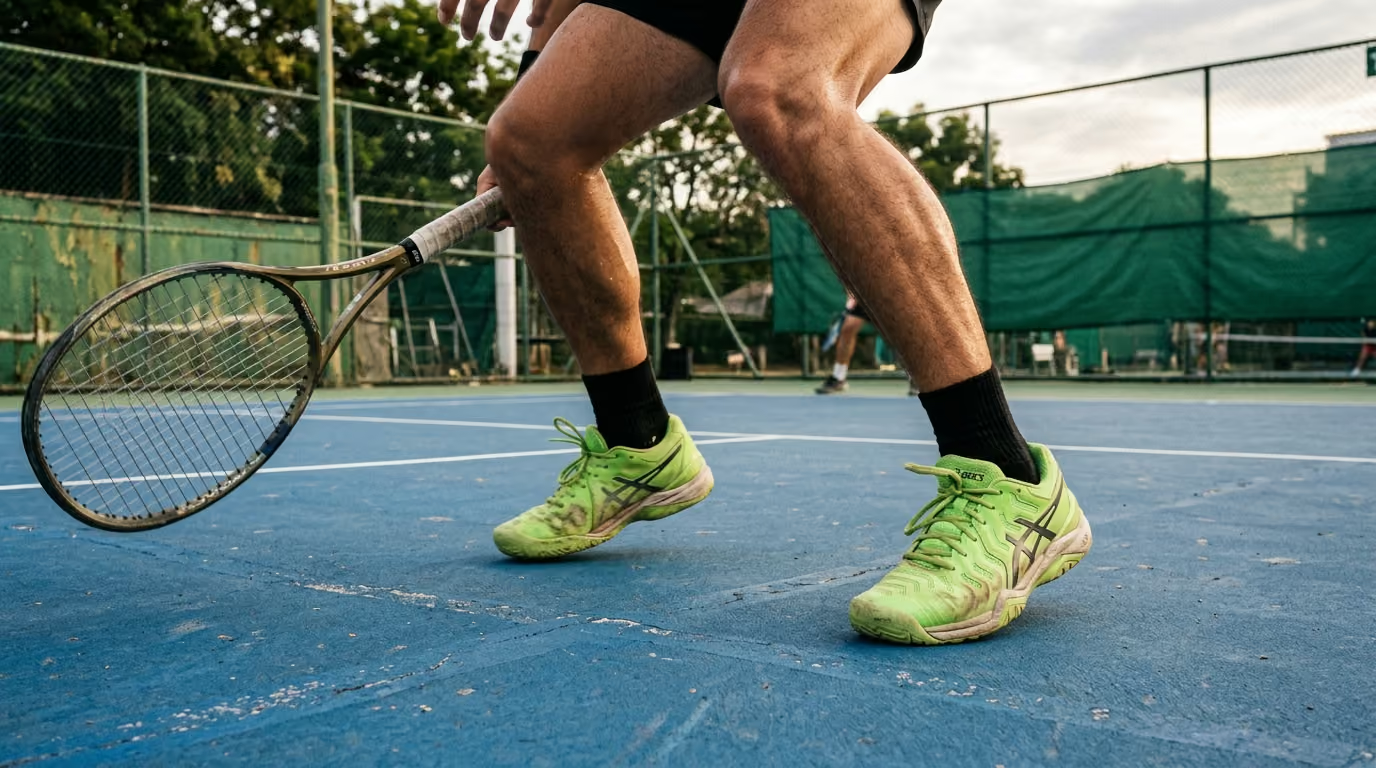

A successful racquet sports taper involves a 40 to 60 percent reduction in total training volume over seven to 14 days, maintaining intensity and frequency.




Preparing for a competitive racquet sports event requires a balance between resting and remaining sharp. Many recreational and competitive players believe they must either train at maximum intensity until tournament day or stop all physical activity entirely. Both of these training approaches are fundamentally flawed.
A successful racquet sports taper requires a structured 40 to 60 percent reduction in total training volume over seven to 14 days. During this period, you must maintain your normal movement intensity and practice frequency to preserve your timing and physical sharpness. This approach helps reduce accumulated physical fatigue so you can arrive at your matches feeling responsive and mentally prepared.
Tapering is not a passive vacation from physical activity, nor is it an unstructured period of complete rest. It is a highly strategic, planned reduction in training load designed to lower fatigue while keeping your physical systems ready to perform. By understanding how to adjust your gym work, court hours, and recovery habits, you can build a reliable path toward athletic longevity and better competitive outcomes.
The science of tapering relies on a classic sports medicine concept known as the fitness-fatigue model. This model states that training simultaneously builds physical fitness and accumulates physical fatigue. Your actual athletic performance on the court is the difference between these two variables. When fatigue is high, your physical capabilities are hidden. As fatigue drops, your true fitness level can finally show on the court.
A key research study from 2007 analyzed taper duration, volume reduction, and performance outcomes. This meta-analysis found that the most effective general taper pattern lasts about two weeks. During this period, reducing training volume by 41 to 60 percent while keeping intensity and frequency high yielded the greatest performance benefits. Although this study analyzed multiple sports, the underlying physiology applies directly to racquet athletes.
A more recent meta-analysis from 2023 looked specifically at tapering effects in competitive endurance environments. The researchers discovered that tapering led to significant improvements in time-trial performance and time to exhaustion. However, the taper did not cause significant changes in maximal oxygen uptake or movement economy.
This scientific distinction is highly relevant for court sports. A taper will not magically build new cardiovascular fitness in the final week before a tournament. Instead, it allows you to express your existing speed, reaction times, and power. It clears away the heavy leg feeling that comes from weeks of hard practice.
Furthermore, weightlifting taper research shows that skeletal muscle adaptations change quickly when you reduce your physical workload. Reducing total training volume allows muscle fibers to restore their glycogen stores. This process also repairs minor micro-tears in the muscle tissue. The result is a major increase in muscular power, which helps with explosive court movements.
The ideal duration of a taper is not a one-size-fits-all duration. The length of your taper should depend on how hard you have trained in the preceding weeks. If you are highly fatigued, you will need a longer period to recover. If you are already relatively fresh, a short, sharp reduction in volume is much better.
You can use a structured planning range to select your taper duration based on your current physical state.
You must also choose between a progressive taper and a step taper. A progressive taper reduces your workload gradually day by day. This approach is highly effective for athletes who thrive on routine. A step taper drops the training load immediately and holds it at that lower level. This method is excellent if you are carrying noticeable fatigue and need a quick reduction in muscle soreness.
Many players make the mistake of reducing their court intensity during a taper. They hit balls softly, move slowly, and avoid explosive actions. This approach can make you feel sluggish and unresponsive during your matches. The correct strategy is to reduce total court volume while keeping your physical intensity high.
To understand physical preparation, you can read more about strength and conditioning resources designed for racquet sports.
If your typical practice session lasts 90 minutes, you should cut it down. During the first week of the taper, reduce the session to 60 minutes. In the final three days before your match, limit court sessions to 30 or 45 minutes. This reduction saves your energy while keeping your nervous system primed.
You must reduce the total number of ball strikes. Instead of hitting three large baskets of serves, hit only half a basket. Avoid endless, repetitive cross-court drilling that has no clear competitive purpose. Focus on short, high-quality sequences that mirror real match play.
During a standard training block, you might rush from one drill to the next. During a taper, you must take generous rest breaks between exercises. If you run a high-intensity point simulation, rest for 60 to 90 seconds afterward. This protocol allows your heart rate to recover and keeps your muscle actions explosive.
Most racquet sports rallies are decided in the first few shots. Focus your court sessions on the serve, the return, and the subsequent recovery shot. These actions require maximum focus and speed but do not generate deep cardiovascular exhaustion.
Avoid playing full, grueling practice sets in the final days of your taper. Instead, play short tiebreaks or game-like scenarios. For example, practice starting games at a score of 30-30. This strategy keeps your tactical decision-making sharp without wearing out your knee joints.
Strength training must remain a part of your taper, but the structure must change. The goal of gym work during a taper is to stimulate the nervous system. You want to maintain muscular force production without causing any new muscle soreness.
To protect your body from wear, you can read more about injury prevention resources for competitive court athletes.
First, you must reduce your total volume-load. Volume-load is the total number of sets multiplied by reps and weight. You can easily achieve this reduction by cutting your total sets in half. If you normally perform four sets of squats, reduce that to two sets.
Second, you must remove all exercises performed close to failure. Do not push your muscles to the point of a deep burning sensation. If you are lifting weights, stop every set three to four repetitions before your muscles give out. This prevents the microscopic muscle damage that causes delayed onset muscle soreness.
Third, you must remove fatigue-producing accessory movements. Exercises that target isolated muscle groups can create unnecessary localized fatigue. Eliminate high-repetition shoulder raises, heavy abdominal circuits, and long lunging sequences. Keep your focus on basic, multi-joint movements like the squat, deadlift, and row.
Here is a practical strength-training timeline for the final week of a taper:
Many competitive players try to build extra cardiovascular endurance right before a major tournament. They go for long runs or perform grueling sprint intervals. This training behavior is highly counterproductive. New aerobic adaptations take weeks to develop, but the fatigue from these workouts occurs instantly.
Your conditioning work during a taper must prioritize speed quality over metabolic exhaustion. Repeated-sprint research indicates that short sprint distances are highly effective for preserving speed. You should focus on sprint distances of 15 to 25 meters.
Furthermore, you must use long recovery intervals between these sprints. Rest for at least 30 seconds to one full minute after every explosive effort. This recovery time allows your muscles to regenerate their immediate energy stores. If you shorten the rest, your body will transition into aerobic conditioning, which builds fatigue.
You should also limit your change-of-direction volume. Multi-directional movements are highly taxing on the tendons and joints. Instead of running complex agility patterns, perform simple footwork drills that mimic the split-step. Stop the session the moment your movement speed or footwork quality begins to drop.
Finally, do not use metabolic conditioning circuits during the final week. These workouts combine resistance exercises with short recovery times. They are designed to challenge your cardiovascular system, which is the opposite of what you need. Save these demanding sessions for your off-season training blocks.
While the general principles of tapering remain the same, each racquet sport has unique physiological demands. You must tailor your tapering protocols to match the specific movement profiles of your chosen game.
To learn more about the physical differences between court sports, you can explore player health articles written specifically for racquet athletes.
Tennis is played on a large court and involves massive deceleration forces. Players must run long distances, stop abruptly, and slide into shots. Tennis matches can also last for several hours, which places a high demand on your energy systems.
If you play on clay courts, you must taper your volume more aggressively. Research shows that clay-court rallies are 22 percent longer than hard-court rallies. Clay-court play is associated with higher average heart rates and greater perceived exertion. If your tournament is on clay, reduce your final practice match play to avoid wearing out your legs.
Additionally, tennis players must protect their serving shoulder. High-volume serving during a taper can quickly cause rotator cuff inflammation. Keep your serving practice to a minimum in the final three days before your first match.
Pickleball is played on a much smaller court, which reduces total running distance. However, it requires exceptionally fast reaction times, quick hand speed, and frequent low-squatting postures. Pickleball players often play multiple matches in a single day during tournament play.
Your pickleball taper should focus on hand-eye coordination and reaction drills. Avoid long, exhausting drill sessions at the kitchen line. Instead, focus on short bursts of dinking patterns that transition into fast volley exchanges.
Because pickleball requires deep knee flexion, you must protect your patellar tendons during the taper. Reduce the volume of deep lunges and squats in the final seven days. This allows the patellar tendon to recover from the constant bending demands of the low game.
Padel is a fast-paced game played inside a glass enclosure. It involves frequent wall rebounds, overhead smash sequences, and rotational changes of direction. The physical demand is highly explosive, with a major emphasis on the upper body and core.
Your padel taper must preserve your overhead coordination while relieving rotational core fatigue. Cut down the number of high-impact smashes, bandejas, and viboras during your practice sessions. Hit just enough overheads to maintain your racket timing.
Furthermore, because padel requires rapid turning movements, you must protect your lower back. Avoid heavy rotational strength training in the final week of your taper. Focus instead on gentle core activation and thoracic spine mobility to keep your rotation smooth.
Understanding what to avoid during a taper is just as important as knowing what to do. Many athletes accidentally ruin their physical preparation by falling into common training traps.
Some players believe that tapering means sitting on the couch for a week. Complete rest actually causes a rapid drop in neuromuscular coordination. Your muscles can lose their resting tension, which makes you feel slow and uncoordinated. You must maintain your normal training frequency, even if the sessions are very short.
It is common to feel a sense of anxiety as a major tournament approaches. Some players respond to this stress by scheduling extra practice sessions to fix a perceived stroke flaw. This panic training builds physical fatigue right before the event. Trust your prior months of preparation and accept your current skill level.
If you reduce both the volume and the intensity of your work, your nervous system will essentially go to sleep. Your muscles will lose their explosive qualities. You must keep the intensity of your movements high. Run at full speed, hit with normal power, but simply do fewer repetitions.
Some players carefully reduce their weightlifting volume but continue to play long, grueling practice matches. Your court play is the primary driver of physical fatigue. You cannot expect to feel fresh if you are playing two-hour practice sets three days before a tournament. Both gym work and court work must decrease in unison.
A well-executed taper has a profound positive impact on your physiological recovery systems. By reducing your physical workload, you allow your body to reverse the chronic low-grade inflammation that comes from regular play.
To dive deeper into the recovery process, you can read our recovery science resources for active court players.
When you train hard, your muscles utilize stored glycogen for fuel. Over several weeks of training, these glycogen levels can become chronically low. A taper allows your body to fully replenish these energy stores. This ensures that your muscles have a full supply of fuel ready for long tournament matches.
Furthermore, a taper allows your connective tissues to repair themselves. Tendons and ligaments have a limited blood supply compared to muscles. They require more time to heal from the microscopic damage caused by jumping, stopping, and swinging. Reducing your training volume gives these tissues the valuable time they need to rebuild their structural strength.
Finally, a taper helps restore the health of your central nervous system. Chronic physical fatigue can impair your brain's ability to recruit muscle fibers quickly. This can lead to slower reaction times and poor hand-eye coordination on the court. A taper clears this neural fatigue, which helps you feel physically sharp, mentally alert, and highly motivated to play.
You do not need expensive laboratory equipment to monitor your training load during a taper. A simple, low-cost method used by sports scientists is the Session-RPE system. RPE stands for Rate of Perceived Exertion.
To use this system, you rate the overall difficulty of your workout on a scale from one to 10. A rating of one means the session was extremely easy, while a 10 means it was a maximal effort. You then multiply this rating by the duration of the session in minutes to calculate your daily workload.
For example, if you practice for 60 minutes and rate the intensity as a five, your training load score is 300 arbitrary units. If you practice for 90 minutes and rate the intensity as an eight, your score is 720 units. During a taper, your goal is to systematically lower this daily score over the course of one to two weeks.
You should also monitor several subjective daily markers:
If your daily monitoring reveals that your soreness is increasing and your sleep quality is dropping, your taper is not aggressive enough. You should immediately reduce your training volume further. Do not let a written training plan override the real-time feedback your body is giving you.
Additionally, do not rely solely on the acute-to-chronic workload ratio to predict your performance. Research on competitive youth tennis players found no direct relationship between this mathematical ratio and match win percentage. While load ratios are helpful for avoiding injury, they cannot replace subjective measures of readiness and physical comfort.
A taper is designed to clear normal physical fatigue and minor muscle stiffness. It is not a medical treatment for structural injuries or chronic pain. If you are carrying a real injury, reducing your training volume for a week will not solve the underlying problem.
You should consult a qualified physical therapist or sports medicine physician if you experience any of the following warning signs:
A healthcare professional can provide a precise diagnosis and design a structured rehabilitation program. Trying to push through a structural injury during a tournament can lead to long-term tissue damage. Prioritize your athletic longevity so you can continue to enjoy court sports for many years to come.
Because you are reducing your total physical workload, your body will burn fewer daily calories during a taper. You do not need to consume extra food to carb-load before your matches. Focus on eating high-quality, whole foods and maintaining normal portion sizes. Keep your hydration levels high by drinking water consistently throughout the day.
Playing doubles is generally less physically demanding than playing singles. However, it still requires explosive movements, quick reactions, and mental focus. If you must play doubles during your taper, treat those matches as part of your total court volume. Reduce your practice sessions on those days to avoid accumulating hidden physical fatigue.
It is relatively common to feel slightly heavy or uncoordinated during the first few days of a taper. This sensation is often caused by your body transitioning out of a state of chronic training stress. You can resolve this feeling by performing a brief, high-quality neural warm-up. Include a few short sprints and quick medicine ball throws to reactivate your nervous system.
Long travel can introduce physical stressors like dehydration, poor sleep, and joint stiffness from sitting. If you must travel to a tournament, build an extra recovery day into your tapering plan. Upon arrival, perform a short, low-intensity movement session to restore your joint mobility. Do not perform a hard, compensatory workout to make up for missed training.
Follow Evercourts for practical insights on tennis, pickleball and padel performance, movement, recovery and healthy ageing. Stay connected for new articles, research-led guidance and ideas to help you play well and keep playing for years.


Read practical guidance for better movement, smarter preparation and a game that keeps working for you.
explore the Blog