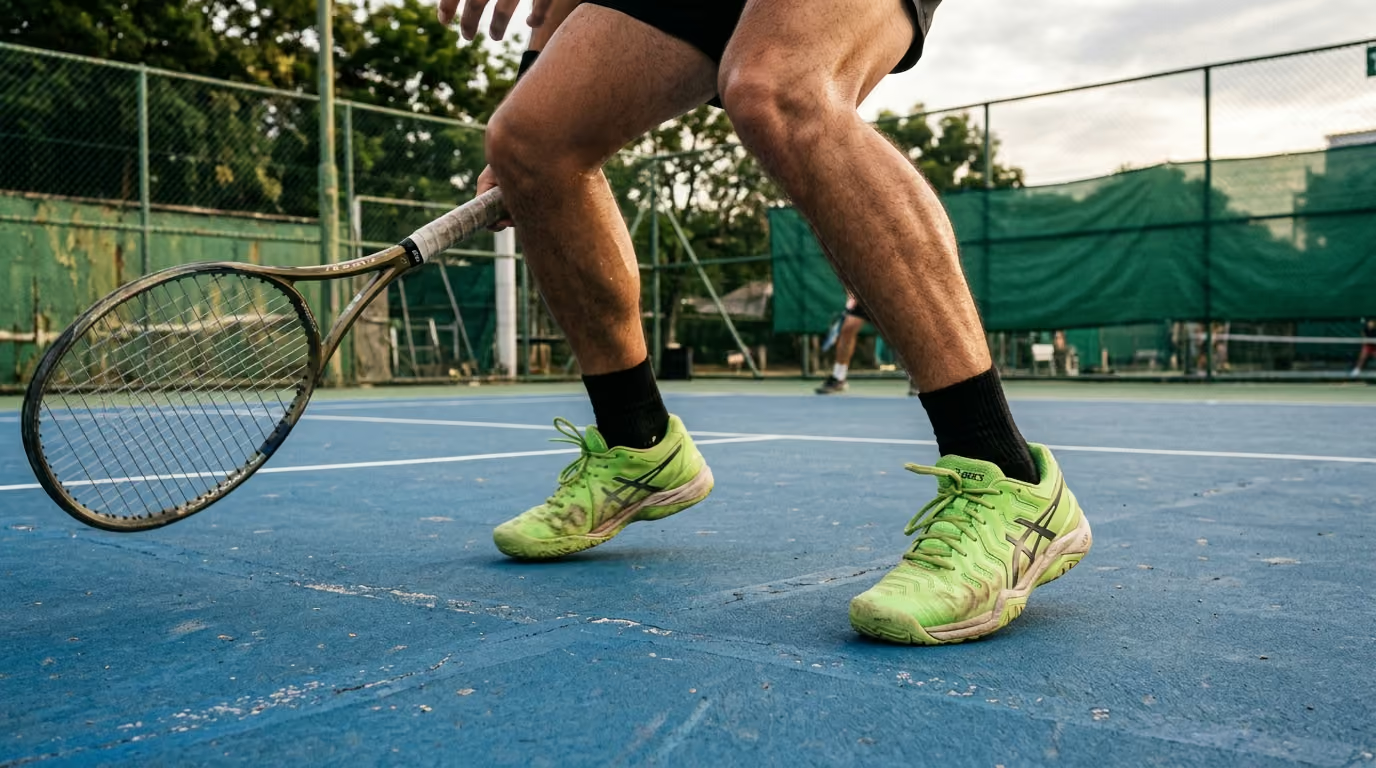
When court athletes struggle with quick movements like reaching drop shots or recovering from lunges, it often signals a decline in muscle power, not just strength.




Many court athletes find themselves struggling to reach short drop shots or recover quickly after wide lateral lunges, even when they feel strong in the gym. To preserve and rebuild explosive court movement as you age, you must train your muscles to express force rapidly using low-volume resistance training and low-impact elastic movements. This approach requires prioritizing movement speed over muscular fatigue, allowing your joints and nervous system to adapt without excess wear.
We often associate on-court speed with general leg strength. If you can perform a heavy squat or leg press, you might assume you can sprint to a drop shot. However, muscle power deserves separate attention because it combines force with movement velocity. In practical terms, power is your ability to apply useful force in a fraction of a second.
An athlete may possess respectable absolute strength while losing the ability to produce that force rapidly. This neuromuscular disconnect explains why you might feel strong when lifting weights, yet feel sluggish when trying to brake into a split step, recover from a deep corner, or react to an unexpected bounce.
The age-related decline in muscle power is often more pronounced and occurs earlier than the decline in maximal strength. A longitudinal study of older adults found that leg-press power declined by 16.5% over the follow-up period, despite no significant change in one-repetition-maximum strength. This study estimated that power declined at approximately 6% per year.
Other scientific reviews report that after age 60, general strength may decline at roughly 1.4% to 2.5% per year. Meanwhile, muscle power is reported to decline at approximately 3.5% per year. For players committed to athletic longevity, the target is not simply to get strong. The real target is to preserve the ability to express force quickly, repeatedly, and safely in sport-specific positions.
To design an effective power program, we must understand why these physical changes occur. The decrease in power is not just about muscle size. It involves a complex interplay of neural signaling, muscle fiber characteristics, and tendon stiffness.
First, aging tends to affect our fast-twitch muscle fibers more than our slow-twitch fibers. Fast-twitch fibers are responsible for rapid, explosive movements like sprinting, jumping, and striking. When these fibers undergo selective atrophy, your maximum rate of force development decreases.
Second, the rate of force development describes how rapidly force rises after a muscle contraction begins. This quality is critical on the court, where you have only a fraction of a second to push off. Research indicates that the speed of actin sliding on myosin, the fundamental mechanism of muscle contraction, reduces by 18% to 25% in older adults. This cellular slowdown explains why contractile velocity decreases with age.
Third, our tendons tend to lose some of their natural elasticity over time. Stiffer or less resilient tendons cannot store and release energy as efficiently during the stretch-shortening cycle. This cycle is the rapid spring-like action that occurs when you land and immediately push off again.
To help organize your training, it is helpful to look at five distinct physical reserves:
While aging can reduce several of these reserves at once, the decline is rarely uniform. By understanding which reserve needs attention, you can choose the correct exercises for your training. For more ideas on managing these physical changes, you can explore our healthy aging and athletic longevity resources.
A practical training model for court athletes can be organized into four distinct zones. This systematic approach allows you to progress safely from basic movement patterns to explosive court actions.
This zone is appropriate for detrained players, athletes returning from an injury, or those managing reduced joint tolerance. The objective is to establish movement quality, joint stability, and basic force production before adding high-speed impacts.
Excellent entry-level choices include the sit-to-stand, supported split squats, leg presses, and step-ups. You can also utilize hip hinges with a light kettlebell, cable rows, incline push-ups, and isometric calf raises. For upper-body coordination, controlled medicine-ball chest passes against a wall are highly effective.
During this phase, perform all movements with absolute control. Focus on finding pain-free ranges of motion and building tissue tolerance. Do not rush the movements yet, as the goal is to prepare your tendons and joints for faster work.
Strength work raises the ceiling of your physical capacity. Higher-intensity resistance training has been shown to produce major strength improvements in older adults. Heavy strength training also improves the rate of force development and maximal power in older individuals.
Appropriate exercises for this zone include the trap-bar deadlift, leg press, split squat, and Romanian deadlift. For the upper body, push presses, chest presses, and lat pulldowns are excellent selections. Focus on controlled tempos, utilizing moderate to heavy loads that you can lift with absolute technical precision.
Rest periods should be long enough to ensure each set is performed without excessive muscular burning. You are not trying to build endurance in this phase. You are teaching your nervous system to recruit as many muscle fibers as possible.
Once you have a solid strength base, you must train your nervous system to use that strength quickly. This phase uses lighter resistance moved with maximum intentional acceleration. Updated guidelines from the American College of Sports Medicine recommend using loads of 30% to 70% of your one-repetition maximum for power training, with an emphasis on moving the load as fast as possible during the concentric phase.
Great exercises for this phase include fast leg presses, medicine-ball scoop tosses, and cable punches. You can also use kettlebell swings, light sled pushes, fast step-ups, and resisted lateral drives. If your shoulder health permits, light dumbbell push presses are also excellent.
The key to Zone 3 is quality of movement. If the speed of the weight slows down, the set is finished. You are training the nerves to fire rapidly, which cannot happen when you are moving slowly due to fatigue.
The final zone integrates your explosive capability with the specific demands and movements of your sport. This is where gym-based power is translated into court performance.
Examples include split-step reactions to a partner's cue, lateral push-offs into short sprints, and crossover steps into controlled braking. You can also utilize rotational medicine-ball throws from an open stance, low-amplitude lateral hops with a stable landing, and shadow swings with your racquet.
Perform these drills at a high intensity but in very short bursts. Keep the recovery times long so that every single effort is explosive. This zone connects your physical capacity directly to the split-second decisions you make during a rally.
Power training is not an exercise in accumulation of fatigue. It is the practice of producing high-quality force and speed repeatedly while preserving technical coordination. When you train for power, you must resist the temptation to finish a set feeling exhausted.
A useful session structure for court athletes follows a specific sequence:
By placing your explosive exercises early in the session, you ensure your nervous system is fresh. This reduces the risk of injury and guarantees you are actually training speed rather than endurance.
For a practical starting prescription, consider the following parameters:
Always leave one or two repetitions in reserve. If you notice your movement speed, landing quality, or coordination beginning to slip, stop the set immediately. Treat speed as the specific quality you are protecting. For structured guidance on integrating these variables, you can read our physical preparation guides.
While the underlying physiology of power is the same for all athletes, the physical demands of tennis, pickleball, and padel are distinct. Your power training should reflect the unique movement patterns of your preferred sport.
Tennis is played on a large court that demands long lateral slides, deep lunges, and powerful overhead actions. The average point involves high-velocity changes of direction over distances of three to ten meters. This requires a large force reserve to decelerate your body weight from high speeds.
To train for tennis, focus on lateral push-off power and rotational trunk stability. Rotational medicine-ball throws from an open stance simulate the loading of a forehand or backhand. Lateral hops that emphasize landing and holding your balance help build the braking power needed for baseline recovery. For more specific advice on court preparation, see our tennis training guides.
Pickleball is characterized by rapid, short-distance reactions on a smaller court. The game demands micro-adjustments, rapid split-steps, and low-stance stability near the kitchen line. Because the paddle is light and the distances are short, your rate of force development in the first step is critical.
Your power training should emphasize quick feet, low-amplitude pogo hops, and rotational hand speed. You do not need to train for long-distance sprints. Instead, focus on rapid split-step reactions, low-amplitude lateral steps, and short-range medicine-ball chest passes. This builds the fast, responsive footwork required for quick hand battles at the net.
Padel combines the explosive overhead requirements of tennis with the quick, multi-directional wall play of squash. The court is enclosed, meaning you must frequently turn, sprint backward, and react to unpredictable angles off the glass. Padel requires frequent overhead smash attempts, which places a high demand on shoulder and upper-body power.
To train for padel, incorporate vertical jumping prep, rotational mobility, and single-leg stability drills. Landmine presses and medicine-ball overhead slams help build the power required for the smash. Crossover stepping drills and rapid back-pedaling exercises will prepare your lower body for the unique movement patterns of wall play.
Power training does not require you to perform maximal vertical jumps or deep, heavily loaded squats. If you are managing joint sensitivity, osteoarthritis, or past injuries, you can easily adapt these movements to protect your tissues.
According to the National Strength and Conditioning Association, the leg press is a highly effective alternative to the traditional squat for individuals with knee osteoarthritis. This machine stabilizes your torso and allows you to focus purely on rapid leg extension in a safe, controlled track.
If you have sensitive knees, avoid deep, high-impact landings. Instead, use a leg press machine to perform fast concentric pushes while lowering the weight slowly. You can also perform sit-to-stands from an elevated box, which shortens the knee flexion angle.
Sled pushes are another outstanding, low-impact option. They provide a high-power workout for your legs without any eccentric landing forces. For lateral movement, replace high jumps with low-amplitude lateral steps where you focus on a soft, controlled landing.
For athletes with hip sensitivity, hip hinges to an elevated target can keep the joint in a comfortable range. Supported step-ups, using a handrail for balance, allow you to train single-leg power with reduced joint stress. Cable pull-throughs are also an excellent way to train the glutes and hamstrings without loading the spine.
You can also use seated or half-kneeling medicine-ball throws to train upper-body and trunk power. This removes the lower limbs from the movement entirely, allowing you to train your nervous system while giving your hips a rest.
If you have a history of Achilles tendon issues, high-volume jumping can easily cause a flare-up. Begin by building a solid foundation with seated and standing isometric calf raises. These holds help build tendon compliance and reduce discomfort.
For dynamic power, use sled pushes with a flat-foot technique to minimize strain on the Achilles tendon. You can also utilize marching drills and low-impact medicine-ball throws. Only introduce light pogo hops when your ankles are completely pain-free and stable.
To train upper-body power without aggravating your shoulders, use light medicine-ball chest passes from a chest-height position. This avoids the stress of overhead throwing. Landmine presses are another excellent option, as they allow you to push at a comfortable, angled plane rather than straight overhead.
Cable presses within a comfortable, restricted range of motion can also build horizontal pressing power. If you need to avoid upper-body loading entirely, focus your power sessions on lower-body sled work and core rotation drills. For more health-centered movement strategies, you can explore our player health articles.
To ensure your training is working, you should regularly monitor your progress. You do not need expensive laboratory equipment to track your power. Simple, repeatable field tests can give you an accurate picture of your physical capacity.
These tests evaluate the basic strength and endurance required to support power training:
These tests measure your ability to produce force quickly:
Make sure to standardize all testing conditions. Perform your tests when you are warm and completely rested. Do not chase personal records if you are experiencing any pain, stiffness, or fatigue.
The total training load on your body is the sum of your gym sessions and your court play. If you play several matches a week and add multiple intense gym sessions, you may exceed your body's ability to recover. This is particularly important for older athletes, who typically require more recovery time between high-intensity sessions.
A practical weekly training structure might look like this:
This schedule ensures that your high-intensity days are separated by lighter days. Avoid stacking heavy lifting sessions directly next to demanding tournaments or matches.
You should also use simple daily readiness markers to guide your training intensity. Ask yourself how your joints feel, evaluate your sleep quality, and note your overall motivation levels. During your warm-up, pay close attention to your movement speed. If your first few repetitions feel sluggish or heavy, consider reducing the weight or volume for that session.
Nutrition also plays a vital role in recovery. The International Society of Sports Nutrition recommends that active individuals consume 1.4 to 2.0 grams of protein per kilogram of body weight daily. This intake helps preserve muscle mass and supports tissue repair following intense power training. For additional scheduling strategies, check out our court athlete training resources.
When training for power, it is easy to fall into habits that limit your progress or increase your risk of injury. Recognizing these common pitfalls will help you get the most out of your gym sessions.
One of the most frequent errors is turning power exercises into a high-repetition conditioning circuit. Performing twenty medicine-ball throws in rapid succession with no rest will build muscular endurance, but it will not improve your power. Power development requires maximum physical effort, which is only possible when you are fully rested. Keep your repetitions low and your rest periods long.
Lifting light weights fast is only one part of the power equation. If you do not have a solid foundation of absolute strength, your power potential will be limited. Heavy resistance training increases your overall force capacity, providing a larger foundation from which to express speed. A balanced program must combine both strength and speed work.
Many athletes focus entirely on the launch phase of a jump while ignoring the landing. On the court, the ability to decelerate and change direction is just as important as your first-step acceleration. Whenever you perform jumps or hops, focus on landing softly, quietly, and with perfect knee alignment.
Learning to absorb force safely protects your joints and builds the braking power needed for quick recovery.
Playing your sport is highly specific, but it does not replace structured physical conditioning. On the court, you cannot control the intensity, the speed of movement, or the joint angles required. In the gym, you can progressively overload your muscles and tendons in a highly controlled environment. This structured approach builds the physical tolerance needed to survive the unpredictable demands of competitive play.
To see how these principles work in practice, let us look at four common scenarios faced by aging court athletes.
Profile: A 58-year-old tennis player can perform a heavy leg press but struggles to reach short drop shots or recover quickly after lateral lunges.
The Issue: This player has an adequate force reserve but lacks the rate of force development and single-leg braking power required on the court.
The Strategy:
Profile: A 67-year-old pickleball player with mild knee osteoarthritis wants to regain their court speed but has reduced confidence during quick lunges.
The Issue: Reduced joint tolerance and knee stability have led to protective, slow movement patterns.
The Strategy:
Profile: A 62-year-old singles padel player can perform several explosive movements early in a match but feels their speed drop off significantly during the second set.
The Issue: Adequate peak power but insufficient repeatability and aerobic recovery capacity.
The Strategy:
Profile: A 71-year-old squash player wants to improve their footwork but experiences heel discomfort after jumping or skipping rope.
The Issue: Reduced tendon resilience combined with high-impact training loads has led to localized tissue irritation.
The Strategy:
While progressive power training is safe and effective for the majority of older adults, you must listen to your body. Recognizing when to seek professional assistance can prevent minor issues from turning into chronic injuries.
Consult a qualified healthcare provider, such as a physical therapist or sports medicine physician, if you experience any of the following warning signs:
A physical therapist can help identify specific mobility or strength deficits, ensuring you can progress your power training safely and effectively.
To begin implementing these principles and improving your court speed, follow this simple five-step checklist:
Follow Evercourts for practical insights on tennis, pickleball and padel performance, movement, recovery and healthy ageing. Stay connected for new articles, research-led guidance and ideas to help you play well and keep playing for years.


Read practical guidance for better movement, smarter preparation and a game that keeps working for you.
explore the Blog