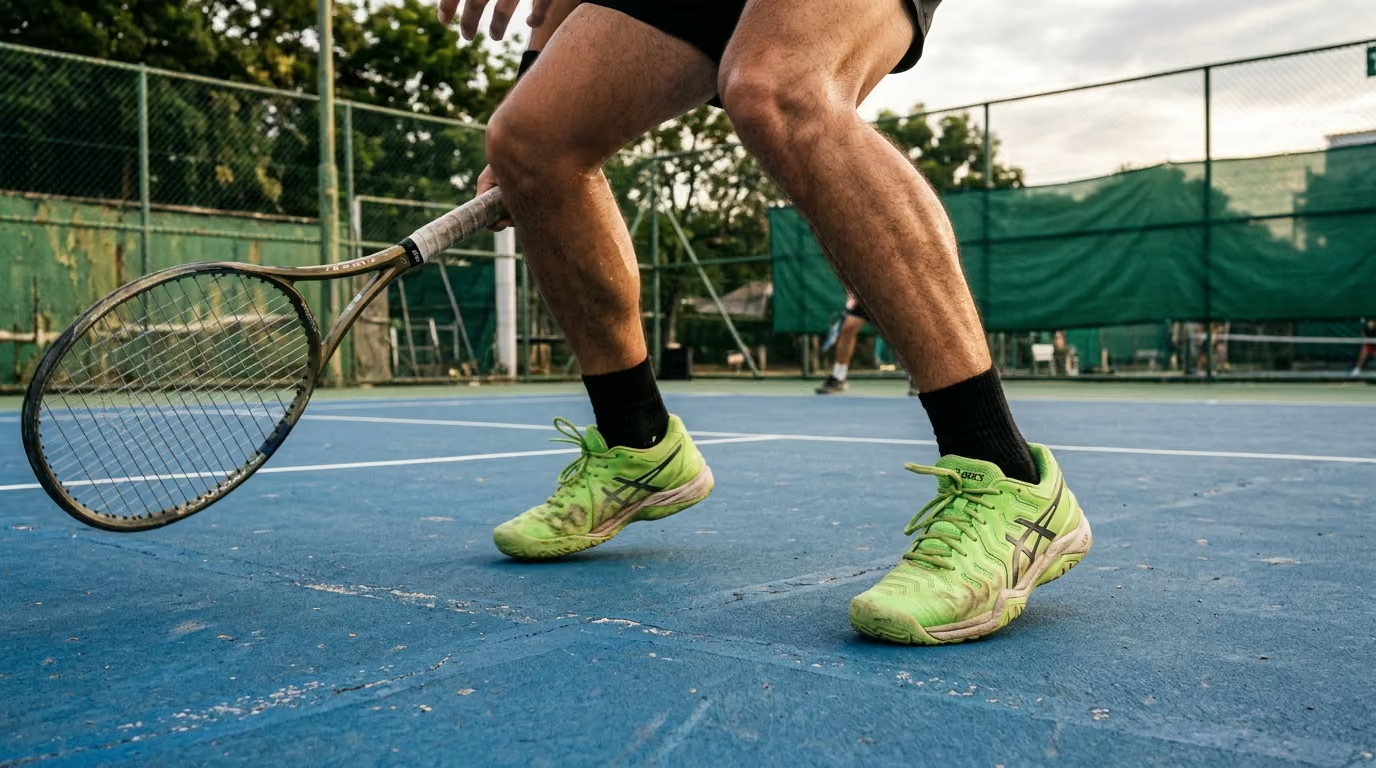
A longevity framework for racquet sports helps players train effectively through a busy life by balancing minimum effective doses with strategic workload variation.




Imagine leaving a stressful meeting at 5:30 PM, driving through heavy traffic, and walking directly onto the court for a competitive league match. Your mind is still racing with work deadlines, your lower back is stiff from sitting for six hours, and your calf muscles feel tight. Within three minutes of the opening rally, you sprint forward for a drop shot, plant your foot hard, and feel a sudden pull in your Achilles tendon. This common scenario illustrates the disconnect between daily life stress and the physical demands of racquet sports.
To train effectively through a busy life, racquet players must apply a framework of minimum effective training doses paired with strategic workload variation. By preserving consistent, low-volume strength work and carefully tracking court intensity, you can protect your joints while continuing to play. This approach balances life stress with physical capacity, allowing you to sustain your athletic identity for decades.
Managing these demands does not mean doing less training over your lifetime. Instead, it requires you to manage your training stress intelligently so you can continue practicing, competing, and improving across changing family and career phases.
To build a sustainable routine, you must first understand training load. Many players only measure their training by the minutes they spend on the court. In reality, your body experiences a combined burden of several distinct types of stress.
External load refers to the physical work you perform during a session. This includes the minutes played, the number of groundstrokes hit, the count of explosive accelerations, and the total distance covered. Tracking external load helps you understand the volume of your training.
Internal load represents how demanding that physical work is for your specific body. Two players can play the same 90-minute singles match but experience completely different internal loads. A player who slept poorly, skipped lunch, and is recovering from a cold will experience a much higher internal load than a well-rested opponent. Internal load can be estimated by multiplying the duration of a session by your session rating of perceived exertion on a scale of 1 to 10.
Mechanical load is the stress placed on specific tissues, such as your Achilles tendon, knee cartilage, rotator cuff, or lower back. Racquet sports place high mechanical loads on single joints during deceleration and overhead hitting.
Life load includes work deadlines, financial stress, family caregiving, poor sleep, and emotional exhaustion. Your nervous system does not distinguish between the stress of a tight work deadline and the stress of a difficult third set. High life load reduces your capacity to recover, making a normal training volume suddenly feel overwhelming.
Athletes often look to the acute:chronic workload ratio to manage these stressors. This ratio compares your training load over the past seven days with your average weekly training load over the past 28 days. Early sports science research suggested that keeping this ratio between 0.8 and 1.3 lowered injury risks in team sports.
However, modern reviews from the International Olympic Committee caution against treating this ratio as a perfect mathematical formula. The ratio is not a direct measure of mechanical tissue stress, and it cannot predict injuries with absolute certainty. Instead, use it as a simple warning signal. Avoid doubling your playing time, adding new heavy gym exercises, and traveling for a tournament all in the same week.
Racquet sports place unique physiological demands on the body that general fitness programs do not prepare you to handle. Unlike running or cycling, court sports are multi-directional, reactive, and highly explosive.
Every point requires a cycle of rapid acceleration, sudden deceleration, and violent changes of direction. The split-step action requires your calves and Achilles tendons to absorb and release elastic energy repeatedly. Rotational forces travel through your ankle, up your leg, across your pelvis, and into your lower back to power your strokes. Overhead serves and high-velocity groundstrokes place significant demands on your shoulder girdle, scapular stabilizers, and elbow tendons.
Injury patterns vary significantly across different racquet disciplines. According to sports medicine reviews, badminton injuries are predominantly acute and affect the lower limbs, often involving ankle sprains or Achilles tendon tears. Tennis shows a higher prevalence of overuse injuries in the upper limbs, lower back, and trunk due to the repetitive nature of serving and groundstrokes. Padel players frequently experience elbow tendon irritation from the constant low-rebound tennis play and overhead glass shots. Pickleball players, particularly older adults, experience a high rate of muscle strains, tendon issues, and acute injuries from falls on the court.
A study of older pickleball players revealed that over 32 percent of participants reported an injury during the previous year. Of those injuries, nearly 58 percent involved the lower extremities, and over 61 percent affected muscle or tendon tissue. The study also highlighted that increased weekly playing hours were a major risk factor for developing these issues.
This research demonstrates that physical preparation must match your specific sport exposure. You cannot rely on playing your sport to get fit for your sport. You must actively prepare your body to tolerate the specific forces of the court, especially as you navigate middle age and beyond. To read more about managing these physical challenges, explore our library of player health articles.
To organize your training through busy times, use a five-layered longevity pyramid. This system prioritizes long-term consistency over short-term intensity.
The base of the pyramid is continuity. The most destructive pattern for a busy athlete is the stop-start cycle. This occurs when you train hard for four weeks, get injured or exhausted, take six weeks off, and then try to restart at your previous intensity. Continuity means doing a small amount of physical work consistently, even when life gets chaotic. Keeping a minimal baseline of movement prevents your tissues from losing their adaptation to stress.
The second layer is tissue capacity. This is the ability of your muscles, tendons, ligaments, and joints to tolerate physical work without failing. For court athletes, this requires targeted conditioning of the calves, shin muscles, quadriceps, hamstrings, gluteals, rotator cuff, and wrist extensors. Building tissue capacity acts as armor for your joints, protecting them from the repetitive, high-impact forces of hard courts.
The third layer is strength and power. Strength is your ability to produce force, which is essential for decelerating your body when you change directions. Power is your ability to produce force quickly, which determines your speed on the court.
As we age, we naturally lose fast-twitch muscle fibers and rate of force development. Preserving these qualities requires dedicated resistance training that challenges your muscles under load. To build a solid foundation in this area, you can benefit from structured strength and conditioning designed for court athletes.
The fourth layer is sport-specific intensity. This involves exposing your body to the actual speeds, angles, and decision-making patterns of real play. While gym work builds general capacity, you still need the specific coordination that only comes from hitting balls. However, these sessions must be planned carefully so they do not exhaust your recovery systems.
The top of the pyramid is resilience and adaptability. This is your psychological and physical ability to adjust your training on the fly. If you have a busy week at work, you must be willing to swap a stressful singles match for a technical drilling session. Adaptability allows you to maintain your athletic identity without forcing your body to perform when it is depleted.
When time is limited, you must focus on the minimum effective dose of training. This is the smallest volume of physical work required to maintain your current physical qualities. Recent research in sports science shows that high-volume workouts are not always necessary to maintain fitness.
Time-saving resistance training strategies include minimal-dose training, strategic exercise selection, and the use of supersets or circuits. You can also utilize exercise snacks, which are brief, structured bursts of intense movement spread throughout your day. A three-minute block of bodyweight squats, lunges, or wall sits during a work break can help preserve joint mobility and muscle activation.
When you only have 20 minutes to train in the gym, a structured minimal-dose workout is highly effective. Focus on compound movements that recruit multiple large muscle groups simultaneously. This approach saves time while providing a robust systemic stimulus.
Perform the following routine as a circuit, moving from one exercise to the next with minimal rest. Complete three total rounds to maintain your physical qualities during your busiest weeks.
Stop each set two repetitions short of complete muscular failure. The goal of this session is to maintain your physical baseline, not to leave you feeling exhausted.
To prevent injury and maximize enjoyment, you need a simple system to organize your weekly court play. This starts with the "three priorities" method. Every week, identify your must-do session, your capacity session, and your enjoyment session.
Your must-do session is the practice most critical to your current playing goals. Your capacity session is your strength, mobility, or conditioning work. Your enjoyment session is your relaxed social hit or doubles game. If work or family disruptions force you to cut back, preserve these sessions in order.
A balanced weekly schedule should separate high-intensity days with low-intensity recovery windows. A typical weekly split for a busy player might look like this:
To determine how to adjust this schedule daily, use the "green, yellow, red" readiness system. Evaluate how you feel during your general warm-up before you begin playing.
You slept well, your motivation is high, and your joints feel comfortable. Your movement during your warm-up feels crisp and fluid. On these days, proceed with your planned high-intensity match or heavy lifting session.
You slept poorly, your work stress is elevated, or your legs feel unusually heavy. During your warm-up, your reaction time feels slightly slow. On these days, reduce your training volume or intensity. You can play doubles instead of singles, focus on controlled technical drilling rather than competitive points, or lower the weight in the gym.
You are experiencing acute pain, extreme physical fatigue, or signs of illness like a fever. Your movement feels awkward, and you have no motivation to play. On these days, cancel your court session entirely. Rest, walk, or focus on light mobility work to allow your nervous system to recover.
While all racquet sports share similarities, the physical demands differ. Your longevity strategy must adapt to the specific sport you play.
Tennis involves a large court, demanding significant linear speed and deep lateral sliding. The ball is heavy, and the rallies can be long, which places high mechanical stress on your shoulder, elbow, and lower back. Tennis players must prioritize shoulder rotator cuff endurance, thoracic spine mobility, and hip hinge strength.
If you are a tennis player short on time, prioritize a thorough dynamic warm-up that prepares your shoulder and hips for explosive rotation. For more tennis-specific advice, read our technical tennis training articles.
Pickleball is played on a smaller court, reducing the need for long-distance sprinting. However, the game demands rapid reflexes, constant low-squatting postures, and abrupt forward-and-back movements near the kitchen line. The quick, short steps place high demands on the Achilles tendons and knees.
Pickleball players should focus on ankle mobility, calf strength, and knee terminal extension strength. Because falls are a common risk source for older players, practicing balance and lateral recovery steps is critical. To build a safer approach to the game, explore our guide to modern pickleball play.
Padel is played in a glass enclosure, resulting in fast, continuous rallies with complex ball rebounds. The court surface is synthetic turf with sand, which allows for sliding but can also catch your shoe unexpectedly. The sport requires constant overhead hitting, frequent low-to-high defensive transitions, and rapid turning movements.
Padel players must build excellent trunk anti-rotation strength, single-leg stability, and forearm muscular endurance. Strengthening your wrist extensors can help protect your elbow from the repetitive impact of off-center hits.
Many dedicated players fall into predictable patterns that lead to injury or chronic fatigue. Recognizing these common pitfalls can help you adjust your training before problems arise.
Recovery is not a passive process of simply sitting on the couch. It is an active set of habits that allows your body to adapt to the physical stress of your training. For a busy player, managing your recovery is just as important as planning your court sessions.
Sleep is the ultimate recovery tool. During deep sleep, your body releases growth hormone, which is essential for repairing muscle tissue and strengthening bones. Chronic sleep deprivation reduces protein synthesis, impairs your coordination, and increases systemic inflammation, directly raising your risk of developing tendon issues. If you sleep less than seven hours a night, your body will have a much lower capacity to tolerate hard matches.
Non-sport life stress acts as a direct multiplier of your physical load. High emotional or mental stress elevates cortisol levels, which impairs muscle recovery and tendon remodeling.
If you are navigating a difficult period at work or home, you must treat that stress as an invisible training load. Scale back your court intensity and prioritize extra rest. To explore the science behind these adaptation mechanisms, view our curated resources on recovery science insights.
During tournament weeks, your overall training strategy must shift. A tournament presents a massive spike in physical and mental stress due to playing multiple matches, traveling, and experiencing performance anxiety.
To prepare, taper your training volume during the week leading up to the event. Do not eliminate all movement, as complete rest can make your joints feel stiff and sluggish. Instead, perform short, low-volume technical hits, light mobility work, and familiar strength maintenance exercises to keep your movement clean and responsive.
To see how these principles apply in the real world, consider these five common player profiles.
A significant hurdle for midlife athletes is psychological rather than physical. Many players believe that if they cannot train six hours a week, play intense singles, and lift heavy weights, they are no longer "real athletes." This all-or-nothing mindset often leads to frustration, burnout, or injury.
To play your sport for decades, you must transition to a longevity-focused athletic identity. A durable athletic identity is built on consistency, deliberate practice, and smart adaptation.
An athlete is not defined by how much they suffer or how close they push themselves to exhaustion. Instead, an athlete is someone who respects their body, prepares diligently, and adapts their training to match their life circumstances. To read more about sustaining your love for the court through all stages of life, browse our athletic longevity resources.
While this framework is designed to help you manage your training safely, it is not a substitute for professional medical care. You should consult a qualified physician, physical therapist, or sports medicine specialist if you experience any of the following warning signs:
Addressing minor joint discomfort early with a physical therapist can prevent a simple overuse issue from developing into a chronic injury that sidelights you for months.
Bookmark this guide and return to it whenever you experience a major change in your life or physical health. Re-read this framework when:
At Evercourts, we believe that racquet sports are a lifetime pursuit. By managing your physical preparation, training volume, and recovery cycles, you can enjoy the speed, competition, and community of court sports for decades to come.
Follow Evercourts for practical insights on tennis, pickleball and padel performance, movement, recovery and healthy ageing. Stay connected for new articles, research-led guidance and ideas to help you play well and keep playing for years.


Read practical guidance for better movement, smarter preparation and a game that keeps working for you.
explore the Blog