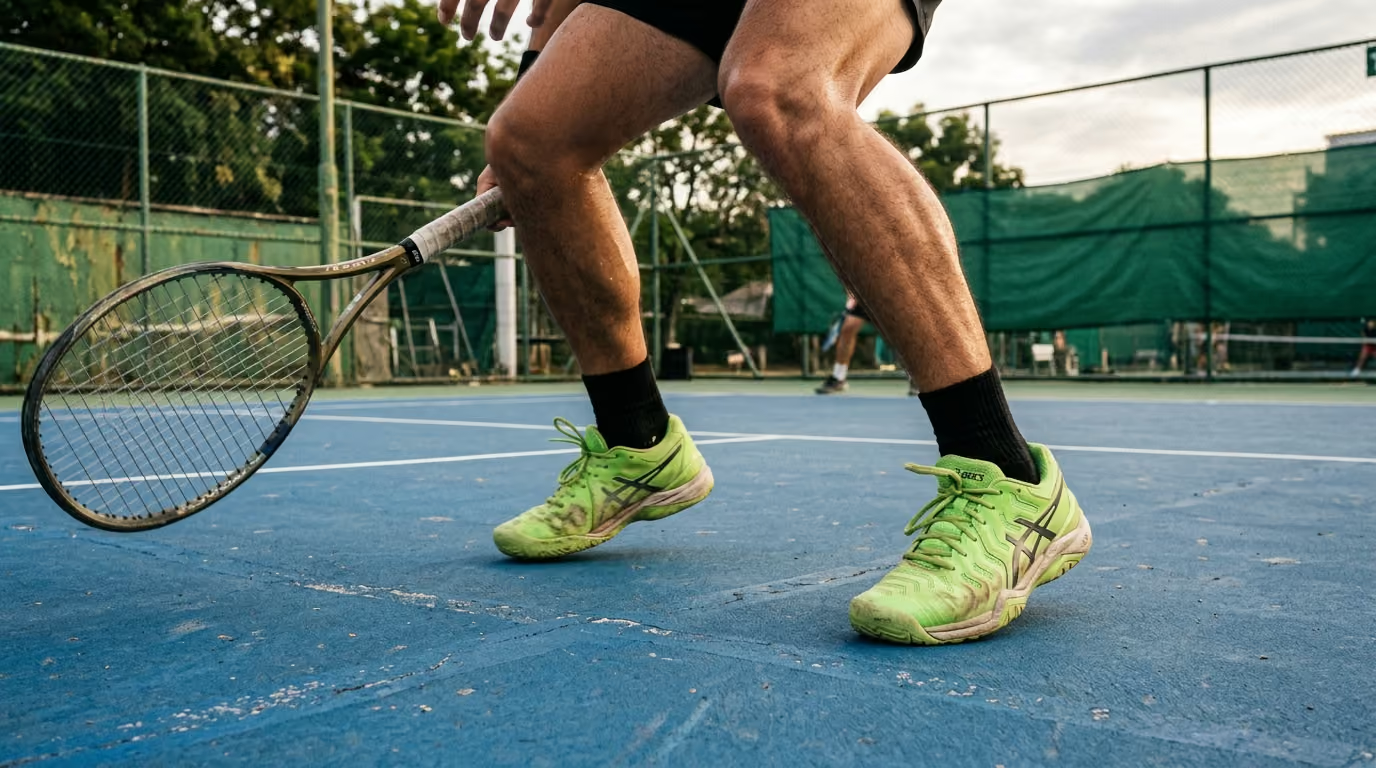
Many players assume that indoor and outdoor racquet sports sessions carry the same physical toll, but environmental factors significantly alter injury risks.




Imagine leaving a temperature-controlled indoor tennis facility where the traction is predictable and the air is still. You step onto an outdoor clay court on a hot afternoon to play a match with the same duration and intensity. While the court dimensions and your opponent remain unchanged, your body immediately encounters a completely different set of physical demands. The way you slide to reach the ball, the rate at which you lose fluids, and the impact forces on your joints are fundamentally altered by the shift in environment.
Many players assume that a ninety-minute session carries the exact same physical toll regardless of the setting. This assumption often leads to sudden muscle strains, joint overload, or systemic fatigue. To protect your body and maintain your athletic longevity, you must treat indoor and outdoor courts as distinct physical workloads. Adjusting your movement patterns, footwear, and recovery strategies is essential when transitioning between these environments.
Adapting to different court environments requires adjusting your movement patterns, footwear, and workload management to match the unique traction and thermal demands of each setting. Outdoor courts introduce variable wind, heat, and sliding mechanics that distribute impact forces differently across your lower body. Indoor courts often provide high traction and stable conditions, but they also subject your joints to rapid deceleration forces and potential heat accumulation if ventilation is limited.
To prevent injuries effectively, you must understand how your body interacts with different playing surfaces. The physical properties of a court determine how much force is transmitted through your feet, ankles, knees, and hips during explosive movements.
Research comparing tennis court surfaces shows that the type of court directly influences the pressure on the bottom of your feet. A study of male tennis players published in the journal of sports sciences revealed that hard-court play produces significantly higher maximum forces and heel pressure during tennis-specific movements. In contrast, clay courts shift the primary loading toward the front of the foot, specifically the big toe and the smaller toes.
This means that surfaces do not simply apply more or less stress to your body. Instead, they distribute that stress to different anatomical structures. A hard court subjects your heel and Achilles tendon to sharp, vertical impact forces. A clay court reduces these vertical impacts but increases the work required by your forefoot, calves, and hip stabilizers as you glide through your shots.
Traction represents the resistance to sliding between your shoe outsole and the court surface. High traction is often viewed as a positive feature because it prevents slipping. However, excessive traction can be a significant risk factor for acute joint injuries.
When a shoe grips a high-traction surface too abruptly, your foot becomes planted while your upper body continues to rotate. This rotational force is transmitted directly to your ankle and knee joints. A lower-friction surface, such as clay or sand-filled turf, allows for a controlled slide. This slide acts as a natural braking mechanism that extends the deceleration time and lowers the peak force on your joints.
A large-scale survey of recreational tennis players revealed that eighty percent of reported injuries were classified as overuse injuries, while only twenty percent were acute. This finding highlights the importance of managing cumulative mechanical stress. While a sudden ankle sprain on a slippery court is highly visible, the slow buildup of microtrauma in your tendons and joints is far more common.
Overuse injuries occur when repeated loading exceeds your body's ability to repair and adapt. If you play on a hard, unforgiving surface without adequate recovery, your tendons and muscles gradually break down. Transitioning to a different surface alters these loading patterns, which can strain tissues that are not accustomed to the new demands.
To protect your body over a lifetime of play, you should move away from tracking your training volume solely by the clock. A ninety-minute session on a humid outdoor court with wind and glare requires much more physical effort than ninety minutes in a cool indoor bubble.
A practical framework for evaluating your injury risk is the environmental workload model. In this model, physical risk is calculated through a combination of several factors:
Risk = exposure × movement demand × surface interaction × athlete readiness × recovery capacity.
Using this model, you can see how changing one variable affects your overall safety. If your surface interaction becomes more demanding, such as moving to a high-traction hard court, you must reduce your exposure or increase your recovery capacity to keep your risk low.
Sports science consensus guidelines recommend tracking both external and internal training loads to prevent under-recovery and injury. External load refers to the objective work you perform on the court, such as the number of games played, sprints completed, or lunges executed. Internal load represents your body's physiological response to that work, which can be measured using your heart rate or your session rating of perceived exertion.
A simple way to calculate this is to multiply the duration of your session by your perceived exertion on a scale of one to ten. A sixty-minute practice that felt like an eight out of ten yields a session workload score of 480. If you move outdoors into high heat, the same physical drills may feel like a nine out of ten, raising your internal workload score and demanding more recovery time.
Indoor courts provide a controlled environment free from wind, rain, and sun. However, this stability can create a false sense of security, as indoor facilities present distinct physical challenges.
Many indoor facilities feature acrylic hard courts or polyurethane flooring. These surfaces are highly uniform and provide exceptional grip. While this predictability allows you to change direction quickly, it also subjects your lower extremities to intense deceleration forces.
Because the shoe grips the surface instantly, your muscles and tendons must absorb the entire force of the stop. If your movement technique relies on abrupt, rigid stops, this repetitive impact can lead to patellar tendinopathy, plantar fasciitis, and shin splints.
Indoor structures, particularly air-supported domes or older warehouses, can trap heat and humidity. When several courts are occupied simultaneously, the air can quickly become heavy and stagnant.
Without adequate airflow, your sweat cannot evaporate efficiently. This impairs your body's natural cooling mechanism, causing your core temperature and heart rate to rise rapidly. Fatigue sets in much faster in these conditions, leading to poor footwork and a higher risk of acute movement errors late in your session.
Playing outdoors exposes you to natural elements that require constant physical and mental adaptation. These variables demand a higher degree of systemic resilience.
Exercising in hot and humid outdoor conditions increases your cardiovascular strain. Your heart must pump more blood to your skin to dissipate heat, leaving less oxygen-delivery capacity for your working muscles.
According to guidelines from the National Collegiate Athletic Association, athletes should gradually increase their exposure to hot conditions over a ten to fourteen-day period. This process of heat acclimatization allows your body to expand its blood plasma volume, lower its resting core temperature, and sweat more efficiently. Skipping this gradual transition when moving outdoors can cause rapid dehydration, muscle cramping, and heat exhaustion.
Outdoor courts are subject to constant environmental wear. Dust, pollen, fallen leaves, and dew can quickly transform a high-traction court into a slippery hazard.
Furthermore, outdoor clay and grass courts change continuously throughout a single day. As the sun dries the court, clay becomes looser and more slippery. Conversely, morning dew or late-afternoon humidity can make grass or hard courts slick and unpredictable. These sudden changes in traction can easily lead to slips, groin strains, and ankle sprains if you do not adjust your movement velocity.
To minimize your injury risk, you must consciously alter your footwork and braking mechanics based on the surface beneath you.
When playing on hard surfaces, your primary goal is to damp the high impact forces of stopping and starting.
Clay courts require a fluid, sliding movement style that must be initiated before you strike the ball.
Grass and artificial turf require rapid reactions and exceptional balance due to their fast, low-bouncing nature.
A thorough warm-up prepares your cardiovascular system, nervous system, and musculoskeletal tissues for the specific demands of your playing environment. You should tailor this preparation to the temperature and traction of the court. To learn more about optimizing your physical preparation, you can read our comprehensive injury prevention resources.
On highly stable, high-traction indoor courts, your warm-up should focus on preparing your tissues for intense braking and rapid deceleration. Spend at least eight to ten minutes executing this progression:
In hot outdoor conditions, your warm-up should raise your heart rate more gradually while preparing your body for environmental variables like sun, wind, and sliding surfaces.
While tennis, pickleball, and padel share some mechanical foundations, each sport imposes unique movement demands that are further modified by the court environment.
Tennis involves the largest playing area of the three sports, leading to higher running velocities and more extreme deceleration forces. On outdoor clay, tennis players must master the slide to conserve energy and recover quickly. On indoor hard courts, the sheer velocity of the game increases the mechanical stress on the knees and shoulder joints during serve and groundstroke repetitions. Tennis players must focus on maintaining ankle stiffness and hip strength to handle these high-velocity forces.
Pickleball is played on a compact court, which shifts the physical demand from long-distance sprints to extremely rapid, short-distance lateral cuts.
When I first started playing pickleball, I noticed how many people skipped warming up entirely. They would jump straight out of their cars and right up to the kitchen line. I tried doing that and immediately pulled a calf muscle. Pickleball requires just as much explosive lateral movement as tennis, just in a tighter space. Since then, I always spend five minutes doing dynamic lunges and ankle rolls. It changes everything about how confident I feel pushing off the baseline.
Because pickleball players spend so much time moving laterally along the kitchen line, their feet are constantly shifting on high-traction concrete surfaces. This repetitive lateral shuffling places immense stress on the peroneal tendons and the lateral ankle stabilizers. If you transition from outdoor concrete to indoor wood gym floors, the traction changes significantly. Wood floors can be slippery due to dust, requiring more careful, balanced footwork to avoid hyperextending your knees or slipping.
Padel courts are enclosed by glass and wire mesh, and the surface is typically a synthetic turf covered with a layer of fine sand. This sand layer is crucial because it allows players to slide and turn smoothly.
However, if the sand is distributed unevenly, the traction of the court can change from one step to the next. You might slide smoothly on one spot and experience an abrupt grip on another, increasing the risk of knee ligament strains. Furthermore, padel involves a high volume of vertical overhead play and rapid rotations to play balls off the glass. This three-dimensional movement requires exceptional thoracic mobility and calf strength to handle the constant jumping and turning.
To build the physical foundation required for these demanding movements, you can review our strength and conditioning guidelines.
Your shoes are the only contact point between your body and the court. Using the wrong shoe-surface combination is one of the most common contributors to acute lower-limb injuries.
Selecting the correct outsole is essential for safe play.
A biomechanical study of court footwear showed that changing the playing surface has a much larger impact on peak forces than changing the shoe itself. This emphasizes that while high-quality shoes are important, they cannot completely cancel out the physical demands of an unforgiving court.
Moving from one surface to another requires a gradual physical transition to allow your nervous system and connective tissues to adapt. If you have spent months playing on soft outdoor clay and must transition to an indoor hard-court tournament, follow this staged approach:
This structured progression is especially important because players who frequently switch surfaces without a transition period show a higher rate of overuse injuries. To learn more about managing these movement transitions, see our resources on mobility and movement training.
Many recreational athletes fall victim to simple misconceptions about court environments, leading to preventable injuries.
It is common to assume that playing indoors is inherently safer because there is no wind, sun, or rain. However, indoor courts often feature stiffer surfaces and higher traction, which can increase the mechanical stress on your joints. Additionally, poor ventilation in indoor facilities can lead to high cardiovascular strain and rapid fatigue, making you more susceptible to injury late in a match.
Many players believe that spending a few minutes stretching their calves and hamstrings before a match will protect them from injury. Research indicates that static stretching does not reduce overall injury rates. A far more effective strategy is a dynamic warm-up that elevates your tissue temperature and rehearses the specific movement patterns you will use on the court.
Assuming that sixty minutes of play always requires the same recovery is a major mistake. A hot, windy outdoor session requires significantly more physiological recovery than an indoor practice of the exact same duration. You must evaluate each session based on the environmental conditions, your level of fatigue, and your overall physical readiness. To structure your long-term fitness safely, consult our athletic longevity plans.
Your ability to perform well and avoid injury depends heavily on how you manage your recovery between sessions. For detailed strategies on resting and repairing your body, read our guide to recovery science principles.
Dehydration reduces your muscle strength, impairs your coordination, and accelerates the onset of mental fatigue. When playing in warm outdoor environments, you should not rely on thirst as your only guide for drinking water.
A practical method for tracking fluid loss is to weigh yourself before and after a hard session. For every pound of body weight lost through sweat, aim to drink sixteen to twenty-four ounces of water or electrolyte-rich fluids. This gradual rehydration helps restore your blood volume and accelerates the removal of metabolic waste products from your muscles.
To prevent overuse injuries, you must pay close attention to how your body feels in the days following a session.
Keep a training log to note any recurring stiffness in your ankles, knees, or shoulders. If you notice a steady increase in localized discomfort after playing on a specific surface, reduce your training volume on that surface until the symptoms resolve.
While proactive movement adjustments and smart recovery can prevent many issues, some symptoms require expert medical evaluation. You should consult a qualified physical therapist or sports medicine physician if you experience any of the following signs:
A professional can identify underlying strength imbalances or movement restrictions, helping you return to the court safely.
You should return to this guide whenever you are planning a significant shift in your playing routine. Re-read these strategies when the seasons change, such as transitioning from indoor winter play to outdoor summer leagues, or when purchasing new footwear for a different court surface. Taking a few minutes to review these principles will help you keep your body healthy and moving well.
Protecting your joints and muscles is not about finding a single perfect court surface or shoe. It requires a mindful approach that respects the physical differences between indoor and outdoor play, allowing you to enjoy your favorite racquet sports for years to come.
Follow Evercourts for practical insights on tennis, pickleball and padel performance, movement, recovery and healthy ageing. Stay connected for new articles, research-led guidance and ideas to help you play well and keep playing for years.


Read practical guidance for better movement, smarter preparation and a game that keeps working for you.
explore the Blog