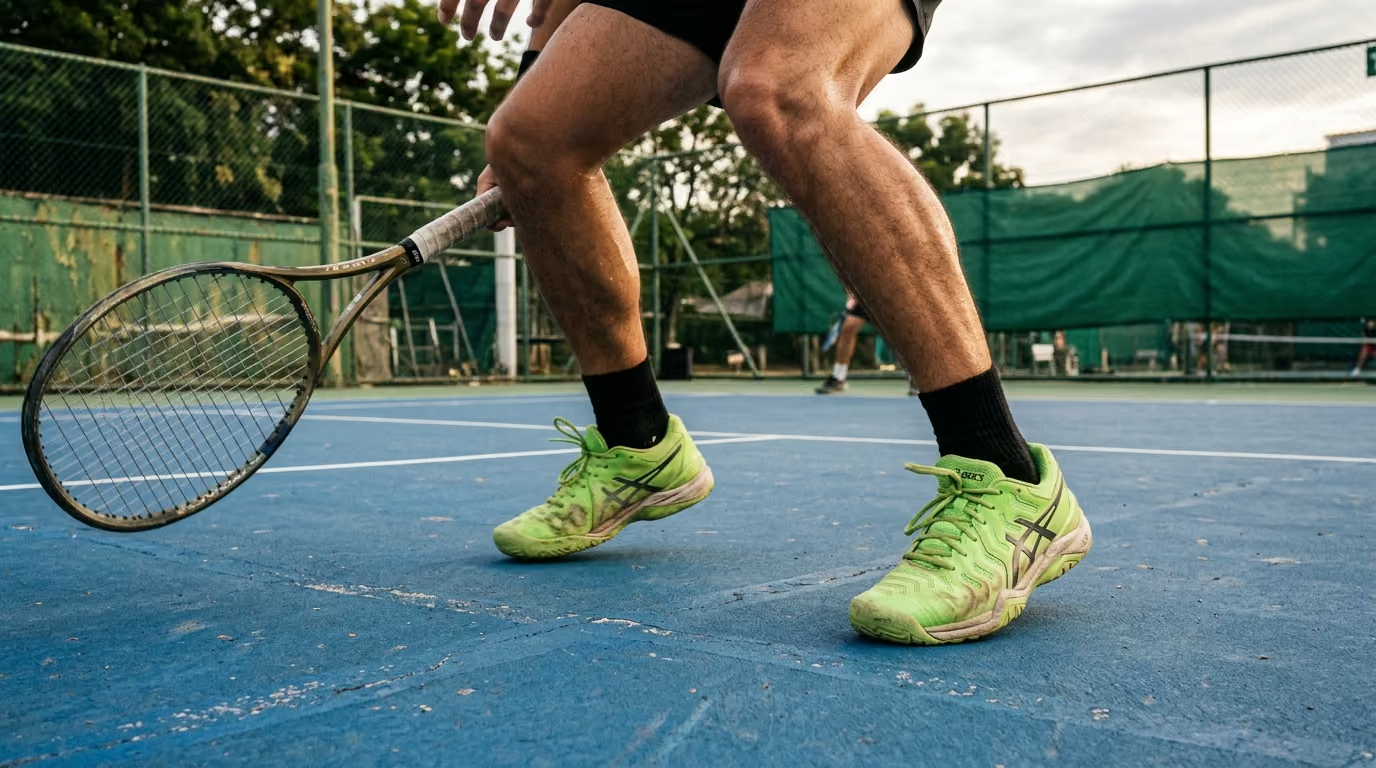
Racquet sport athletes gain targeted strength at precise joint angles, condition tendons, and maintain physical durability over a long playing career.




Isometric training is the practice of producing muscular force against an immovable external resistance or holding a static position without visible movement at a joint. It is not a complete replacement for dynamic strength training, nor is it a shortcut to athletic power. Instead, it is a highly targeted training method that allows players to build strength at precise joint angles, condition tendons, and maintain physical durability over a long playing career. This resource provides an in-depth examination of how static holds fit into your routine, the science behind their effectiveness, and the specific progressions that can help you play without interruption.
For tennis, pickleball, and padel players, isometric training is a practical method to develop localized joint strength, prepare tendons for high-force impacts, and maintain physical performance with minimal joint wear. These holds allow players to load specific positions, such as the split-step landing or lateral lunge, without the repetitive impact of full-range movement. When integrated correctly with a broader program, isometrics provide a safe, scalable foundation for court athletes of all ages.
Research indicates that isometric contractions can produce substantial adaptations in both muscular strength and tendon stiffness. When you perform a static hold, the muscle fibers contract and build tension, even though the overall length of the muscle-tendon unit remains relatively constant. According to a systematic review by Oranchuk and colleagues, these adaptations are highly dependent on factors such as training intensity, muscle length, and the duration of the contraction. Choosing the right style of hold is essential to achieving your specific athletic goals.
One of the most notable features of isometric training is joint-angle specificity. A controlled study by Lanza and colleagues showed that isometric strength gains are greatest near the specific angle trained. In their research, training at a sixty-five-degree angle increased maximum voluntary torque by twelve percent at that exact position. The improvements at other tested angles were significantly smaller, ranging from five to eleven percent. This means that if you only train a muscle in a short position, you will not build significant strength in its longer, more vulnerable ranges.
To build comprehensive strength, players should prioritize holds at longer muscle lengths. Oranchuk and colleagues found that training at longer muscle lengths tends to produce greater muscle hypertrophy and a better transfer to dynamic athletic movements. For a court athlete, this means holding a split squat at a deep, stable depth rather than a shallow one. It also means choosing joint angles that replicate the deep defensive lunges required during a match. This approach builds strength where your muscles are most vulnerable to strain.
Tendon adaptation is another key scientific consideration for racquet sports. Tendons respond to mechanical tension, but the magnitude of the load determines the structural adaptation. Research compiled by Oranchuk and colleagues suggests that high-intensity contractions, typically seventy percent or more of your maximal voluntary contraction, are generally required to improve tendon stiffness and thickness. A systematic review of tendon-loading interventions found strong evidence that high-intensity isometric training increases Achilles tendon stiffness. These high-force holds send a strong mechanical signal to the tendon tissue without the wear and tear of repetitive impact.
However, the science also reminds us of the limitations of static training. A review by Bomba and colleagues suggests that while isometrics improve dynamic performance, they must be combined with dynamic exercises to build strength across a full range of motion. Static holds do not train the coordination, timing, or rapid stretch-shortening cycles needed for sprinting and jumping. Therefore, isometrics are best viewed as a supportive tool within a comprehensive training program.
Court sports place unique physical demands on the human body, requiring a combination of rapid deceleration, rotational power, and single-leg stability. A match often consists of high-intensity rallies separated by brief periods of rest. Research by Fernández-Fernández and colleagues highlights that these sports require repeated multi-directional movements, placing significant stress on the knees, ankles, and shoulders. Over the course of a long match, this constant braking and accelerating can lead to localized fatigue and reduced joint stability.
A study measuring physical changes during prolonged play showed that a three-hour match can cause a nine percent reduction in maximal voluntary leg strength. This loss of force production is often accompanied by a decline in leg stiffness and an increase in perceived muscle soreness. When leg stiffness decreases, your ability to absorb landing forces and push off efficiently is compromised. Integrating these holds into your strength and conditioning routine can help build the local endurance needed to resist this late-match fatigue.
Isometric training is also highly valuable because it allows you to target precise positions that are difficult to load dynamically. For instance, the split-step landing requires a player to absorb force rapidly in a wide, low stance. By holding a wide split squat statically, you can train your nervous system to stabilize the hips and knees in this exact posture. This positional control is crucial for maintaining balance and transitioning smoothly into your next stride.
For players focused on healthy aging and athletic longevity, static training provides a low-impact alternative to traditional lifting. As we age, joints may become sensitive to repeated bending under heavy loads. Isometric holds allow you to apply high levels of muscular tension without moving the joint through a painful range of motion. This makes it easier to maintain muscle mass, tendon integrity, and movement confidence without aggravating arthritic joints or old injuries.
Applying isometric training to your routine does not require complex equipment or long hours in the gym. You can integrate static holds directly into your warm-up, your court-side preparation, or your off-court training sessions. The key is to match the type of hold to your immediate objective, whether that is physical preparation, strength building, or skill integration. By following a structured approach, you can ensure that your static training transfers directly to your movement on the court.
During a warm-up, short submaximal holds can be used to prepare your nervous system and muscles for play. For example, performing two sets of a fifteen-second split squat hold before you step onto the court can activate your quadriceps and glutes. This static activation helps your body recognize stable alignment before you begin dynamic moving. It is an excellent way to prime your posture without accumulating the fatigue that comes from dynamic jumping or sprinting. Keep these warm-up holds brief and focus on maintaining a level pelvis and stable knees.
If you are training for raw strength, you should perform high-intensity isometrics early in your workout. These efforts require maximum neural drive, meaning your brain is sending the strongest possible signals to your muscles. Attempt to push or pull against an immovable object, such as a wall or a locked barbell, for three to six seconds per repetition. Because these efforts are highly demanding, you must rest for at least two minutes between sets to allow your nervous system to recover. This approach is highly effective for building force production at specific joint angles.
For on-court integration, you can pair a static hold with an immediate dynamic movement. This method, often called contrast training, helps connect static strength to dynamic coordination. For instance, you can hold a deep lateral lunge for five seconds, then immediately perform three rapid lateral shuffles. This sequence teaches your brain to use the force generated during the hold to power your explosive movement. It is a highly practical way to bridge the gap between static gym exercises and fluid court movement.
While all racquet sports share some physical demands, the specific movement profiles of tennis, pickleball, and padel require different training focuses. Understanding these differences allows you to customize your isometric program to the unique demands of your preferred sport. This targeted approach ensures that you are spending your training time on the positions that matter most for your court performance.
Tennis players operate on a large court, which demands long sprints, deep lateral slides, and high-impact decelerations. The ground reaction forces in tennis are substantial, particularly on hard courts. To prepare for these forces, tennis players should focus on deep, long-muscle-length holds, such as deep split squats and wide lateral lunges. These positions build the strength needed to decelerate from a full sprint. Additionally, tennis players require high-force calf holds to prepare the Achilles tendon for the repeated sprint starts and jumps typical of the sport.
Pickleball is played on a much smaller court, which reduces the need for long-distance sprinting but increases the demand for rapid, low-profile footwork. Pickleball players spend a significant amount of time in a low, athletic stance near the non-volley zone line. This requires exceptional endurance in the quadriceps, hips, and lower back. Pickleball players should prioritize moderate-depth split squat holds and wide, shallow stance holds for longer durations, such as thirty to forty-five seconds. These endurance-oriented holds prepare the lower body to sustain a low athletic posture without losing positional control.
Padel involves a high volume of overhead play, wall rebounds, and rapid changes of direction within an enclosed court. The frequent overhead smashes and transitions demand exceptional shoulder stability and trunk control. Padel players should focus heavily on shoulder external-rotation holds and scapular wall presses to protect the rotator cuff from the stress of constant overhead hitting. Additionally, the rapid turns in padel require strong trunk anti-rotation holds, such as the Pallof press. These holds help players transfer force efficiently from the lower body through the torso and into the racquet.
To build a resilient lower body, you must select exercises that target the major muscle groups used in braking, lunging, and jumping. The following exercises are highly effective for court athletes and can be easily adjusted to match your current fitness level. By focusing on precise alignment and gradual progression, you can build the physical capacity needed to handle demanding court movement.
The split squat hold is the foundation of lower-body static training. This exercise targets the quadriceps, glutes, and hip stabilizers in a stance that closely mimics court movement. To set up, place one foot forward and one foot back, then lower your hips until your back knee is just above the floor. Keep your front foot flat on the ground and ensure your front knee tracks in a straight line over your toes. Hold this position while keeping your trunk upright and your pelvis level. You can progress this exercise by holding dumbbells or by elevating your rear foot on a low bench.
The lateral lunge hold is essential for preparing the body for wide defensive reaches. To perform this exercise, step out to the side and bend your loading leg while keeping the opposite leg straight. Keep your weight centered over the middle of your loading foot and avoid letting your knee collapse inward. Your trunk should have a slight, natural forward lean, but you must avoid rounding your lower back. Hold this position to build strength in the adductors and glutes at a long muscle length. You can increase the challenge by holding a weight in the opposite hand.
Calf-raise isometrics are critical for protecting the Achilles tendon and improving push-off power. To perform a single-leg calf hold, stand on one foot and raise your heel until you are on the ball of your foot. Hold this position without letting your ankle wobble or your heel drop. For a complete program, perform some holds with a straight knee to target the gastrocnemius, and others with a bent knee to target the soleus. You can add load by holding a dumbbell in the hand on the same side as your working leg.
The Spanish squat hold is a highly effective way to load the knee extensors with minimal joint stress. To set up, loop a heavy resistance band around a secure post and place the band behind your knees. Step back until the band is taut, then lower your hips into a shallow squat position as if sitting in a chair. Keep your shins vertical and push your knees back against the resistance of the band. This hold targets the quadriceps without placing excessive pressure on the kneecap, making it a great option for players managing joint sensitivity.
A strong upper body and a stable midsection are essential for transferring power from your legs to your racquet. Static holds are excellent for training the core to resist unwanted movement and training the shoulder to stabilize the arm during high-speed swings. By integrating these upper-body and trunk exercises, you can improve your swing efficiency and protect your joints from repetitive strain.
The Pallof press hold is an exceptional anti-rotation exercise that teaches your core to resist twisting forces. To perform this hold, stand sideways to a cable machine or resistance band anchor. Hold the handle against your chest, step away to create tension, and then press the handle straight out in front of you. Your goal is to keep your hands centered in front of your chest without letting the band pull your torso toward the anchor point. Hold this position for twenty seconds while breathing naturally and keeping your hips stable. This exercise builds the trunk stiffness needed to transfer force during rotational groundstrokes.
The shoulder external-rotation isometric is critical for rotator-cuff health and shoulder stability. To set up, stand next to a wall or cable machine with your elbow bent at a ninety-degree angle and tucked against your ribs. Press the back of your hand outward against the wall or cable resistance without letting your elbow leave your side. To make the exercise more sport-specific, you can also perform this hold with your arm elevated to shoulder height. This variation targets the rotator cuff in a position that closely resembles the overhead serve.
Tennis-elbow prevention recommendations from organizations like the International Tennis Federation emphasize the importance of forearm, wrist, and grip strength. The wrist-extension isometric is a simple but powerful exercise for building the capacity of the forearm extensors. Rest your forearm on a flat surface with your palm facing down and your wrist extending slightly over the edge. Use your opposite hand, a cable, or a small dumbbell to apply downward pressure while you resist the movement and keep your wrist in a neutral, slightly extended position. Hold this contraction for twenty to thirty seconds, ensuring you do not grip the weight too tightly.
To complete your upper-body program, integrate a direct grip-strength hold. The racquet-grip hold is a highly functional way to build local endurance in the hand and forearm. Hold your racquet using your normal stroke grip, and have a partner gently try to twist or move the racquet face. Your goal is to maintain a firm, stable wrist and resist any movement from your partner. This drill trains the exact muscular coordination needed to handle ball impact without allowing the wrist to collapse.
To get the most out of isometric training, you must organize your exercises into a logical framework based on your specific physical goals. Simply holding random positions for arbitrary amounts of time will produce inconsistent results. By using structured programming frameworks, you can target maximal force production, local endurance, or tendon health with precision.
The first framework focuses on maximal-force production, which is designed to build raw, angle-specific strength. This approach is best suited for overcoming isometrics, where you push or pull as hard as possible against an immovable object. Perform these efforts for three to six seconds, aiming for eighty to one hundred percent of your maximal effort. Because these contractions are highly demanding on the nervous system, limit your volume to three to six repetitions per set and rest for at least two minutes between efforts. This framework should be used early in a session when your body is fully rested.
The second framework targets strength endurance, which helps you maintain your posture and court position during long rallies. For this approach, use submaximal holds with your bodyweight or moderate external loads. Hold each position for fifteen to forty-five seconds, completing two to four sets per exercise. The focus during these holds must be on perfect body alignment rather than surviving a maximal struggle. Stop the set immediately if your knee begins to collapse, your pelvis rotates, or your posture breaks down.
The third framework is designed for tendon-oriented loading, which is useful for players looking to improve tendon capacity. To build tendon stiffness, you must use high-intensity loads that exceed seventy percent of your maximal voluntary contraction. Hold these heavy positions for five to eight seconds, repeating the effort for three to five repetitions. This high-force loading should be introduced gradually, starting with comfortable joint angles before moving to longer, more challenging muscle lengths. Always monitor your next-day joint stiffness and discomfort to ensure the training dose is appropriate.
The fourth framework is position-specific preparation, which links static holds directly to dynamic movement. To apply this method, select a court-specific position, such as a lateral lunge, and hold it for five to ten seconds. As soon as you release the hold, immediately transition into a dynamic movement, such as a lateral shuffle or a shadow swing. This pairing teaches your nervous system to utilize the motor units activated during the hold to power your movement. It is an excellent way to transition your static strength gains directly into sport-specific coordination.
Although isometric training is highly accessible, several common errors can limit its effectiveness or increase your risk of joint irritation. Recognizing these pitfalls allows you to adjust your technique and programming for better results. By training mindfully, you can ensure that your static holds support your long-term athletic longevity and improve your overall mobility and movement control on the court.
The first common mistake is assuming that a single static hold will build strength across your entire range of motion. Research shows that isometric strength gains are highly specific to the angle trained. If you only perform split squat holds at a shallow depth, you will remain weak in the deeper positions required during a match. To avoid this pitfall, you must train at multiple joint angles or pair your isometrics with dynamic, full-range resistance training.
Another frequent error is prioritizing hold duration over alignment quality. Many players believe that holding a position for a longer time is always better, even if their form collapses. If your knee caves inward during a split squat hold, or if your lower back arches during a plank, you are reinforcing poor movement patterns. The moment you cannot maintain proper joint alignment, the exercise is no longer productive. Always end the set when your form begins to deteriorate, regardless of how much time is left on the clock.
A third mistake is using isometric holds as an excuse to avoid dynamic movement entirely. While static holds are excellent for targeting positions and tendon loading, they cannot replicate the timing, balance, and coordination of actual play. To maintain your movement skill, you must continue to perform dynamic exercises, landing drills, and on-court footwork. Isometrics should be a supportive component of your program, not the entirety of your physical preparation.
Finally, players often treat isometric training as if it is entirely free of fatigue. While static holds do not involve landing impact, high-intensity holds can still cause significant muscular and neural fatigue. Performing maximal-effort holds immediately before a demanding match can reduce your technical precision and movement speed. Always plan your high-force holds for dedicated training days or after your court sessions to ensure you are fresh for play.
Understanding how isometric training affects your recovery and tissue health is essential for managing your total training volume. Unlike dynamic lifting, static holds do not involve repetitive eccentric lengthening under load, which is a primary cause of muscle soreness. This unique characteristic makes isometrics a valuable tool for maintaining physical capacity without creating excessive muscle soreness.
Because static training does not involve joint movement, it avoids the repetitive friction that can irritate sensitive joint structures. This makes it an ideal option for players managing minor joint soreness or those returning from a period of inactivity. By applying tension to the muscles and tendons without moving the joint, you can preserve muscle activation and tendon capacity. This low-impact loading helps maintain your physical base without overstressing your cartilage or ligaments.
Furthermore, high-intensity isometric holds provide a strong mechanical stimulus to your tendons, encouraging structural remodeling and increased stiffness. This increased stiffness is crucial for court sports, as it allows your tendons to absorb and return elastic energy more efficiently during sprinting and jumping. However, because tendons adapt slowly, you must progress your training load gradually over several weeks. Consistent, high-quality loading is far more effective for tendon health than occasional, excessive training sessions.
It is also important to remember that static holds can still create significant metabolic fatigue within the muscle. During a long-duration hold, the constant muscle contraction restricts blood flow to the tissue, creating a strong local burning sensation and accumulating metabolic waste products. This local fatigue can temporarily reduce your force production and coordination. To support tissue health, ensure you allow adequate recovery time between heavy sessions and maintain a balanced program that includes mobility work and light recovery movement.
While isometric training is a safe and scalable method for most players, it is not a substitute for professional medical care when dealing with physical injuries. Knowing how to distinguish between normal exercise discomfort and signs of a more serious issue is essential for protecting your long-term health. If you experience warning signs of injury, you should consult a qualified healthcare provider for a comprehensive assessment.
Normal exercise discomfort typically presents as a mild, stable muscle burn during the hold, followed by temporary muscle fatigue after the session. This sensation should not worsen as the exercise continues, and it should not interfere with your normal daily movements. If you experience a sharp, stabbing, or radiating pain during a hold, you must stop the exercise immediately. This type of pain is a clear signal that the joint angle, load, or position is inappropriate for your current physical capacity.
You should seek professional medical evaluation if you notice persistent joint swelling, marked loss of strength, or a feeling of instability in the knee, ankle, or shoulder. Other clear red flags include any numbness, tingling, or shooting pain that travels down your arm or leg. These symptoms may indicate nerve compression or significant tissue damage that requires a targeted clinical diagnosis. Attempting to train through these warning signs can lead to more severe injuries and prolonged time away from the court.
Additionally, if you are managing chronic tendon issues that do not improve with gradual loading, a physical therapist can provide an individualized assessment. They can help identify underlying movement compensations, measure your specific strength deficits, and design a customized rehabilitation pathway. Partnering with a professional ensures that you are addressing the root cause of your physical limitations, allowing you to return to the sports you love with confidence and durability.
To implement isometric training safely and effectively, follow this structured four-phase progression. This framework gradually increases the physical demands of the holds, ensuring your body has adequate time to adapt. Adjust the duration of each phase based on your training experience, current fitness level, and symptom response.
The goal of this phase is to establish stable alignment and build local muscular tolerance. Focus on bodyweight or light external loads, keeping the exercises supported and highly stable. Perform two to three sets of fifteen- to thirty-second holds, ensuring your posture remains perfect throughout the set. Examples include wall sits, supported split squat holds, and double-leg calf-raise holds. Spend one to three weeks in this phase before progressing.
In this phase, you will gradually increase the physical challenge by adding external load or moving to unilateral exercises. Perform three to four sets of twenty- to forty-five-second holds, or transition to shorter holds of five to eight seconds with increased resistance. Focus on maintaining a level pelvis and stable joint alignment under the heavier load. Excellent options for this phase include loaded split squat holds, single-leg calf holds, and full side planks.
This phase introduces high-intensity holds and positions that place the target muscles in a longer, more challenging range of motion. Perform short, near-maximal efforts of three to six seconds, allowing two to three minutes of rest between sets to ensure high neural output. Ensure you only load these deep positions if you can maintain technical control and remain pain-free. Examples include heavy overcoming leg presses, deep split squat holds, and high-load calf isometrics.
The final phase connects your static strength gains to the dynamic movement patterns used on the court. Perform a five- to ten-second isometric hold, then immediately follow it with a dynamic, explosive movement. This pairing teaches your nervous system to utilize the recruited muscle fibers to power your court movement. Examples include a lateral lunge hold followed by a lateral shuffle, or a wrist-extension hold followed by controlled shadow swings.
Isometric training can improve your power output indirectly by building a more stable physical foundation. When you perform holds for the shoulder, trunk, and lower body, you improve your ability to transfer force through your kinetic chain. This improved force transmission allows you to deliver more power into your racquet during dynamic swings. However, to see a direct improvement in speed, you must combine these static holds with explosive dynamic exercises, such as medicine-ball throws and actual serve practice.
For most recreational and competitive players, performing isometric exercises two to three times per week is highly effective. You can include them as part of your regular strength sessions or perform them as a brief warm-up before you play. If you are using high-intensity holds for maximum strength, allow at least forty-eight hours of recovery between sessions targeting the same muscle groups. For lighter postural holds or forearm work, you can perform them more frequently, provided they do not interfere with your recovery or court performance.
Yes, static holds are an exceptionally safe and scalable option for older players. The World Health Organization recommends muscle-strengthening activities at least two days per week for older adults to maintain physical independence and joint health. Isometric exercises allow older players to build strength and balance without the high-impact landing forces that can irritate sensitive joints. Starting with supported, bodyweight positions allows you to build confidence and strength safely before moving to dynamic movements.
Isometric exercises can be a valuable part of managing early forearm sensitivity, but they must be introduced carefully. According to the International Tennis Federation, grip and forearm strengthening can help build the tissue capacity needed to handle ball impact. Start with low-to-moderate wrist-extension holds in a pain-free range of motion, and avoid gripping the weight too tightly. If your symptoms worsen during or the day after the exercise, reduce the load or duration, and consult a healthcare professional if the discomfort persists.
Isometric training is a highly effective, low-impact tool that belongs in a comprehensive conditioning program for racquet sports. By allowing you to target specific joint angles and load tendons with high force, static holds build physical resilience exactly where you need it most. However, isometrics are not a complete replacement for dynamic training, nor are they a guaranteed cure for joint pain. To maximize your athletic longevity, combine progressive static holds with dynamic strength training, landing drills, and proper recovery protocols.
Follow Evercourts for practical insights on tennis, pickleball and padel performance, movement, recovery and healthy ageing. Stay connected for new articles, research-led guidance and ideas to help you play well and keep playing for years.


Read practical guidance for better movement, smarter preparation and a game that keeps working for you.
explore the Blog