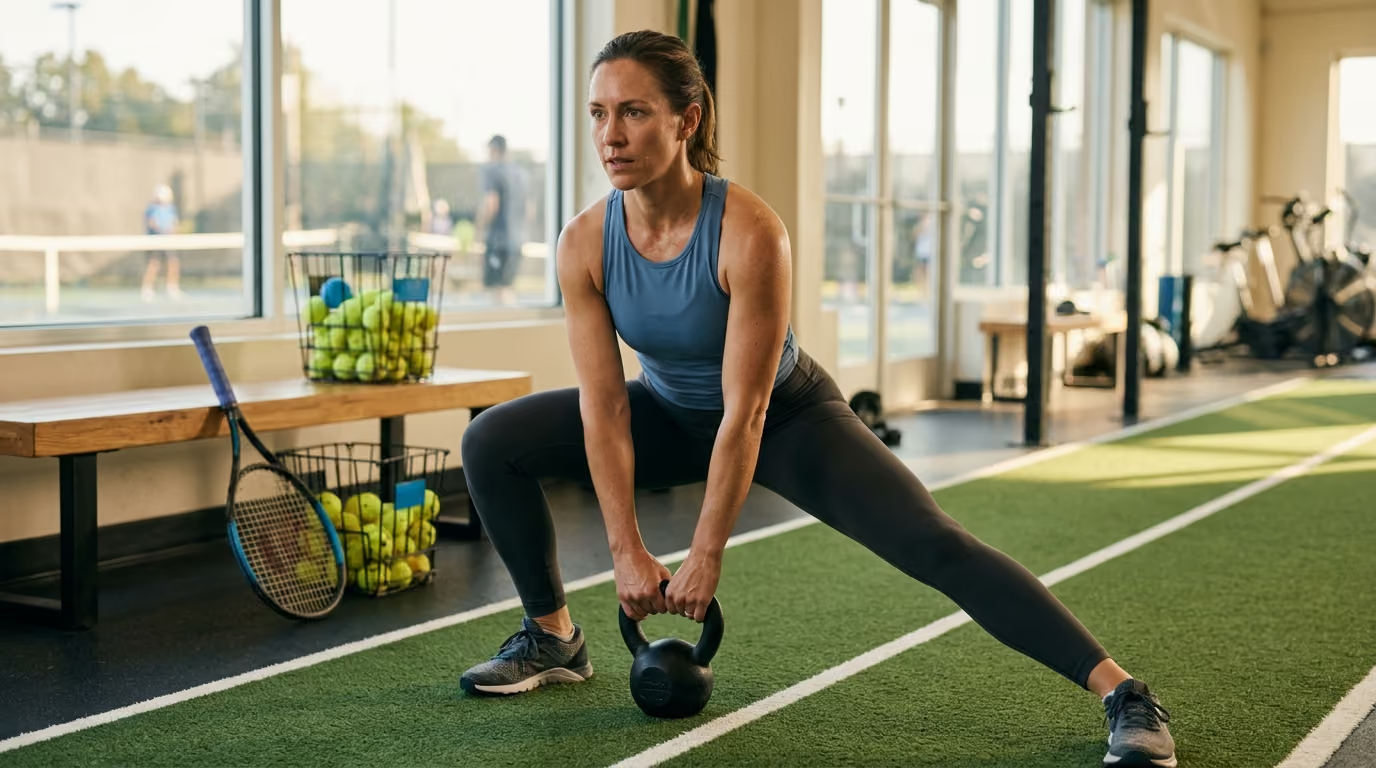
Many racquet sports players struggle with a common on-court frustration. They can run forward to reach a drop shot, but they cannot stop quickly enough to recover their position. They find themselves overrunning the ball, losing balance during wide lunges, or feeling sluggish when trying to change direction.
Lower-body training for court sports requires a structured progression from general force capacity to unilateral control, eccentric braking, and rapid power development. This sequence builds the physical capacity to accelerate, change direction, and absorb impact on a single leg. Consistent practice of these progressions helps players maintain court coverage while supporting athletic longevity.
Lower-Body Demands in Racquet Sports
Court coverage depends on more than simple running speed. To cover the court effectively, a player must initiate movement rapidly, lower their center of mass, and brake without losing balance. They must also push off in a new direction and maintain trunk control while reaching for the ball. A player who can accelerate but cannot brake will often arrive late or hit from an unstable position.
True court balance is dynamic rather than static. It requires controlling your center of mass while moving at high speeds, tolerating sudden disruptions, and keeping your joints aligned during heavy loading. Research on padel players has shown that many athletes demonstrate poor dynamic balance on standardized reach tests. This indicates a clear need for targeted lower-limb strengthening and stability work.
Deceleration is the ability to reduce momentum through the coordinated action of the feet, ankles, knees, hips, and trunk. It involves a braking impulse to reduce velocity, postural control to maintain a usable body position, and a reorientation phase to redirect force. Whether you are hitting a lateral lunge in tennis, a crossover step in padel, or a quick split-step landing in pickleball, your body relies on eccentric strength.
A review of change-of-direction training concluded that strength training is highly useful for strength-oriented directional changes. Plyometric training influences both strength-oriented and velocity-oriented movements, while sprint work targets maximum velocity. For court athletes, combining bilateral and unilateral strength work is ideal. This is because changing direction requires massive unilateral eccentric strength during braking and unilateral concentric strength during the subsequent push-off.
Bilateral Versus Unilateral Training
Bilateral exercises are movements where both legs contribute simultaneously to lift a load. Examples include the back squat, trap-bar deadlift, and Romanian deadlift. These exercises are highly efficient for developing high total force and targeting large muscle groups like the quadriceps, gluteals, and hamstrings. They allow you to lift heavier weights with relatively low coordination demands, making them excellent for building a broad strength baseline.
Unilateral exercises require one leg to produce or absorb the majority of the force. Examples include split squats, step-ups, and single-leg Romanian deadlifts. These movements closely match the unilateral demands of court play, where you rarely push off with both feet perfectly parallel. Unilateral training helps athletes practice force production from a split stance, improves pelvic alignment, and highlights strength differences between your left and right legs.
A systematic review and meta-analysis published in sports medicine literature compared these two training styles. The researchers found no significant differences in muscle growth between unilateral and bilateral training. However, strength gains were task-specific. Bilateral training produced greater gains in bilateral strength, whereas unilateral training was superior for building unilateral strength.
Rather than choosing one style exclusively, court athletes should combine both. Use bilateral lifts to raise your overall force ceiling and build a robust physical foundation. Use unilateral exercises to develop single-leg control, manage structural imbalances, and prepare your joints for the specific angles of court movement. This balanced approach is highly effective for comprehensive strength and conditioning guidelines designed for racquet sports.
Phase 1: Movement Competency and Tissue Tolerance
The goal of this initial phase is to establish consistent joint alignment and build tissue tolerance. It is particularly valuable for older recreational players, deconditioned athletes, or those returning from a long break. Focus on clean movement patterns rather than high levels of fatigue.
Goblet Squats
- Objective: To build bilateral knee and hip flexion while maintaining an upright torso.
- Setup: Stand with your feet slightly wider than shoulder-width apart, holding a dumbbell or kettlebell close to your chest.
- Execution: Sit back and down as if lowering into a chair, keeping your elbows inside your knees. Push through your whole foot to return to the starting position.
- Progression: Gradually increase the depth of the squat or increase the weight of the held dumbbell.
Supported Split Squats
- Objective: To introduce single-leg loading with external balance assistance.
- Setup: Place one foot forward and one foot back in a long split stance, holding a stable rack or wall with one hand.
- Execution: Lower your back knee slowly toward the floor, keeping your front heel flat. Push back up primarily using your front leg while using the wall for balance.
- Progression: Transition to an unsupported split squat, holding light dumbbells at your sides.
Low Step-Downs
- Objective: To develop eccentric control of the knee and hip during single-leg descent.
- Setup: Stand on a low platform or step that is roughly two to four inches high.
- Execution: Extend one leg off the side and slowly lower your hips until that heel touches the floor. Keep your standing knee tracking directly over your middle toe.
- Progression: Increase the step height to six inches once you can complete ten controlled repetitions without your knee collapsing inward.
Tibialis Raises
- Objective: To strengthen the muscles on the front of the shin to assist with deceleration and foot clearance.
- Setup: Stand with your upper back resting against a wall and your feet placed roughly twelve inches away from the wall.
- Execution: Keep your knees straight and pull your toes up toward your shins as high as possible. Pause at the top for one second before lowering your toes slowly back to the floor.
- Progression: Move your feet further from the wall to increase the resistance on the shins.
Phase 2: Foundational Bilateral Strength
Once movement patterns are consistent, the focus shifts to building maximum force capacity. According to the American College of Sports Medicine (ACSM), intermediate trainees should utilize periodized loading. This means using a variety of repetition ranges to stimulate both strength and structural durability.
Trap-Bar Deadlifts
- Objective: To develop high total-body force through a joint-friendly lifting position.
- Setup: Step inside a hexagonal trap-bar, bend at your hips and knees, and grip the handles firmly.
- Execution: Keep your chest up and drive your feet into the floor to stand up straight. Squeeze your glutes at the top without leaning backward or arching your spine.
- Progression: Increase the load by two to ten percent when you can complete your target repetitions with perfect form.
Romanian Deadlifts
- Objective: To target the hamstrings and glutes, which act as the brakes during sudden forward stops.
- Setup: Hold a barbell or two dumbbells in front of your thighs with a shoulder-width stance.
- Execution: Push your hips straight back while keeping a flat spine and a very slight bend in your knees. Lower the weight until you feel a stretch in your hamstrings, then drive your hips forward to return to standing.
- Progression: Increase the load slowly or transition to a single-leg variation with support.
Double-Leg Calf Raises
- Objective: To build strength in the gastrocnemius and soleus muscles to protect the Achilles tendon.
- Setup: Stand on the edge of a step with your heels hanging off the back, holding a handrail for balance.
- Execution: Lower your heels below the level of the step to feel a stretch, then press up as high as possible on your big toes. Hold the top position for a full second before lowering down.
- Progression: Hold a dumbbell in one hand to increase the load on the calves.
Phase 3: Unilateral and Asymmetrical Strength
This phase transitions the strength built in bilateral lifts into asymmetrical positions. This directly reflects the single-leg demands of court movement. Unilateral exercises can also highlight hidden strength differences between your dominant and non-dominant sides.
Rear-Foot-Elevated Split Squats
- Objective: To load the front leg heavily while stretching and strengthening the rear hip flexor.
- Setup: Stand about two feet in front of a low bench or step, placing the top of your back foot on the bench.
- Execution: Lower your hips down until your front thigh is parallel to the ground, keeping your front knee aligned over your foot. Drive through your front heel to stand up.
- Progression: Hold dumbbells at your sides or use a barbell across your upper back.
Single-Leg Romanian Deadlifts
- Objective: To build single-leg hamstring and glute strength while developing pelvic stability.
- Setup: Stand on one leg, holding a dumbbell in the opposite hand of your standing foot.
- Execution: Hinge at your hip, reaching your non-standing leg straight back behind you like a see-saw. Keep your hips square to the floor and return to an upright position by squeezing your standing glute.
- Progression: Perform the movement without external support or increase the weight of the dumbbell.
Lateral Lunges
- Objective: To develop strength in the frontal plane, which is essential for lateral shuffling and court-wide reaching.
- Setup: Stand with your feet together, holding a dumbbell in a goblet position.
- Execution: Take a wide step to the right, bending your right knee and pushing your hips back while keeping your left leg straight. Push forcefully off your right foot to return to the starting position.
- Progression: Increase the depth of the lunge or use heavier dumbbells held at your sides.
Step-Ups with Knee Drive
- Objective: To transition force from a single-leg push to an athletic posture.
- Setup: Place your right foot on a sturdy box that is roughly mid-shin height.
- Execution: Drive through your right heel to stand on the box, bringing your left knee up toward your chest in a running motion. Lower your left foot slowly back to the floor with complete control.
- Progression: Hold a dumbbell in the opposite hand of the stepping leg to challenge rotational stability.
Phase 4: Eccentric Strength and Deceleration
To change direction quickly, you must first stop. Deceleration-specific training focuses on absorbing force efficiently. This helps protect your joints and prepares your muscles to transition from braking to propulsion.
Slow Split-Squat Lowering
- Objective: To build eccentric strength in the quadriceps and patellar tendon.
- Setup: Assume a standard split squat stance with or without external load.
- Execution: Lower your back knee toward the floor over a full five-second count. Once your knee is just above the floor, stand up quickly in one second.
- Progression: Add load or transition to a rear-foot-elevated position.
Lateral Squat Catches
- Objective: To train the body to catch and stabilize its weight during lateral movements.
- Setup: Stand with a wide stance, keeping your weight centered.
- Execution: Shift your weight rapidly to one side, dropping into a deep lateral lunge and stopping the movement instantly at the bottom. Hold this bottom position for two seconds before pushing back to center.
- Progression: Hold a light medicine ball and catch it at the same time you drop into the lunge.
Low-Height Drop Landings
- Objective: To teach correct landing mechanics and force absorption.
- Setup: Stand on a low box or step that is roughly six to twelve inches high.
- Execution: Step off the box with one foot and land on both feet, dropping into a soft squat position. Ensure your knees do not cave inward and your landing is quiet.
- Progression: Land on a single leg and hold the balance for two seconds.
Deceleration Run to Stick
- Objective: To apply deceleration mechanics to forward running.
- Setup: Mark out a distance of five yards on a flat surface.
- Execution: Accelerate forward for three steps, then brake sharply in a split stance within two steps, holding the final position. Keep your hips low and your chest slightly forward.
- Progression: Increase the acceleration distance to ten yards to generate more forward momentum before braking.
Phase 5: Power Development and Rapid Force Production
Power is the ability to apply your strength very quickly. The ACSM guidelines recommend utilizing moderate loads of thirty to seventy percent of your maximum lift with fast speed for power training. Always perform these exercises when you are fresh, and stop the set if your movement speed drops.
Countermovement Jumps
- Objective: To develop bilateral vertical power using the stretch-shortening cycle.
- Setup: Stand with your feet hip-width apart, keeping your hands at your sides.
- Execution: Swing your arms back and bend your knees quickly, then immediately reverse the movement to jump as high as possible. Land softly with bent knees to absorb the impact.
- Progression: Hold light dumbbells or place your hands on your hips to eliminate arm assistance.
Lateral Bounds
- Objective: To build lateral explosive power, which is essential for reaching wide balls.
- Setup: Stand on your right leg with your knee slightly bent.
- Execution: Push off your right foot to leap sideways to the left, landing on your left leg and holding your balance. Hold the landing for one second before leaping back to the right.
- Progression: Increase the distance of the bound or decrease the ground contact time.
Single-Leg Pogos
- Objective: To build ankle stiffness and reactive power in the lower leg.
- Setup: Stand on one leg with a tall, upright posture.
- Execution: Perform short, rapid hops on your forefoot, keeping your ankle stiff and spending as little time on the ground as possible. Ensure your knee remains relatively straight so the force is absorbed by the calf and Achilles.
- Progression: Perform the hops while moving forward or laterally over a short line.
Phase 6: Reactive and Sport-Specific Force Production
The final phase of training integrates your strength and power into unpredictable court scenarios. This is where you transition from planned gym movements to reactive, sport-specific actions.
Split-Step to Lateral Push-Off
- Objective: To train the transitional footwork used before almost every court shot.
- Setup: Stand in an athletic stance facing forward.
- Execution: Perform a small hop and land with your feet wide, instantly pushing off your left foot to sprint to the right. Make the transition from the landing to the sprint as fast as possible.
- Progression: Initiate the movement only when a partner claps or points in a direction.
Crossover Step Recovery
- Objective: To train the recovery footwork used to return to the center of the court after a wide shot.
- Setup: Stand in a deep lateral lunge position to simulate a wide hit.
- Execution: Push off your outside foot, cross that leg over the front of your standing leg, and transition into a rapid lateral shuffle back to your starting point.
- Progression: Perform this drill on a court, moving from the singles sideline back to the center mark.
Forward Run to Backward Transition
- Objective: To develop the ability to brake from a forward run and immediately backpedal.
- Setup: Place two cones five yards apart.
- Execution: Sprint to the first cone, brake quickly with short steps, and immediately transition into a backward run to the starting cone. Keep your center of mass low during the transition to avoid falling backward.
- Progression: Have a partner call out a change of direction while you are in motion.
Sport-Specific Biomechanics and Demands
While tennis, pickleball, and padel share many movement qualities, each sport places unique demands on your lower body. Understanding these differences allows you to customize your training to match the specific physical stresses of your preferred game.
Tennis
Tennis is characterized by high-velocity directional changes, wide lateral sliding, and heavy rotational loading. Players must frequently hit from wide, open-stance positions, which places massive eccentric stress on the outer leg. A systematic review of tennis injuries noted that lower-limb trauma accounts for approximately 48% to 56% of all tennis injuries. To prepare for these demands, tennis players should focus on deep lateral lunging, single-leg landing control, and excellent hamstring capacity to support high-speed braking. Practicing mobility and movement patterns specific to tennis can also help players move more fluidly during deep court transitions.
Pickleball
Pickleball features short, rapid accelerations, constant lateral shuffling at the non-volley zone, and frequent lunging for low ball placements. A cross-sectional study of 92 recreational pickleball players found that 42% of participants reported falling during play. Lunging accounted for 57% of those falls, while moving backward accounted for 24%.
Interestingly, while hip abduction strength did not directly distinguish fallers from non-fallers, greater hip strength was strongly associated with faster performance on court agility tests. Pickleball players need a training program that prioritizes multidirectional lunges, quadriceps strength, and backward movement mechanics. This comprehensive approach is much more effective than simply performing isolated hip exercises.
Padel
Padel is a fast-paced game played within a glass enclosure. It involves short sprints, abrupt stops, and unique rotational movements to respond to wall rebounds. A scoping review of padel injuries highlighted the knee and ankle as the most common sites of lower-limb issues, with musculotendinous injuries being particularly frequent.
Padel players must be highly competent at low-position play and rapid transitions around the walls. Their strength program should emphasize calf and Achilles capacity, rotational hip control, and rapid braking. To further support court performance, players can review court-focused player health resources to stay ahead of common physical strains.
Program Design and Weekly Training Structures
A well-designed program must balance strength work with actual court play. Below are three example weekly structures tailored to different player profiles.
Beginner Recreational Player
This program focuses on building basic movement control, joint tolerance, and confidence. It utilizes two short sessions per week.
Session A
- Goblet Squat: 3 sets of 8 to 12 repetitions. Rest 90 seconds between sets.
- Supported Split Squat: 3 sets of 8 repetitions per side. Rest 60 seconds.
- Romanian Deadlift: 3 sets of 8 to 10 repetitions. Rest 90 seconds.
- Low Step-Down: 2 sets of 6 to 8 repetitions per side. Rest 60 seconds.
- Double-Leg Calf Raise: 3 sets of 10 to 15 repetitions. Rest 60 seconds.
Session B
- Glute Bridge: 3 sets of 10 to 12 repetitions. Rest 60 seconds.
- Step-Up: 3 sets of 8 repetitions per side. Rest 60 seconds.
- Reverse Lunge: 3 sets of 8 repetitions per side. Rest 60 seconds.
- Tibialis Raise: 3 sets of 15 repetitions. Rest 45 seconds.
- Low-Intensity Lateral Shuffle: 4 to 6 short repetitions of 5 yards. Rest 30 seconds.
Intermediate Tennis or Padel Player
This program is designed for active players who want to improve their court speed and deceleration. It includes one strength-focused session and one power-focused session.
Session A: Strength Focus
- Trap-Bar Deadlift: 3 to 5 sets of 3 to 6 repetitions. Rest 3 minutes.
- Rear-Foot-Elevated Split Squat: 3 sets of 5 to 8 repetitions per side. Rest 2 minutes.
- Romanian Deadlift: 3 sets of 6 to 8 repetitions. Rest 90 seconds.
- Lateral Lunge: 3 sets of 6 to 8 repetitions per side. Rest 90 seconds.
- Single-Leg Calf Raise: 3 sets of 8 to 12 repetitions. Rest 60 seconds.
Session B: Power and Deceleration Focus
- Countermovement Jump: 3 to 5 sets of 3 repetitions. Rest 2 minutes.
- Lateral Bound to Stick: 3 sets of 3 repetitions per side. Rest 90 seconds.
- Eccentric Split Squat (5-second lower): 3 sets of 5 repetitions per side. Rest 90 seconds.
- Deceleration Run to Stick (5-yard start): 4 to 6 repetitions. Rest 60 seconds.
- Split-Step to Reactive Lateral Shuffle: 6 to 10 repetitions. Rest 60 seconds.
Older Recreational Pickleball Player
This template focuses on athletic longevity, balance, and fall prevention. It prioritizes lunging control and backward movement confidence.
Session A
- Supported Squat: 3 sets of 8 to 10 repetitions. Rest 90 seconds.
- Low Step-Up: 3 sets of 6 to 8 repetitions per side. Rest 60 seconds.
- Supported Lateral Lunge: 2 sets of 6 to 8 repetitions per side. Rest 60 seconds.
- Double-Leg Calf Raise: 3 sets of 12 to 15 repetitions. Rest 60 seconds.
- Slow Backward Walking: 2 to 3 sets of 10 yards. Rest 60 seconds.
Session B
- Supported Split Squat: 3 sets of 6 to 8 repetitions per side. Rest 60 seconds.
- Single-Leg Romanian Deadlift (with wall support): 3 sets of 6 to 8 repetitions. Rest 60 seconds.
- Seated Sit-to-Stand (performed with rapid standing intent): 3 sets of 6 to 8 repetitions. Rest 90 seconds.
- Low-Amplitude Lateral Stepping: 2 sets of 10 yards. Rest 60 seconds.
- Ankle Balance Stand: 3 sets of 20 seconds per side. Rest 30 seconds.
Training Pitfalls and Execution Errors
To get the most out of your training, avoid these common mistakes on the gym floor.
Overcomplicating Balance Training
Many players believe that standing on a soft, unstable surface like a wobble board is the best way to train court balance. However, unstable surfaces significantly reduce the amount of force your muscles can produce. Court balance is highly dynamic and task-specific. You are much better off performing unilateral exercises on stable ground, where you can lift challenging weights and build true single-leg alignment.
Chasing Fatigue Over Movement Quality
Power, deceleration, and reactive drills are highly demanding on the central nervous system. Performing these exercises to the point of complete exhaustion ruins your movement mechanics and increases your risk of joint strain. Keep your repetitions low, focus on maximum effort and speed, and take full rest periods between sets. If your jump height or landing quality begins to drop, end the set immediately.
Ignoring the Eccentric Phase
Many gym-goers drop weights quickly and only focus on the lifting portion of an exercise. For court athletes, this is a missed opportunity. Since court movement requires constant braking, you must actively train your muscles to absorb force. Control the lowering phase of your squats, lunges, and step-ups to build the eccentric strength required to stop on a dime on the court.
Recovery and Tissue Adaptation
Strength training does more than just make you faster. It also plays a key role in protecting your tissues from the wear and tear of long matches.
Tendon Health
Court sports place massive, rapid loads on your tendons, particularly the Achilles and patellar tendons. Tendons respond best to heavy, slow loading, which stimulates collagen synthesis and increases tendon stiffness. By incorporating controlled squats and heavy calf raises into your routine, you build a protective buffer that helps your tendons tolerate the high-impact demands of jumps and sudden stops. Practicing smart injury prevention habits is a foundational element of athletic longevity.
Managing Muscle Fatigue
Stronger muscles do not have to work as hard to perform a given court action. When you increase your maximum strength, every sprint, lunge, and split-step requires a lower percentage of your total physical capacity. This delays the onset of fatigue during a long third set, allowing you to maintain your movement mechanics and coordinate your shots late in a match. Understanding how your body adapts to these stresses is a key concept in modern muscle recovery and tissue health.
Clinical Guidance and Safety Indicators
While some mild muscle soreness is a normal response to a new training program, you should never try to play through joint pain or swelling.
Step off the court and consult a qualified healthcare professional, such as a physical therapist or sports medicine specialist, if you experience any of the following warning signs:
- Sharp or shooting pain in your knees, ankles, hips, or lower back.
- Visible swelling, redness, or heat around a joint.
- A feeling of instability, catching, or giving way in your knee or ankle.
- Persistent pain that does not improve after 48 to 72 hours of rest.
- Pain that worsens during low-impact daily activities, like walking or climbing stairs.
A professional can provide an accurate assessment and create a personalized recovery plan. This ensures you can return to training safely and continue enjoying your sport for years to come.
Actionable Weekly Checklist
Use this simple checklist to integrate lower-body conditioning into your schedule this week.
- Schedule Your Sessions: Block out two 30-minute periods in your calendar for lower-body training. Ensure you have at least 48 hours of recovery between sessions.
- Start with Competency: If you are new to training, begin with Phase 1 exercises. Focus entirely on keeping your knees aligned over your toes and maintaining a stable posture.
- Log Your Weights: Write down the weights, sets, and repetitions you complete. Aim to increase the weight by a small amount only when your current sets feel completely controlled.
- Incorporate Balance: Add one single-leg exercise, like a supported split squat or step-down, to every workout to address side-to-side strength differences.
- Warm Up Before Play: Spend 5 minutes performing dynamic movements, like lateral shuffles and light lunges, before stepping onto the court for a match.
Sources
- Systematic review comparing unilateral and bilateral resistance training: Journal of Science and Medicine in Sport
- Agility and falls research in recreational pickleball players: Journal of Strength and Conditioning Research
- Injury patterns and physical demands in padel: Applied Sciences
- ACSM progression models in resistance training for healthy adults: Medicine & Science in Sports & Exercise
- Analysis of deceleration training in court sports: International Journal of Sports Science & Coaching
- Change of direction and strength development review: Sports Medicine