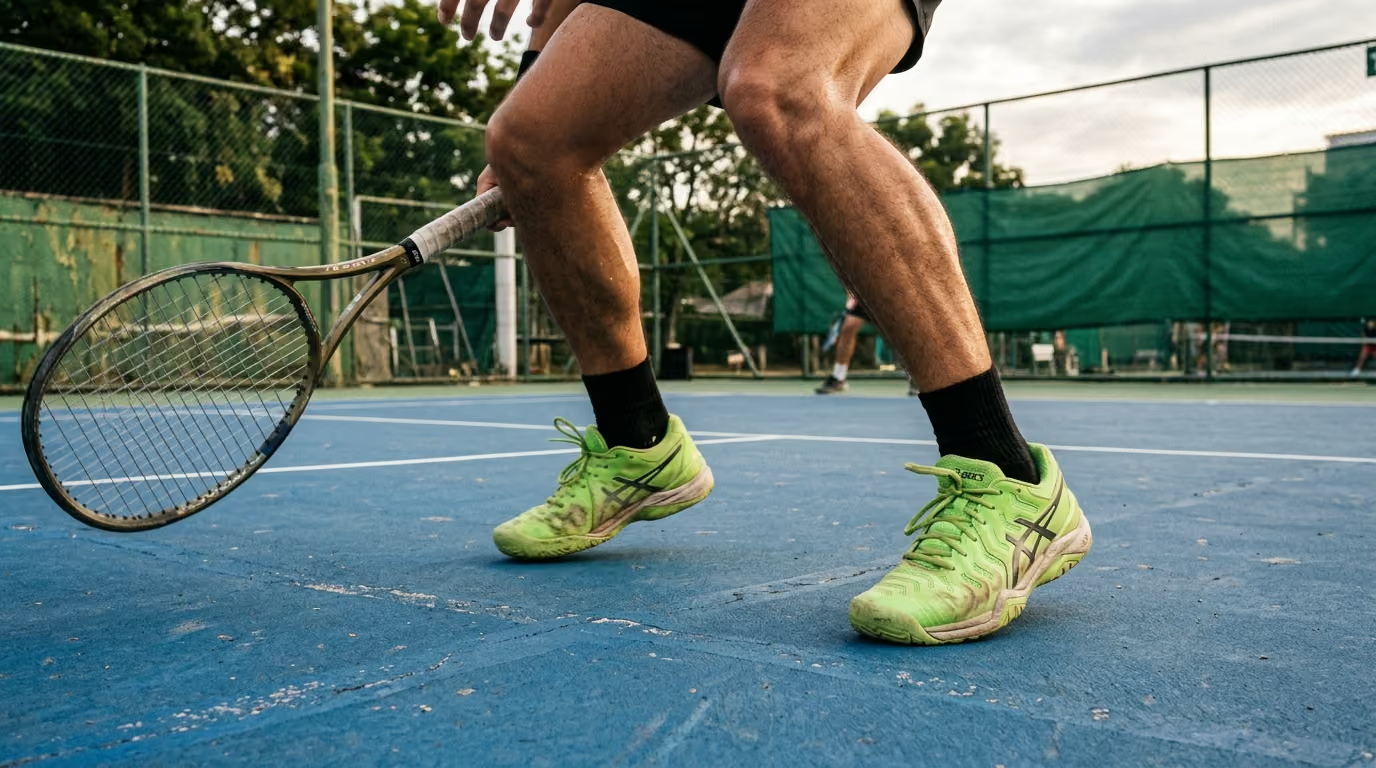
Racquet sports players can achieve long-term health and peak performance by effectively managing their training load, balancing physical stress with recovery capacity.




Many racquet sports players believe that injury prevention is simply a matter of stretching before a match. They spend minutes pulling on their hamstrings, yet they ignore the total volume of stress they place on their bodies each week. This common approach misses the real driver of most court-related physical issues.
True physical longevity on the court is not about avoiding activity or performing tedious pre-match rituals. It is about understanding and managing your training load.
Managing racquet sports training load requires balancing your total playing time and intensity with your body's recovery capacity. By tracking your daily physical stress and early warning signs, you can prevent sudden spikes that lead to tissue damage. This systematic approach ensures you can stay active, build physical resilience, and enjoy your favorite sport for years.
To play your best and avoid long layoffs, you must look beyond court hours. You need to understand how training stress accumulates, how your body responds to that stress, and how to structure your weeks. This guide provides a practical, research-backed framework to help you manage your workload and protect your physical health.
Training load is the total stress imposed on your body by practice, matches, physical conditioning, and external lifestyle factors. It is a multidimensional concept rather than a simple tally of minutes spent on court. To manage it effectively, you must distinguish between the different types of stress you experience.
External load is the objective work you perform during a session. It is completely independent of how you feel or how hard your heart is beating. In racquet sports, your external load includes several measurable variables:
These metrics tell you exactly what you did on the court. They provide a clear record of physical exposure, but they do not show how your body tolerated that work.
Internal load is your body's physical and psychological response to the external work you perform. Two players can complete the exact same 90-minute singles match but experience completely different internal loads.
Your internal response is influenced by your current fitness, your sleep quality, and your general fatigue levels. Common indicators of internal load include heart rate, perceived effort, and post-session muscle soreness.
If you ignore your internal load, you miss critical signs of fatigue. A standard technical drill can feel light when you are rested, but it can place massive stress on your system when you are run down.
Your body does not separate court stress from lifestyle stress. Contextual load includes all the non-sport factors that affect your ability to recover and adapt to training.
Occupational stress, poor nutrition, travel, and sleep loss all drain your physical resources. When your contextual load is high, your capacity to tolerate court time decreases.
Understanding these three dimensions helps you see why some weeks feel much harder than others. It is never just about the hours you play, but how those hours interact with your life.
You do not need expensive sensors or complex software to track your training load. A simple, consistent dashboard is far more valuable than high-tech tools that you only use occasionally. You can build an effective field-monitoring system around five key areas.
Keep a daily log of your physical activity. Record your total court minutes, the type of session, and any extra physical conditioning.
Note whether the session was a singles match, a doubles match, or a technical drill session. If you play a match, record the number of sets you completed.
For players managing shoulder issues, tracking serve volume is highly beneficial. You can note whether your overhead and serve volume was low, medium, or high.
The most practical way to measure internal load is the Session Rating of Perceived Exertion, or Session-RPE. This method is highly recommended by sports scientists as a reliable tool for tracking training stress.
To calculate your Session-RPE load, rate your overall physical effort on a scale of 0 to 10 after each session. A rating of 0 represents complete rest, while 10 represents a maximal, exhausting effort.
Multiply your session duration in minutes by your perceived exertion rating to find your workload score in arbitrary units.
For example, a 60-minute technical session with an RPE of 4 equals a workload score of 240 units. A 90-minute intense singles match with an RPE of 8 equals a workload score of 720 units.
This simple math reveals that the singles match placed three times more stress on your body, even though the court time was only 30 minutes longer. Tracking this score is a fundamental part of managing player health over a long season.
Every morning, take 30 seconds to assess your recovery status. Rate your sleep quality, morning fatigue, and general muscle soreness on a simple 1-to-5 scale.
Note any sudden changes in your motivation to train or your overall mood. A drop in motivation or an increase in irritability often points to accumulated system fatigue.
These markers serve as an early warning system. They show when your body is struggling to adapt to your current schedule.
Pay attention to how your body moves during your warm-up. Note if you feel unusually stiff or if your coordination feels slightly off.
Track whether you can maintain your normal serve speed and movement speed without extra effort. A sudden drop in movement quality is a clear sign that physical fatigue is affecting your motor control.
Record any localized aches, joint stiffness, or mild discomfort. Note when the discomfort occurs, what movements trigger it, and if it changes your playing technique.
Pay close attention to whether the soreness disappears after your warm-up or persists into the next day. Tracking these symptoms helps you distinguish between normal training fatigue and early overuse issues.
Many athletes get frustrated because they want a single number that tells them exactly when they will get injured. In reality, no such number exists. The human body is highly complex, and your tolerance for workload changes constantly.
To understand training trends, you must compare your recent activity to your historical baseline. Your acute load is the work you have completed over the last seven days. Your chronic load is the rolling average of your weekly workload over the past three to four weeks.
Your chronic load represents your physical preparation. It is the foundation that protects your tissues from injury.
Your acute load represents your immediate fatigue. When your acute load rises far above your chronic load, your risk of injury and illness increases.
The Acute to Chronic Workload Ratio, or ACWR, is a helpful tool for assessing this relationship. You calculate it by dividing your acute weekly load by your average chronic weekly load.
Research published by the International Olympic Committee indicates that in team sports, injury risk is often lower when this ratio stays between 0.8 and 1.3. When the ratio rises above 1.5, the risk of injury can double.
Do not treat these numbers as absolute laws for racquet sports. Instead, use them as general guideposts.
A ratio above 1.5 does not guarantee you will get hurt, but it does mean you have spiked your workload. It is a prompt to look closely at your recovery, sleep, and physical symptoms.
A weekly schedule that is perfectly safe for a well-conditioned player can cause severe issues for someone else. Your individual capacity is shaped by your age, training history, and joint health.
A high chronic workload can actually protect your body, provided you build up to it gradually. The key is to progress your training slowly so your muscles, tendons, and joints have time to adapt. This gradual progression is a vital component of any injury prevention resources you use to guide your schedule.
While tennis, pickleball, and padel all use racquets or paddles, they place unique mechanical demands on your body. Understanding these differences allows you to customize your workload management strategy.
Tennis is characterized by high-velocity actions on a large court. Players must cover significant distances, which leads to high-volume linear sprinting and hard lateral braking.
The tennis serve is one of the most demanding movements in all of sports. It requires extreme shoulder rotation, trunk extension, and explosive leg drive.
According to a study on competitive adolescent players, accumulated external workload is closely linked to shoulder complaints. If you play tennis, you must track your serve volume separately from your total court time.
A long session focused entirely on serving and overheads is far more stressful for your upper body than a session of baseline groundstrokes.
Pickleball is played on a much smaller court, which reduces sprinting distances but increases the frequency of rapid reactions. The game requires constant, low-amplitude lunges and deep knee flexion to retrieve low dinks.
Because players stand closer together, the pace is fast, requiring repetitive, high-frequency wrist and elbow actions. Pickleball players rarely experience the extreme overhead strain of tennis, but they face high repetitive stress on their knees, Achilles tendons, and lower back.
If you are focusing on pickleball longevity, your load management should prioritize tracking your total lunging repetitions and lower-body joint soreness.
Padel combines elements of tennis and squash within an enclosed court. The presence of glass walls leads to long, continuous rallies with constant multi-directional twisting and turning.
Padel play involves a very high volume of overhead strokes, such as the bandeja and vibora, as players constantly deal with defensive lobs. This creates unique, repetitive stress on the shoulder, elbow, and upper back.
For those engaging in padel training, tracking the frequency of overhead shots and rotational trunk movements is essential. The constant change of direction on artificial turf also places high shear forces on the ankles and knees.
To maintain your physical health, you must structure your training weeks intentionally. A major mistake is treating every session on the court as a high-intensity workout.
High-intensity matches, explosive movement drills, and heavy lower-body strength training all stress the same tissues. If you schedule these demanding sessions on consecutive days, your muscles and tendons will eventually break down.
Aim to separate your high-stress days with low-load days or complete rest. If you play an intense singles match on Tuesday, use Wednesday for light technical work or mobility exercises.
This approach gives your nervous system and connective tissues time to repair. It is a highly effective strategy for supporting your long-term athletic longevity on the court.
Do not confuse a long session with an intense session. A two-hour lesson focused on slow technical adjustments may have low intensity but high technical volume.
Conversely, a 45-minute session of competitive point play can have incredibly high intensity. You should record both duration and intensity to capture the true stress of each workout.
Be careful not to stack high volume and high intensity in the same session too often. This combination is highly fatiguing and requires extended recovery time.
A low-load day does not mean you must sit on the couch all day. Active recovery can actually speed up your recuperation by promoting blood flow to tired muscles.
An ideal low-load day might include light, relaxed hitting without competitive pressure. You can also focus on mobility work, low-impact aerobic exercise, or targeted strength work.
The goal of a low-load day is to keep your body moving while allowing your systemic fatigue levels to drop.
Tournament weeks are highly demanding and extend far beyond your match play minutes. They involve pre-match nervous tension, long periods of waiting, travel, altered sleep schedules, and limited access to recovery tools.
When planning for a tournament, you must adjust your schedule beforehand to build up your physical reserves. Reduce your training volume in the three to five days leading up to the event.
During the tournament, eliminate any extra physical conditioning or unnecessary practice sessions. Focus entirely on match play, hydration, and sleep.
Your body always communicates when the accumulated stress of your schedule is becoming too high. The key is learning to recognize these signals before they turn into a serious injury that forces you off the court.
Healthy muscle soreness is normal after a hard session and usually peaks 24 to 48 hours later. However, localized pain in a joint or tendon is a clear warning sign.
Pay close attention to stiffness in your shoulder, elbow, knee, or Achilles tendon that is present when you first wake up. If this stiffness takes longer than ten minutes to fade, your tendons may be struggling to tolerate their current workload.
If you feel pain that forces you to alter your playing technique, your body has exceeded its capacity. Continuing to play through this type of pain is a primary cause of chronic overuse injuries.
When training load is appropriate, your sleep should be deep and restorative. If you find yourself tossing and turning, or waking up feeling exhausted, your nervous system may be overstimulated.
A 13-week study on youth athletes showed that increased training load and match play had direct negative effects on perceived recovery and muscle soreness. Conversely, getting more sleep had moderate positive effects on daily wellbeing and recovery.
If you are sleeping poorly and feeling constantly drained, your body cannot repair the tissue damage from your court sessions.
If you find yourself struggling to react to shots that you normally retrieve with ease, fatigue is likely affecting your motor control. You might also notice that your serve speed drops, or your timing on your groundstrokes feels inconsistent.
When your muscles are fatigued, your body alters its movement patterns to protect itself. These altered patterns place unexpected stress on other joints and muscles, which increases your risk of acute injury.
An early sign of excessive systemic stress is a sudden drop in your enthusiasm for playing. If you find yourself dreading your scheduled matches, or feeling unusually irritable on the court, your body is telling you to rest.
These psychological markers are deeply connected to your physical readiness. A comprehensive approach to recovery science always respects the link between mental stress and physical performance.
A simple, practical way to manage your daily workload is to implement a traffic light decision-making model. This system translates your physical data and symptoms into clear action steps for your next session.
You are clear to play your scheduled matches and complete high-intensity workouts when:
You should adapt your session to reduce physical stress when:
To modify an Amber session, you can shorten your play time or focus on light technical work instead of competitive match play. You can also remove high-stress movements like maximal serving or deep, explosive lunges.
You must stop playing and prioritize rest or medical assessment when:
Using this traffic-light system takes the guesswork out of your daily schedule. It allows you to make objective decisions based on how your body is actually responding to the work.
Returning to full court activity after an injury, illness, or a high-stress tournament requires a careful, step-by-step approach. You cannot simply jump back into your previous schedule without risking a major setback.
Before you resume your normal training, take time to evaluate the impact of your recent high-stress week. Review your total match minutes, your average perceived exertion, and your sleep quality.
Check for any lingering joint tenderness or localized muscle soreness. If your recovery markers are still depressed, your body is not ready for another hard training block.
Use the first few days of the new week to actively unload your system. This allows your chronic workload base to catch up with your acute fatigue.
An unloading period does not mean you have to stop moving entirely. Instead, reduce your overall volume while keeping your movement controlled and pain-free.
You can cut your court time in half and avoid competitive point play. Focus on smooth, rhythmic hitting that keeps your joints moving without placing high demands on your cardiovascular system.
Reduce your strength training weights and eliminate explosive jumping or sprinting drills. This structured reduction in load allows your body to repair micro-damage in your tissues.
When rebuilding your court capacity after a layoff, follow a progressive sequence. This model, supported by return-to-sport consensus guidelines, ensures that you expose your tissues to stress gradually.
Never move to the next stage of the ladder until you can complete the current stage with zero pain and normal next-day recovery. This systematic approach is an excellent addition to your strength and conditioning plan.
Many dedicated court athletes make predictable errors when trying to manage their training volume. Recognizing these misconceptions will save you from unnecessary physical setbacks.
The idea that you should never increase your weekly training volume by more than 10% is a common guideline in fitness circles. However, the International Olympic Committee consensus statement notes that different sports have highly unique load-injury profiles.
A rigid 10% limit can be overly restrictive for players returning from a short break, while being too aggressive for those recovering from serious tendon issues. Use it as a conservative planning heuristic rather than an absolute, unyielding law.
Measuring your training stress solely in hours is a major mistake. A 60-minute session spent hitting easy, cooperative groundstrokes does not place the same stress on your body as a 60-minute singles match with constant sprinting and lunging.
Always combine your session duration with your Rating of Perceived Exertion to capture the true internal stress of your work. This is particularly important when evaluating your overall schedule on the Evercourts Blog.
A single rest day is not a magic cure that completely resets your physical fatigue. If you have spent three consecutive weeks training at an excessively high volume, one day of rest will not fully restore your tissues.
True recovery is an ongoing process that requires consistent sleep, proper nutrition, and a well-balanced weekly schedule. Do not use a weekly rest day as an excuse to overtrain on the other six days.
Your physical tissues do not know the difference between stress from a demanding project at work and stress from a tough singles match. High mental tension, poor sleep, and travel all impair your body's ability to repair muscle and tendon fibers.
When your life stress is high, you must proactively reduce your court volume. This adjustment protects your health and ensures you can continue playing for years to come.
While self-monitoring is incredibly valuable, it should never replace professional medical care when serious symptoms arise. You must know how to distinguish between normal training fatigue and issues that require professional evaluation.
Yellow flags are warning signs that your body is reaching its limit. You should monitor these closely and modify your schedule:
If these issues do not improve after a week of reduced court volume, schedule a visit with a physical therapist or sports medicine physician.
Red flags are serious symptoms that require immediate professional attention. Do not attempt to play through or self-manage the following:
A qualified healthcare professional can provide an accurate diagnosis, assess your movement patterns, and design a customized rehabilitation program. Taking swift action when red flags appear is the best way to protect your athletic longevity. For more information on how we approach court health and wellness, visit the About Evercourts page.
By tracking your physical stress and respecting your body's recovery signals, you can enjoy competitive play for years without facing long layoffs.
Follow Evercourts for practical insights on tennis, pickleball and padel performance, movement, recovery and healthy ageing. Stay connected for new articles, research-led guidance and ideas to help you play well and keep playing for years.


Read practical guidance for better movement, smarter preparation and a game that keeps working for you.
explore the Blog