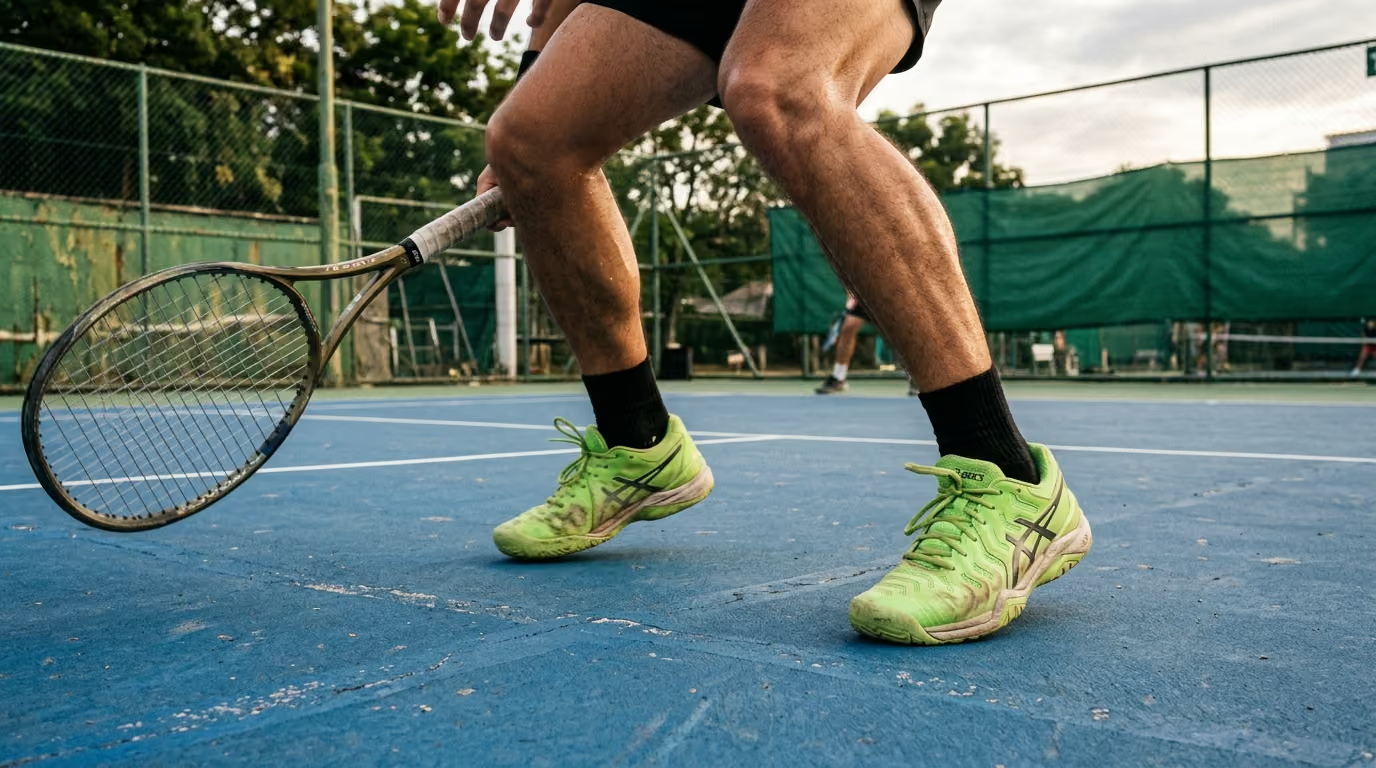
While many perceive mobility as mere flexibility, a player's joint range of motion fundamentally dictates their racquet technique and stroke mechanics.




Court mobility is not the simple ability to stretch. It is the active capacity to place your body in an efficient position to strike the ball with control. When your joints cannot reach these positions, your technique must adapt, often increasing the physical demand on other body segments.
Many players view mobility as a recovery goal or a simple flexibility score. In reality, your joint range of motion acts as a physical boundary for your technique. It dictates how early you can prepare your racket. It determines how much space you can maintain between your body and the ball.
Understanding this relationship allows you to adjust your training and play style to your body. Our team focuses on how specific joint restrictions alter your movement. We look at the actual physics of racquet sports to find real solutions. This approach helps you maintain your performance and support your athletic longevity.
Flexibility and mobility are often used as synonyms, but they describe different physical attributes. Flexibility is the passive extensibility of your muscles and connective tissues. It is measured by how far a joint can be moved by an external force. Mobility, however, is your active movement capacity during a specific task.
Active movement requires several systems to work together. It includes your passive range of motion and your muscle strength at the end of that range. It also relies on your nervous system to coordinate the timing of your muscles. A player can have highly flexible hamstrings but still move poorly on the court. This happens when they lack the strength or coordination to use that length under time pressure.
Stability is the companion of mobility. It is the capacity to control your movement and resist unwanted motion. In racquet sports, these two qualities are completely interdependent. For example, your shoulder needs enough rotation to accelerate the racket. However, your rotator cuff and scapular muscles must be strong enough to decelerate that motion.
When your dynamic stabilizers cannot control your range of motion, your passive structures must absorb the force. This places extra stress on your ligaments, labrum, and joint capsule. This relationship is why our team prioritizes active control over simple passive stretching in our mobility and movement resources.
The kinetic chain describes how your body segments coordinate to transfer energy. This transfer moves from the ground, through your legs, and out to the racket. In an efficient power stroke, each segment plays a specific role. The lower body creates the initial force against the ground.
Then, the pelvis and trunk rotate to pass this energy upward. Finally, the shoulder, arm, and wrist orient the racket and impact the ball. The kinetic chain is not a rigid sequence. Biomechanical research shows that players can produce similar racket positions using different joint speeds and timings.
However, if one segment cannot move or coordinate properly, the other segments must compensate. Removing or limiting one link forces other body parts to work harder. This compensation often increases tissue overload and reduces efficiency. Biomechanists have measured the exact contributions of various upper limb movements to racket velocity at the moment of impact.
These percentages show that the arm and hand are critical for final racket acceleration. However, they rely entirely on the hips, torso, and legs to position them. A player with restricted hip rotation cannot generate sufficient energy from the ground. They will be forced to use more arm muscle to swing the racket at the same speed.
The shoulder joint undergoes significant physical changes in competitive racquet players. A systematic review analyzed 25 different studies of competitive tennis athletes. The research found clear differences between the dominant and nondominant shoulders. The dominant shoulder showed a significant reduction in internal rotation.
On average, dominant shoulder internal rotation was 53.0 degrees. In contrast, nondominant shoulder internal rotation was 62.6 degrees. Interestingly, the difference in external rotation was not statistically significant. Dominant external rotation pooled at 105.4 degrees, while the nondominant side was 100.8 degrees.
The study also revealed that age plays a major role in these measurements. Adults had lower overall shoulder rotation than children. Adult internal rotation was 44.5 degrees, compared to 57.1 degrees in children. External rotation was 95.2 degrees in adults, compared to 110.3 degrees in children.
The researchers noted extremely high variability across all studies. This variance means these numbers are population references rather than strict goals for every individual. These dominant side adaptations are often normal responses to the sport. They do not automatically indicate a physical problem.
Furthermore, preseason range of motion screening has not consistently predicted shoulder or elbow injuries. A player with limited range but excellent strength may function perfectly. We must look at a wider range of markers. These include your strength, paint response, scapular control, and weekly playing volume.
Every stroke on the court poses a unique mechanical problem. A restriction in a single joint can cause different technical flaws depending on the shot you are hitting.
An efficient forehand requires significant hip and pelvic rotation. It also demands thoracic rotation and controlled shoulder horizontal movement. During the backswing, your shoulders should rotate more than your hips to create separation. This separation preloads your trunk muscles.
If your hip rotation is limited, your backswing becomes arm dominant. You may struggle to prepare your racket early enough. You might also overrely on an open stance. This can limit your ability to transfer force from your back foot.
The two handed backhand uses a more compact upper body structure than other groundstrokes. The backswing separation is typically around 20 degrees. This is smaller than the 30 degree separation seen in the one handed backhand.
The second arm provides stability, which can help players with limited shoulder mobility. However, you still need sufficient hip and trunk rotation. If your hips are stiff, you may swing too close to your body. This can cause you to hit late and lose power.
The one handed backhand requires excellent shoulder horizontal movement and scapular control. It also demands a stable wrist through the entire impact zone. Skilled players strike the ball with a hyperextended wrist. They keep this wrist position extended through impact.
Novice players often strike with a flexed wrist and move into further flexion. This errors forces the wrist extensors to contract eccentrically, which can stress the elbow tendon. If you lack the trunk rotation to prepare early, you will often contact the ball late. You may then try to rescue the shot by flicking your wrist.
The serve is the most complex stroke from a mobility standpoint. It combines lower body flexion with extreme shoulder rotation and thoracic extension. Efficient knee flexion and extension are directly linked to lower shoulder and elbow loads.
If your shoulder external rotation is limited, your racket drop will be shallow. This shallow drop reduces your racket path and forces your arm to accelerate early. If your thoracic spine cannot extend, you may arch your lower back excessively. This compensation can place high mechanical stress on your lumbar spine.
Overheads share many mechanical demands with the serve but occur under less stable conditions. You must move backward or diagonally while tracking the ball above you. This movement requires rapid foot adjustment and thoracic extension.
If your hips or ankles are stiff, you may stand too upright. This makes it difficult to get completely under the ball. You might end up reaching backward with a bent elbow. This position limits your power and strains your shoulder.
Volleys are precision strokes that require rapid movement organization. Research shows that skilled players have very short reaction times. The average reaction time to initial racket movement is 226 milliseconds for forehand volleys. It is 205 milliseconds for backhand volleys.
The stroke itself is quick, ranging from 381 to 803 milliseconds. Players use different footwork depending on ball speed. On slow balls, they tend to lean sideways. On fast balls, they use a vigorous push off from the opposite foot.
An ankle or hip restriction will limit your ability to get low. You may bend at the waist instead of sinking your hips. This can cause you to reach for the ball, which opens your racket face and ruins your control.
Spacing is the distance you maintain between your body and the ball at impact. Many coaches treat spacing purely as a footwork issue. However, spacing is also a major mobility outcome. If you cannot rotate your hips or extend your arm, you cannot preserve your preferred contact distance.
Poor spacing often appears as contact that is too close to your torso. It can also cause you to hit late, behind your body. You might find yourself reaching with a locked elbow or using excessive trunk side bending. To test your spacing, you must first assess your movement during play.
I remember finishing a tough two hour padel match on a cold Tuesday night and waking up the next morning feeling like my lower back was locked in concrete. For a long time, I just accepted this as the price of playing hard in my forties. But once I started spending just ten minutes on targeted hip mobility before heading to the club, the stiffness almost completely vanished. It taught me that we do not have to accept pain as a default state of our athletic longevity.
If you struggle with spacing, you can use a simple assessment framework. Start with the court task rather than testing isolated joints in a gym. Watch how you prepare, load, and strike under different ball speeds.
While all racquet sports share kinetic chain principles, each sport places unique physical demands on your body. These differences change how mobility restrictions affect your performance.
Tennis features a heavy racket, a large court, and high ball speeds. This combination requires maximum kinetic chain contribution. You must run long distances, decelerate quickly, and use large swing paths.
Because of these demands, tennis players need excellent hip and shoulder rotation. You must generate high racket head speed over and over. This repetition makes shoulder and trunk mobility critical for tennis play.
Pickleball is played on a smaller court with a very light paddle. The ball bounces low, and players spend significant time at the non volley zone line. This means you do not need giant, looping backswings.
Instead, you need extreme hip and ankle flexion to stay low to the ground. You must make rapid, short movements with your wrists and shoulders. Limited ankle dorsiflexion is highly exposed in pickleball because you must constantly bend to hit low balls.
Padel is played in an enclosed glass court, which leads to long, tactical rallies. It features a high volume of overhead lobs from your opponents. This means you must hit many overheads and transition quickly between attack and defense.
You need excellent thoracic extension and rotational mobility to handle glass rebounds. You must turn and adjust your body in tight spaces. This constant rotation makes trunk and hip mobility crucial for padel players.
Many players spend significant time trying to improve their flexibility, but they often use methods that do not transfer to the court.
Static stretching involves holding a muscle in a lengthened position for 30 seconds or more. While this can increase passive flexibility, it does not prepare your nervous system for movement.
In fact, research suggests that prolonged static stretching can temporarily reduce your muscle power and speed. It is much better to use a dynamic warm up. Focus on active movements like leg swings, lunges, and arm circles to prepare your body.
Many players believe that the left and right sides of their body must be perfectly symmetrical. However, your dominant side adaptions are often normal responses to your sport.
Trying to force your dominant shoulder to match your nondominant shoulder can sometimes cause joint instability. You should focus on pain free, functional range of motion instead of perfect symmetry. Only seek to correct asymmetries if they cause pain, weakness, or a sudden decline in your technique.
Your mobility is not a fixed score. It changes during a match as your muscles fatigue. A study of 26 professional male tennis players assessed shoulder range of motion and strength before and after an 80 minute match.
The researchers found that dominant shoulder internal rotation decreased by 1.2 percent after the match. However, external rotation increased by 5.7 percent, and total range of motion increased by 3.3 percent. Crucially, dominant shoulder external rotation strength decreased by approximately 5.8 percent.
While average serve speed did not drop significantly, five players lost more than 18 degrees of internal rotation. This fatigue can alter your movement quality without any permanent structural injury. When your shoulder muscles tire, your body will find other ways to swing the racket.
You might start arching your back more or using your wrist to make up for lost arm speed. This change is why recovery is so important. Recovery is not just about resting; it is a movement quality test.
If you finish a match feeling stiff, your movement system has been overloaded. Restoring your normal range of motion through light, active movement is essential before your next session.
Most minor stiffness can be managed with sensible training and recovery. However, some symptoms require a formal assessment from a qualified healthcare provider. You should consult a physical therapist or sports medicine specialist if you experience any of the following warning signs:
A qualified professional can help identify the root cause of your movement restriction. They can design a specific program to help you return to play safely. If you need assistance finding guidance, you can always reach out through our contact page.
Yes, you can play successfully with naturally stiff joints. You do not need extreme flexibility to enjoy tennis, pickleball, or padel. Instead, you should focus on early racket preparation and efficient footwork. A compact swing path can help you maintain control without forcing your joints into uncomfortable end range positions.
A simple way to tell is to test your movement without a ball or racket. Try to perform the joint motion slowly and without any stress. If you can easily reach the required position in a calm environment, your issue on the court is likely a technical habit or timing problem. If you cannot reach the position even when moving slowly at home, you have a physical mobility restriction.
Light, active stretching after a match can help restore your resting muscle length. However, you should avoid aggressive stretching when your muscles are highly fatigued. Focus on gentle, pain free movements to help calm your nervous system. Save your deeper mobility work for your dedicated training days when your body is fresh.
Follow Evercourts for practical insights on tennis, pickleball and padel performance, movement, recovery and healthy ageing. Stay connected for new articles, research-led guidance and ideas to help you play well and keep playing for years.


Read practical guidance for better movement, smarter preparation and a game that keeps working for you.
explore the Blog