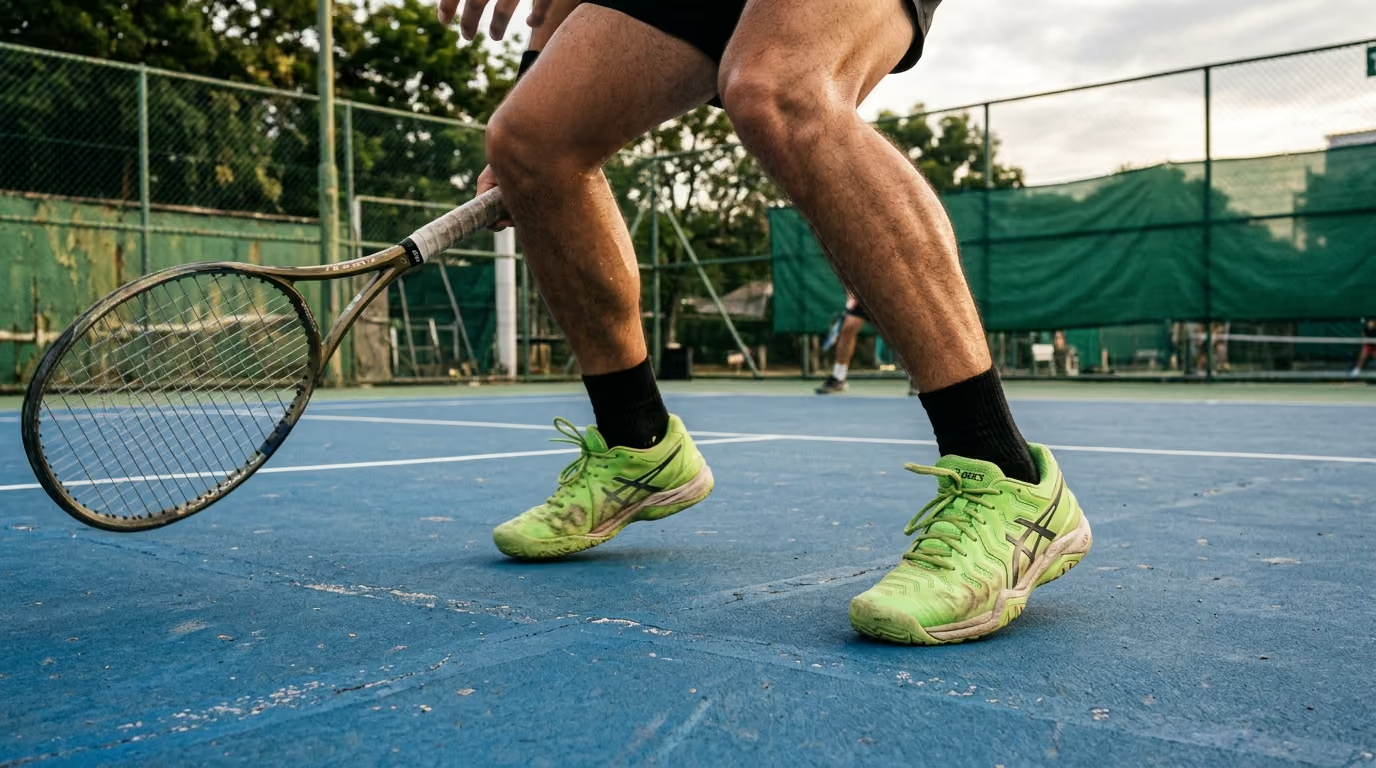
Mobility for racquet sports involves actively controlling movement ranges under high speeds and heavy loads to prevent injuries and enhance performance.




Many players spend hours holding passive stretches on the court fence, hoping to protect their muscles from strains. True court mobility is not about forcing every joint into its absolute maximum range of motion. Instead, it is the ability to actively control the exact movement ranges your sport requires, under the high speeds and heavy loads of active play.
This distinction is essential for your athletic longevity. Attempting to gain excessive passive flexibility without developing the strength to control that range can actually increase your risk of joint issues. By understanding how your joints interact during a serve, groundstroke, or sudden lunge, you can build a physical preparation strategy that keeps you on the court for years to come.
To build an effective physical preparation routine, you must first understand the terms commonly used in sports training. Range of motion is the total physical movement available at a specific joint. Flexibility refers to the passive extensibility of your muscles and connective tissues. Active mobility represents the range of motion you can actively reach and control using your own muscular strength.
This difference between passive and active movement is where many traditional training programs fail. A player may have the passive flexibility to pull their arm far behind their head with their other hand. If they cannot control that same arm position during a high-speed serve, that passive range does not protect them. To learn more about this distinction, you can read our mobility and movement resources.
True court stability is the capacity to maintain a clean joint position while producing or absorbing high force. Your brain uses motor control to coordinate the timing and sequencing of your muscles during a complex movement. When you combine these elements, you build strength through range, which is the ability to produce torque at varied joint angles.
Finally, you must develop end-range capacity, which is the physical tolerance of your tissues near the limits of your available motion. In court sports, you are frequently forced to hit the ball from off-balance, reaching positions. If your muscles have no strength at their longest lengths, they are highly vulnerable to strains. By focusing on active, loaded movement, you build tissues that can withstand these extreme positions.
No joint on the court operates in absolute isolation. Your body functions as a coordinated kinetic chain, where force travels from the ground up through your legs, trunk, shoulder, elbow, and wrist. If one link in this chain is weak or restricted, another link must work harder to compensate. This compensation is a major driver of chronic overuse injuries.
During a tennis serve, your legs and trunk generate the majority of the ball's potential velocity. According to research on tennis mechanics, force is transferred progressively through a proximal-to-distal sequence, ending at the racquet face. If you perform a serve with insufficient knee flexion, the upper body must compensate to maintain power. A mechanical review showed that serving with restricted knee bend increases the physical loads on the shoulder by 17 percent and on the elbow by 23 percent.
This means a nagging pain in your elbow may not actually be an elbow problem. It is often the result of limited hip rotation or poor leg drive forcing your arm to do all the work. If you only stretch your forearm, you leave the true cause of the stress untouched.
Workload management also plays a critical role in how well your body tolerates these forces. A systematic review published in 2025 tracked high-performance tennis players to analyze injury patterns. The researchers found that rapid spikes in weekly playing volume were the strongest predictors of physical issues. Specifically, when the ratio of recent play to historical play exceeded 1.3 for younger players or 1.5 for adults, injury risk rose sharply. While these figures represent competitive athletes, the lesson applies to recreational players: mobility drills cannot protect you from sudden, massive increases in weekly playing hours. For deeper guidance on managing these challenges, check our injury prevention resources.
Your upper body must absorb high rotational forces while managing a lightweight or middleweight racquet. To protect these joints, you must systematically prepare each major segment, beginning with the shoulder and moving down to the hand.
The shoulder joint is highly mobile but inherently unstable, relying heavily on surrounding muscles for support. During overhead serves and high volleys, the shoulder repeatedly moves into extreme abduction and external rotation. Research on shoulder mechanics shows that injuries in this area rarely stem from a single tissue. Instead, they result from a complex mix of poor scapular movement, rotator cuff fatigue, and restricted thoracic spine rotation.
Your shoulder shoulder-blade complex requires specific mobility priorities to function well. First, your thoracic spine must extend and rotate to allow the arm to reach overhead without pinching. Second, your scapula must rotate upward and tilt backward to clear space for the upper arm bone. Finally, the muscles on the back of the shoulder must possess the eccentric strength to decelerate your arm after you strike the ball.
To prepare these areas before you play, try this progressive sequence:
The elbow acts as a hinge joint positioned between two highly mobile areas: the shoulder and the wrist. Because of this position, the elbow is subjected to massive valgus stress, which forces the joint to bend inward, and sudden extension forces during late hits. In a classic one-handed backhand, a skilled player contacts the ball with a stable, extended wrist. A novice player often contacts the ball with a flexed wrist, which subjects the forearm muscles to sharp, eccentric loading.
To protect your elbow, your preparation should focus on forearm rotation and wrist control rather than just stretching the joint itself. You need clean forearm pronation and supination to spin the ball without overloading the joint. You also require adequate grip endurance so you do not have to squeeze the handle with excessive force.
Try these simple preparation exercises:
The wrist is the final link in the kinetic chain that transfers energy to your racquet. In modern play, spin-heavy strokes force the wrist to move through extreme angles at high speeds. For example, hitting a heavy topspin forehand requires rapid ulnar deviation, which puts stress on the extensor carpi ulnaris tendon on the pinky side of your wrist. Additionally, physical contact with the ground during falls can cause wrist fractures, which is a frequent issue in paddle sports.
Your wrist mobility priorities must include smooth flexion, extension, and lateral deviation. You also need the ability to maintain a relaxed grip between shots, as constant tension tires the forearm muscles and reduces shock absorption.
Use these gentle wrist preparation movements:
Your lower body must produce and absorb the massive forces required to sprint, stop, and change direction. Preparing these joints ensures you can move efficiently without putting excess stress on your lower back or knees.
Your hips are the primary engine for rotational power and lateral acceleration on the court. They allow you to drop low for groundstrokes, slide into lateral lunges, and rotate your pelvis during a serve. Systematic reviews of tennis injuries show that lower limb issues make up nearly half of all physical complaints in competitive players, with hip and lumbar compensations being highly common.
To move well, you need adequate hip internal and external rotation, along with clean hip extension. If your hips are stiff, your body will force your lower back or knees to rotate instead, which can lead to chronic discomfort.
You can improve your active hip range with these movements:
The knees must tolerate massive compression and rotational forces during court play. Every split step, hard brake, and deep lunge requires the knee to bend and stabilize under your full body weight. Because the knee is a simple hinge joint, its health depends heavily on the mobility of the joints directly above and below it: the hip and the ankle.
To protect your knees, you must focus on single-leg alignment and deceleration control. If your ankles are stiff or your hips are weak, your knees may cave inward during a lunge, putting stress on the ligaments.
Use these exercises to build knee control:
Your feet and ankles are the only contact point between your body and the court. They must be stiff enough to push off with explosive power, yet mobile enough to absorb the impact of a hard landing. Emergency department studies show that ankle sprains are among the most common acute injuries in court sports, particularly when players are forced to make sudden lateral cuts.
Your primary ankle priority is knee-to-wall dorsiflexion, which is the ability to bend your ankle so your shin can tilt forward. A restriction here will prevent you from getting low in your stance and will force your heel to lift during lateral movements.
Try these ankle and foot drills before you play:
An effective pre-court routine should be progressive, specific, and highly economical. The goal of a warm-up is to raise your core temperature, prepare your nervous system, and rehearse court movements. You should not use this time to perform deep, passive stretches that reduce muscle power or tire you out before play begins.
To understand how to prepare your body, you can read our resources on healthy aging and athletic longevity. While research on warm-ups shows mixed results regarding absolute injury prevention, systematic reviews consistently show that a dynamic warm-up improves performance and helps tissues handle sudden loads.
Use this structured, four-phase routine before your next match:
The objective of this phase is to increase your heart rate and muscle temperature.
This phase moves your major joints through the ranges of motion you will need during play.
These exercises wake up key stabilizing muscles in your hips, core, and shoulders.
In this final phase, you gradually ramp up the speed and intensity of your movements.
While tennis, pickleball, and padel share many similarities, they place distinct physical demands on your body. Understanding these differences allows you to tailor your mobility and strength preparation to your specific sport. For sport-specific guides, check our tennis articles, pickleball articles, or padel articles.
Tennis is played on a large court that requires long, explosive sprints and heavy deceleration. The tennis racquet is the heaviest of the three options, and the ball is highly pressurized, which increases the impact force on your wrist and elbow.
Because of the serve, tennis players must prioritize thoracic spine extension and shoulder external rotation. The overhead motion is performed more frequently and with higher velocity than in the other sports. Additionally, tennis players must develop deep hip internal rotation to handle the wide, open-stance groundstrokes common on modern hard courts.
Pickleball is played on a smaller court, which reduces the need for long sprints but dramatically increases the frequency of short, rapid lateral steps. The paddle is short and lightweight, but the plastic ball does not compress, creating a fast, sharp impact.
Because players spend significant time in a low, athletic stance at the non-volley zone line, pickleball requires exceptional ankle dorsiflexion and deep hip flexion. If you cannot get low through your hips and ankles, you will bend from your lower back, leading to stiffness after play. Furthermore, emergency department data indicates that falls are a primary cause of injury for older adult pickleball players. This means balance training, backward-stepping drills, and wrist-impact preparation are vital for this population.
Padel is played in an enclosed glass cage, combining elements of tennis and squash. The racket is thick and solid, and players must react to erratic bounces off the back and side walls.
This environment requires padel players to rotate their torso constantly to track balls behind them. Thoracic rotation and hip mobility are paramount for turning quickly in tight spaces. Padel also features a very high volume of overhead shots, such as the bandeja and vibora. Because these overheads are hit from varied, off-balance positions rather than a structured serve, shoulder blade stability and core control are critical to avoid shoulder impingement.
When players try to improve their court mobility, they often make mistakes that can hinder their performance or increase their risk of injury. Recognizing these errors is the first step toward building a more effective routine.
The most common mistake is assuming that every sensation of tightness means a muscle needs to be stretched. Often, a muscle feels tight because your brain is keeping it tense to protect a nearby joint that lacks stability. For example, if your hips are weak, your hamstrings may feel constantly tight because they are working overtime to stabilize your pelvis. If you aggressively stretch those hamstrings, you strip away that temporary stability, which can lead to lower back discomfort.
Another frequent error is trying to make your dominant and non-dominant sides look exactly the same. Racquet sports are inherently asymmetrical. Over years of play, your dominant shoulder will naturally develop more external rotation and less internal rotation to assist with serving. This is a normal, healthy adaptation to the physical demands of your sport. Trying to force your dominant shoulder to match your non-dominant shoulder can disrupt this natural balance and lead to instability.
When players experience shoulder or elbow soreness, they often focus all their attention on stretching and massaging their arm. As we explored with the kinetic chain, upper body issues are frequently caused by restricted movement in the hips, ankles, or trunk. If you do not address the lower body's ability to generate force, your upper body will continue to absorb excessive wear and tear, no matter how much you stretch it.
An intelligent mobility routine does more than prepare you to play, as it also plays a key role in how your body recovers between sessions. When you move your joints through their full, active ranges of motion, you promote healthy circulation and keep your tissues sliding smoothly.
During high-intensity play, your muscles undergo repeated micro-tears, and your nervous system becomes highly stimulated. After a match, your muscles naturally guard themselves by shortening and increasing their resting tone. Gentle mobility work, when performed as a cool-down, can help signal to your brain that the physical threat has passed, allowing your muscles to relax.
To learn more about how to support your body after hard matches, read our recovery science resources. It is important to note that deep, painful static stretching immediately after a match can actually worsen tissue damage. Instead, focus on slow, relaxed movements that promote blood flow and restore normal joint motion without adding extra stress to tired muscles.
While a structured mobility routine is excellent for maintaining physical preparation, it cannot replace professional medical care. You must be able to recognize the signs that indicate your physical limitation is actually an injury that requires clinical evaluation.
If you experience any of the following red flag symptoms, stop playing and consult a qualified physical therapist or sports medicine physician:
By working with a professional, you can get an accurate diagnosis and a customized rehabilitation plan. For more information about our independent, research-led approach to player health, you can visit our about page or use our contact page to get in touch.
By focusing on active control, respecting your body's natural adaptations, and managing your weekly playing hours, you can build a resilient physical foundation that supports your love of racquet sports for many years to come.
Follow Evercourts for practical insights on tennis, pickleball and padel performance, movement, recovery and healthy ageing. Stay connected for new articles, research-led guidance and ideas to help you play well and keep playing for years.


Read practical guidance for better movement, smarter preparation and a game that keeps working for you.
explore the Blog