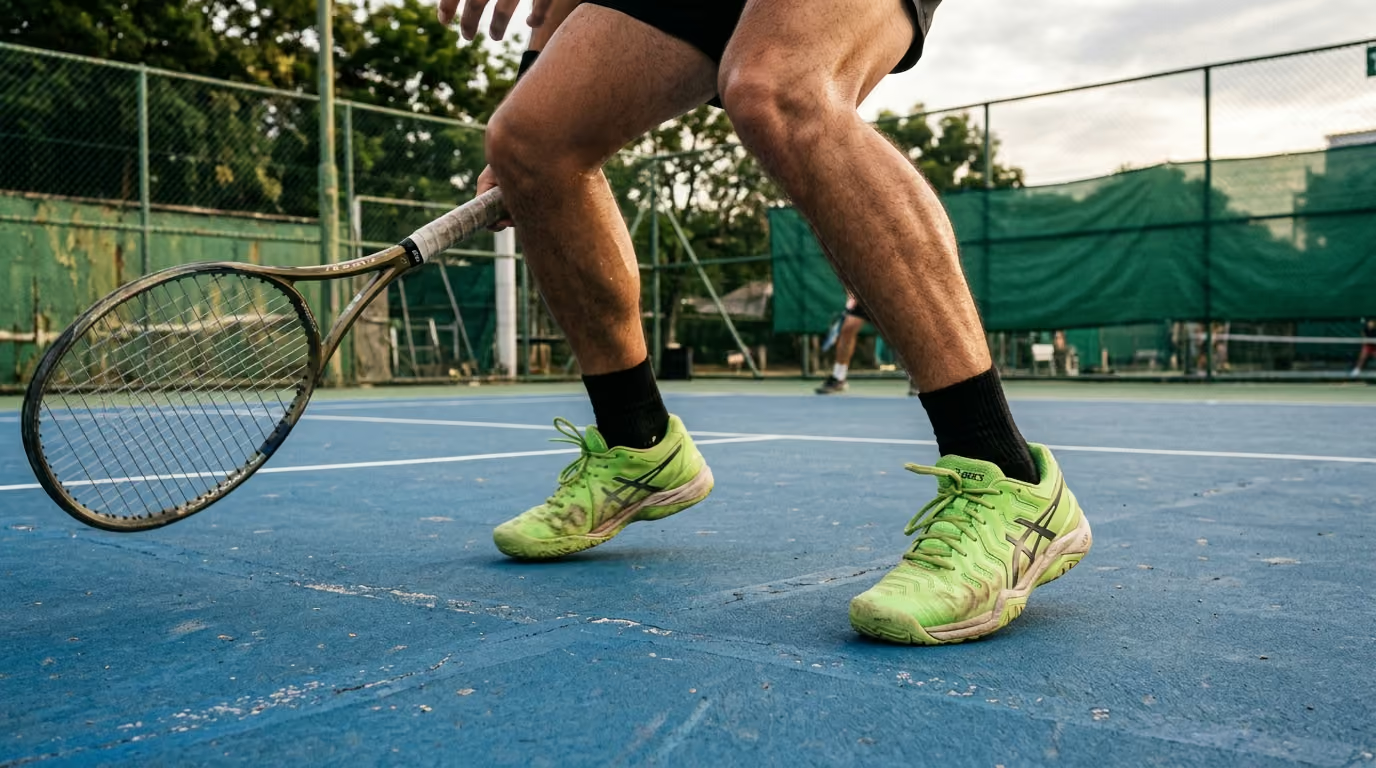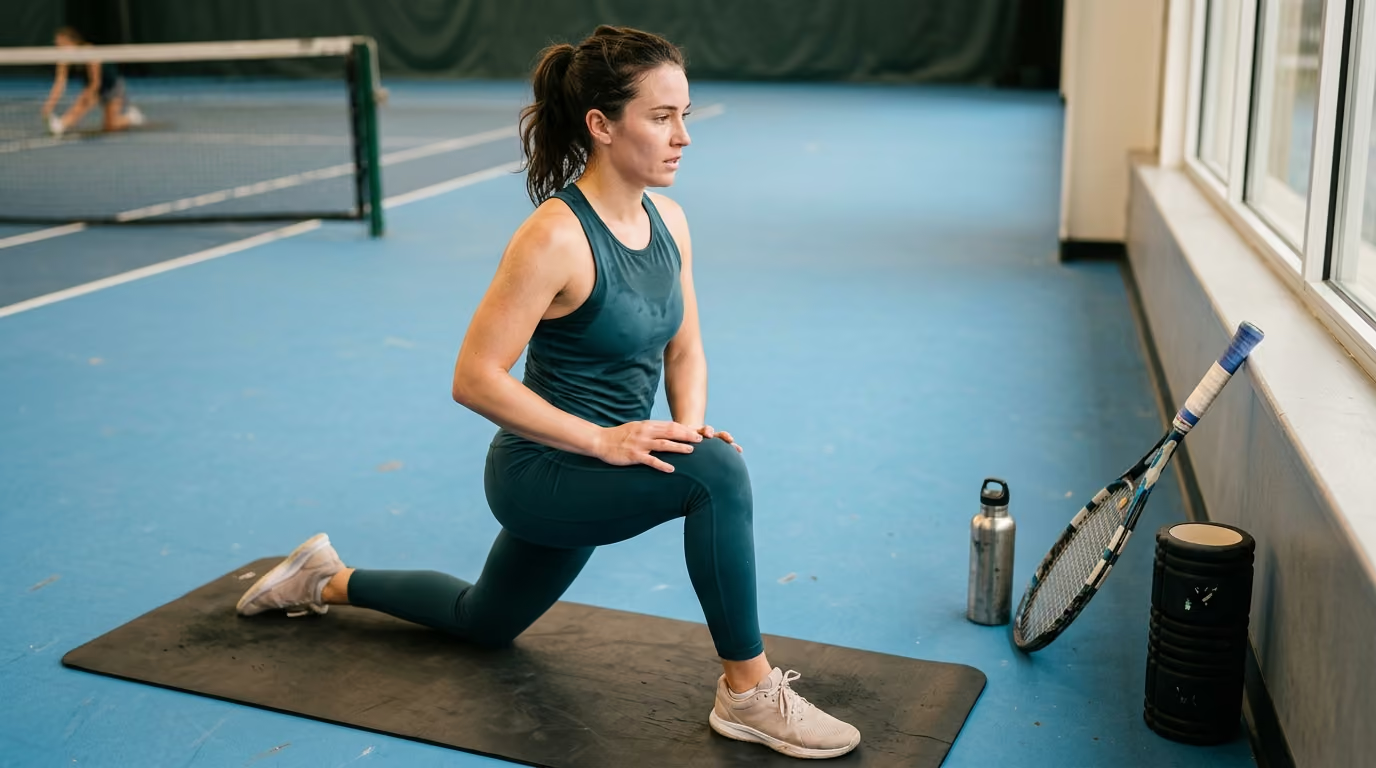

Aggressive stretching is often assumed to prevent post-match soreness, but real recovery science shows a more nuanced picture of mobility's role after intense court play.




Many court athletes finish a demanding match and immediately drop to the floor to pull their knees to their chest. They assume that aggressive stretching is a mandatory shield against next-day soreness. However, real recovery science paints a more nuanced picture of what happens to the body after intense racquet play.
Post-match mobility is best understood as a low-intensity restoration practice. It helps an athlete move comfortably, transition out of competition, and settle psychologically. Current evidence does not support the claim that post-exercise stretching prevents soreness or accelerates the recovery of muscular strength.
Using gentle, active movements and breathing techniques immediately after play helps athletes ease the feeling of stiffness and move smoothly into daily life. This strategy shifts the body out of fight-or-flight mode without adding extra stress to tired tissues. By understanding when and how to apply these techniques, you can support your athletic longevity and remain highly active on court for years to come.
To understand how to recover, we must look at what current research says about stretching after exercise. For decades, players believed that stretching was the ultimate way to prevent delayed-onset muscle soreness, commonly known as DOMS. Modern sports science has thoroughly challenged this idea.
A major systematic review and meta-analysis examined whether post-exercise stretching improves strength recovery, DOMS, or range of motion compared with passive rest. The researchers found no sufficient evidence that post-exercise stretching prevents soreness or speeds up muscle recovery. A later systematic review and meta-analysis reached a similar conclusion. It reported that post-exercise stretching had non-significant effects on soreness, strength, and overall athletic performance when used as a standalone recovery tool.
These findings do not mean you should abandon your post-match movement routine. Instead, they mean we must frame the value of mobility more accurately. Gentle movement does not speed up the microscopic repair of muscle fibers. However, it is highly effective for reducing the subjective sensation of stiffness and helping you move normally after a tough session.
The primary goal of post-match mobility is to restore comfortable movement, not to aggressively create a new range of motion. This aligns with guidelines from the USTA Recovery Project. They recommend that post-match stretching should focus on restoring normal resting muscle length and normal joint movement. You should avoid trying to force your joints into extreme positions when your muscles are already fatigued.
To make the best decisions for your body, you must understand the difference between feeling better, moving better, and recovering faster. A mobility routine can make you feel more comfortable and help you walk without stiffness. It does not, however, shorten the time it takes for your muscle tissue to physically rebuild. Recognizing this distinction keeps you from overworking your body when it needs rest the most.
Tennis, pickleball, and padel are highly demanding because of their physical structure. These court sports are intermittent rather than uniformly steady. A review of tennis activity profiles describes rallies that involve roughly four to ten seconds of high-intensity work. These bursts are followed by approximately ten to twenty seconds of recovery, with longer breaks of sixty to ninety seconds during changeovers.
This constant starting and stopping places a heavy burden on your cardiovascular system and your joints. Throughout a match, a player accumulates several different kinds of physical stress. You perform repeated accelerations and sudden decelerations. You shift laterally, split-step, drop into low defensive positions, and lunge repeatedly.
These movements require your muscles to contract eccentrically to slow your body down. Eccentric contractions are highly fatiguing and are the primary driver of muscle soreness. Furthermore, rotational strokes and repeated overhead actions place high demands on your spine, shoulders, and hips. The sheer volume of these actions during a competitive match often exceeds the demands of an ordinary practice session.
Research on elite junior tennis players confirms that training sessions rarely reproduce the full physical and perceptual demands of tournament play. This discrepancy means that tournament matches put a much higher stress load on your body. Your recovery routine must adapt to the intensity of the play you just completed.
The court surface and the match format also dictate how much strain your body endures. For example, clay-court rallies are approximately 22% longer than hard-court rallies. This increase in rally length leads to longer playing times, higher heart rates, and greater blood lactate accumulation. If you play multiple matches in a single day, the physical toll increases significantly.
Repeated play can temporarily impair your jumping, sprinting, and change-of-direction performance. It also raises your reported levels of muscle soreness and fatigue. A standard recovery routine is not suitable for every scenario. You must adjust your post-match care based on whether you played a brief doubles match or a grueling singles match on clay.
Furthermore, match play can alter your range of motion in complex ways. A study of professional tennis players showed that a single match produced both increases and decreases in shoulder mobility. In the dominant shoulder, internal-rotation range decreased by 1.3%. Conversely, external rotation increased by 5.3%, and the total arc of shoulder motion increased by 3.1%.
This same study revealed a 4.8% reduction in dominant-shoulder isometric external-rotation strength. These mixed changes show why simple assumptions about post-match stiffness are often incorrect. A feeling of tightness does not always mean a muscle needs to be stretched aggressively. Sometimes, restriction is a protective response from your nervous system to stabilize a tired joint.
To build an effective recovery plan, we must define our terms clearly. Many players use the words mobility and flexibility interchangeably, but they represent different physical traits. Understanding these differences will help you choose the right tools for your post-match needs.
Mobility is the ability to actively access, control, and use your available joint motion during a specific movement. It is a dynamic quality that requires your nervous system and your muscles to work together. Mobility is much broader than passive flexibility. It includes joint range of motion, tissue extensibility, muscular control, and coordination.
It also requires strength within that range and confidence from your nervous system. For example, a player might have excellent passive hip flexibility while lying on a table. Yet, they may lack the active mobility to control their hips during a deep lateral lunge on court. Post-match mobility focuses on restoring this active control.
Flexibility refers to the passive range of motion available to a joint or a muscle-group unit. It is usually measured when an external force, such as a partner or a strap, moves your limb. While passive flexibility is useful, it does not guarantee high-quality movement on the court. Trying to increase your passive flexibility immediately after a hard match can be counterproductive. Your tired nervous system may not be able to stabilize any new range you force open.
Range of motion is the measurable movement available at a joint. When assessing your recovery, it is helpful to break down range of motion into distinct categories:
Dynamic mobility relies on controlled, active movement through a comfortable range. Examples include walking with gentle arm swings, controlled hip rotations, and light thoracic twists. The goal of dynamic mobility after a match is to keep your blood circulating and lower muscle tension. It is not designed to push your flexibility to its absolute limit.
Static stretching involves holding a specific muscle group near its end-of-range position for a set period. Static stretching can be a valuable part of your long-term athletic longevity plan, but timing is critical. The USTA Recovery Project distinguishes between brief, gentle stretches done immediately after play and longer, deep stretches done hours later. Forcing long, intense static stretches on highly fatigued muscles can cause further micro-damage to the tissue.
Finally, we must distinguish between restoration and physiological recovery. Restoration refers to short-term improvements in how you feel and move. This includes reducing the sensation of stiffness, easing your breathing, and helping your muscles relax. Recovery is the complete biological return of your physical capacities, such as your peak power, sprint speed, and tissue health. Mobility is excellent for short-term restoration, even if it does not change the biological timeline of cellular repair.
To simplify your post-match routine, our team recommends using a structured, repeatable method. We call this the R-E-S-E-T model. This framework helps you transition smoothly from high-intensity competition to a restful state.
Before you begin any physical routine, you must check in with your body. Take a moment to evaluate your overall physical state. Look for signs of genuine injury versus ordinary post-match stiffness. If you experience sharp, localized pain, joint instability, or rapid swelling, do not start a generic stretching routine.
You should also check for symptoms of heat illness, such as dizziness, nausea, or headache. If you feel lightheaded, prioritize shade, active cooling, and hydration over movement. Reading your body ensures you do not aggravate an underlying issue.
Do not stop moving abruptly the moment your match ends. Your cardiovascular system needs a gradual transition to return to its resting state. Spend three to eight minutes performing very low-intensity active recovery, such as easy walking.
A systematic review of active recovery found that short interventions of six to ten minutes showed the most consistent positive effects on performance. Keeping this transition short and easy prevents you from adding unnecessary fatigue to an already exhausted body.
Once your heart rate begins to normalize, use simple, gentle movements to scan your body for tightness. Perform a few low-amplitude ankle rocks, a shallow bodyweight squat, or a gentle hip hinge. Do not push to your absolute limit during this scan.
The goal is simply to observe how your joints feel and identify any major asymmetries. If one hip feels significantly stiffer than the other, note it. You can then address it with gentle, non-painful movement.
Now you can select two to five targeted movements to address the tightness you observed. Focus on key areas used in racquet sports, such as your ankles, hips, thoracic spine, and shoulders. Use slow repetitions, comfortable positions, and very low effort.
The rule here is simple: restore comfortable movement, do not force new range. If a movement causes pinching or sharp discomfort, back off immediately.
Conclude your routine by transitioning toward your broader recovery priorities. This is the ideal time to focus on deep, slow breathing to help calm your nervous system. After a few minutes of breathing, you can move on to hydration, a balanced meal, and a warm shower.
By wrapping up your session with this transition, you set the stage for high-quality rest. If you want to learn more about optimizing your post-match habits, you can read our detailed recovery science resources.
While all court sports share some physical demands, each sport places unique stresses on your body. Tailoring your mobility work to your specific sport is essential for long-term health. Understanding these differences will help you keep playing for years.
Tennis players face a vast court area that requires long, explosive sprints and deep, defensive lunges. The serve is a highly complex, full-body motion that demands excellent thoracic extension and shoulder mobility. As noted in the research, a tennis match can cause a reduction in internal-rotation range in your dominant shoulder.
To address this, tennis players should focus on gentle, active shoulder rotations that do not pinch the joint. You should also target your hip adductors and calves, which absorb massive forces during deep lateral slides on hard courts. Keeping these areas loose is key to maintaining your speed. You can find more targeted advice on this in our library of tennis articles.
Pickleball is played on a much smaller court, but it introduces its own mechanical challenges. Players spend a significant amount of time in a low, semi-squatting position near the kitchen line. This sustained stance places continuous isometric stress on your quadriceps, glutes, and lower back.
Furthermore, the paddle is shorter, which forces players to bend forward repeatedly to reach low dinks. After a tough pickleball session, your recovery should focus on decompressing your lower back and restoring hip extension. Gentle hip flexor releases and slow, unloaded cat-cow movements are highly beneficial. For more strategies on staying healthy in this sport, check out our pickleball articles.
Padel is a fast-paced game played within glass walls, requiring constant rotational movements and rapid changes of direction on artificial turf. Players must frequently react to balls rebounding off the glass, which demands excellent rotational mobility in the hips and spine. The sport also involves a high volume of overhead overheads, such as the bandeja and the vibora. These shots can place repetitive stress on your dominant shoulder and upper back.
In our experience, we have felt this firsthand. I remember finishing a tough two hour padel match on a cold Tuesday night and waking up the next morning feeling like my lower back was locked in concrete. For a long time, we just accepted this as the price of playing hard. But once our team started spending just ten minutes on targeted hip mobility before heading to the club, the stiffness almost completely vanished.
It taught us that we do not have to accept pain as a default state of athletic longevity. If you play this dynamic sport, focus your post-match work on thoracic spine rotation and deep hip mobility. You can explore more tips for court movement in our dedicated padel articles.
When you play a competitive match, your body enters a state of high sympathetic arousal. This is your fight-or-flight response, which raises your heart rate, dilates your airways, and increases muscle tone. While this state is essential for peak performance, you must exit it quickly once the match is over to begin the recovery process.
Slow, deliberate breathing is one of the fastest ways to signal safety to your brain. This practice encourages downregulation, which is the transition from sympathetic dominance to parasympathetic activity. The parasympathetic nervous system is responsible for rest, digestion, and tissue restoration. By consciously slowing your breath, you can help lower your heart rate and reduce resting muscle tension.
Scientific research supports this approach. A comprehensive systematic review and meta-analysis of voluntary slow breathing examined 223 studies. The researchers found that slow breathing practices lead to significant increases in vagally mediated heart-rate variability, or HRV. HRV is a reliable indicator of autonomic nervous system balance, and higher HRV is associated with better recovery.
A separate meta-analysis of physical post-exercise recovery techniques looked at 24 studies. It found that these techniques had a positive effect on RMSSD, which is a key HRV measure of parasympathetic activity. These findings show that a dedicated breathing routine is a powerful, science-backed tool for calming your body after play.
To practice post-match downregulation, find a comfortable position. You can sit with your back supported or lie flat on your back with your knees bent. Relax your jaw, face, and shoulders.
Inhale quietly through your nose for a count of four seconds, allowing your abdomen to expand naturally. Then, exhale slowly and smoothly through your nose or pursed lips for a count of six seconds. The key is to keep the exhalation slightly longer than the inhalation without forcing it. Continue this gentle rhythm for two to five minutes, keeping your focus entirely on the physical sensation of your breath.
While breathing is highly effective, remember that it is not a substitute for the core fundamentals of recovery. It cannot replace the need for adequate sleep, proper nutrition, and consistent hydration. Think of breathing as a supportive transition tool. It prepares your body to make the most of your food and rest, helping you maintain your long-term health.
To help you apply these concepts, we have developed four simple mobility menus. Choose the routine that best matches your physical needs and the intensity of your session. You can also read our mobility and movement guides for more detailed exercise options.
This routine is perfect for a quick transition right beside the court. It focuses on gentle, full-body movements to lower your physical arousal.
Use this menu after a match that involved intense running, shuffling, and deep lunging. It targets the heavy-working muscles of your hips and lower legs.
This routine is designed for tennis and padel players after a session with heavy serving or overhead smashes. It helps restore shoulder comfort without straining tired tissues.
Perform this gentle routine at home, several hours after your match. It is designed to prepare your body and mind for a night of deep, restorative sleep.
Even well-intentioned players can fall into recovery habits that hinder their athletic longevity. By recognizing these errors, you can protect your body and make better use of your training time.
When your muscles are highly fatigued, their protective reflexes are temporarily compromised. Forcing a deep, painful stretch immediately after intense play can cause micro-tears in the muscle fibers. This aggressive stretching can also irritate joint capsules that are already sensitive from hours of pounding on court.
Always remember that post-match mobility should restore comfortable movement, not force new flexibility. If you feel sharp or pinching discomfort, you are pushing too hard. Save your deep flexibility work for a separate session when your body is fully rested.
Some highly competitive players feel they must turn every recovery session into an intense physical challenge. They perform long, complex routines with heavy resistance bands, deep foam rolling, and challenging balance exercises.
This approach adds a physical load to a body that is already struggling to recover. Your post-match routine should feel easy, restorative, and relaxing. If your mobility work leaves you feeling tired or sore, it is no longer a recovery tool. Keep your sessions brief, simple, and low-leverage.
Many players still believe that stretching is required to flush lactic acid from their muscles. This is a myth. Lactic acid clears from your bloodstream naturally within an hour of ending exercise, whether you stretch or not. Furthermore, as the scientific research shows, stretching does not prevent next-day muscle soreness.
If you believe stretching is a cure-all for soreness, you may neglect actual recovery priorities. Make sure you do not skip high-quality nutrition, proper hydration, and sleep in favor of a 45-minute stretching routine. Focus on the basics first to support your player health.
While post-match stiffness is a normal part of playing court sports, you must be able to recognize the difference between fatigue and injury. Knowing when to seek professional help is vital for maintaining your healthy aging and athletic longevity.
If you experience general, symmetrical stiffness that gradually improves with gentle movement, this is typically a normal response to training. However, you should stop your routine and consult a qualified healthcare provider, such as a physical therapist or sports physician, if you notice any of the following signs:
Seeking professional guidance early can prevent a minor irritation from developing into a chronic issue. A physical therapist can help you identify the root cause of your discomfort and design a personalized plan. This proactive approach is the best way to protect your body and ensure you keep enjoying your sport for years. If you are looking for more structured guidance on avoiding injuries, our injury prevention resources offer valuable insights.
Neither tool is universally superior. They simply serve different purposes. A foam roller can help temporarily reduce the sensation of localized muscle tightness by stimulating sensory receptors in your skin and fascia. Dynamic mobility, on the other hand, actively moves your joints through their natural ranges, helping to coordinate your muscles and nervous system.
For the best results, you can combine them. Spend two minutes using a foam roller on tight spots at a very light intensity, then move into a few gentle, dynamic mobility exercises.
If a muscle is actively cramping, a gentle, static stretch can help suppress the involuntary contraction. However, you must be very careful not to force the muscle, as this can cause a strain. Hold a mild, pain-free stretch until the cramp subsides.
Remember that stretching is only a temporary fix for cramps. To address the root cause, you must look at your overall fatigue, hydration, electrolyte intake, and match-play workload.
Yes. Doing your mobility work several hours after play is highly effective. By this time, your body has had a chance to cool down, and your nervous system is in a more relaxed state.
This is the ideal time to perform longer static stretches or gentle, floor-based mobility movements. Performing a calming routine before bed can also improve your sleep quality by promoting relaxation.
If you naturally have excessive joint laxity, your recovery needs are very different from a stiff player. Hypermobile athletes should avoid aggressive passive stretching. Doing so can further destabilize your joints.
Instead, focus your recovery on gentle, active movements that emphasize control and stability. Use low-amplitude, comfortable movements to help your nervous system regain coordination without pushing your joints to their extreme end ranges.
Follow Evercourts for practical insights on tennis, pickleball and padel performance, movement, recovery and healthy ageing. Stay connected for new articles, research-led guidance and ideas to help you play well and keep playing for years.


Read practical guidance for better movement, smarter preparation and a game that keeps working for you.
explore the Blog