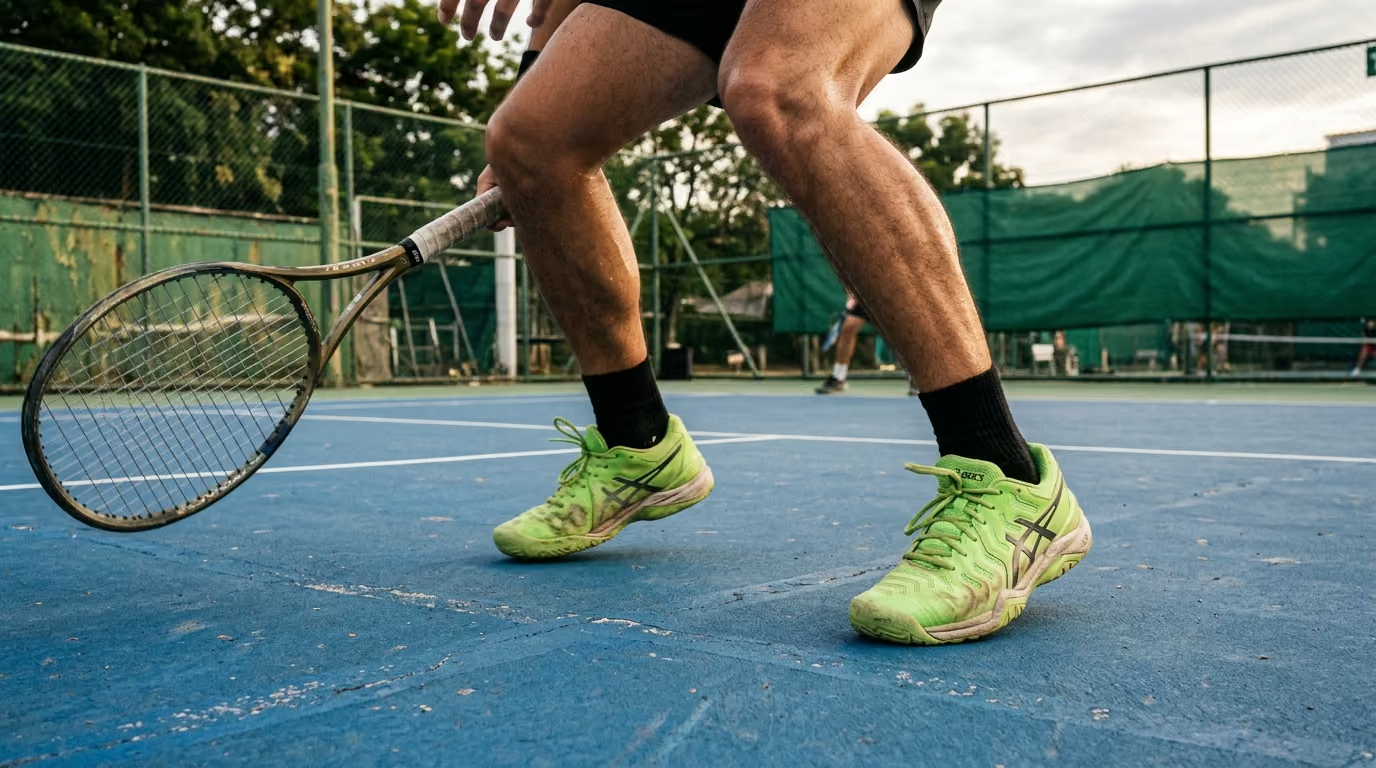
An athlete's court performance significantly improves by understanding how mobility, stability, and control collectively contribute to effective movement capacity.




If you have ever searched online for "how to get lower to the ball" or "how to stop hurting after court play," you likely found endless static stretching routines. You might stretch your hips daily, but still find yourself off-balance during a sharp lateral cut. True movement capacity is the interaction of your usable range of motion, joint stability, force production, and coordination under time pressure. The most valuable athletic range is not the largest stretch you can show on a mat, but the range you can actively control, load, and recover from during a match.
To build a better court presence, we must first define what we are training. Many players confuse basic flexibility with functional mobility. While flexibility is the passive length of your muscles, mobility is your active, usable range. This section clarifies the key components that determine how you move during a match.
Mobility is the functional range through which you can move and your ability to sustain active movement through that range. This definition is more useful for court athletes than simple joint-angle measurements. During play, you must repeatedly move into and out of deep positions while producing or absorbing force. Therefore, we must look at mobility as an active strength quality.
To understand your movement, you should distinguish among five types of range.
The critical distinction is between available range and usable range. A player may be able to reach a deep split squat passively while lying on the floor. Yet that same player might lack the hip, knee, ankle, and trunk control needed to decelerate safely in that position during play.
Stability is the ability to provide a stable foundation from which to move. On the court, stability does not mean remaining rigid or motionless. Instead, it means controlling a body segment or joint sufficiently to transfer force, redirect momentum, and maintain your position while other parts of your body move.
Stability is always task-dependent. For example, your foot must become a stiff, force-transmitting base during braking. Your ankle must allow appropriate forward bending while resisting unwanted inward collapse. Your knee must tolerate and redirect force without uncontrolled rotation, and your pelvis must remain organized so your hips can generate power.
Therefore, a stable joint is not necessarily a joint with zero movement. Stability is better understood as controlled movement within an acceptable range. Your muscles must contract in the right sequence to keep your joints centered.
Controlled mobility links mobility and stability together. It means moving within joints and between limbs while following an efficient path of motion. To help visualize this, we can use a simple conceptual model:
> Usable movement capacity = available range × strength in range × coordination × timing × tolerance to load
This model is not a strict mathematical formula. However, it explains why increasing your passive flexibility alone does not automatically improve your performance on the court. If your strength, coordination, or timing in a deep range is zero, your usable movement capacity in that range is also zero.
Strength is simply your capacity to produce force. In court sports, the most relevant forms of strength go far beyond maximal lifting capacity.
A major theme of physical preparation is that deceleration is primarily a strength task. It is not merely a technique task. You must have the eccentric strength to absorb your momentum before you can redirect it.
Coordination is the organization of your muscle actions, joint motions, and sensory information into an effective movement. Court athletes do not repeat identical movement patterns. Instead, they solve changing physical problems under severe time pressure. A technically perfect stroke performed too slowly, too early, or in the wrong direction is ineffective.
Proprioception concerns information about your body position and movement in space. Balance involves maintaining or recovering control of your center of mass over your feet. On court, balance is highly dynamic and task-specific. It involves braking on one leg, reaching outside your base of support, recovering after a deep stroke, and rotating while maintaining foot pressure.
To design effective training, we must look at what current research says about movement, flexibility, and performance. The science of court movement shows that simple answers are rarely complete.
Many players believe that stretching is the single best way to prevent court injuries and run faster. However, scientific reviews paint a more nuanced picture. A comprehensive review published in the Journal of Sports Sciences found no conclusive universal relationship between flexibility and injury risk or athletic performance.
The relationship appears to depend heavily on the specific sport and the task. Increasing your joint range beyond what is required for your sport-specific function is not necessarily beneficial. In fact, reviews suggest it may sometimes reduce your performance or increase your injury risk by creating a range you cannot actively control.
Stretching certainly has its place in a balanced routine. A systematic review of acute stretching research reported that all forms of muscle stretching produce significant temporary range of motion benefits. However, the timing of your stretching matters.
A synthesis of research reported that long-duration static stretching before training can improve flexibility, but it can also produce small, temporary performance reductions in explosive actions. Conversely, dynamic stretching within a warm-up has small positive effects on subsequent performance. Long static stretching is therefore better suited for separate mobility sessions or after play, rather than immediately before a match.
Foam rolling is another popular method used to improve joint range of motion. A systematic review published in physical therapy research found that foam rolling increased range of motion across multiple studies, showing a large pooled effect size.
However, the authors did not conclude that foam rolling directly improves athletic performance beyond these temporary joint range changes. It is a useful tool to temporarily open up a position, but you must still train your nervous system to control that new range.
While flexibility research shows mixed results, the evidence for balance and proprioceptive training is highly encouraging. A meta-analysis of twelve proprioceptive-training studies involving over 1,800 participants reported a 38% reduction in ankle-sprain incidence compared with control groups.
Another meta-analysis of randomized controlled trials involving over 3,700 participants reported a similar relative risk reduction for ankle sprains. The evidence was particularly strong for athletes with a history of prior ankle sprains, showing that proprioceptive work is highly effective for secondary prevention.
However, this evidence is not uniform across all injury types. Proprioceptive and balance training is highly effective for preventing ankle sprains, but research cautions that it should not be presented as a standalone solution for knee or anterior cruciate ligament injuries. A complete approach must combine balance with strength and progressive impact training.
Every point played in a racquet sport is a sequence of rapid starts, stops, and turns. To understand how movement capacity works on court, we can use two practical frameworks: the brake-redirect-reaccelerate model and the base-mass-limb model.
Almost every important court movement can be broken down into three linked phases.
Court sports are characterized by repeated accelerations and decelerations interspersed with lower-intensity movements. Athletes in multidirectional sports may change their activity between 500 and 3,000 times during a single competition. These transitions occur approximately every two to four seconds. Basketball studies have reported as many as 450 lateral movements per game, illustrating the immense physical load on the lower joints.
Every movement you perform can also be analyzed through three interacting components: your base, your mass, and your limbs.
Consider a wide-ball recovery step. Your contact foot must create a reliable base against the floor. At the same time, your pelvis and trunk must lower and redirect your center of mass back toward the center of the court. Finally, your free leg must reach or push off without disrupting your balance. If you have a stiff ankle, your base suffers. If you have weak hips, your mass is mismanaged.
Acceleration requires you to apply force to the ground and project your center of mass forward. This requires sufficient ankle range to create effective shin angles, hip extension capacity, trunk control, and foot stiffness. If you have insufficient ankle mobility, you might compensate by turning your foot outward or lifting your heel early.
Deceleration is often the most neglected component of court movement. It requires immense eccentric quadriceps and gluteal strength to absorb momentum. Research characterizes court match demands through these demanding acceleration and deceleration profiles. Repeated short braking actions create substantial muscle fatigue, even when each individual stop appears brief.
The lateral shuffle requires you to move your pelvis sideways while keeping your feet in a position to push in either direction. This requires strong hip muscles, control of your inner and outer thigh muscles, and stable ankles. A common mistake is treating lateral movement as a sequence of isolated foot actions. Your pelvis, trunk, and feet must coordinate so your body mass does not lag behind.
The crossover step introduces rotation and asymmetry. You must place one leg across the other while controlling your hips and trunk. This requires good hip internal and external rotation, single-leg strength, and precise foot placement.
Cutting is the ultimate test of change-of-direction speed. Tennis data from professional matches shows that players average 1.6 changes of direction per point. Approximately two-thirds of these changes involve angular changes greater than 105 degrees. Sharper cuts of less than 45 degrees are less frequent but are commonly associated with the highest movement intensities.
Single-leg landing combines impact absorption, balance, and readiness for the next shot. You must control your foot contact, ankle motion, knee flexion, pelvic drop, and trunk sway. If you lack the control to land quietly, you will struggle to react to the next ball.
Jumping requires rapid force production, while landing requires excellent force absorption. They should always be trained together. A simple landing that is technically controlled but leaves you frozen and unable to react is not useful for real competition.
It is a common belief that stretching further will automatically make you a better athlete. However, expanding your joint range without a matching increase in strength and control can actually hinder your performance.
Every additional degree of motion you gain potentially increases the range that your nervous system must regulate. If you are highly flexible, you actually need greater strength and coordination to prevent unwanted motion. Both insufficient flexibility and excessive flexibility can be associated with injury risk, and the optimal level depends on your individual body.
Excessive mobility is especially problematic when accompanied by joint laxity, poor proprioception, or weakness near the end of your range. If you have a history of recurrent ankle sprains or poor landing mechanics, focus on stability. The goal is to couple your existing range with active, muscular control.
A player may test well in passive ankle dorsiflexion while lying on a physical therapy table. However, that same player might fail to access that ankle range during a loaded squat, plant, or landing. This discrepancy occurs when the limiting factor is not the length of the tissue.
Instead, the limitation is often strength, balance, pain, timing, or coordination. A player might have excellent hip rotation during a passive test, but lose control of the pelvis when cutting at speed. Therefore, we must move away from simple passive tests and focus on how we move under load.
Stretching can certainly increase your joint range, and dynamic stretching is highly useful as part of a warm-up. However, stretching beyond the requirements of your sport does not offer additional benefits. You only need enough range to perform your court tasks efficiently.
To improve your court-specific movement capacity, you should focus on building strength throughout your existing range. You can learn more about structured movement training by visiting our mobility and movement resources. The goal is to make your current range as strong and resilient as possible.
While tennis, pickleball, and padel share many similarities, each sport places distinct physical demands on your body. Understanding these differences allows you to tailor your movement training to your specific game.
Tennis is played on a large court, which requires longer sprint distances, deeper lunges, and high-velocity deceleration. Players must cover a wide area, often sliding on clay or braking hard on hard courts. Match analyses show that players perform repeated changes of direction, with medium-intensity changes comprising the vast majority of movements.
Because tennis points can last for several shots over multiple hours, players need a high level of endurance and repeated rotational control. Lunging for a wide ball requires deep hip flexion and ankle dorsiflexion. You must also have the upper body stability to strike the ball while your center of mass is heavily displaced.
Pickleball is played on a much smaller court, which dramatically changes the movement demands. You rarely perform long, maximal sprints. Instead, the game is characterized by rapid, short-distance micro-adjustments, fast lateral shuffles, and quick forward-backward transitions.
A major physical challenge in pickleball is the constant low-squatting position required during dink rallies at the non-volley zone line. Players must sustain a semi-squat for extended periods, demanding excellent isometric endurance in the quadriceps, glutes, and calves. Additionally, because pickleball is highly reactive, you need exceptional foot speed and ankle stability to respond to fast, deflected shots.
Padel is played in an enclosed glass cage, which introduces unique rotational and spatial demands. Unlike tennis, where you recovery-step back to the center, padel players must constantly turn, track balls off the glass walls, and run backward. This requires excellent thoracic rotation, hip mobility, and multidirectional agility.
The frequent overhead play in padel, such as the bandeja or vibora, demands high shoulder mobility and upper-back extension. Padel players must also transition quickly from defending deep in the court to attacking at the net. This constant transition requires rapid acceleration and deceleration in small spaces, placing a premium on eccentric calf and quadriceps strength. To optimize your physical preparation for these sports, check out our strength and conditioning guidelines.
To build usable movement capacity, you need a structured framework. You cannot simply perform random exercises and expect them to transfer to your match play. This five-phase system helps you convert raw mobility into dynamic court control.
Before starting any training, you must assess the joint ranges that matter most on court. Check your ankle bend by bending your knee toward a wall with your heel firmly planted. Assess your hip flexion, hip extension, and hip internal and external rotation. Finally, check your thoracic rotation by sitting and turning your upper body as far as possible to each side.
Compare your left and right sides. Do not worry about meeting an arbitrary, idealized standard. Instead, look for significant asymmetries. If one ankle or hip is noticeably stiffer than the other, that is your primary target.
Once you have identified a restricted range, you must pair your mobility work with active control. Simply stretching a tight muscle is not enough. You must immediately teach your nervous system how to use that newly opened range of motion.
Follow this simple rule: open the position, own the position, load the position, and then express it at speed. For example, if you perform an ankle mobility stretch, follow it immediately with split-squat isometric holds. If you work on hip rotation, follow it with controlled lateral lunges. This sequence builds the strength needed to stabilize your joints in deep positions.
Next, you must build strength in the specific positions and directions you use on court. Your strength training should reflect the unilateral and multiplanar demands of racquet sports.
Perform these exercises slowly and with control, focusing on keeping your foot, knee, and hip aligned.
Once you can control your joints under slow, heavy loads, you must add speed. Start with planned movement drills, such as a predictable lateral shuffle between two cones. Focus on landing quietly and pushing off with a stiff foot and ankle.
Next, progress to reactive drills. Have a partner point left or right, or throw a ball in an unpredictable direction. This forces your brain to coordinate your movement under real-time pressure. This progression bridges the gap between gym-based strength and court-based agility.
Finally, you must monitor how your body responds to your training and your matches. Ask yourself these questions:
If your movement quality deteriorates significantly under fatigue, you may need to focus more on movement conditioning. Your goal is to maintain control even during the final game of a long match.
To see how this framework applies to real life, let us examine five common case patterns that racquet sports players often face.
Consider an athlete who struggles to get into a low defensive stance. When they try to squat, their heels lift off the ground, and their knees cannot travel forward comfortably. Many coaches would immediately assume this player has tight calves and needs aggressive stretching.
However, a thorough assessment might reveal that the limitation is actually a foot-control problem or a lack of hip strength. If the player cannot stabilize their arch, their ankle cannot bend efficiently. The correct training response is to pair mild ankle mobility drills with foot-strengthening exercises and loaded split squats. This helps the player build a stable base without relying on endless stretching.
Another common pattern is the highly flexible player who can easily touch their toes and reach deep positions. However, during a fast single-leg cut, their knee caves inward, and they lose pelvic control. This player has plenty of available range, but lacks the stability to control it.
For this athlete, further flexibility training is counterproductive and may even increase their injury risk. Instead, their training should focus on single-leg strength, isometric holds, frontal-plane hip control, and progressive change-of-direction drills. They must learn to own their available range.
An athlete with a history of recurrent ankle sprains often has adequate flexibility, but very poor joint position sense. Their brain struggles to recognize when the ankle is turning, leading to repeated injuries. Research shows that proprioceptive and balance training is highly effective for these players.
The training progression should start with simple single-leg balance exercises on a flat surface. Once this is mastered, progress to controlled hopping, lateral landing drills, and eventually reactive cutting. Building a strong, reactive ankle helps prevent the cycle of repeated sprains.
This pattern involves a player who can perform heavy bilateral squats in the gym, but struggles with lateral braking on the court. They move slowly during shuffles and crossover steps, and often feel off-balance. This is because general bilateral strength does not automatically transfer to unilateral, frontal-plane movements.
To bridge this gap, the athlete should add lateral lunges, adductor strengthening, and lateral deceleration drills to their routine. They must train their body to absorb and produce force sideways, not just up and down.
Finally, some players look technically perfect during predictable, preplanned drills in practice. Yet, during a real match, they look uncoordinated and frequently lose their balance. The limiting factor here is not their physical mobility or strength.
Instead, the limitation is their perception-action coupling. They struggle to read the ball and coordinate their movement under pressure. To address this, their training should include visual cues, variable starting positions, and opponent-based decision-making. They must learn to apply their movement capacity in an unpredictable environment.
To ensure your training is effective, you must avoid several common errors that players frequently make regarding mobility and recovery.
When a muscle feels tight, our natural instinct is to stretch it. However, a feeling of tightness is often a protective response from your nervous system, rather than a physical shortening of the tissue. If a joint is unstable, your brain may signal the surrounding muscles to contract tightly to protect the joint.
If you aggressively stretch these tight muscles, you may remove the only stability that joint has left. This can lead to increased joint laxity and a higher risk of injury. Instead of stretching, you should assess whether the tightness is caused by weakness or instability. Often, strengthening the surrounding muscles will signal your brain that the joint is safe, causing the feeling of tightness to resolve.
Many players spend hours balancing on rubber domes, wobble boards, or soft foam pads to improve their court balance. While these exercises can be useful for early-stage ankle rehabilitation, they have limited transfer to dynamic court movement.
Balancing on a squishy surface teaches your body to stabilize against a constantly moving base. However, on the court, the floor is solid and unyielding. Real court balance requires you to apply high forces rapidly against a stable surface. Therefore, your balance training should progress to dynamic single-leg landing and cutting on a firm floor. To read more about effective movement preparation, visit our injury prevention resources.
How you move on court has a direct impact on your recovery time, fatigue levels, and overall tissue health between playing sessions. Moving efficiently is not just about playing better; it is about playing longer.
When you possess adequate movement capacity, you can distribute the high impact forces of court play across your entire body. For example, a deep lunge allows your large hip muscles to absorb the force of a low shot. If your hips are stiff, that force must be absorbed by your lower back and knees.
Over time, this localized stress leads to joint wear, chronic stiffness, and overuse injuries. By improving your movement quality, you protect your joints and maintain your athletic longevity. You can learn more about managing your body's physical demands by exploring our recovery science principles and healthy aging and athletic longevity guidelines.
As discussed, deceleration is a highly demanding eccentric strength task. Eccentric contractions cause micro-tears in your muscle fibers, which is the primary cause of delayed onset muscle soreness. If you have poor deceleration mechanics, you will experience greater muscle damage and require longer recovery times between matches.
Furthermore, fatigue directly degrades your proprioception and joint position sense. As a match goes on, your brain becomes less precise at tracking your joint positions, raising the risk of an awkward plant or a sprain. Building eccentric strength and movement efficiency ensures you can maintain control even when tired, reducing post-match soreness and accelerating your recovery.
While structured movement training is highly beneficial, it is important to recognize when a physical limitation requires professional medical attention.
You should consult a physical therapist, sports physician, or other qualified healthcare professional if you experience any of the following warning signs:
Do not attempt to push through these symptoms with mobility drills or stretching. A professional clinical assessment is essential to identify the underlying cause and design a safe, effective recovery plan.
To help you apply this knowledge to your game this week, here is a practical checklist you can follow:
Follow Evercourts for practical insights on tennis, pickleball and padel performance, movement, recovery and healthy ageing. Stay connected for new articles, research-led guidance and ideas to help you play well and keep playing for years.


Read practical guidance for better movement, smarter preparation and a game that keeps working for you.
explore the Blog