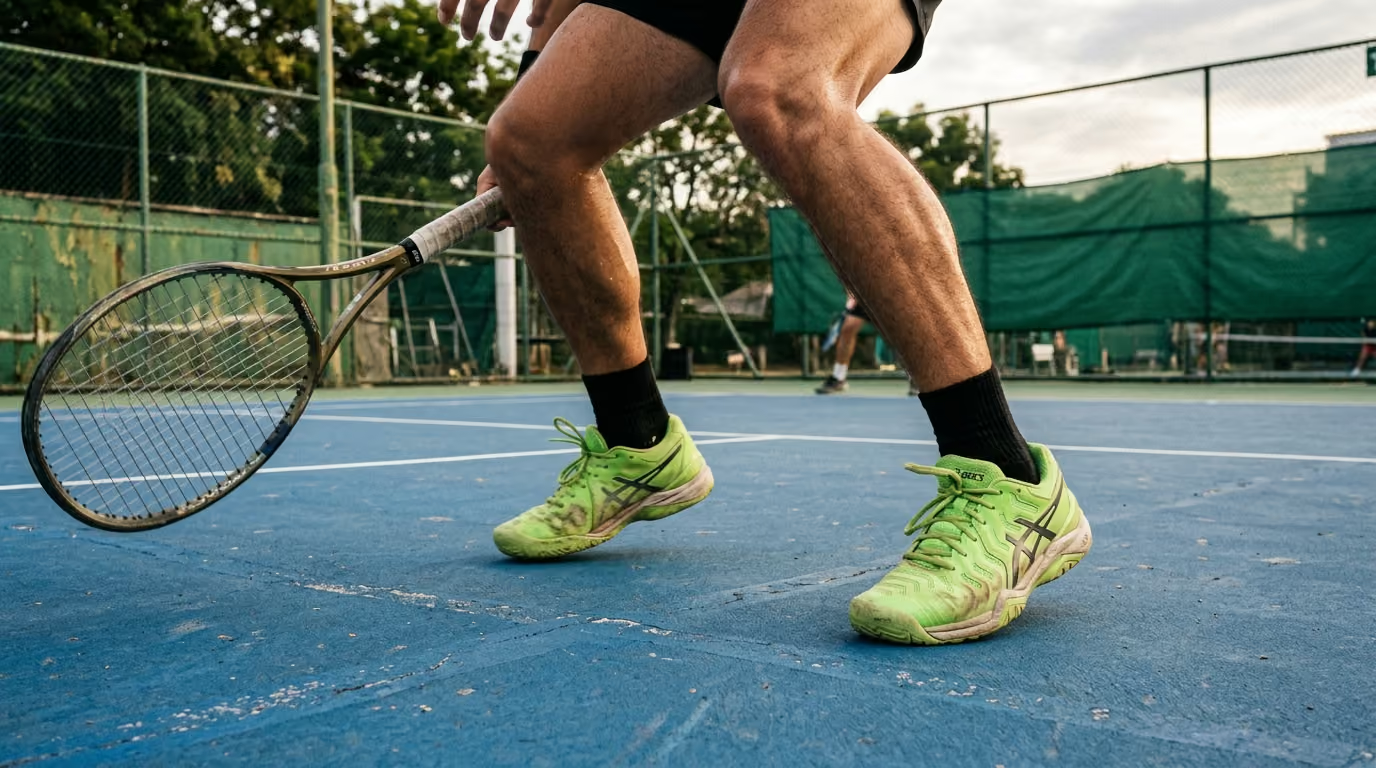
Joint health and physical durability in racquet sports require sufficient active range of motion coupled with the muscular strength to control that movement.




You step off the court after a long evening match, pack your gear, and head home. The next morning, you swing your legs out of bed and feel a deep stiffness in your lower back or a sharp ache in your Achilles tendon. Many recreational players accept this stiffness as a natural penalty for playing the sports they love. Fortunately, you can change how your body reacts to these physical demands.
To maintain joint health and physical durability in racquet sports, players must develop sufficient active range of motion coupled with the muscular strength to control that movement. True physical durability comes from a balanced kinetic chain where every joint, from the foot to the wrist, shares the stress of rapid changes of direction and repetitive ball strikes. This systematic approach allows court athletes to play efficiently while protecting sensitive tissues from overuse.
To build a durable body, we must first define what these physical capacities actually mean. Players often use the terms mobility and flexibility interchangeably, but they represent different physical realities. Flexibility describes the passive extensibility of your muscle-tendon units and surrounding soft tissues. You can measure flexibility by seeing how far a partner can push your leg into a stretch while you relax.
Mobility, by contrast, is the usable range of motion available to a joint under the active conditions of a task. It requires muscle strength, coordination, nervous system control, and tissue tolerance. If you have great passive hamstring flexibility but cannot control your leg during a deep run, you lack functional mobility. You can find more targeted ideas on this in our library of mobility and movement resources.
Stability is the ability to maintain or regain control of a joint segment when exposed to internal or external forces. It does not mean keeping a joint completely rigid. A stable joint can move through a wide range while remaining centered and controlled. Dynamic stability refers to this control during high-speed actions, such as braking from a sprint or landing after a smash.
Joint capacity is the total amount of loading a joint, tendon, or muscle system can tolerate and recover from. This capacity is shaped by your training history, age, previous injuries, sleep quality, and technique. Load tolerance is your ability to perform a movement repeatedly without losing coordination or experiencing pain. Racquet sports require high load tolerance because you must repeat the same movements hundreds of times per match.
The kinetic chain is the linked sequence through which your body generates, transfers, and absorbs force. In court sports, this sequence begins at the feet, travels through the knees and hips, passes through the trunk, and finishes at the shoulder, elbow, wrist, and racquet. If one link in this chain is weak or restricted, another link must work harder to compensate. This compensation often leads to overload and eventual injury in adjacent tissues.
Finally, movement variability is the ability of your nervous system to solve the same movement goal using slightly different physical paths. Having high movement variability helps distribute mechanical stress across different muscles and joints. It prevents the exact same tissue fibers from taking the brunt of every single stroke. A rigid, highly repetitive movement pattern is more likely to cause overuse issues over time.
An excellent way to understand court durability is to analyze the body joint by joint, starting from your contact point with the court. Each segment has a primary job, but they all rely on each other to create fluid athletic movement.
Your feet and ankles are the only contact points between your body and the court surface. They must function as dynamic shock absorbers when you land and as rigid levers when you push off. If your ankle lacks dorsiflexion, which is the ability to pull your toes toward your shin, your body will find that movement elsewhere. This compensation often forces the knee to collapse inward or causes the heel to lift early during a lunge.
To test your ankle mobility, stand facing a wall with your big toe five inches away. Keep your heel firmly on the ground and try to touch your knee to the wall. If your knee cannot reach, or if your heel lifts, your ankle dorsiflexion is limited. This restriction increases the stress on your Achilles tendon and plantar fascia during lateral movements.
To improve this area, you should focus on controlled knee-over-toe movements and progressive calf strengthening. Perform calf raises through a full range of motion, using both straight and bent knees to target different muscles. Eccentric calf loading, where you lower your heel slowly over the edge of a step, is highly effective. You can find more preventative movement patterns in our player health guides.
The knee is a simple hinge joint positioned between two highly mobile segments, the ankle and the hip. Its primary job is to transfer force while controlling flexion and extension. The knee is highly vulnerable to rotational forces, which it is not designed to handle in large amounts. When a player lacks hip or ankle mobility, the knee is often forced to twist to complete a movement.
During deceleration, your knees must tolerate massive eccentric forces as they bend to absorb your body weight. If your thigh muscles lack the strength to brake your movement, the joint structures themselves take the force. This can lead to irritation of the patellar tendon or the cartilage behind the kneecap.
Train your knees by practicing controlled single-leg step-downs and split squats. Ensure your knee aligns with your second toe and does not collapse inward during these movements. Do not fear letting your knee travel forward over your toes, as this is a natural athletic position. The goal is to build the strength and control needed to handle that forward travel under load.
The hips are the engine room of the court athlete. They provide the rotational power needed for groundstrokes and the extension required for sprinting. Your hips must also allow you to drop into a deep, low stance to return low balls. When hip mobility is restricted, players tend to bend from their lower back instead, which increases spinal stress.
I remember finishing a tough two hour padel match on a cold Tuesday night and waking up the next morning feeling like my lower back was locked in concrete. For a long time, I just accepted this as the price of playing hard in my forties. But once I started spending just ten minutes on targeted hip mobility before heading to the club, the stiffness almost completely vanished. It taught me that we do not have to accept pain as a default state of aging.
To improve hip function, you should train both internal and external rotation. Exercises like the 90/90 hip switch help restore lost rotational ranges. Additionally, perform lateral lunges and deep goblet squats to build strength in these newly accessible positions. This strength allows you to transfer force from the court up into your torso without overloading your lower back.
Your lumbar spine must be strong enough to transfer forces between your lower and upper body. While it needs some mobility, its primary job on the court is to resist unwanted extension and excessive twisting. Rotational power should come mostly from your hips and thoracic spine, not from your lower back. When your hips are stiff, your lumbar spine is forced to rotate beyond its natural limits.
Trunk endurance is far more important for court safety than absolute trunk strength. If your core muscles fatigue after three games, your lower back will begin to arch during serves and overheads. This repetitive arching under fatigue is a common cause of back muscle strains and disc issues.
Build trunk endurance using static hold variations, such as side planks and pallof presses. These movements train your body to resist rotation and lateral bending. You can also include controlled medicine ball rotations to teach your hips and torso to turn together as a single unit. This coordinated movement pattern protects your spine during high-velocity strokes.
The thoracic spine is your mid-back, and it is designed to rotate, flex, and extend. It works closely with the scapula, or shoulder blade, to position your arm for overhead actions. If your mid-back is rounded and stiff, you will struggle to raise your arm fully overhead. To compensate, you will likely arch your lower back to reach the ball, which strains both your spine and shoulder.
Your shoulder blade must move freely across your rib cage. It needs to rotate upward and tilt backward when you reach for a high volley or serve. If the muscles controlling the scapula are weak, the shoulder blade cannot support the arm. This lack of support can lead to shoulder impingement and rotator cuff irritation.
Improve your mid-back mobility with foam roller extensions and quadruped rotations. To strengthen the scapular stabilizers, practice face pulls and wall slides. These exercises teach your shoulder blades to glide smoothly, creating a stable foundation for your arm movements.
The shoulder is the most mobile joint in the human body, which also makes it the most unstable. It relies heavily on the rotator cuff, a group of four small muscles, to keep the arm bone centered in its shallow socket. During a tennis serve or a padel smash, the shoulder must rotate at extremely high speeds. The muscles on the back of the shoulder must then contract forcefully to decelerate the arm after contact.
Many players focus only on strengthening the front of their body, which can pull the shoulders forward. This posture reduces the space inside the shoulder joint, increasing the risk of tissue pinching. To protect this area, you must balance your training by focusing on the muscles of the upper back and the back of the shoulder.
Integrate external rotation exercises using resistance bands to build rotator cuff endurance. Combine these with overhead carries to improve the stability of the entire shoulder girdle. Remember that a mobile shoulder is only safe if you have the muscular strength to control that mobility.
The elbow and wrist are the final links in the kinetic chain before force is transferred to your racquet or paddle. They must manage the high-frequency vibrations and impact forces created when you strike the ball. If you hit the ball off-center, or if your grip is too tight, these forces increase significantly. This repetitive stress can lead to tendinopathy on either side of the elbow.
While forearm stretching can offer temporary relief, building muscle capacity is the key to long-term joint health. Your forearm muscles must be strong enough to stabilize your wrist during impact. If your wrist is floppy, your elbow must work much harder to control the racquet face.
Train your grip and wrist strength using targeted exercises like wrist curls, reverse curls, and forearm rotations. Ensure you use a racquet or paddle grip size that fits your hand comfortably. A grip that is too small or too large forces you to squeeze harder, which quickly fatigues your forearm muscles.
While all racquet sports share common movement patterns, each sport places distinct physical demands on your body. Understanding these differences allows you to customize your training appropriately.
Tennis is played on a large court, which requires players to sprint long distances and decelerate rapidly. This large playing area demands exceptional lower-body power and eccentric strength. Tennis players must also master open-stance groundstrokes, which place massive rotational forces on the hips and trunk.
The tennis serve is one of the most physically demanding movements in all of sports. It requires extreme shoulder external rotation and trunk hyperextension during the cocking phase. According to tennis sports medicine reviews, the lower extremity accounts for 31% to 67% of tennis injuries, while the upper extremity accounts for 20% to 49%. Acute injuries usually affect the legs, while chronic overuse issues are more common in the shoulders and elbows. You can read more about managing these demands in our tennis training strategies.
Pickleball is played on a smaller court, which reduces the need for long sprints but increases the frequency of rapid starts and stops. Players spend a significant amount of time at the non-volley zone line, also known as the kitchen. This position requires a low, crouched stance and constant lateral shuffling.
This low stance demands excellent ankle dorsiflexion and deep hip flexion. Pickleball also involves rapid, short paddle reactions that place high repetitive stress on the wrist and elbow. Emergency department data shows a significant rise in pickleball injuries, particularly among players aged 60 to 79. Slips, trips, falls, and dives account for 64.3% of these injuries, with older players facing a higher risk of fractures. To play safely, check out our resources on pickleball player safety.
Padel is a fast-paced game played within an enclosed glass court, which requires constant multi-directional movement. Players must handle rapid rebounds off the walls, requiring quick turns and low defensive saves. Padel also features a high volume of overhead shots, such as the tray shot, known as the bandeja, and the smash.
These frequent overheads require excellent thoracic extension and scapular control to avoid shoulder irritation. The quick changes of direction also place high demands on the knees and ankles. Padel literature indicates that sudden direction changes and high action velocity are primary injury risk factors, particularly for untrained players. For specific preparation tips, explore our padel physical preparation section.
Before starting any new exercise routine, it is wise to assess your current physical capabilities. This self-assessment helps you identify where your movement might be restricted or uncontrolled.
Begin by documenting your physical history. Note any past injuries, surgeries, or joint areas that regularly feel stiff or sore. Keep track of how many hours you play each week and any recent changes in your training volume. If you experience active pain, swelling, or joint locking, skip the self-tests and consult a healthcare professional.
Perform a few simple movements to evaluate your baseline strength and balance. These tests are not medical diagnoses, but they can highlight areas that may need attention.
Once you have tested your baseline balance, progress to more sport-specific movement patterns.
If you struggle with a specific movement, try to determine why. A movement limitation is usually caused by one of three things: a lack of joint range, a lack of muscle strength, or a lack of coordination. For example, if your knee collapses inward during a lateral lunge, the issue could be a stiff ankle, weak hip muscles, or simply a habit of moving that way.
The ultimate test of any training program is how you feel and move on the court. After four to six weeks of targeted exercise, re-test the movements you found challenging. You should notice that you can reach lower, brake more smoothly, and recover your court position more quickly and with less effort.
To build a body that can withstand the physical demands of court sports, your training should follow these five core principles. For more information, read our comprehensive strength and conditioning guidelines.
Start your training with simple, controlled exercises before moving on to fast, unpredictable movements. Begin by building basic muscle strength with slow, loaded movements, such as squats and hinges. Once you have built a strong foundation, transition to faster movements like jumps, bounds, and quick changes of direction. This gradual progression gives your tendons and joints plenty of time to adapt to the physical stress.
Many players focus all their energy on learning to run faster and hit harder. However, most joint injuries happen when you are trying to stop, land, or slow down. Your training must include exercises that teach your body to absorb force safely. Practice landing softly from small jumps and coming to a controlled stop from a short sprint to build this essential physical capacity.
Because racquet sports are naturally one-sided, they tend to create physical imbalances over time. Including single-leg and single-arm exercises in your routine helps balance these differences. Single-leg step-ups, single-leg deadlifts, and single-arm rows ensure that both sides of your body develop equal strength and stability.
Static balance is a great starting point, but court sports require dynamic coordination. Once you can easily hold a single-leg stance, make the exercise more challenging by adding movement. Try turning your head from side to side, catching a ball, or reaching in different directions while balancing on one leg. This training prepares your nervous system to keep you balanced during fast, unpredictable court rallies.
Long, passive stretches can feel nice, but they do not always translate to better movement on the court. A more effective way to improve your usable range of motion is to build strength at the end of your physical limits. Performing exercises like full-range split squats and deep lunges teaches your nervous system to control and use those deeper ranges safely.
Avoid these common training mistakes to ensure your preparation is as safe and effective as possible.
A sensation of tightness is often your nervous system’s way of protecting a weak muscle, not a sign that the muscle is physically short. If you stretch a weak, tired muscle repeatedly, you may actually make it feel tighter. Instead of constant passive stretching, try strengthening the tight area to give your body the stability it needs to relax.
Having joint flexibility is only helpful if you have the muscular strength to control that range of motion. If you have extremely flexible joints but weak muscles, your connective tissues are exposed to higher stress. Focus on building control and strength within the movement ranges you already have before trying to open up new ones.
This is a common fitness myth that does not match how our bodies actually move. Your knees must travel forward over your toes when you lunge for a low ball or stop suddenly. Training your knees to move safely over your toes in a controlled gym environment is one of the best ways to prepare them for the court.
Your spine is designed to move, rotate, bend, and flex. Keeping your torso completely rigid while playing can make your strokes stiff and awkward. The goal of core training is to teach your body to produce and control spinal movement, not to prevent it entirely.
The shoulder does not work in isolation; it is highly dependent on the rest of your kinetic chain. If your hips are stiff or your mid-back is rounded, your shoulder is forced to work much harder to generate power. To resolve shoulder discomfort, you must address movement limitations throughout your entire body.
Because the pickleball court is small, many players assume the sport is physically effortless. However, the quick reaction times and constant lateral movements place high physical demands on your body. Treating pickleball with the same physical respect as tennis or padel is key to staying healthy.
Padel is a relatively new sport, and scientific research on its physical demands is still developing. While current studies show high rates of elbow and knee injuries, the overall evidence is still limited. It is best to interpret these statistics with a healthy dose of caution and focus on general athletic preparation.
Because you play racquet sports with one dominant hand, some physical differences between your left and right sides are normal. You do not need to spend hours trying to make both sides of your body perfectly symmetrical. Focus on correcting an asymmetry only if it is causing you active discomfort or clearly limiting your movement.
Pain is a complex alarm system managed by your brain, not a direct measure of tissue damage. You can experience physical stiffness or discomfort without having any structural injury. Use your symptoms as a guide to adjust your training volume, rather than assuming every ache means you are injured.
A good warm-up prepares your body for play, but it cannot make up for a lack of general strength or a sudden spike in playing time. True injury prevention is the result of consistent strength training, sensible scheduling, and prioritizing high-quality sleep and recovery.
When you move efficiently, your joints and muscles share the physical stress of play evenly. This balanced distribution of force prevents any single muscle group from becoming overloaded and excessively fatigued. As a result, you will experience less soreness and recover much faster between sessions.
Stiff joints force your body to use less efficient movement patterns, which wastes energy and increases muscle fatigue. When your muscles are tired, they lose their ability to absorb shock, placing higher stress on your joints and tendons. Improving your active mobility breaks this cycle, allowing you to play longer and feel fresher the next day.
Here is a simple, three-session weekly plan designed to improve your joint health and on-court performance. Customize the exercises, weights, and repetitions to match your current fitness level.
Spend five to ten minutes warming up before you step onto the court. Jog lightly, perform some dynamic leg swings, and complete a few bodyweight lunges to raise your heart rate. Follow this with gentle shoulder circles and a few practice swings to prepare your upper body for action. Save your static stretching for after your session.
Spend five minutes cooling down after your match to help your body transition into recovery mode. Walk slowly around the court, breathe deeply, and perform a few gentle stretches for your calves, hips, and shoulders. Holding these stretches for 30 seconds when your muscles are warm can help maintain healthy muscle length.
While physical soreness is a normal part of playing sports, some symptoms require professional evaluation. Consult a qualified physical therapist or sports medicine physician if you experience any of the following warning signs:
A qualified professional can help identify the root cause of your symptoms and design a customized recovery plan. This professional guidance ensures you can return to the court safely and continue playing the sports you love for years to come. For more details on athletic longevity, explore our healthy aging resources.
You should return to this joint framework whenever you prepare for a new competitive season, experience a change in your playing volume, or notice new areas of physical stiffness after matches. Using these self-assessments regularly helps you catch movement limitations early, allowing you to make small adjustments to your training before they turn into nagging injuries.
By investing just a few minutes each week in your active mobility, you can protect your joint health, move more efficiently on the court, and enjoy playing your favorite racquet sports for years to come.
Follow Evercourts for practical insights on tennis, pickleball and padel performance, movement, recovery and healthy ageing. Stay connected for new articles, research-led guidance and ideas to help you play well and keep playing for years.


Read practical guidance for better movement, smarter preparation and a game that keeps working for you.
explore the Blog