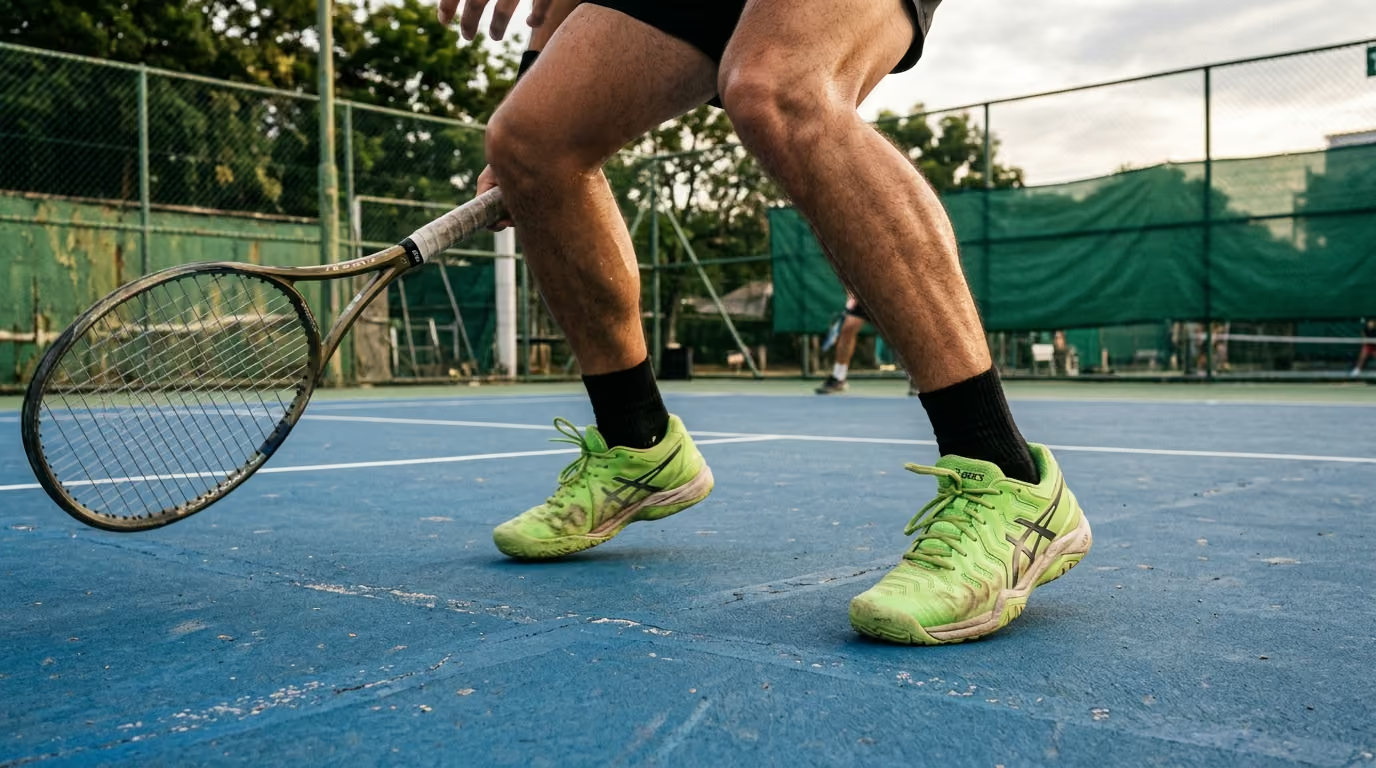
While many believe lifting weights makes a person stiff, building strength through a full range of motion is actually the most effective way to achieve lasting mobility.




Why do your hips feel stiff and restricted every time you try to lunge for a low volley on the court? If you have ever asked this question, you are not alone.
To improve your movement on the court, you do not need passive flexibility. You need to build usable range of motion by training your muscles to produce and control force at their longest lengths. Strength training performed through a controlled, full range of motion is the most effective way to achieve this lasting change.
For decades, athletes have separated strength and flexibility into distinct, isolated training buckets. One group spent hours lifting heavy weights in restricted ranges of motion. Another group focused entirely on long, passive stretching sessions. This division created the false belief that lifting weights makes a person stiff, while stretching is the only way to stay fluid.
In our experience, these two physical qualities are not mutually exclusive. I remember finishing a tough two hour padel match on a cold Tuesday night and waking up the next morning feeling like my lower back was locked in concrete. For a long time, I just accepted this as the price of playing hard in my forties. But once I started spending just ten minutes on targeted hip mobility before heading to the club, the stiffness almost completely vanished. It taught me that we do not have to accept pain as a default state of aging. You can read more about our research-led approach to healthy aging on our about page.
Instead of chasing passive flexibility, court athletes should focus on usable range. Usable range means having the active strength to control and stabilize your joints at their physical limits. If you only train with short, restricted movements, your nervous system will protect you by locking down your movement on the court. Combining strength and movement capacity is the key to athletic longevity.
When you build strength at long muscle lengths, your brain allows your joints to access deeper positions. This is because your nervous system feels safe when it knows you can produce force in those deep positions. True mobility is not just about how far you can bend with help. It is about how much force you can produce and control on your own.
To build a better body for court sports, we must clarify our terms. Many players use flexibility and mobility as if they mean the exact same thing. In reality, they describe very different mechanical properties. Understanding these differences will help you choose better exercises for your daily training.
Flexibility describes the passive range of motion available at a joint. It is measured when an external force, such as a partner or a strap, stretches your tissue. Having excellent passive flexibility does not mean you can move well during a match. It simply means your tissues can tolerate being pulled into a deep position.
Mobility is the ability to actively move a joint through a complete range while coordinating the surrounding muscles. It requires active muscle contraction, balance, and motor control. Active range of motion is what you can reach using only your own muscular effort. Passive range of motion is what you can reach with outside assistance.
The space between your active and passive range is called the control gap. A large control gap means you can stretch into a position but cannot protect yourself there. Usable range is the portion of motion you can actively access, control, load, and coordinate without pain or compensation. We want to make your usable range as close to your passive range as possible.
To achieve this, we can view movement capacity as a progressive continuum. The stages of this continuum are exposure, access, control, strength, speed, and finally adaptability. Each step builds on the previous one to prepare your body for the physical demands of play. This model explains why simply having joint range is not enough to perform at your best. You must teach your nervous system to trust and use that range under load.
Modern sports science supports the idea that lifting weights can improve your movement on the court. A systematic review published in 2023 analyzed multiple clinical trials on this topic. The researchers found that resistance training significantly improved range of motion. The overall effect size was measured at a robust 0.73.
This positive effect disappeared only when the training relied solely on body mass. Adding external resistance provides a stronger stimulus for your tissues to adapt. Another systematic review from 2024 confirmed these findings. This study reported a pooled effect size of 0.63 for resistance training on flexibility in healthy adults.
The evidence does not suggest that stretching is useless. Clinical studies show that chronic stretching is still an effective way to increase joint range. Rather, the research shows that resistance training and stretching produce different physical adaptations. Stretching primarily increases your tolerance to a stretch sensation.
Strength training actually builds tissue capacity and active control. In one direct comparison, full range resistance training was as effective as static stretching for joint flexibility. However, the strength training group also gained substantial muscular power and joint stability. This means you do not have to choose between being flexible and being strong.
Furthermore, your training status affects how quickly you will see these improvements. Research summarized by the Canadian Strength and Conditioning Association shows that untrained individuals experience rapid mobility gains. Experienced athletes may need more specific, loaded exercises to see progress. Using a full range of motion is also highly effective for building strength. A systematic review of sixteen studies showed that full range training outperformed partial range training for lower limb strength.
Before you start a new training program, you must identify why your movement is limited. Not all stiffness is caused by tight muscles. If you treat every limitation with static stretching, you may waste time and effort. We use a simple five part framework to classify movement restrictions.
The first category is an access limitation. This occurs when you cannot reach a joint position even with external assistance or low loads. If you cannot pull your knee to your chest while lying down, you have an access issue. This requires supported joint mobilizations and progressive, passive stretching to improve tissue tolerance.
The second category is a control limitation. In this scenario, you have the passive range, but you cannot actively reach or hold it. For example, a partner can lift your leg high, but you cannot hold it there yourself. This requires end range isometrics and slow, active repetitions to bridge the control gap.
The third category is a strength limitation. You can access and control the position, but you cannot produce force when you get there. This makes it difficult to push off the ground when lunging or recovering. You can address this by training with loaded, full range compound exercises and long muscle length resistance.
The fourth and fifth categories are coordination and confidence limitations. A coordination issue means you have the local joint range but cannot combine movements, which is common in complex rallies. A confidence issue occurs when your brain restricts movement because a position feels unsafe. Reducing load, using slower tempos, and practicing in stable environments can help retrain your nervous system.
The mobility demands of racquet sports are highly specific. A movement program that works for a runner may not prepare you for the court. Each sport places unique physical demands on your joints, muscles, and nervous system. We must design our training to match these specific movement patterns.
In tennis, players must manage high speeds and sudden changes of direction. The overhead serve requires excellent shoulder flexion and thoracic spine extension. Deep groundstrokes on clay courts require robust hip abduction and ankle dorsiflexion. You can find more detail on court injury prevention techniques in our injury prevention section.
Pickleball features a smaller court but requires intense, repetitive low stance play. Players spend long periods bent forward at the kitchen line. This stance demands exceptional deep hip flexion and lower back endurance. Ankle mobility is critical for the quick, lateral lateral steps needed to defend the dink. You can learn more about managing these demands in our pickleball section.
Padel combines elements of both sports with the added complexity of wall rebounds. Players must rotate their trunks rapidly to play balls off the glass. This requires exceptional thoracic mobility and multi-directional hip power. Overhead shots like the bandeja demand continuous shoulder stability at the end of your physical reach. You can learn more about managing these demands in our padel section.
Because of these differences, your training should target your specific sport. Tennis players should prioritize hip abduction and overhead range. Pickleball players should focus on deep squats and lateral ankle control. Padel players need to emphasize rotation and off balance stability. Tailoring your work to your sport ensures your joint range becomes useful on court.
To turn passive joint range into usable strength, you must follow clear programming principles. Simply lifting weights with poor form will not solve your movement restrictions. Your nervous system requires structured, deliberate input to adapt. We use six key concepts to guide our training design.
First, you must train the specific range you want to use. If you want to improve your low volley, you must practice producing force in a deep split stance. General hamstring stretching will not transfer directly to a fast paced match. The most transferable gains come from loaded exercises that mimic your on court shapes.
Second, use slow tempos to build active control. Slower eccentric phases, which are the lowering portions of an exercise, reduce momentum. This forces your muscles to do the work and allows you to feel joint alignment. We recommend a tempo of three to five seconds for the lowering phase.
Third, incorporate pauses and end range isometrics. Holding the bottom position of a squat or split squat for one to three seconds is highly effective. It removes the elastic rebound of your tendons and forces your muscles to contract at their longest lengths. This building of force at long muscle lengths is a key driver of joint health.
Fourth, prioritize unilateral exercises. Single leg and single arm movements prevent your dominant side from compensating for weaknesses. Unilateral training also exposes hidden differences in balance, strength, and coordination. While some asymmetry is normal, large side to side differences can affect your performance on court. You can read more about balancing your body in our strength and conditioning resources.
Fifth, progress only one training variable at a time. Do not try to make an exercise deeper, heavier, and faster all in the same week. First, establish a comfortable, repeatable range of motion with a light load. Next, increase the range, then add weight, and finally introduce speed. This step-by-step approach keeps your training safe and measurable.
Sixth, use the minimum effective range. Your training range does not always need to be your absolute physical limit. It should be the largest range you can repeat with acceptable, stable technique. Forcing a joint into a deeper position through spinal compensation or pain is always counterproductive. Focus on quality of movement rather than arbitrary depth.
To make these principles practical, we have developed specific exercise progressions. These movements target the joints most commonly restricted in tennis, pickleball, and padel. Start with the easiest variation and progress only when you can control the movement completely.
For ankle dorsiflexion, start with a simple knee to wall mobilization. Stand facing a wall and slowly touch your knee to the wall without letting your heel lift. Once this feels comfortable, progress to isometric calf raises held at the deepest bottom position. Finally, transition to slow, heel elevated squats, and eventually loaded split squats with your front knee traveling forward.
To improve your hip flexion, begin with the active straight leg raise. Lie on your back and slowly lift one leg as high as possible while keeping both knees straight. Next, try seated hip flexion lifts, where you sit on the floor and lift your foot over a small block. Progress this to slow step ups, and eventually deep, front loaded squats.
For hamstring range, the Romanian deadlift is our preferred movement tool. Start with a light weight and focus on pushing your hips back while keeping your spine long. Lower the weight only as far as your hamstrings allow without rounding your back. Progress by adding a two second pause at the bottom, or by transition to a single leg Romanian deadlift.
To build overhead shoulder flexion, start with wall slides. Stand with your back against a wall and slide your arms upward while keeping your ribcage from flaring. Next, use a half kneeling landmine press to train upward rotation of the shoulder blade. Progress to single arm overhead carries, holding a kettlebell or dumbbell locked out overhead as you walk.
Finally, train your hip abduction and adductor strength to improve lateral movement. Start with supported lateral weight shifts, keeping your feet wide and sliding your weight side to side. Progress to side lying leg raises, and then to modified Copenhagen planks. Finish with loaded lateral lunges, descending with a slow, controlled tempo.
Many court athletes make simple mistakes that stall their mobility progress. Understanding these pitfalls will save you time and protect your joints from unnecessary irritation. The most common error is forcing joint depth with poor overall alignment.
For example, players often try to squat deeper by rounding their lower back or letting their knees collapse inward. This does not improve hip mobility; it simply shifts stress to your passive spinal structures. Always prioritize a neutral spine and stable foot placement over arbitrary depth.
Another error is relying exclusively on passive static stretching before you play. While stretching can temporarily improve joint range, it can also reduce your explosive power if done excessively. A better approach is to perform a dynamic warm up that includes active, loaded movements.
Finally, avoid using highly unstable surfaces to build mobility. Exercises performed on wobble boards or foam pads reduce the force your muscles can produce. This makes it difficult to build the end range strength needed for rapid court movements. Use stable ground to build real, usable capacity.
Building usable range of motion has a profound effect on how your body recovers between matches. When your joints can move freely and with strength, physical stress is distributed evenly across your tissues. This prevents single muscle groups or tendons from taking repetitive, damaging impacts. You can learn more about tissue recovery in our recovery science resources.
Many court players experience chronic lower back stiffness after long sessions. This often happens because stiff hips or ankles force the spine to bend and twist excessively during play. By improving your hip and ankle capacity, you allow your lower back to remain stable and pain free.
Active end range strength also protects your muscles during rapid eccentric contractions. When you chase down a wide ball, your muscles must stretch and absorb force at high speeds. If you have trained your muscles to be strong at long lengths, they can handle this deceleration safely. This reduces muscle soreness and speeds up your return to play.
Investing ten minutes a day in active mobility builds a foundation for long term play. It allows you to maintain your physical capabilities and continue enjoying racquet sports for years to come. For more science based recovery advice, visit our player health section.
While progressive strength training is highly effective for improving movement, it is not a cure all. You must know when to step back and seek professional guidance. Pain is a complex signal, and training through sharp or escalating pain can lead to serious injury.
If you experience sharp, pinching pain inside a joint during a movement, stop immediately. This is different from the mild, tolerable discomfort of a muscular stretch or fatigue. Joint pinching often indicates a mechanical issue that requires clinical assessment.
You should also consult a qualified healthcare provider if you experience neurological symptoms. These include numbness, tingling, radiating pain, or unexplained weakness in your limbs. Persistent swelling, night pain, or a sudden loss of joint control also require medical evaluation.
A physical therapist or sports physician can help identify the root cause of your symptoms. They can provide a specific diagnosis and guide your return to sport. Use training to build health and capacity, but always respect the boundaries of clinical care. If you need help finding resources or have questions, feel free to visit our contact page.
To make these concepts a regular part of your routine, you need a structured plan. You do not need to spend hours in the gym to see significant improvements. Consistency is far more important than training volume when building usable range.
For beginner athletes, we recommend a simple three day per week template. This program fits easily around your scheduled matches and requires minimal equipment. Focus on executing each movement with slow, controlled tempos and perfect alignment.
Experienced players can integrate mobility directly into their existing strength and conditioning routines. Perform a full range primary lift, followed by a unilateral accessory movement and a long muscle length exercise. Finish your session with an end range isometric hold and a loaded carry.
To track your progress, monitor quantitative metrics like active range of motion and the load used in your target ranges. Also note qualitative improvements, such as movement confidence and how your joints feel the morning after a match. These feedback loops will help you refine your training over time.
To help you apply this knowledge immediately, we have created a simple checklist. You can start implementing these steps this week to build better movement capacity. Focus on small, consistent actions rather than major, sudden changes.
Follow Evercourts for practical insights on tennis, pickleball and padel performance, movement, recovery and healthy ageing. Stay connected for new articles, research-led guidance and ideas to help you play well and keep playing for years.


Read practical guidance for better movement, smarter preparation and a game that keeps working for you.
explore the Blog