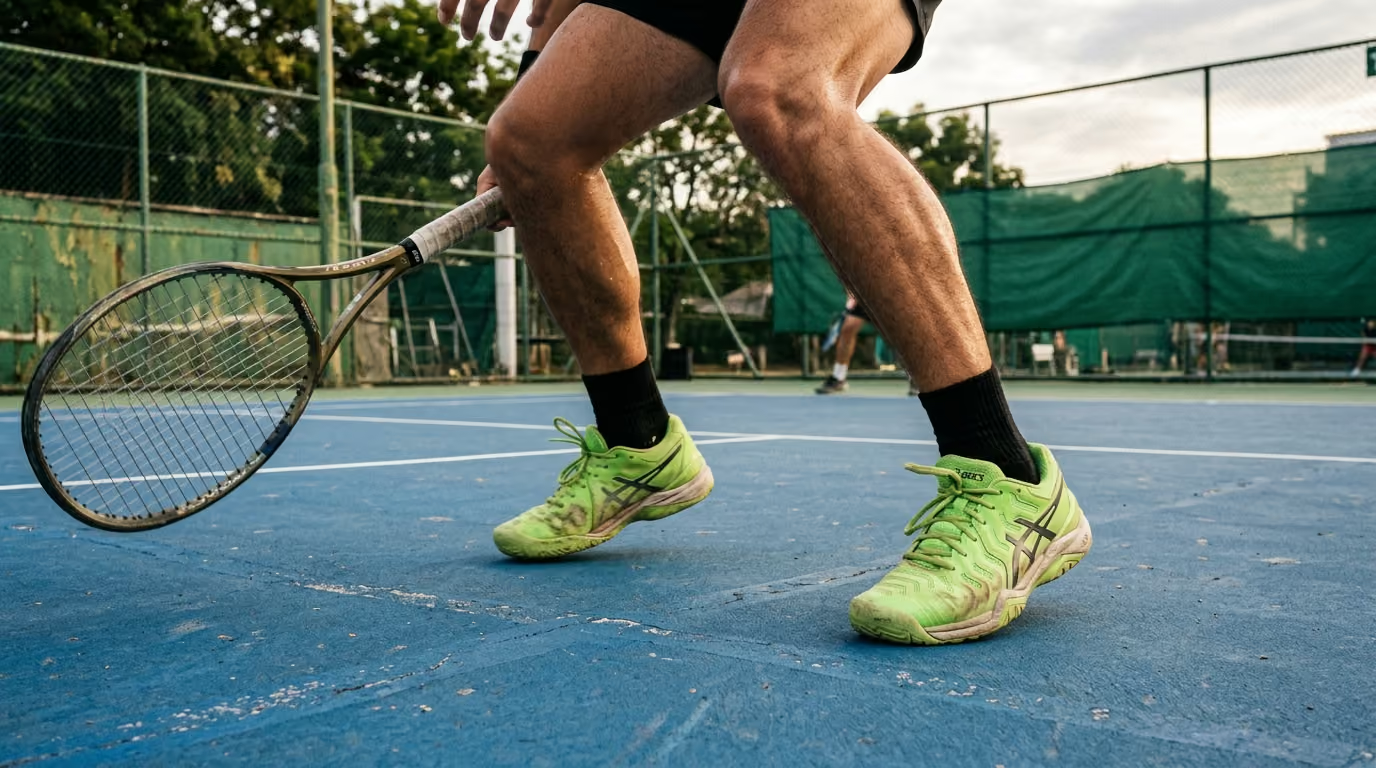
Approximately 80% of tennis strokes occur within 2.5 meters of a player's ready position, highlighting how small movements determine late-match mobility and performance.




Late-match mobility is not about your ability to sprint at maximum speed for hours on end. Rather, it is the capacity to maintain balance, control posture, and prepare your racquet early when your physical reserves are low. To maintain mobility when you are tired, you must focus on early racquet preparation, small adjustment steps, and balanced positioning. By prioritizing physical economy over raw speed, you can preserve technical accuracy and avoid late-match physical breakdowns.
Many players believe that getting tired simply means running slower. In reality, fatigue changes how your brain and muscles work together on the court. It alters your reaction time, makes your steps heavier, and ruins your posture before you even realize you are exhausted. Understanding how fatigue affects your movement is the first step toward moving better during long matches. With the right movement strategies, you can keep playing high-quality shots even when your legs feel heavy.
Our team focuses on helping court athletes maintain athletic longevity without relying on fitness hype or unrealistic training schedules. We want to help you understand the true science of movement so you can enjoy your sport for many years. To do that, we must look closely at how fatigue develops on the court and what you can do to manage it. Let us examine the physiological changes that occur during a long match and how they impact your performance.
To understand late-match movement, we must separate physiological load from actual fatigue. Physiological load refers to measurable metrics like heart rate, oxygen consumption, and lactate accumulation. Fatigue, however, is the actual reduction in your muscles' ability to produce force and repeat fast accelerations. A player might run less during the third set because of tactical changes, muscle soreness, or even mental exhaustion. It is a complex physical and mental state that cannot be measured by a heart rate monitor alone.
The real problem during a long match is not sprinting across the entire court. Most court movement is actually very short. Research shows that approximately 80% of tennis strokes occur within 2.5 meters of the player's ready position. Only about 10% of strokes require moving between 2.5 and 4.5 meters, and fewer than 5% require running further than that. This means your late-match movement is determined by tiny details, not by your ability to run marathon distances.
When you get tired, you lose the ability to perform these small movements efficiently. You might miss the split-step timing by a fraction of a second. Your first step might become slightly slower, or your braking might become heavy and unbalanced. These tiny errors accumulate, causing you to arrive at the ball just a few inches out of position. You then have to reach or lean, which makes your stroke unstable and less accurate.
Furthermore, court sports require repeated starts and stops rather than continuous running. A typical point involves frequent accelerations, decelerations, and changes of direction. This constant braking requires a massive amount of eccentric muscle force from your quadriceps and glutes. As these muscles tire, your body tries to find easier ways to move. This usually results in an upright posture and late racquet preparation, which can ruin your hitting consistency.
Current sports science shows that prolonged match play leads to clear physical declines. According to a research review published in Sports Medicine, a player's quadriceps strength can drop by 10% to 13% after a long match. This reduction in leg strength directly impacts how quickly you can push off and change direction. It also makes it harder to absorb the impact of landing after a jump or a hard sprint.
The same research highlights a reduction in leg stiffness during long matches. Think of your legs as springs. When you land from a split-step, healthy leg stiffness helps you bounce quickly in the next direction using elastic energy. When fatigue sets in, your legs lose this spring-like quality. You have to rely more on active muscle force to move, which uses more energy and makes you feel even more tired.
Interestingly, fatigue does not always cause a complete collapse in stroke accuracy. The relationship between physical exhaustion and shot quality is quite complex. Some studies show that while ball speed decreases as a match progresses, experienced players can often maintain their accuracy. They do this by choosing safer targets and using smarter tactics to compensate for their slower movement.
However, when fatigue becomes extreme, accuracy does begin to suffer. During structured fitness tests like the Loughborough Intermittent Tennis Test, groundstroke accuracy dropped by roughly 70%, and serve accuracy fell by 30%. These drops show what happens when players are pushed past their physical limits. For the everyday player, the goal is to use smart mobility and movement resources to prevent reaching this extreme state of exhaustion.
It is also important to note that most sports science studies have some limitations. Many studies use simulated drills rather than actual competitive matches. Furthermore, female athletes and older players are often underrepresented in this research. This is why we must combine scientific data with practical on-court experience to build reliable training strategies. We want to focus on healthy aging and athletic longevity so you can keep playing without pain.
Every movement you make on the court can be broken down into a seven-step chain. Fatigue acts like a wedge, slowly breaking the links in this chain one by one. By understanding each step, you can identify exactly where your movement starts to fail when you get tired.
Before you can move, your brain must recognize where the ball is going. Fatigue increases your mental strain and makes it harder to concentrate. When you are tired, you might take a fraction of a second longer to read the ball's depth, spin, and speed. This delayed reaction makes the entire court feel twice as large.
The split-step is a timed jump that prepares your body to move in any direction. When fatigue sets in, players often skip the split-step entirely or land with flat feet. This flat-footed landing means you lose the benefit of elastic energy. You have to push off from a dead stop, which requires much more muscular effort.
To move toward the ball, you must direct force into the ground through your feet. This requires strong lateral, diagonal, or forward pushes. As your lower-body force capacity declines, your push-off becomes weak. You will find yourself shuffling toward the ball rather than taking explosive steps.
Deceleration is the most physically demanding part of court movement. You must absorb your forward momentum before you can strike the ball cleanly. Tired muscles cannot absorb this force efficiently, which often causes players to slide too far or overrun the ball. This makes it incredibly difficult to set up a stable base for your stroke.
A stable base is essential for a clean, powerful stroke. Your feet should be spaced comfortably apart to support your body weight during the swing. Fatigue often causes players to stand too tall with their feet close together. This narrow base limits your balance and forces you to swing using only your arms.
As you move toward the ball, your upper body should prepare the racquet early. When you are physically tired, your brain prioritizes running over racquet preparation. You will often find yourself running with your racquet down, only pulling it back at the very last second. This late preparation leads to rushed, inconsistent shots.
After hitting the ball, you must return to a sensible position on the court. Recovery requires a quick push-off and immediate acceleration back to the center. Tired players often watch their shot instead of recovering, or they walk back slowly. This slow recovery leaves you vulnerable to your opponent's next shot.
You do not need to be in perfect physical shape to move well late in a match. By making small, smart adjustments to your movement patterns, you can preserve energy and stay balanced. Here are five practical strategies you can use during your next session.
First, use smaller adjustment steps as you get close to the ball. Many players try to cover the court with huge, lunging strides. These large steps are very difficult to brake and often leave you off-balance. Instead, use your first two steps for speed, then use small, rapid adjustment steps to set your distance from the ball. This helps you preserve your spacing and hit from a stable base.
Second, prioritize the quality of your arrival over your maximum speed. It is often better to arrive at the ball slightly slower but completely balanced, rather than running at full speed and sliding out of control. Control your approach so you can decelerate smoothly. This gives you more control over your shot and makes it easier to recover for the next point.
Third, maintain a sustainable athletic posture throughout the match. When players get tired, they tend to stand upright and bend only at the waist to reach low balls. This puts an immense amount of pressure on your lower back. Instead, keep your knees slightly soft and bend from your hips. This keeps your center of mass low and allows you to push off in any direction.
Fourth, use early racquet preparation as a mental cue. As soon as you see which way the ball is going, turn your shoulders and start moving your racquet back. This simple action organizes your body and makes your movement feel much less rushed. It also reduces the amount of physical work your arms have to do to generate power.
Fifth, reduce unnecessary recovery distance by positioning yourself tactically. You do not always need to sprint back to the exact center of the baseline. Instead, recover to a position that covers your opponent's most likely response based on the shot you just hit. This simple tactical shift can save you miles of running over the course of a three-set match.
The rules of most racquet sports give you about 20 seconds between points and 90 seconds during changeovers. These brief pauses are not long enough for complete physical recovery. However, they are perfect for resetting your nervous system and preparing your body for the next effort.
During changeovers, your primary goal is to lower your core temperature and replenish lost resources. Sip water or an electrolyte drink to stay hydrated. If you are playing in hot conditions, place a cold towel around your neck or pour cool water over your wrists. This helps reduce cardiovascular strain and keeps your mind clear.
Avoid the temptation to mentally replay your mistakes during the changeover. Use this time to simplify your game plan for the next two games. If your legs are feeling heavy, decide to hit higher-margin shots to give yourself more time to recover between hits. This smart tactical management is key to maintaining your mobility late in the match.
While all racquet sports require quick movement and balance, each sport has its own unique physical demands. Understanding these differences allows you to tailor your training and recovery to your specific sport.
Tennis is played on a large court, which means players must cover significant distances. It requires longer sprint phases and incredibly heavy deceleration forces. Players must often slide on clay or brake hard on hard courts to reach wide balls. This puts a massive demand on the eccentric strength of the quadriceps and requires excellent ankle mobility. For tennis players, focusing on strength and conditioning guidelines is essential to build the physical capacity needed to handle these heavy braking forces.
Pickleball is played on a much smaller court, which reduces the need for long sprints. However, the game is incredibly fast, requiring rapid reaction times and constant lateral shuffling. Players spend a lot of time at the non-volley zone line in deep, static crouches. This puts a unique demand on the isometric strength of the quadriceps and requires excellent hip and knee flexion. Pickleball players often suffer from lower back stiffness because they stand in a bent-over position for long periods without moving their hips.
Padel is a fast-paced game played within glass walls, requiring constant turning, twisting, and overhead reaching. Players must quickly adjust to ball rebounds off the glass, which demands exceptional rotational mobility in the thoracic spine and hips. The court is smaller than a tennis court, but the rallies are often much longer, leading to high cardiovascular demand.
I remember finishing a tough two hour padel match on a cold Tuesday night and waking up the next morning feeling like my lower back was locked in concrete. For a long time, I just accepted this as the price of playing hard in my forties. But once I started spending just ten minutes on targeted hip mobility before heading to the club, the stiffness almost completely vanished. It taught me that we do not have to accept pain as a default state of aging.
For padel players, maintaining mobility in the hips and upper back is the key to preventing the lower back from taking too much rotational stress.
When trying to improve their late-match endurance, many players fall into the same common training traps. These mistakes can actually decrease your movement quality and increase your risk of injury.
One of the most common errors is over-relying on passive static stretching to improve court mobility. Many players spend hours holding static stretches, believing this will make them move better when tired. However, static stretching only improves your passive range of motion. It does not teach your muscles to control that range under speed and fatigue. To move well on the court, you need active mobility, which is the ability to control your joints through their entire range of motion during fast movements.
Another frequent mistake is training to complete physical failure during technical practice. While it is important to practice playing when you are tired, pushing yourself to absolute exhaustion during drilling can ruin your muscle memory. When you are extremely tired, your brain will find the easiest, most inefficient ways to move just to get the ball over the net. If you repeat these bad habits constantly, they will become your default movement patterns. It is much better to learn new techniques when you are fresh, then use structured intervals to practice them under moderate fatigue.
Finally, many players try to build match endurance by running long, slow miles on the road. While this builds basic aerobic fitness, it does not prepare your body for the specific demands of court movement. Court sports require short, explosive bursts of speed followed by rapid deceleration and change of direction. To train this capacity, you should use high-intensity interval training and specific court movement drills that mimic the work-to-rest ratios of actual match play.
The physical toll of a long match does not end when you shake hands at the net. The heavy deceleration and eccentric muscle work required during a match cause microscopic damage to your muscle fibers. This damage triggers an inflammatory response, which leads to delayed onset muscle soreness (DOMS) over the next 24 to 48 hours.
If you do not recover properly, this muscle damage can accumulate over time. Research shows that playing consecutive match days can lead to a 15% reduction in overall movement volume by day four. This is not just because your muscles are tired; it is also because your brain is trying to protect your damaged tissues by limiting your speed and power. This cumulative fatigue makes you move slower and increases your risk of sustaining an injury.
To prevent this decline, you must prioritize active recovery after a hard match. Spend five to ten minutes walking slowly to allow your heart rate to return to normal. Follow this with gentle, active mobility exercises for your hips, ankles, and thoracic spine. This helps restore your joints' natural range of motion and promotes blood flow to your tired muscles. To learn more about how to manage post-match stiffness, check out our guide on the science of sports recovery.
Proper hydration and nutrition are also essential for tissue repair. Try to drink water and consume some simple carbohydrates and protein within thirty minutes of finishing your match. This helps replenish your glycogen stores and provides your muscles with the building blocks they need to repair themselves. By taking recovery seriously, you can ensure you are ready to move well during your next session.
While feeling tired and sore after a long match is completely normal, you should always pay attention to your body's warning signs. Normal muscle soreness should be symmetrical and should resolve within two to three days of rest. If you experience persistent pain that does not go away, it may be a sign of a more serious issue.
You should consult a qualified healthcare provider if you experience sharp, localized pain on one side of your body. This is especially true if the pain is accompanied by swelling, redness, or joint instability. These symptoms can indicate a ligament sprain, muscle tear, or joint issue that requires professional diagnosis and treatment. Seeking early help is crucial to prevent minor issues from turning into chronic injuries that keep you off the court.
Another red flag is a sudden, unexplained drop in your physical performance or energy levels. If you are sleeping well, eating a balanced diet, and resting between matches but still feel completely exhausted, it could indicate an underlying medical condition. Chronic fatigue, nutritional deficiencies, and hormonal imbalances can all impact your athletic performance. A doctor can run the necessary tests to find the root cause of your fatigue and help you build a safe recovery plan.
Finally, always seek professional advice if you experience neurological symptoms like numbness, tingling, or weakness in your limbs. These sensations can be caused by nerve compression in your spine or joints, which requires immediate attention. A physical therapist or sports medicine specialist can help you address these issues with targeted exercises and lifestyle adjustments, ensuring you can continue playing safely for years to come. For more information on preventing common court issues, explore our resources on injury prevention on the court.
Clay courts allow players to slide into their shots, which can change how you decelerate. Sliding helps absorb some of the braking forces, reducing the impact on your joints and muscles. However, clay rallies are often much longer than hard court rallies, which can increase your overall cardiovascular strain. While your joints might feel less sore after playing on clay, the total cardiovascular fatigue can be just as high as on hard courts.
Hot conditions put an immense amount of strain on your cardiovascular and thermoregulatory systems. Your heart must pump blood to your skin to cool your body, leaving less blood flow for your working muscles. This can make you tire much faster and can lead to a drop in your serving accuracy. In hot weather, you must extend your between-point recovery and use active cooling strategies, like cold towels, to keep your core temperature down.
Junior players are still developing their movement patterns and coordination. Training under extreme fatigue can ruin their technical habits and increase their risk of injury. While older juniors can benefit from structured endurance work, the focus should always be on quality of movement. Junior training should prioritize skill acquisition and proper mechanics in a fresh state, rather than pushing young athletes to physical exhaustion.
Yes, dehydration is a major contributor to late-match fatigue and movement decline. Losing just 2% of your body weight in fluids can impair your concentration, reaction time, and physical output. Since sweat rates vary based on your body size, fitness level, and weather, you should monitor your body weight before and after play to find your personal hydration needs. Replacing lost fluids and electrolytes is one of the simplest ways to preserve your mobility late in a match.
Follow Evercourts for practical insights on tennis, pickleball and padel performance, movement, recovery and healthy ageing. Stay connected for new articles, research-led guidance and ideas to help you play well and keep playing for years.


Read practical guidance for better movement, smarter preparation and a game that keeps working for you.
explore the Blog