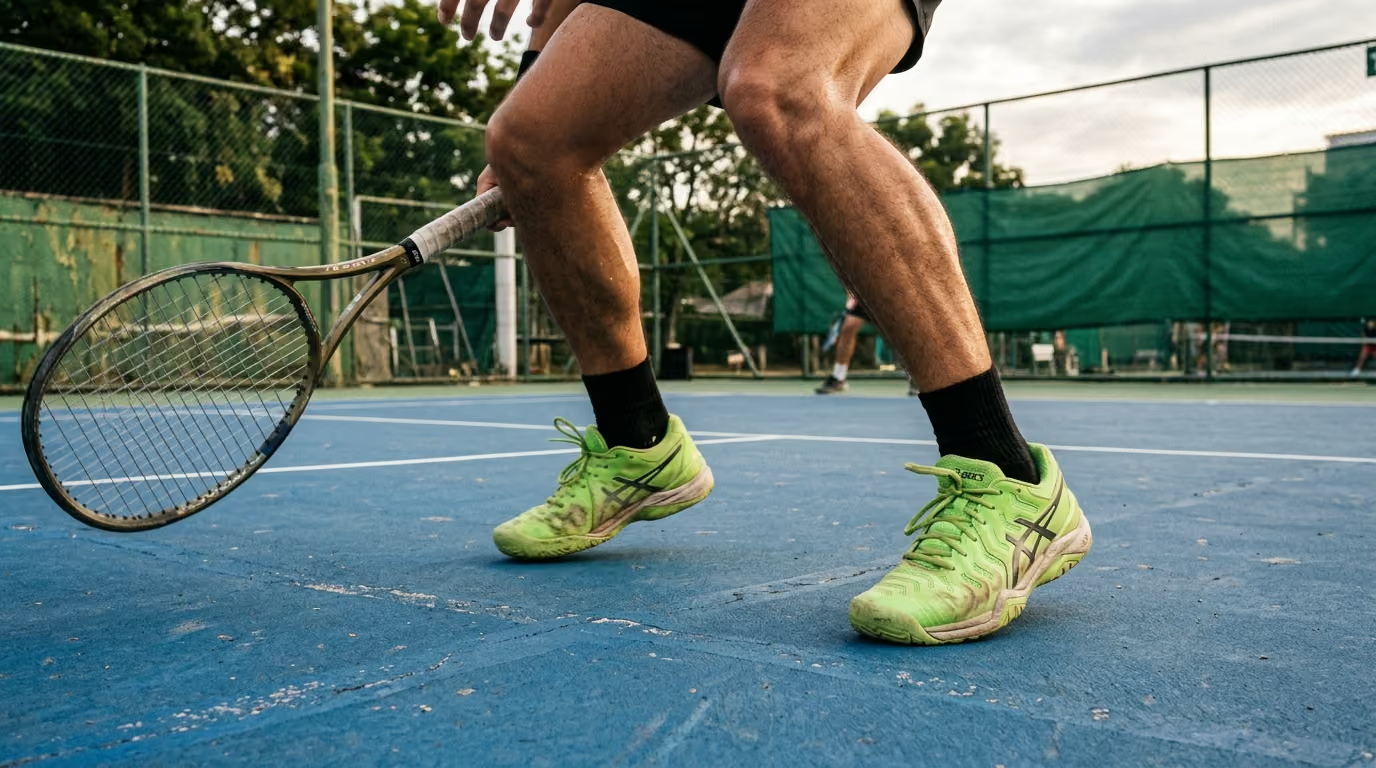
When a tennis stroke breaks down, the visible error on court is often a compensation for a silent limitation elsewhere in the kinetic chain, not the primary problem.




Many players spend years trying to fix a late contact point or a collapsing knee by repeating the same technical cues. However, the visible error on court is rarely where the actual problem lies. When a stroke breaks down, the joint that looks faulty is usually just compensating for a silent limitation elsewhere in the kinetic chain. Identifying and correcting this hidden bottleneck is the key to building a highly resilient, efficient game.
A visible technical error is often the final expression of a physical limitation elsewhere in the movement system rather than the primary problem. In tennis, for example, a player who contacts the ball late may not simply have poor timing. The delay may reflect inadequate court positioning, insufficient first-step acceleration, limited hip or trunk rotation, poor preparation sequencing, or an inability to create force from the lower body. Tennis strokes depend on coordinated contributions from the legs, pelvis, trunk, shoulder, elbow, wrist, and racket. A restriction or timing failure at one link can alter loading elsewhere in the chain.
Our working model relies on a clear progression. First, a constraint or capacity deficit exists in the body. This deficit forces the player to use an altered movement strategy. The altered strategy manifests as a visible compensation on the court. Finally, this compensation leads to performance loss or tissue overload.
This framework is a practical coaching tool rather than a rigid medical diagnosis. We use it to analyze how different physical systems interact during high-speed play. By focusing on the root cause, players can make real progress in improving physical movement patterns on court. This approach shifts the focus away from isolated joints and toward the entire moving body.
When you observe a technical error, ask yourself a simple question. What must the player be unable to do for this compensation to make sense? This shifts your perspective from judging a movement to understanding its purpose. The body is highly intelligent and will always find a way to hit the ball, even if it has to sacrifice joint health to do so.
To understand why compensations occur, we must view the body as an interconnected system. The kinetic chain describes the sequential and interacting contributions of different body segments. In a tennis serve, force and motion transfer from the ground through the legs, pelvis, trunk, shoulder, elbow, wrist, and racket. In groundstrokes, trunk and shoulder rotation are major sources of power.
The kinetic chain is not a perfectly rigid, one-directional sequence. Real strokes involve overlapping contributions, segmental interaction, braking, and individual variation. Nevertheless, the model is useful because it shifts attention away from isolated joints. A limitation at an earlier stage can increase the demand placed on later segments, although the exact compensation depends on the player and task.
The lower body is not merely a support base for the upper body. The serve begins with interaction between the player and the ground. Lower-limb extension contributes to vertical and rotational impulse, followed by pelvic and trunk contributions before the upper limb accelerates the racket. A forceful leg drive and trunk rotation are associated with the transfer of angular momentum toward the upper limbs, which creates greater racket and ball velocities.
One biomechanical review reported that approximately 51 percent of serve kinetic energy was produced by the trunk and legs, with the shoulder contributing 13 percent, the elbow 21 percent, and the wrist 15 percent. These values come from a specific biomechanical model and should not be generalized as universal proportions for every player, serve type, or testing method. However, they illustrate the massive role the lower body plays in power generation.
When the legs, pelvis, or trunk do not contribute effectively, the shoulder, elbow, or wrist must work harder to create or redirect racket speed. The serve’s shoulder internal-rotation angular velocity can exceed 2,500 degrees per second during acceleration. This high velocity demand shows why proximal limitations can lead to distal overload. Developing a strong leg drive is essential for maintaining sustainable athletic longevity on the court.
Groundstrokes also require much more than arm technique. Trunk and shoulder rotation are major contributors to groundstroke power. A player with limited ability to rotate the hips and trunk may compensate by opening the shoulder early, swinging primarily with the arm, rotating through the lumbar spine, or contacting the ball too far behind. The correct intervention depends on the actual bottleneck rather than the visible symptom.
Mobility should not be treated as a universal score or as a general quality that is either good or bad. A player may have adequate passive range of motion in a clinic but be unable to access it quickly, under load, or while coordinating a stroke. To make sense of movement quality, we must look at mobility through different lenses.
Passive mobility is the range available when an external force or examiner moves the joint. Active mobility is the range the player can control voluntarily without external assistance. Loaded mobility is the range available while producing or absorbing force, such as during a deep split step. Dynamic mobility is the range available at sport-relevant speed, and contextual mobility is the range available during the specific stance, foot position, and time constraint of the stroke.
This distinction prevents the common mistake of assuming that a limitation seen in a slow, passive screening position automatically explains a high-speed tennis error. A player might pass a lying hip rotation test with ease. Yet, that same player might fail to rotate their hips when decelerating from a full sprint.
Mobility and stability are not opposites that should be maximized independently. A player needs sufficient movement at one segment and sufficient control at another. For example, a hip may need to rotate while the trunk maintains an appropriate relationship to the pelvis. The ankle may need to dorsiflex while the foot manages ground contact, and the trunk must transmit force without becoming either rigid or excessively loose.
During the serve, the trunk rotates across multiple axes and helps transfer power from the lower limbs to the upper limbs. Leg drive and trunk rotations help transfer angular momentum from the lower limbs toward the upper limbs. If the trunk lacks the stability to transmit this force, the energy is lost, and the shoulder must overwork to compensate.
We must also distinguish between harmful compensations and normal movement variations. Not every deviation from a textbook model is a fault. Skilled players use different stances, swing paths, preparation styles, and movement solutions. Research on movement variability emphasizes that inter-individual and intra-individual differences in coordination are important features of sports movement rather than noise that should automatically be eliminated.
A movement should be considered problematic only when it meets specific criteria. It is a problem if it is inefficient for the player’s task, inconsistent under pressure, or associated with pain. It is also a problem if it cannot meet the required ball speed, costs too much time, or becomes unstable when the game gets faster.
Analyzing on-court movement requires a systematic approach to identifying bottlenecks. We can categorize the most frequent compensation patterns into four primary areas. Each pattern has specific visual cues, underlying contributors, and diagnostic tests.
The collapsing knee is one of the most common visual errors in court sports. It occurs when the knee moves medially, or caves inward, during dynamic movements. This compensation is highly visible during split-step landings, lateral push-offs, and deep braking actions.
Many coaches immediately blame weak glutes for a collapsing knee. While hip strength is important, several other factors can cause this compensation. Limited ankle dorsiflexion is a primary culprit. If the ankle cannot bend forward, the foot may pronate excessively, forcing the knee inward to find a path of least resistance.
To test this, compare a slow double-leg squat with a single-leg squat. Next, observe the player during a predictable lateral step and stop. Finally, watch the movement during a reactive, live-ball drill. If the knee remains aligned during the slow squat but collapses during fast lateral braking, the limitation is likely force-absorption timing and control rather than basic strength.
In our experience, trying to cue the player to simply push the knee out is ineffective if they lack the physical capacity to do so. The intervention must address the task constraint. You may need to improve ankle mobility, train deceleration mechanics, or build single-leg force capacity.
Excessive lumbar rotation occurs when a player twists aggressively through their lower back to generate power. This is highly visible during open-stance forehands, high-ball strokes, and serve recoveries. The lower back is designed for stability, not large degrees of rotation.
The primary contributor to this compensation is a lack of rotation in the joints above and below the lower back. If the hips or the thoracic spine are tight, the body will steal rotation from the lumbar spine to complete the swing. Late preparation can also cause this, as the player must quickly whip the body around to meet the ball.
I remember finishing a tough two hour padel match on a cold Tuesday night and waking up the next morning feeling like my lower back was locked in concrete. For a long time, I just accepted this as the price of playing hard in my forties. But once I started spending just ten minutes on targeted hip mobility before heading to the club, the stiffness almost completely vanished. It taught me that we do not have to accept pain as a default state of aging.
To identify this bottleneck, compare seated thoracic rotation with standing rotational reach. Next, observe pelvic-trunk separation during a slow shadow swing. If the player rotates well in a seated position but uses pure lower-back twisting during a live rally, the issue is likely footwork, timing, or late preparation. You can learn more about managing these physical patterns by reviewing our practical injury prevention strategies.
Reaching occurs when a player contacts the ball with an fully extended arm, a leaning torso, and a trailing pelvis. The contact point is often far outside the base of support. This makes it incredibly difficult to recover quickly for the next shot.
This compensation is rarely a stroke mechanics problem. Instead, it is usually a movement-to-ball problem. Poor first-step direction, inadequate spacing, delayed visual recognition, or a lack of lateral acceleration can all force a player to reach. The arm is simply trying to bridge the gap created by poor footwork.
To test this, feed a series of balls directly into the player's comfort zone. If the stroke looks clean and balanced when they do not have to move, their arm technique is fine. The limitation lies in their movement capacity, court positioning, or split-step timing.
Assess the entire sequence from the split step to the contact point. Check if the player recognized the ball direction early. Look at whether their first step moved toward the correct space. If they failed to brake before the final adjustment, they will always end up reaching.
Late serve preparation is characterized by a rushed racket drop or an incomplete backswing. The player often has to accelerate the racket using pure shoulder and wrist action. This reduces ball velocity and increases the physical demand on the upper limb.
While players often complain of shoulder tightness, the issue is frequently a timing or sequencing error. An inconsistent ball toss is a highly common contributor. If the toss is too low or too far forward, the player must abbreviate their backswing to make contact in time.
To analyze this pattern, examine the ball toss independently of the stroke. Compare a shadow serve with a full, live serve. Observe whether the lower-limb loading phase aligns with the peak of the toss. If the coordination breaks down only when a ball is introduced, the limitation is timing and toss consistency rather than shoulder mobility.
The serve’s kinetic chain must be coordinated as a whole. You must link the toss, the lower-body load, the trunk rotation, and the upper-limb release. Trying to fix the shoulder path without addressing a wild ball toss is a waste of time.
We recommend a systematic assessment algorithm to identify the real movement bottleneck on court. Do not try to analyze everything at once. Change one variable at a time to isolate the physical or technical limitation.
First, define the performance failure precisely. Do not just say the player has a bad forehand. Specify whether they are losing balance, contacting the ball late, or struggling to recover.
Next, identify the exact phase of the movement where the error begins. A stroke should be divided into distinct phases. These include recognition, initial movement, approach, braking, preparation, loading, acceleration, contact, deceleration, and recovery. A compensation seen at contact often originates several phases earlier.
Once you have identified the phase, observe the entire chain. Watch the foot placement, the knee and hip behavior, the pelvic position, and the trunk orientation. Note how these segments coordinate with the shoulder and arm action.
Now, use the counterfactual test. Change one constraint to see if the compensation disappears. You can reduce the ball speed, make the target predictable, change the stance, or test the player when they are completely fresh versus fatigued.
If a player can perform a technically clean shadow swing but becomes late against a live ball, the limitation is not mobility. It is likely a perception-action timing problem. If the error appears only under fatigue, the issue is capacity and endurance rather than basic movement range.
Finally, test the physical capacity separately. If you suspect a hip mobility limitation, perform a basic hip rotation test on a table or in a controlled stretch. If the capacity is missing in a controlled test, you must restore it before you can expect to see it on the court.
Once you build the physical capacity, you must reintegrate it immediately. A physical change that only appears in an isolated drill will not transfer to play. Progress from isolated exercises to shadow movements, then to controlled feeding drills, and finally to live match play.
The physical demands and movement compensations differ significantly across tennis, pickleball, and padel. Each sport features distinct court sizes, equipment weights, ball bounces, and tactical tempos. Recognizing these sport-specific nuances is essential for recreational player wellness and longevity.
Tennis is characterized by a large court, high ball velocities, and substantial running distances. Players must cover a wide area, which requires high-velocity deceleration and explosive lateral directional changes. Thigh, hip, pelvis, and ankle injuries are highly prevalent in tennis populations.
Common compensations in tennis often stem from the sheer force required to cover the court and strike the ball. If a player lacks the hip strength to brake quickly, they will use an excessive slide or an extreme trunk lean to make contact. The high-velocity serve also places immense demands on the shoulder, making lower-body kinetic chain contribution vital.
Pickleball is played on a much smaller court with a lightweight paddle and a plastic ball. While running distances are shorter, the game demands deep squatting stances, rapid-fire kitchen exchanges, and quick reactions. The ball bounces much lower than in tennis, requiring players to operate in a low center of mass.
The primary movement compensation in pickleball is bending from the waist rather than the knees and hips. Because the ball is low, players with limited hip flexion or ankle dorsiflexion will round their lower back to reach the ball. This repetitive lumbar flexion under quick reaction constraints is a major source of back stiffness.
Padel combines elements of tennis and squash within an enclosed glass court. The game features constant transitions, overhead lobs, glass rebounds, and rapid multi-directional movements. The court size is moderate, but the pace is fast, and the physical transitions are continuous.
In padel, players frequently compensate for poor spatial awareness of the glass by twisting their bodies awkwardly. If a player cannot turn their hips quickly to run back with the ball, they will reach behind their body, putting the shoulder and elbow in highly vulnerable positions. The heavy paddle also increases the requirement for trunk rotation to generate power rather than relying on the arm.
The following guidelines highlight these sport-specific differences:
When trying to correct on-court movement, players and coaches often fall into several predictable traps. Recognizing these misconceptions can save months of wasted effort and prevent unnecessary physical frustration.
A common pitfall is assuming that every physical limitation is a mobility problem. A player may have excellent passive flexibility on a yoga mat but be completely unable to control that range on a court. Adding more static stretching to a joint that lacks strength or control is useless and can actually increase the risk of injury.
Another error is overusing isolated corrective exercises. Spending thirty minutes performing glute bands and lying leg lifts will not automatically improve your lateral movement on the court. Corrective exercises can help build basic tissue capacity, but you must bridge the gap with integrated, racquet-specific movement patterns.
Many players also fall into the trap of trying to eliminate all movement asymmetry. Racquet sports are asymmetric by nature. The dominant side of a tennis player will always look and move differently than the non-dominant side. Asymmetry is normal and functional, and attempting to make both sides of the body perfectly symmetrical can actually disrupt your athletic coordination.
Finally, avoid correcting yourself into physical rigidity. Overemphasizing a perfect knee alignment or a perfectly flat back can make your movement stiff and mechanical. Sports movement requires both control and adaptability. You need enough stability to transfer force, but you also need enough movement variability to handle bad bounces, wind, and unpredictable opponents.
Research on movement-screening protocols, such as the Functional Movement Screen, shows that broad composite scores have low predictive validity for sports injuries. A screen may help identify a specific area of interest, but it cannot replace a dynamic, sport-specific observation. Do not let a generic screening score convince you that your movement is broken.
Movement quality is not static. A player who moves beautifully during the first ten minutes of a warm-up may look completely different after two hours of intense play. Fatigue is one of the most powerful drivers of movement compensation.
As the primary movers of the lower body tire, they lose their ability to absorb force. To keep playing, the body will naturally find alternative strategies. The hips will stop rotating, the knees will begin to collapse inward, and the player will start relying on their arm to generate racket speed.
This fatigue-induced compensation pattern is where many chronic injuries begin. The issue is not a lack of mobility or technique, but rather a lack of localized muscular endurance and systemic recovery. If you only assess a player when they are fresh, you will miss the real bottleneck that occurs during a tight third set.
Managing your playing volume and recovery is essential for maintaining clean movement. If you step onto the court with residual muscle soreness and joint stiffness, your body will immediately start compensating to protect those tissues. Prioritizing sleep, hydration, and progressive physical conditioning is just as important as practicing your strokes.
While movement analysis and self-correction are highly valuable, there are clear boundaries where coaching and training must transition to clinical care. Pain is not merely a sign of physical tightness, and trying to stretch or push through pain can lead to severe tissue damage.
If you experience persistent or escalating joint pain, localized swelling, or a sudden loss of movement function, you must stop playing immediately. These symptoms suggest a structural issue that requires professional evaluation. Neurological signs, such as numbness, tingling, or radiating pain down your leg or arm, are also clear indicators that you need to see a specialist.
A qualified healthcare professional, such as a physical therapist or sports medicine physician, can perform a comprehensive clinical assessment. They can help rule out structural pathology, manage acute tissue healing, and design a safe rehabilitation plan. Once your pain is resolved and your basic tissue capacity is restored, you can return to training your on-court movement patterns.
Finding the real limitation in your movement takes patience and observation, but it is the most effective way to build a sustainable, resilient game that you can enjoy for years to come.
Follow Evercourts for practical insights on tennis, pickleball and padel performance, movement, recovery and healthy ageing. Stay connected for new articles, research-led guidance and ideas to help you play well and keep playing for years.


Read practical guidance for better movement, smarter preparation and a game that keeps working for you.
explore the Blog