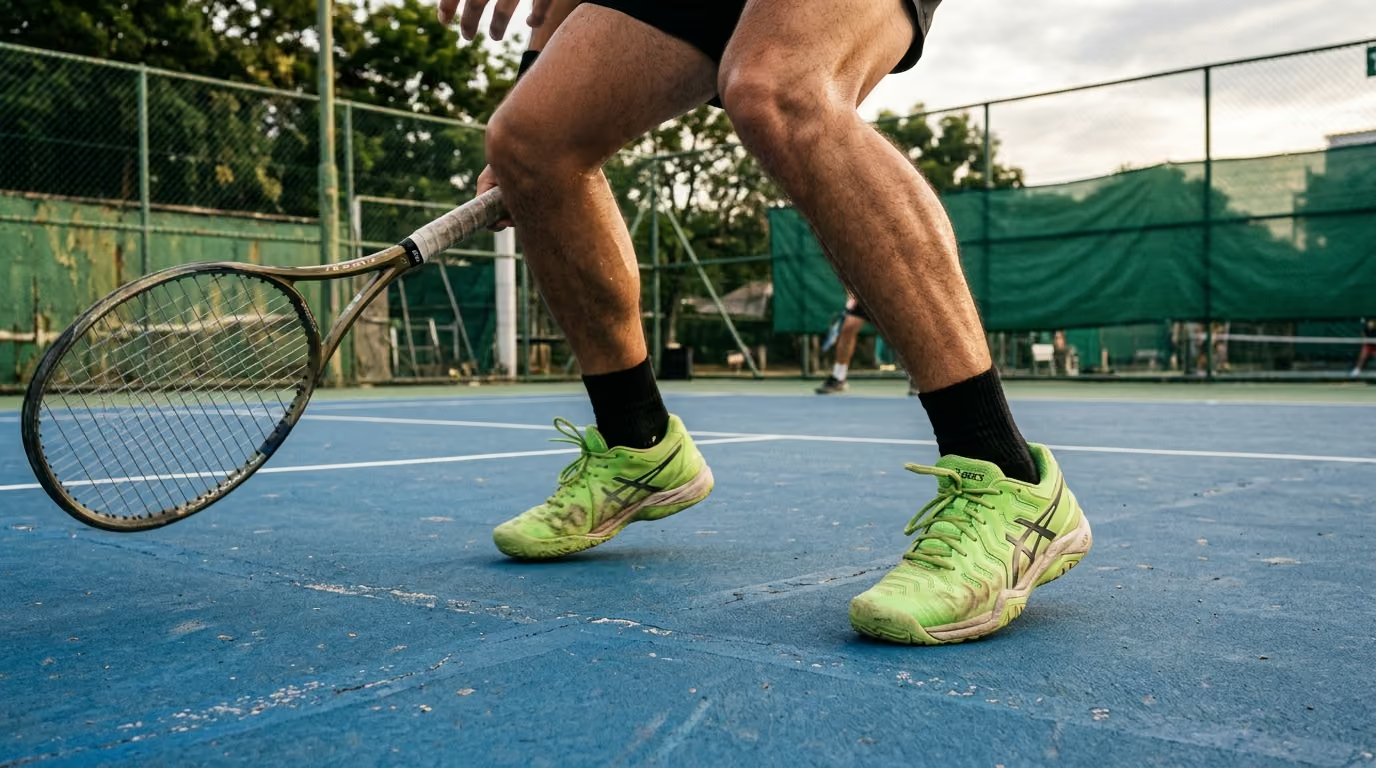
Movement economy in racquet sports focuses on efficient movement patterns that conserve energy, protect joints, and improve overall performance on the court.




Most training programs encourage court athletes to chase maximum speed and explosive acceleration. Yet, the most comfortable players on the court often look like they are barely running at all. This contrast reveals a fundamental truth about racquet sports. Sprinting at absolute maximum speed on every point often leads to rapid fatigue, poor timing, and inaccurate shots.
True movement economy means arriving at the ball with controlled balance, striking with a stable base, and recovering using the shortest path possible. By optimizing this cycle, you preserve your energy, protect your joints, and play better for years to come. This guide will show you how to move with greater efficiency, helping you maintain high performance without exhausting your physical reserves.
To move better, we must first change how we think about court speed. Movement economy is the amount of physiological or metabolic energy your body uses to achieve a specific outcome on the court. In tennis, pickleball, and padel, that outcome is not simply running from point A to point B. It requires reading the ball, selecting the correct footwork, maintaining structural balance, striking cleanly, and recovering immediately.
Many players assume that physical fitness is the only factor that prevents late-match fatigue. However, a study of competitive adolescent tennis players published in the Journal of Sports Medicine and Physical Fitness showed that mechanical efficiency was not associated with maximal oxygen uptake or running speed. Instead, the researchers highlighted footwork technique, strength, and neuromuscular control as the primary factors that determine how much energy a player expends.
To build a sustainable movement pattern, you must understand the difference between external mechanical work and metabolic cost. Mechanical work is the physical force you apply to the ground to move your center of mass. Metabolic cost is the chemical energy your muscles consume to produce that work.
A player with poor coordination or excessive muscular tension will expend far more metabolic energy to perform the same physical movement as an efficient player. Improving your general court mobility and movement is not about running faster; it is about reducing the energetic cost of every step you take.
Racquet sports do not require continuous, steady-state running. Instead, they consist of short, high-intensity bouts of activity followed by brief periods of recovery. Understanding these intervals is essential for designing effective training and preserving your physical stamina during long matches.
Match play analyses show that typical rallies last between five and ten seconds. A systematic review published in the Journal of Sports Science and Medicine reported average rally durations of 5.5 seconds for international male tennis players and 6.4 seconds for female players. These brief, explosive rallies are followed by rest periods of 10 to 20 seconds, representing a work-to-rest ratio of roughly 1:2 to 1:5.
The same systematic review found that players cover an average of 8 to 10 meters per point. Over the course of a best-of-three-sets match, this accumulates to roughly 1,200 to 2,300 meters of total movement. Because this distance is covered in short, disjointed bursts, your movement economy depends on how efficiently you accelerate and decelerate.
An Australian Open match analysis found that professional players perform an average of 1.6 changes of direction per point. Interestingly, the study revealed that medium-intensity changes of direction represent 88% to 94% of all movement adjustments. This indicates that most court movement is moderate and controlled, rather than a series of maximum-intensity sprints.
To make your movement more economical, you can divide every sequence on the court into six distinct phases. If any single phase breaks down, your energy consumption rises, and your technical execution suffers.
Perceptual economy is the ability to read the ball early, allowing you to begin moving before your opponent even finishes their follow-through. By observing your opponent’s body positioning, racquet face angle, and court position, you can anticipate where the ball will land. This early recognition eliminates the need for sudden, panic-induced sprints that consume massive amounts of energy.
Your initial step determines the speed and efficiency of your entire movement path. The split step should not be a high, dramatic jump; rather, it is a low, dynamic pre-activation of your lower body. Timing the split step so that you land just as your opponent makes contact with the ball allows you to push off instantly in any direction.
Once you identify the ball's path, you must select the most efficient footwork pattern for the distance required. Short distances of one to two meters are best covered with lateral shuffles or compact adjustment steps. Longer distances require a decisive crossover step or a direct forward run to conserve steps and maintain momentum.
Braking economy is the ability to decelerate smoothly rather than slamming on the brakes at the last second. Stopping abruptly places immense shear stress on your knees and ankles, demanding high muscular effort to stabilize your body. By taking several small, progressively shorter deceleration steps, you absorb the force gradually and remain balanced.
Your hitting stance should provide a stable, balanced base of support without requiring extreme joint ranges of motion. An economical stance allows your large muscle groups, such as your hips and glutes, to transfer force from the ground through your torso. This structural stability reduces the physical strain on your shoulder, elbow, and wrist joints.
Recovery is the process of returning to a tactically advantageous position after you strike the ball. You do not need to sprint back to the exact center of the court after every shot. Instead, calculate the likely path of your opponent’s reply, and use a smooth side-shuffle or crossover step to reach your recovery target.
You cannot move economically if your muscles lack the strength to absorb and produce force efficiently. Implementing targeted exercises into your strength and conditioning routine will build the physical qualities needed for fluid, low-energy court movement.
To stop smoothly, your muscles must work eccentrically to absorb kinetic energy. If you lack eccentric strength, your body will rely on passive structures like tendons and ligaments to stop, which can lead to chronic wear.
Excellent exercises for building deceleration capacity include lateral lunges, step-downs, and single-leg landing holds. Focus on lowering your body slowly and controlling the movement without letting your knee collapse inward.
Because court sports are played primarily on one leg at a time, single-leg stability is critical for balanced movement. If your hips tilt or your knees wobble during lateral movements, your body must perform constant micro-adjustments that drain your energy.
Incorporate split squats, single-leg Romanian deadlifts, and lateral step-ups into your weekly routine. These exercises teach your pelvis and lower joints to remain stable under asymmetrical loads.
Smooth movement relies on the stretch-shortening cycle of your muscles and tendons. When you land from a split step, your tendons act like springs, storing elastic energy and releasing it to assist your next movement.
You can train this quality using low-amplitude pogo jumps, lateral line hops, and quick ankle stiffness drills. Keep your ground contact times short, and focus on a crisp, springy bounce rather than jumping for maximum height.
A stable torso acts as a bridge, transferring force from your legs to your racquet. If your upper body sways excessively when you run, you waste kinetic energy and disrupt your stroke timing.
To prevent this energy leak, practice anti-rotation exercises like the Pallof press, lateral suitcase carries, and split-stance cable rotations. A quiet, stable torso allows your limbs to move freely and efficiently.
Having a wide range of motion is beneficial, but chasing extreme flexibility can actually hinder your performance on the court. To move economically, you need functional mobility, which is the ability to actively control your joints through their sport-specific ranges.
Many players spend significant time performing static stretching before their matches, believing it prevents injury. However, a comprehensive systematic review published in the Clinical Journal of Sport Medicine found no significant association between pre-exercise stretching and a reduction in total sports injuries.
Furthermore, research published in the Journal of Strength and Conditioning Research indicates that prolonged static stretching immediately before explosive activity can temporarily reduce muscular force production and sprint speed.
Instead of static stretches, use a dynamic warm-up to prepare your body for movement. Dynamic movements gently elevate your heart rate, lubricate your joints, and prime your nervous system for action.
Start with simple movements like hip circles, arm swings, and gentle torso twists. Progress to sport-specific actions like lateral lunges, skipping, and short acceleration bursts. This active preparation is vital for long-term injury prevention and optimal court performance.
To maintain clean, efficient movement, prioritize active control in three key anatomical areas:
One of the most effective ways to teach your body to move more economically is through constraint-led training. By altering the rules, space, or objectives of a drill, you force your nervous system to discover smoother, more efficient movement solutions.
Set up three lateral zones on your side of the court: left, center, and right. Have a partner feed balls to these zones at a moderate, predictable pace.
Your goal is to move between the zones using a consistent, relaxed tempo rather than rushing. Focus on keeping your upper body calm, taking quiet adjustment steps, and finishing each shadow swing with perfect balance.
To break the habit of taking excessive, erratic steps, practice playing points with a strict step limit. Challenge yourself to reach and play each ball using no more than five or six total steps from your starting position.
This constraint forces you to read the ball early, choose the most direct movement path, and glide into your shots. It immediately highlights where you are wasting steps or overrunning the ball.
Standard practice drills often reward players simply for hitting the ball back, regardless of how chaotic their movement was. Change the incentive structure by introducing a balance-focused scoring system.
During a standard rally, award yourself three points for a clean shot hit with a stable, balanced base. Award one point if you reach and return the ball while off-balance, and subtract a point if you fail to recover to your starting position.
Predictable drills, like running side-to-side in a fixed pattern, do not build match-relevant movement economy. Instead, have a partner feed balls to random locations, keeping the speed moderate so you have time to organize your body.
This layout forces your brain to couple perception with action, teaching you to adjust your stride length and timing based on real-time visual information.
While the core principles of movement economy apply to all racquet sports, the specific demands of tennis, pickleball, and padel differ significantly due to court size, equipment, and ball speed. Understanding these differences is crucial for maintaining player health and preventing sport-specific overuse injuries.
Tennis courts are the largest of the three major racquet sports, requiring you to cover substantial distances. Points feature longer rallies, higher ball bounces, and larger recovery runs.
Pickleball is played on a compact court with a lightweight paddle and a plastic ball that does not bounce high. The game features rapid, short-distance exchanges, especially when all four players are positioned at the non-volley zone, also known as the kitchen line.
Padel is played on a glass-enclosed court with tennis-like balls, meaning the ball can rebound off the back and side walls. This unique environment alters your movement geometry, requiring you to run backward and rotate frequently.
Many dedicated athletes work incredibly hard on their movement but fail to see improvements because they fall into common training traps. Recognizing these mistakes is the first step toward building a more economical court style.
Many players spend hours performing straight-line sprints, hoping it will make them faster on the court. While basic speed is useful, court movement is almost entirely lateral, diagonal, and rotational.
If you only train straight-line running, you fail to develop the lateral hip strength and rotational coordination required to change direction efficiently. Shift your focus toward multidirectional movement drills that reflect the true demands of your sport.
Some coaching manuals suggest that taking fewer steps is always better because it looks clean. However, taking too few steps can force you to reach for the ball, strike from an unstable base, and lunge awkwardly.
The goal is not to take the absolute fewest steps, but rather the most appropriate number of steps. Use clean travel steps to cover distance, but never skip the small adjustment steps that allow you to establish perfect spacing from the ball.
Agility ladders are excellent tools for warm-ups, coordination, and foot-speed awareness. However, they lack the key ingredient of match-play agility: perception.
On a ladder, your foot placements are completely predetermined, meaning your brain does not have to read a ball, track an opponent, or make split-second decisions. To build true match economy, you must quickly progress from predictable ladder drills to reactive, open drills.
Many players who feel tight on the court respond by stretching their hamstrings, calves, and hips repeatedly. However, persistent muscle tightness is often a protective response from your nervous system because those muscles lack the strength to stabilize your joints.
If you stretch a weak joint without building strength, you make the joint less stable, forcing other muscles to work harder and increasing your overall fatigue. Always pair your mobility work with strength exercises to ensure you can actively control your new range of motion.
Improving your movement economy is not just about performing better during a single match; it is a vital strategy for healthy aging and athletic longevity. Every inefficient step, hard braking action, and off-balance strike you make acts like a small withdrawal from your physical bank account. Over months and years, these inefficient movements accumulate, leading to chronic joint wear, tendon fatigue, and muscle strains.
When you move economically, you distribute the physical forces of the sport evenly across your entire kinetic chain. Your large, powerful muscles, like your glutes and hamstrings, absorb the brunt of the load, sparing your smaller, more vulnerable joint structures.
This balanced loading reduces the muscular damage you experience during a tough match, which directly decreases your recovery time and keeps you feeling fresh for your next session. By investing in smooth movement patterns now, you protect your body from unnecessary stress and ensure you can keep playing the sports you love for decades.
To improve your movement economy, you must have a way to measure it. While sports science laboratories use expensive metabolic masks and force plates, you can track your efficiency using simple, practical methods on your local court.
Have a partner record a video of you playing a standard game or point-play drill. Analyze the footage using these three key observation points:
Combine your video analysis with subjective measures of physical effort. During different drills, track your Rating of Perceived Exertion (RPE) on a simple scale of 1 to 10.
If you perform a drill with a high speed but also a very high RPE, and then perform a rhythm-focused version of the same drill with a lower RPE while maintaining similar shot quality, you have successfully improved your movement economy.
For a simple, practical way to rate your efficiency across different sessions, use this basic scoring framework:
$$\text{Economy Index} = \frac{\text{Successful Balanced Arrivals} + \text{Effective Recoveries}}{\text{Perceived Physical Effort (1-10)}}$$
Use this index to compare your movement quality across different weeks of training. As your technique and coordination improve, your Economy Index score should rise, showing that you are achieving better results with less physical effort.
While developing smooth movement patterns can resolve many common court-related aches, it is essential to recognize when physical tightness or movement limitations require professional medical attention.
Consult a licensed physiotherapist, sports physician, or athletic trainer if you experience any of the following warning signs:
An experienced healthcare professional can perform a detailed biomechanical assessment, identify specific joint restrictions or muscle weaknesses, and design a customized rehabilitation program to keep you moving safely.
Developing exceptional movement economy is a long-term investment in your game, helping you stay fast, feel fresh, and continue enjoying your time on the court for years to come.
Follow Evercourts for practical insights on tennis, pickleball and padel performance, movement, recovery and healthy ageing. Stay connected for new articles, research-led guidance and ideas to help you play well and keep playing for years.


Read practical guidance for better movement, smarter preparation and a game that keeps working for you.
explore the Blog