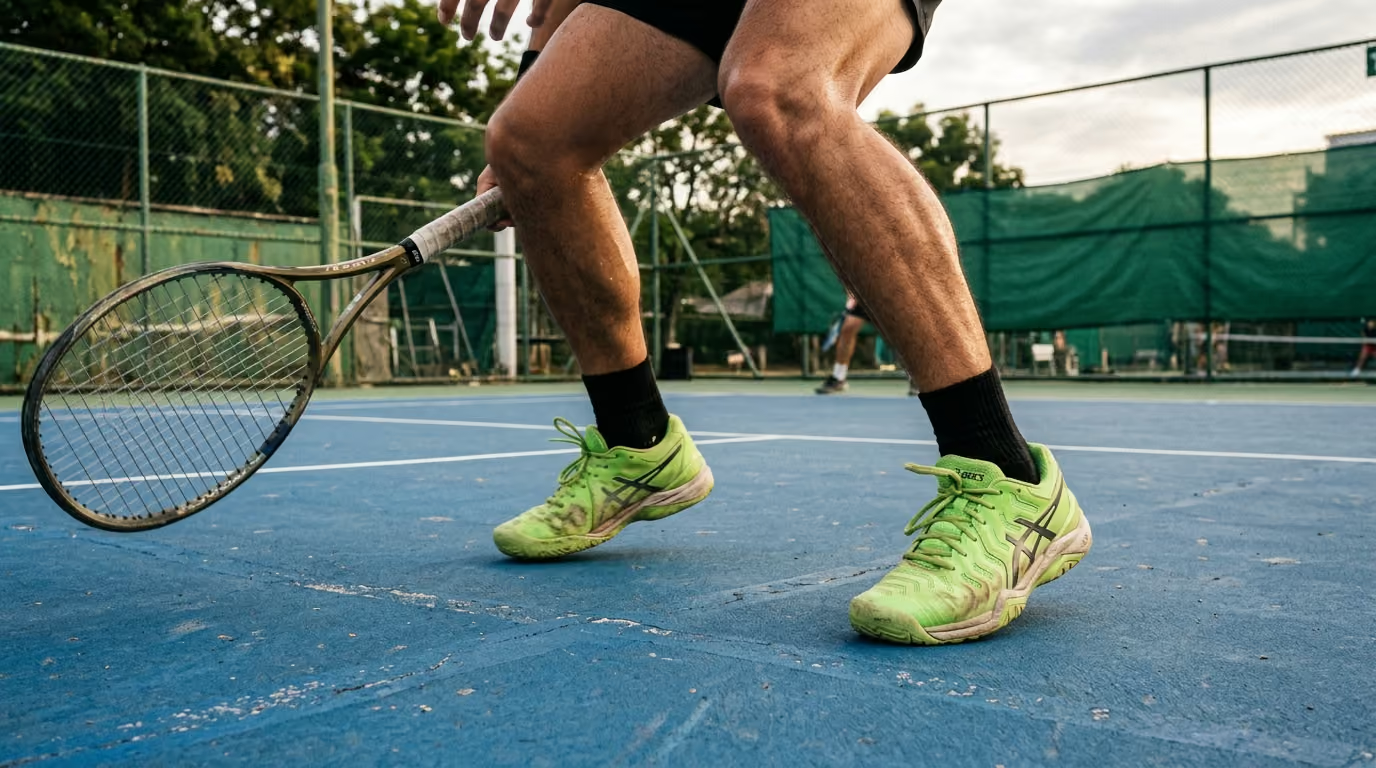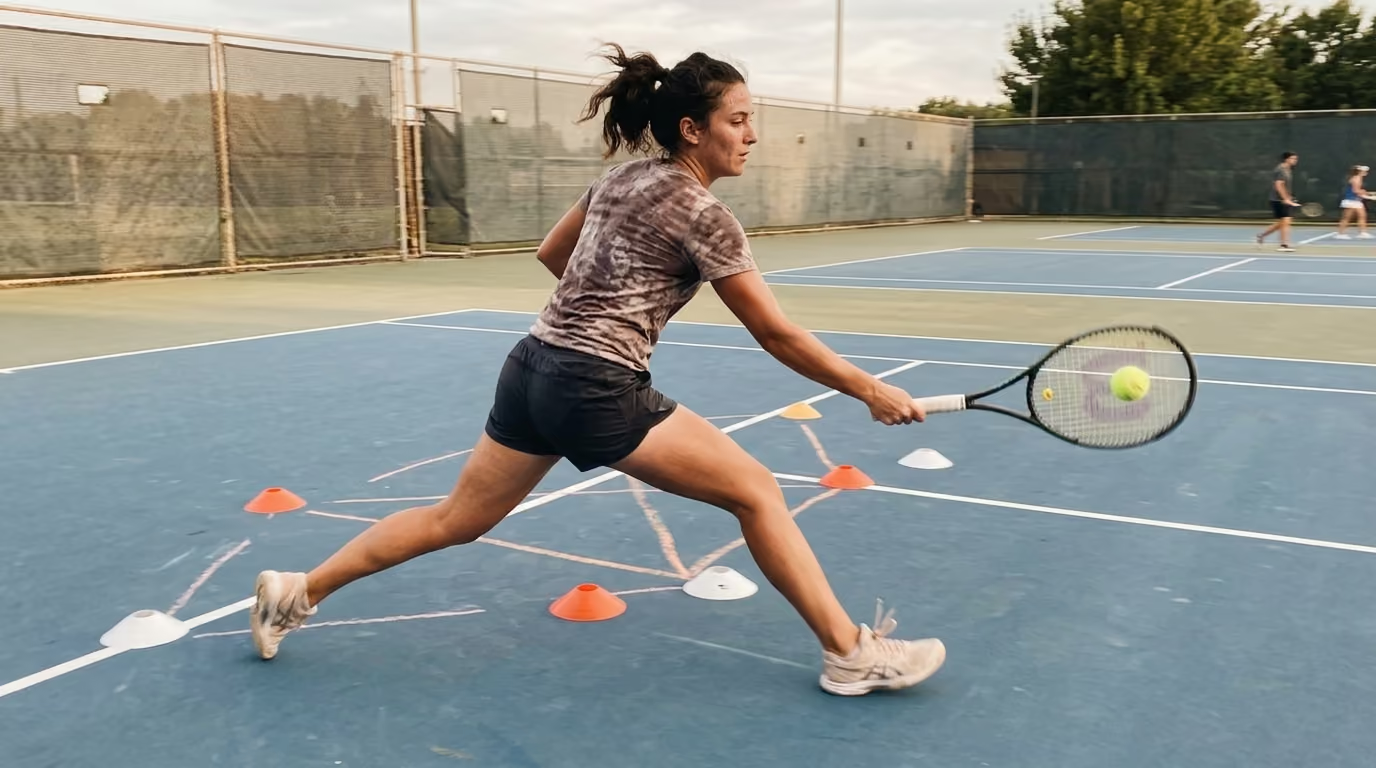

While many athletes prioritize linear speed, true court dominance in sports like tennis, pickleball, and padel hinges on mastering multi-planar movement.




Multi-planar movement is the ability to coordinate and stabilize your body while moving through multiple directions and rotation axes simultaneously on the court. It combines balance, visual tracking, deceleration, and rotational control. This integration allows you to reach the ball in an optimal position to strike and recover quickly.
Imagine reacting to a deep diagonal shot. Your feet cross over, your body turns, and you slide to a stop. You perform these complex tasks in a fraction of a second. This is multi-planar movement in action, the foundation of athletic longevity on the court.
We often see players focus on basic linear speed. Running in a straight line is simple. Court sports, however, demand constant transitions. If you cannot transfer force across different movement axes, your performance will suffer.
To improve your court movement, you must understand how your body moves through space. Human motion occurs across three distinct geometric fields. These are the sagittal, frontal, and transverse planes.
The sagittal plane divides your body into left and right halves. Movements in this plane are forward and backward. Examples include sprinting to the net, backpedaling for a lob, and split-stepping.
Most gym programs focus heavily on this plane. Squats, deadlifts, and lunges are primary sagittal movements. While these exercises build foundational power, they do not prepare you for lateral or rotational demands.
A player may have excellent linear sprint speed. If they cannot move side-to-side, that speed is wasted. You need more than forward power to excel.
During forward acceleration, your body leans forward to push off the ground. When you need to stop, your front leg must absorb this forward momentum. This deceleration requires eccentric strength in your quadriceps and calves.
The frontal plane divides the body into front and back halves. It accommodates side-to-side movements. Lateral shuffling, crossover steps, and wide reaching lunges occur in this plane.
Frontal plane control is essential for recovery. When you slide wide, your outer leg must absorb your body weight. You must then push off that leg to return to the center.
In our experience, weak frontal plane stability leads to balance loss. If your hips cannot resist lateral forces, you will tip over. This reduces your hitting accuracy and slows your recovery.
The primary muscles responsible for frontal plane stability are the gluteus medius and the adductors. These muscles keep your pelvis level when you stand on one leg. Without this support, your knees and lower back take on excessive lateral stress.
The transverse plane divides the body into upper and lower halves. It governs rotational movements. Groundstroke preparation, torso rotation, and turning to chase a ball are transverse actions.
Rotational power starts in the feet. Force travels up through the legs, hips, and torso. It finally reaches the racquet.
A common mistake is rotating only from the shoulder. According to tennis biomechanics research, using the whole body reduces stress on the arm. You must coordinate your hips and thoracic spine to rotate safely.
When you prepare for a forehand, your hips rotate backward to load your glutes. As you swing, your hips turn forward, followed by your torso and shoulders. This sequential movement is called the kinetic chain.
Real play does not happen in isolated directions. A single point requires you to blend these three fields of motion. You split-step, push laterally, turn your hips, and lunge diagonally.
This blending is true multi-planar movement. Your nervous system must manage these transitions seamlessly. When you master this coordination, court coverage feels smooth and effortless.
Our team has analyzed how players handle these demands. We found that the transition points are where movement breaks down. Players often struggle when changing from a lateral shuffle to a rotational swing.
For instance, a deep diagonal run requires you to sprint forward (sagittal), slide laterally (frontal), and rotate your torso (transverse) to strike. If any of these links are weak, your movement breaks down. You will arrive late, off-balance, or unprepared to hit.
To move well, you need a balance of three physical attributes. These are mobility, stability, and movement control. Many players confuse these terms, but they require different training approaches.
Mobility refers to the active range of motion available at your joints. In racquet sports, certain joints require high mobility. These include the hips, ankles, thoracic spine, and shoulders.
If your hips are tight, your lower back will compensate. This compensation often leads to chronic soreness. Improved joint mobility allows you to get low without straining your spine.
Ankle mobility is also critical for court athletes. If your ankles cannot bend deeply, you cannot lower your center of mass. This restriction forces you to bend from the waist, which throws off your balance.
It is normal to have some physical asymmetry. For example, racquet players often display unique shoulder profiles. Research on shoulder adaptations shows reduced internal rotation on the dominant side.
This asymmetry is not always a problem. Your body adapts to the specific demands of your sport. We only address asymmetry when it causes pain or limits functional movement.
Stability is the ability to maintain joint alignment under load. It is not about stiffness. True stability allows you to control your body during sudden changes of direction.
Your core and hips must provide this stability. When you plant your foot to strike, your pelvis must remain level. If your pelvis drops, you lose balance and hitting power.
We can build stability through targeted strength work. Single-leg exercises are highly effective for this purpose. They teach your hip muscles to stabilize your weight during dynamic movements.
When you lunge, your knee should track over your toes. If your knee caves inward, it indicates poor hip stability. Strengthening your glutes helps keep your knees aligned and protected.
Movement control is the ability to coordinate mobility and stability during a sport task. You can have mobile hips and strong legs, but still move poorly. Your nervous system must learn to use these assets together.
This control is task-specific. You must practice the actual footwork patterns you use during a match. This bridges the gap between gym strength and court performance.
We recommend prioritizing movement control in your practice. Focus on how you arrive at the ball. Smooth movement is always more efficient than raw, uncontrolled effort.
To build movement control, you must practice transition footwork under controlled conditions. This includes shadow swings, slow-motion footwork drills, and targeted balance challenges. These activities teach your brain to coordinate complex movement patterns.
True court agility is not just about physical speed. A tennis meta-analysis published in the journal Sports Medicine describes agility as a combination of change-of-direction speed and perceptual factors. These factors include visual scanning, situational knowledge, and anticipation.
If you cannot read the play, your physical speed will not save you. You must anticipate where the ball is going. This cognitive skill allows you to start your movement early.
Many agility tests lack sport-specific validity. A preplanned shuttle run does not replicate the chaos of a live point. You must train your brain and your body together.
By learning to read your opponent's body language, you can anticipate their shot. Watch their shoulder angle, their hip position, and their racquet preparation. This visual information allows you to start moving before the ball leaves their racquet.
We often focus on acceleration. However, deceleration is the true limiting factor in court movement. If you cannot stop safely, you cannot hit a balanced shot.
Braking requires significant eccentric muscle strength. Your quadriceps and glutes must absorb your momentum. This absorption protects your knees and lower back from excessive stress.
Research on change-of-direction biomechanics shows that faster players display specific braking characteristics. They lower their center of mass and utilize shorter ground-contact times. They also maintain a controlled trunk angle during deceleration.
If you brake with a straight leg, you transfer force to your joints. This habit can lead to knee and ankle issues. Learning to bend your knees and hips when stopping is essential for longevity.
Deceleration is also a skills-based movement. You must use several small adjustment steps to slow down before you plant. This footwork distributes the braking force over multiple foot contacts rather than a single harsh stop.
The transition from moving to hitting is a precise sequence. It begins when you recognize the opponent's shot. You then choose your route and accelerate toward the ball.
As you approach, you must begin to decelerate. This is the brake-to-hit sequence. You take shorter, quicker steps to adjust your position.
Your final step should establish a stable base. Your racquet should be prepared before your feet finish moving. This timing ensures a smooth, controlled stroke.
After the swing, you must immediately transition to recovery. A high-quality sequence preserves your energy. It keeps you ready for the next shot.
If your braking is late, you will hit while still sliding or falling. This forces your arms to compensate for your lack of balance. The result is a weaker, less accurate shot and a slower return to the center.
To evaluate your movement, we use the arrival-position framework. This model looks at five specific dimensions of your movement. It helps identify where your footwork needs improvement.
Your base of support is your foot position relative to the ball. Your feet should be wide enough to provide stable balance. If your feet are too close together, you will feel unstable.
A wide base allows you to transfer weight effectively. It also keeps your center of mass low. This position makes it easier to change direction after your swing.
Your front foot should point slightly outward to support your weight. Your back foot should be anchored to provide power. This solid stance is the foundation of any successful groundstroke.
We evaluate how you absorb your momentum. Do you slide to a controlled stop, or do you stumble? Controlled braking requires active knee and hip flexion.
If you hear loud, heavy squeaks from your shoes, you may be braking inefficiently. Quiet footwork often indicates better force absorption. Try to land softly and distribute the load through your muscles.
Watch your ankles during deceleration. They should remain stable without rolling inward or outward. Strong, mobile ankles are critical for absorbing these high forces safely.
Your trunk should remain relatively upright and stable during the stroke. If you lean excessively, you lose control of your swing path. An unstable torso also increases the load on your spine.
Keep your shoulders aligned over your hips. Avoid reaching with your torso when you can step closer. A stable trunk is the bridge between your legs and your racquet.
If your trunk sways, your head will move. This movement makes it harder to track the ball accurately. Keeping your head still during the swing improves your hand-eye coordination.
Your racquet must be prepared before you complete your movement. If you are still taking back your racquet during your final step, you will feel rushed. This leads to mistimed hits and poor control.
Early preparation simplifies your swing. It allows you to focus on ball contact and balance. Try to initiate your backswing during your first recovery step.
As soon as you recognize the ball's path, turn your shoulders. This action naturally brings your racquet back. You can then focus entirely on your footwork and arrival position.
Your arrival position must allow you to move immediately after the shot. If you finish your swing and cannot push back, you are vulnerable. You must maintain tension in your legs to spring back.
The recovery step is the final part of any movement sequence. If you ignore it, you will always be late for the next ball. A good arrival position always anticipates the recovery.
Keep your weight on the balls of your feet. This posture keeps your muscles primed for action. Avoid standing flat-footed after your swing, which slows your reaction time.
While tennis, pickleball, and padel share common elements, they have different court sizes and rules. These factors create unique movement demands. Understanding these differences helps you tailor your training.
Tennis involves the largest court of the three sports. This size requires longer running distances and higher maximum speeds. You must frequently transition from full sprints to deep slides.
The baseline game in tennis is highly lateral. You must shuffle, crossover, plant, and recover repeatedly. This constant change of direction places high demands on your lateral hip stabilizers.
Tennis also requires diagonal movement. When a short ball is hit, you must sprint forward and diagonally. You must then brake rapidly to execute a precise groundstroke.
The serve and overhead require significant rotational loading. Your body must rotate through the transverse plane to generate power. This requires excellent thoracic mobility and shoulder stability.
If you play tennis, you can find specific training ideas in our tennis articles section. These resources help you develop the physical capacities needed for the large court.
On clay courts, players slide into their shots. This sliding technique requires unique frontal-plane control. On hard courts, you must stop completely before swinging, which increases the eccentric demand on your legs.
Pickleball is played on a much smaller court. While you run shorter distances, the pace of play is incredibly fast. You must make frequent short adjustments, side lunges, and emergency recoveries.
The non-volley zone, or kitchen, creates a unique constraint. You must often lunge forward and laterally to reach low volleys. This requires deep hip flexion and excellent single-leg balance.
Older players must pay close attention to fall prevention. Pickleball injury studies show that falls are a primary concern. According to a ten-year analysis, falls accounted for over sixty-five percent of injuries.
Many of these injuries involve wrist fractures from bracing a fall. Improving your balance and leg strength can reduce this risk. You must train your hips to support quick lateral reaches.
For more on pickleball safety and movement, visit our pickleball articles section. We provide practical strategies to keep you moving safely on court.
The paddle transitions in pickleball are extremely rapid. Because the distance between opponents is short, reaction times are minimal. Your footwork must be compact and efficient to keep up with the fast exchanges.
Padel is unique because it utilizes glass walls and wire mesh fences. This environment requires you to track rebounds and rotate constantly. You must turn and run backward to retrieve balls off the glass.
This wall interaction creates a delay in your movement. You must wait for the ball to bounce, hit the wall, and rebound. This requires exceptional spatial awareness and footwork adjustment.
Padel literature identifies sudden changes of direction as key injury factors. This risk is especially high in untrained players. The lower limbs are the most common site of padel injuries.
A survey of recreational padel players reported that over thirty-six percent sustained an injury in the previous year. The injury rate was calculated at 2.81 per one thousand hours of play. These numbers show the importance of physical preparation for padel.
To improve your wall movement and court positioning, check out our padel articles section. We focus on the specific rotational and turning skills required for padel.
When retrieving a ball off the back wall, you must pivot and run backward. This maneuver requires you to turn your head and shoulders while maintaining your stride. You must then plant your back foot, rotate your hips forward, and strike.
Before starting a movement program, you should assess your current abilities. A simple screening process can help identify your strengths and weaknesses. This allows you to target your training effectively.
To find more screening tools and programs, visit our resources for court athletes. We provide guided templates to track your progress over time.
Begin by documenting your playing history. Consider the frequency and duration of your play. Note any history of ankle, knee, hip, back, or shoulder discomfort.
Pay attention to when symptoms occur. Do you feel tightness during deep lunges? Does your back ache after a long match?
Research on older pickleball players shows that weekly playing hours correlate with injury risk. If you play frequently, your movement quality is even more critical. Your body needs sufficient capacity to handle the volume.
If you have a history of ankle sprains, your balance may be compromised. These past injuries can affect your joint awareness and reaction time. Identifying these areas helps you focus your rehabilitation efforts.
Test your joint mobility at home. Check your ankle dorsiflexion by bending your knee toward a wall with your heel down. Assess your hip rotation while sitting on a chair.
You should also check your thoracic rotation. Sit tall, cross your arms, and rotate your torso as far as possible to each side. Compare your range of motion on both sides.
Remember that absolute symmetry is not the goal. Your dominant side will likely have some differences. We only look for major restrictions that cause discomfort or limit your play.
If your thoracic spine is stiff, your lower back will twist to compensate. This extra twisting can cause muscle strain and joint irritation. Improving your upper back mobility protects your lumbar spine.
Stand on one leg with your eyes open. Try to hold this position for thirty seconds without moving your arms. This test measures your static balance.
To make it more dynamic, try a single-leg reach. Reach your non-standing foot forward, sideward, and backward. Keep your standing knee aligned over your foot.
Observe your knee and ankle. Do they wobble excessively? Does your pelvis drop? These signs indicate that your stabilizers need work.
If your knee caves inward during the reach, your hip stabilizers are weak. This lack of control increases stress on your kneecap and ligaments. Strengthening your outer hips will help keep your knee aligned.
Set up a simple lateral shuffle test. Shuffle five yards to the right, plant your foot, and shuffle back. Repeat this sequence several times.
Observe your movement quality. Do you stop smoothly, or do you lose balance? Can you push off your outer leg with power?
Try the same test moving diagonally. Note any differences between your left and right sides. This simple screen reveals your baseline physical capacity.
If you struggle to stop on one side, you may have an asymmetry in leg strength. This imbalance can affect your court coverage and increase your injury risk. Targeted single-leg work can help balance your strength.
Once you have assessed your movement, you can begin training. We recommend building your program in progressive layers. This ensures you master the basics before moving to high-speed drills.
For a full list of movement and conditioning workouts, visit our strength and conditioning resources. These plans are designed specifically for racquet sports.
Begin your warm-up with joint preparation. This wakes up your nervous system and improves your range of motion. Focus on the hips, ankles, and thoracic spine.
A great exercise is the world's greatest stretch. It combines a deep lunge with thoracic rotation. Perform five repetitions on each side before you play.
I remember finishing a tough two hour padel match on a cold Tuesday night and waking up the next morning feeling like my lower back was locked in concrete. For a long time, I just accepted this as the price of playing hard in my forties. But once I started spending just ten minutes on targeted hip mobility before heading to the club, the stiffness almost completely vanished. It taught me that we do not have to accept pain as a default state of aging.
We can also use single-leg exercises to build hip stability. Single-leg squats and lateral step-downs are excellent choices. They teach your hips to control your body weight during one-leg support.
Add some ankle circles and calf stretches to your routine. These exercises improve your ankle flexibility and prepare your legs for jumping and landing. Mobile ankles are critical for absorbing court impacts.
Next, focus on your ability to stop. Many players practice sprinting but neglect deceleration. You must train your body to absorb force.
Try the lateral bound and stick exercise. Leap sideways off one foot and land on the other. Hold the landing for two seconds.
Your knee should bend slightly to absorb the impact. Keep your hips back and your trunk stable. This drill teaches your leg muscles to act as brakes.
You can also practice forward acceleration to a controlled stop. Run forward three steps and stop instantly on a split stance. Hold this position to check your balance.
Focus on landing quietly. Soft, controlled landings indicate efficient force absorption. Avoid stamping your feet, which transfers the impact directly to your joints.
To improve your hitting power, you must train your rotational capacity. Medicine ball throws are ideal for this. They allow you to develop power through the hips and torso.
Try the rotational scoop toss. Stand perpendicular to a wall and hold a medicine ball. Rotate your hips back, then throw the ball against the wall using your lower body.
Focus on transferring force from your back foot to your front foot. Keep your core engaged to protect your lower back. This movement patterns the open-stance forehand.
You can also use cable woodchops. These exercises build rotational strength under controlled resistance. They teach your body to resist unwanted rotation during movement.
Perform three sets of eight repetitions on each side. Focus on quality and control rather than speed. This strength work builds the power needed for explosive swings.
The final layer of training adds perception to your physical movement. This is where you transition from change-of-direction speed to true agility. You must react to external cues.
Have a partner stand across from you. They will point left or right, and you must react instantly. This drill forces you to scan and make quick decisions.
You can also practice with a tennis racquet and ball. Have your partner feed balls to unpredictable locations. Focus on preparing your racquet early and arriving in a balanced position.
This reactive training is essential for match play. It ensures your physical skills are available when the game gets fast. It bridges the gap between structured drills and real competition.
Start with slow feeds and gradually increase the speed. This gradual progression allows your brain to adapt to the visual cues. You will find your reactions on court become sharper and more automatic.
For more guidance on movement drills, see our mobility and movement resources. We provide step-by-step videos and detailed guides for all fitness levels.
Many players make simple mistakes when trying to improve their court movement. Avoiding these pitfalls will save you time and help prevent unnecessary strain.
Many players spend hours stretching to increase their range of motion. However, flexibility without strength is useless. You must be able to control your joint range.
If you have loose joints, you need to focus on stability. Stiff joints, on the other hand, require mobility work. A balanced approach is always best.
We focus on functional mobility rather than extreme flexibility. You only need enough range to perform your court movements safely. Excess passive range can actually increase your injury risk.
Over-stretching your joints can lead to instability and weakness. Focus on building strength through your full range of motion. This active control is what protects your joints on court.
Preplanned cone drills are popular for agility training. While they build basic coordination, they do not replicate match play. They lack the perceptual demands of reacting to an opponent.
If you only train with cones, your brain is not fully engaged. You miss the visual cues that tell you when and where to move. This can make you look fast in drills but slow during a match.
Integrate reactive drills into your routine. Respond to a moving ball or a partner's movement. This type of training improves your real court speed.
Cones do not hit back, nor do they disguise their shots. Training with a partner or ball machine provides the unpredictable environment you need. It forces your brain to solve movement problems in real time.
Many training programs focus exclusively on acceleration. Players practice sprinting forward or shuffling quickly. They ignore the braking phase of movement.
This omission can lead to joint stress and balance loss. If you cannot stop safely, you cannot strike the ball cleanly. You will also struggle to recover for the next shot.
Dedicate time to deceleration drills. Practice landing, stopping, and stabilizing your body. This is the secret to smooth, efficient court coverage.
Good deceleration requires eccentric leg strength. Exercises like eccentric squats and drop landings build this capacity. They prepare your muscles to handle the high forces of stopping quickly.
It is easy to get frustrated when one side of your body feels different from the other. However, racquet sports are naturally asymmetrical. You use one arm and have a dominant leg.
Do not force your body to move identically on both sides. Focus on functional competence instead. As long as both sides can perform the court tasks safely and without pain, minor differences are normal.
We monitor asymmetry to ensure it does not limit performance. If one hip is extremely tight, it may cause issues elsewhere. A sensible approach is to address major restrictions while accepting minor natural differences.
If your dominant arm has more muscle mass, that is a normal adaptation. The key is ensuring your non-dominant side remains strong enough to support your balance and posture. Focus on functional strength, not aesthetic symmetry.
Moving well is not just about performance. It is also the key to healthy aging and athletic longevity. When you move efficiently, you distribute physical stress across your entire body.
For more on recovery strategies, visit our recovery science resources. We explore how to manage fatigue and protect your joints over time.
Poor movement patterns place excessive stress on specific joints. For example, if your hips do not rotate, your lower back must twist. Over time, this compensation can lead to chronic wear and tear.
Multi-planar movement distributes these forces safely. Your hips and legs absorb the shock of deceleration. Your core stabilizes your spine during rotational swings.
This balanced force distribution protects your cartilage and tendons. It allows you to play for years without developing chronic issues. Efficient movement is the ultimate form of joint protection.
Your connective tissues, like tendons and ligaments, adapt to the loads you place on them. Gradual strength training strengthens these structures, making them more resilient. This physical shield is essential for preventing overuse injuries.
As you get tired, your movement quality naturally declines. Your steps become shorter, and your trunk starts to sway. This fatigue-induced breakdown increases your risk of slips and falls.
Training your endurance helps maintain your movement quality late in a match. You must practice keeping your center of mass low even when fatigued. This requires both physical strength and mental focus.
Pay attention to your posture during long rallies. If you feel your trunk collapsing, take a moment to reset. Maintaining good movement mechanics is essential for avoiding late-game mistakes.
Take deep breaths and focus on your balance between points. This mental reset helps lower your heart rate and restores your focus. It keeps your brain sharp for the next tactical decision.
After a tough match, your muscles need time to recover. Gentle mobility work can help restore normal joint range. It promotes blood flow and reduces post-match stiffness.
We recommend a light cool-down after playing. Spend five minutes stretching your hips, calves, and shoulders. This simple habit kickstarts your recovery process.
Proper hydration and sleep are also essential for tissue health. Your body repairs muscle fibers and connective tissues while you rest. Prioritize these recovery basics to stay on the court.
Consider a warm bath or a gentle massage to soothe tired muscles. These simple techniques can reduce muscle soreness and promote relaxation. They help your body prepare for the next training session.
To find more resources on staying active as you age, visit our healthy aging and athletic longevity resources. We are committed to helping you enjoy racquet sports for a lifetime.
While physical training can improve your movement, some issues require professional care. Knowing when to see a specialist is essential for your safety and long-term health.
If you experience sharp, sudden pain during movement, stop playing immediately. This is a clear sign of potential tissue damage. Do not try to play through it.
Chronic pain that persists for more than a few days also requires attention. If your knee or shoulder aches after every match, consult a healthcare professional. Ignoring these warning signs can lead to more serious issues.
Other red flags include swelling, joint instability, or a feeling of catching or locking. These symptoms indicate structural issues that require medical evaluation. A qualified clinician can provide an accurate diagnosis.
If you experience recurrent joint sprains, your ligament integrity may be compromised. A specialist can assess your joint stability and recommend appropriate rehabilitation or bracing. This early intervention can prevent chronic instability.
Look for a physiotherapist or sports medicine physician who understands racquet sports. They can assess your movement and identify the root cause of your discomfort. They will also design a safe, effective recovery plan.
For more details on our approach and how to connect with experts, visit our about page. We provide research-led guidance to help you navigate your movement health.
You can also reach out to us directly through our contact page. We are always happy to help our readers find the resources they need.
We recommend returning to this guide whenever you feel your court movement slowing down or after recovering from a joint injury. Regularly reviewing your movement habits is an excellent way to maintain your athletic longevity.
By focusing on balanced movement, controlled braking, and sport-specific training, you can enjoy tennis, pickleball, and padel for years to come.
Follow Evercourts for practical insights on tennis, pickleball and padel performance, movement, recovery and healthy ageing. Stay connected for new articles, research-led guidance and ideas to help you play well and keep playing for years.


Read practical guidance for better movement, smarter preparation and a game that keeps working for you.
explore the Blog