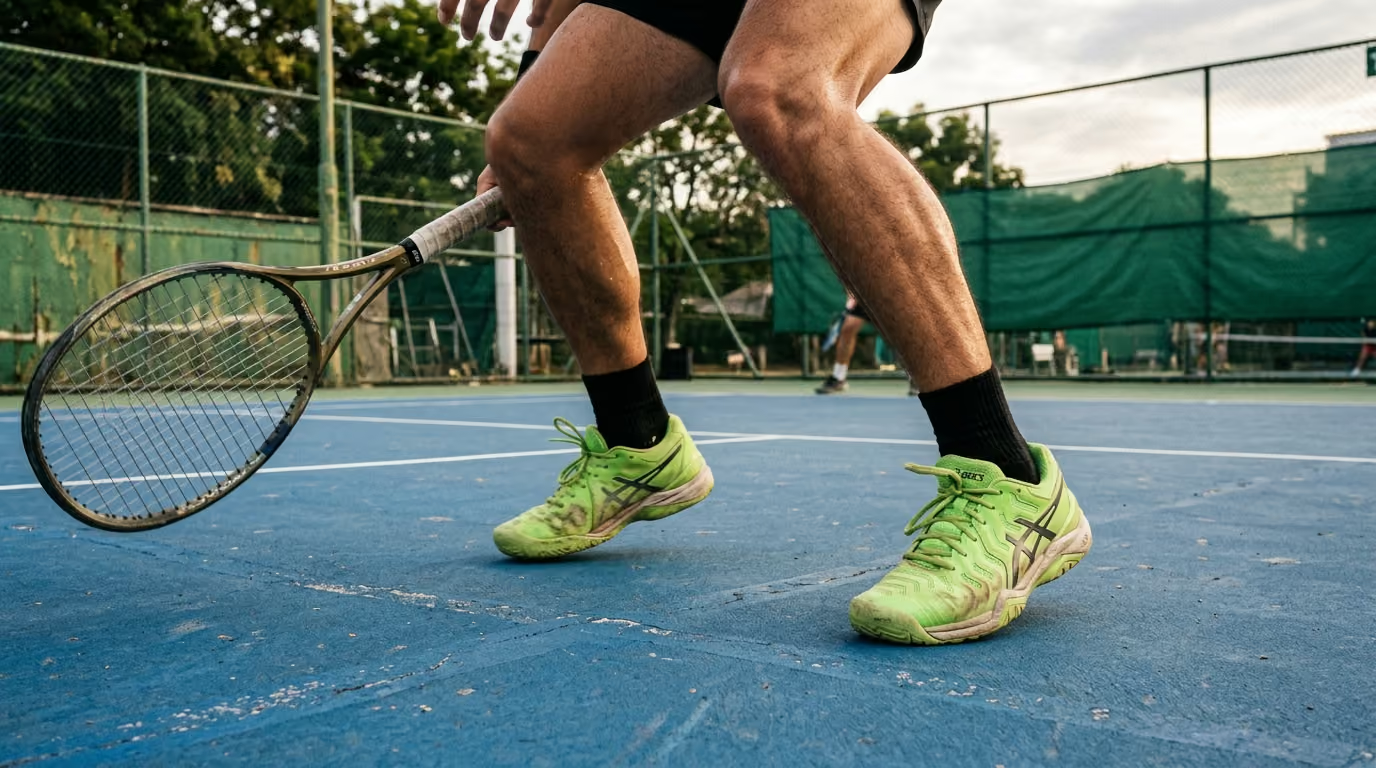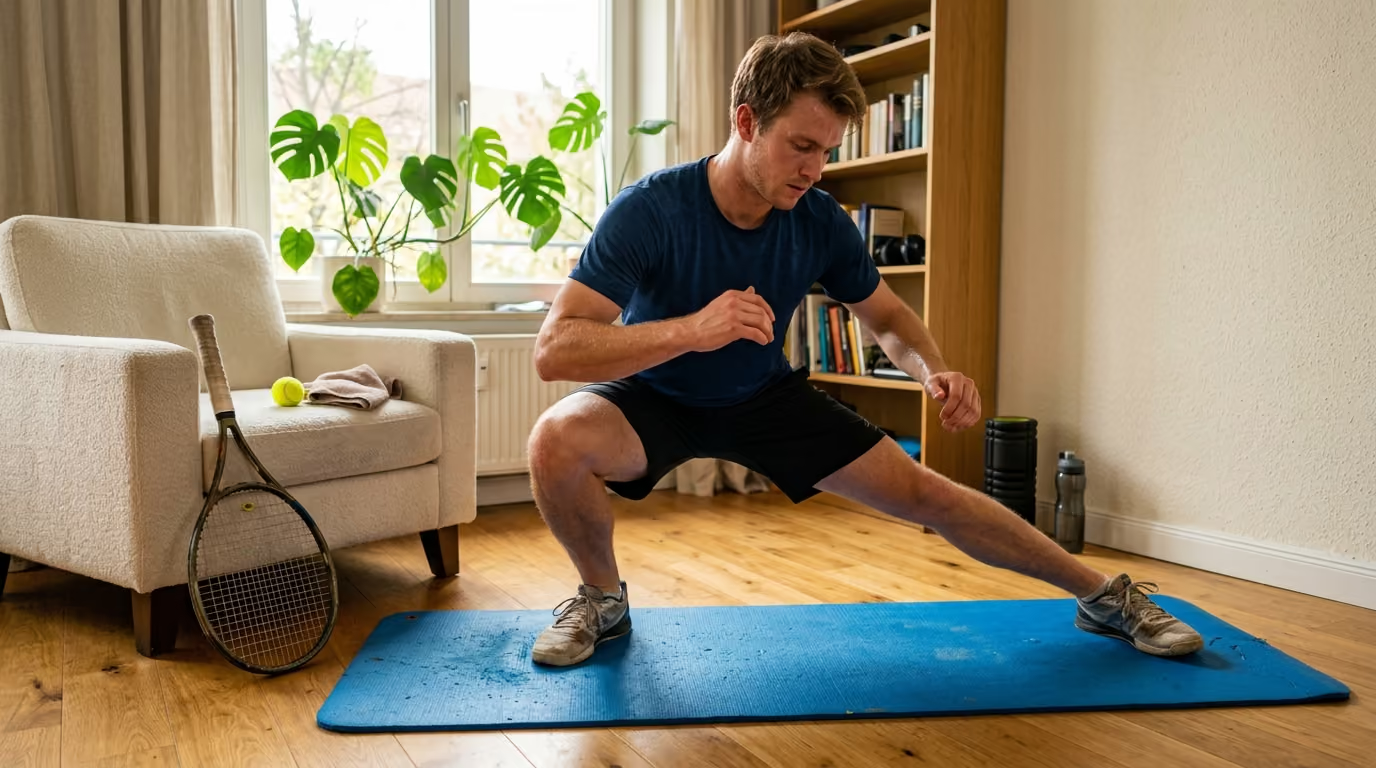

Racquet sports players perform an average of 1.6 changes of direction per point, requiring specific off-court mobility training to maintain peak physical condition.




When winter weather, business travel, or seasonal club closures keep you away from the court, it is easy to worry about losing your athletic movement. You might notice that your hips feel tight, your ankles feel stiff, and your first step back on the court lacks its usual spring.
To maintain your physical capabilities during these layoffs, you do not need access to a full club gym. A targeted off-court mobility routine can preserve your range of motion, keep your joints prepared for deep lunges, and help you return to play without the customary post-break stiffness. Applying structured mobility and movement training guides at home ensures your joints remain active, resilient, and prepared for your next match.
To train effectively off the court, we must first understand the intense mechanical demands of racquet sports. Court movement is highly chaotic, rapid, and demanding on the joint structures.
According to match analysis data from the Australian Open, tennis players perform an average of 1.6 changes of direction per point. During these rallies, they cover approximately 4.8 metres per change of direction. Furthermore, a large portion of these movements involves sharp turns. Players frequently change direction at angles exceeding 105 degrees.
This constant shifting of weight means that passive flexibility is simply not enough. In the sports science community, mobility is defined as the ability to actively access, control, and use movement range in a specific task. Passive flexibility only refers to how far a muscle can stretch with outside help. True mobility requires active muscular control, joint stability, and strength at the end of your physical range.
Without active control, a wide joint range can actually be a liability. When you slide for a ball or lunge deep on the court, your muscles must absorb force. They must then instantly redirect that force to push you back to the centre of the court.
This process relies heavily on the kinetic chain. Energy travels from your feet, through your knees and hips, up your trunk, and out through your shoulder to the racquet. A restriction anywhere in this chain can disrupt the flow of power.
Research published in professional tennis journals indicates that dominant-shoulder internal-rotation deficits are closely linked to shoulder pain. Similarly, a deficit in lead-hip internal rotation and lumbar extension often relates to low-back pain. By addressing these areas off the court, you maintain the link that allows safe energy transfer.
When you stop playing your sport regularly, your body begins to shed its hard-won adaptations. This process is known in exercise science as detraining. Detraining is defined as the partial or complete loss of training-induced anatomical, physiological, and performance adaptations. It occurs when the training stimulus is reduced or removed entirely.
Your balance and coordination are usually the first qualities to decline during a layoff. Studies show that balance-related adaptations can become significantly reduced as early as four weeks after you stop training.
While some balance benefits can persist for up to eight weeks, the neurological control of your joints begins to fade much sooner. Your brain simply becomes less efficient at coordinating rapid, unstable movements when it does not practice them.
Your flexibility also suffers during periods of inactivity. A 2025 meta-analysis examining several stretching studies found that while regular training increases range of motion, stopping for just two to six weeks causes a measurable reduction in joint reach. This loss of flexibility is especially pronounced in individuals who remain generally sedentary during their time away from the court.
I remember finishing a tough two hour padel match on a cold Tuesday night and waking up the next morning feeling like my lower back was locked in concrete. For a long time, I just accepted this as the price of playing hard in my forties. But once I started spending just ten minutes on targeted hip mobility before heading to the club, the stiffness almost completely vanished. It taught me that we do not have to accept pain as a default state of aging.
Our team at Evercourts has observed that players who maintain a basic movement routine at home experience a much smoother transition when they return to play. They do not suffer from the severe muscle soreness or joint stiffness that typically follows a multi-week layoff. They are able to step right back into competitive matches with confidence in their bodies.
To construct a balanced home routine, we can break mobility training down into seven key pillars. Each pillar addresses a specific movement quality needed on the court.
Joint access is the raw range of motion available at a specific joint. This is the foundation of the mobility pyramid. Without sufficient access, your body cannot physically reach the positions required by your sport. Key areas of focus include ankle dorsiflexion for deep squatting, hip rotation for lateral lunges, and thoracic rotation for backswing preparation. A classic 2003 study on junior tennis players demonstrated that targeted interventions could produce significant range increases in these exact joint segments.
Active control is your ability to use your muscles to move a joint through its available range without relying on gravity or momentum. It is the bridge between passive stretching and active sports movement. For instance, can you raise your leg high using only your hip flexors, or do you need to pull it up with your hands? Training active control helps your nervous system map your joint boundaries. This mapping makes you feel more secure and stable when moving quickly.
End-range capacity refers to your ability to produce and absorb force at the outer limits of your joint range. When you stretch sideways for a wide groundstroke, your hip is at its absolute limit. If your muscles are weak in that deep position, you will struggle to push back to the recovery position. Building capacity involves performing isometric holds and slow, controlled repetitions at your maximum safe range. This teaches your muscles to remain active when they are fully lengthened.
Your body does not move in isolated segments on the court. To hit a forehand, your hips must rotate, followed by your torso, and finally your shoulder and arm. Off-court training must include integrated drills that teach these segments to work together. Half-kneeling rotations and split-stance reaches are excellent tools for this purpose. They teach your hips and upper back to share the rotational workload, which reduces the stress placed on your lower back.
Court movement is incredibly fast, meaning you must be able to access your mobility in a fraction of a second. Reactive range is the ability to use your flexibility under high-speed conditions. Once you have established good static and dynamic control, you can introduce low-level plyometric drills. These include light lateral hops, split-step holds, and rapid snap-downs. These movements prepare your tendons and muscles for the quick, elastic demands of match play.
It is one thing to show perfect movement quality during a warm-up when you are fresh. It is quite another to maintain that quality in the third set when you are tired. Repeatability is the ability to maintain proper joint alignment and movement control under mild physical fatigue. We can train this quality by organizing our mobility exercises into short, continuous circuits. This exposure helps your brain maintain movement standards even as your heart rate rises.
The final pillar is your ability to transition your body from a state of high stress to a state of recovery. Downregulation involves using slow, static stretching and controlled breathing to calm your nervous system. This process helps lower muscle tension, promotes healthy blood flow, and accelerates joint recovery. Performing these routines after a workout or at the end of a long day of travel helps keep your connective tissues healthy and pliable.
To keep your movement sharp, you must target the specific joint systems that absorb the most stress during racquet play.
Your ankles are your primary point of contact with the court. They must absorb the impact of every step, hop, and slide. Specifically, you need adequate ankle dorsiflexion, which is the ability to pull your toes toward your shin.
Limited dorsiflexion prevents you from getting into a low, athletic stance. It forces your knees to cave inward and increases the strain on your plantar fascia.
To maintain ankle mobility at home, try the half-kneeling ankle rock. Kneel on one knee with your other foot flat on the floor in front of you. Keeping your front heel firmly on the ground, gently push your knee forward over your toes.
Hold the stretch for a few seconds at the end of your comfortable range, then return to the start. Repeat this movement for ten repetitions on each side to keep your calves and Achilles tendons supple.
Your hips are the powerhouse of your court movement. They must rotate internally and externally to allow for lateral lunges, open-stance hitting, and rapid changes of direction.
A lack of hip mobility forces your lower back to twist excessively to compensate. Over time, this unwanted lower-back rotation can lead to chronic soreness.
The 90/90 hip switch is an exceptional exercise for preserving hip rotation. Sit on the floor with your knees bent at 90 degrees, keeping your feet wide apart. Lower both knees to one side so that one leg is in front of you and the other is behind you, both forming 90-degree angles.
Slowly lift your knees and rotate them over to the opposite side while keeping your heels on the ground. Focus on moving from your hip joints rather than twisting your spine.
Your thoracic spine, or middle back, is designed for rotation. It allows you to wind up for serves, overheads, and powerful groundstrokes.
If your thoracic spine is stiff, your body will seek rotation from your lumbar spine or your shoulder joints. Neither of these areas is anatomically suited to handle high-velocity rotational forces.
Preserve this mobility with the side-lying open book exercise. Lie on your side with your knees bent at 90 degrees and stacked on top of each other. Extend your arms straight out in front of you at chest height, touching your palms together.
Slowly lift your top arm and rotate it open to the opposite side, keeping your knees pinned together on the floor. Follow your hand with your eyes to ensure your upper back rotates fully.
Overhead racquet sports place immense strain on the shoulder complex. Tennis and padel players often develop sport-specific adaptations, including a loss of internal rotation in their dominant shoulder.
To maintain healthy shoulder function, you must preserve your ability to raise your arms overhead without arching your lower back. You also need to keep your shoulder blades moving freely.
Wall slides are an effective, low-equipment tool for shoulder health. Stand with your back flat against a wall, bending your knees slightly for comfort. Place your elbows and the backs of your hands against the wall at shoulder height.
Slowly slide your hands upward, keeping your elbows, hands, and lower back in contact with the wall. Go only as high as you can without pain or letting your back arch away from the wall.
To make your off-court training practical, we have designed a 20-minute daily mobility routine. You can perform this routine in a hotel room, a living room, or any small space without specialized gym equipment.
The goal of this phase is to increase your core body temperature and prepare your nervous system for movement. Do not skip this step, especially on cold mornings or after long periods of sitting.
This phase uses active movement to gently guide your joints through their functional ranges. Focus on smooth, controlled tempos rather than speed.
This phase combines movement range with active muscle engagement. It helps build the strength required to protect your joints during explosive court movements.
These drills translate your mobility gains into the coordination patterns you actually use during a match.
End your session by calming your nervous system. This helps kickstart your recovery process.
While all racquet sports share some movement patterns, each sport place unique demands on your body. Tailoring your off-court mobility work to your specific sport will yield the best results.
Tennis movement is characterized by long sprints, high-velocity sliding, and deep, explosive lunges on wide balls. Tennis players must rotate their hips and torso forcefully to generate power on groundstrokes.
If you play tennis, you should place extra emphasis on hip internal rotation and lateral hip strength. This preparation is essential for managing physical health as a racquet player on hard or clay courts.
Your off-court routine should include deep lateral lunges and single-leg stability exercises. These movements prepare your adductors and glutes to handle the extreme decelerating forces of a hard-court slide.
Additionally, spend time on thoracic spine extension to support your serve. A stiff upper back can lead to shoulder impingement during the overhead service motion.
Pickleball is played on a much smaller court, which reduces the need for long sprints. However, the game requires rapid, short-step footwork and extremely fast reactions.
Players spend a significant amount of time bent forward at the kitchen line, waiting to volley low balls. This constant low position puts a premium on ankle dorsiflexion and lower-back endurance.
To support healthy aging and athletic longevity, pickleball players should focus on ankle mobility and deep squatting comfort. If your ankles are stiff, you will bend from your lower back to reach low dinks, which can lead to spinal fatigue.
Incorporate regular calf stretches and supported squat holds into your off-court program. These exercises will help you stay low and balanced at the kitchen line without straining your back.
Padel involves a high volume of overhead play, including frequent smash shots and defensive lobs. The sport also features rapid, multi-directional changes of direction within a confined, glass-walled court.
Padel players must be highly proficient at rotating their shoulders and torso while tracking high balls off the glass. This combination of movements can put significant stress on the shoulder joint and the elbow.
If you are focusing on padel-specific preparation, prioritize shoulder rotation and thoracic mobility. Exercises like wall slides and lying thoracic rotations are highly beneficial.
Additionally, focus on calf flexibility and ankle stability. The rapid turning and twisting in padel require your lower leg muscles to be highly reactive to prevent sudden twists or sprains.
Squash and badminton require some of the deepest lunges of any sport. Players must often drop their hips almost to the floor to retrieve low drops or soft shots.
This extreme depth demands exceptional hip flexion, hamstring length, and adductor flexibility. It also requires the strength to push back up from these deep positions.
For these sports, your off-court training must include deep, controlled lunging variations. The Cossack squat, where you slide your weight fully to one side while keeping your opposite leg extended, is highly effective.
Always start with a shallow range of motion. Gradually increase your depth as your strength and comfort improve over several weeks of training.
When designing an off-court program, it is easy to fall into a few common traps. Avoiding these mistakes will make your training safer and more effective.
One of the most common misconceptions is that more flexibility is always better. In reality, your joints need a balance of flexibility and strength.
There is no scientific proof that having loose, hypermobile joints prevents injuries. In fact, excessive laxity without muscular control can make your joints more susceptible to strains and sprains.
Instead of trying to touch your toes to your head, focus on building control within your functional range. Ensure you can stand balanced on one leg, squat comfortably, and rotate your torso smoothly without pain.
If you are looking for sensible injury prevention methods, prioritize joint control and strength over passive stretching. This approach builds a much more resilient body for the court.
Many players believe that holding a few static hamstring stretches for a minute is a complete mobility routine. While static stretching has its place, it does not prepare your body for athletic movement.
Static stretching does not train your coordination, balance, or ability to decelerate. It can actually temporarily reduce your muscle power if performed immediately before explosive exercise.
Always combine your static stretches with active, loaded mobility work. Follow a stretch with an exercise that requires you to use that new range of motion under control.
For example, after stretching your hips, perform a set of controlled bodyweight squats or lunges. This sequence teaches your brain how to use and support your newly accessed joint range.
Another serious mistake is forcing your joints into painful positions under the assumption that pain means progress. Mobility training should never cause sharp, radiating, or pinching pain.
If you feel a pinch in your hip during a rotation, do not push through it. Pushing through joint pain can lead to inflammation, bursitis, or tendon tears.
Instead, work right up to the edge of your comfortable range. Your muscles should feel a stretch, but your joints should feel secure.
If a movement feels uncomfortable, reduce the range or simplify the exercise. Over time, your body will naturally grant you more range as it learns that the movement is safe.
Racquet sports are inherently one-sided. You swing with one dominant arm and often push off more frequently with one dominant leg.
As a result, your body will naturally develop some structural asymmetries. Your dominant shoulder might have less internal rotation, and your lead hip might feel tighter than your trail hip.
Do not obsess over making both sides of your body perfectly symmetrical. Some asymmetry is a healthy adaptation to your sport.
Instead, focus on ensuring both sides have enough functional range to perform your court movements without pain. Focus on quality of movement and control on both sides rather than trying to balance every single degree of rotation.
Mobility training is not just a tool for building performance. It also plays a massive role in your recovery between tough matches.
During a hard match, your muscles contract repeatedly, which can lead to localized fatigue and a build-up of metabolic waste products. Connective tissues, such as your tendons and fascia, can become stiff and less pliable.
An off-court mobility routine acts as a form of active recovery. Gentle, dynamic movements help pump fresh, oxygen-rich blood to your tired muscles.
This increased circulation delivers essential nutrients that speed up tissue repair. It also helps clear metabolic waste, which can reduce the severity of delayed onset muscle soreness.
Furthermore, mobility work helps calm your sympathetic nervous system, which is your body's fight-or-flight response. Playing a competitive match keeps your nervous system highly stimulated.
Transitioning into a calm, static stretching routine after play sends a signal to your brain that it is safe to relax. This shift promotes better sleep quality, which is the single most important factor in athletic recovery.
By incorporating light mobility sessions on your rest days, you keep your joints moving through their full ranges. This consistent movement prevents your tissues from locking up during periods of rest.
It keeps your body supple and prepared, ensuring that your next return to the court is comfortable and free of early-game stiffness.
While a home mobility routine is highly beneficial for healthy athletes, it is not a substitute for medical treatment. If you are experiencing pain, you must know when to step back and consult a professional.
If you experience sharp, catching, or aching pain inside a joint during or after your mobility exercises, stop immediately. Healthy mobility work should produce a muscular stretching sensation, not joint pain. Persistent pain that lasts for more than a few days, or worsens with light activity, requires an evaluation by a qualified physiotherapist or sports physician.
The appearance of swelling, redness, or heat around a joint is a clear sign of inflammation or acute injury. These symptoms are common after sudden sprains or during flare-ups of chronic conditions like arthritis. Do not attempt to stretch or exercise a swollen joint at home. Seek medical advice to identify the underlying cause and receive a proper recovery plan.
Any sensation of numbness, tingling, or "pins and needles" traveling down your arms or legs is a potential sign of nerve compression. This can occur when a nerve is pinched in your neck or lower back. Forcing stretches when you have nerve irritation can worsen the compression and lead to long-term nerve damage. A healthcare professional should evaluate these symptoms promptly.
If a joint feels unstable, loose, or as if it might give way during movement, do not attempt to increase its flexibility. Instability indicates that the ligaments or muscles supporting the joint are stretched or weakened. In these cases, you need a targeted strengthening and stabilization program designed by a clinical specialist, rather than more stretching.
To help you apply this guide immediately, here is a practical checklist you can follow this week.
Maintaining your movement quality off the court is a highly effective way to protect your athletic longevity. By dedicating just twenty minutes a few times a week to your joints, you can ensure that you are always ready to step back onto the court with confidence, power, and ease.
Follow Evercourts for practical insights on tennis, pickleball and padel performance, movement, recovery and healthy ageing. Stay connected for new articles, research-led guidance and ideas to help you play well and keep playing for years.


Read practical guidance for better movement, smarter preparation and a game that keeps working for you.
explore the Blog