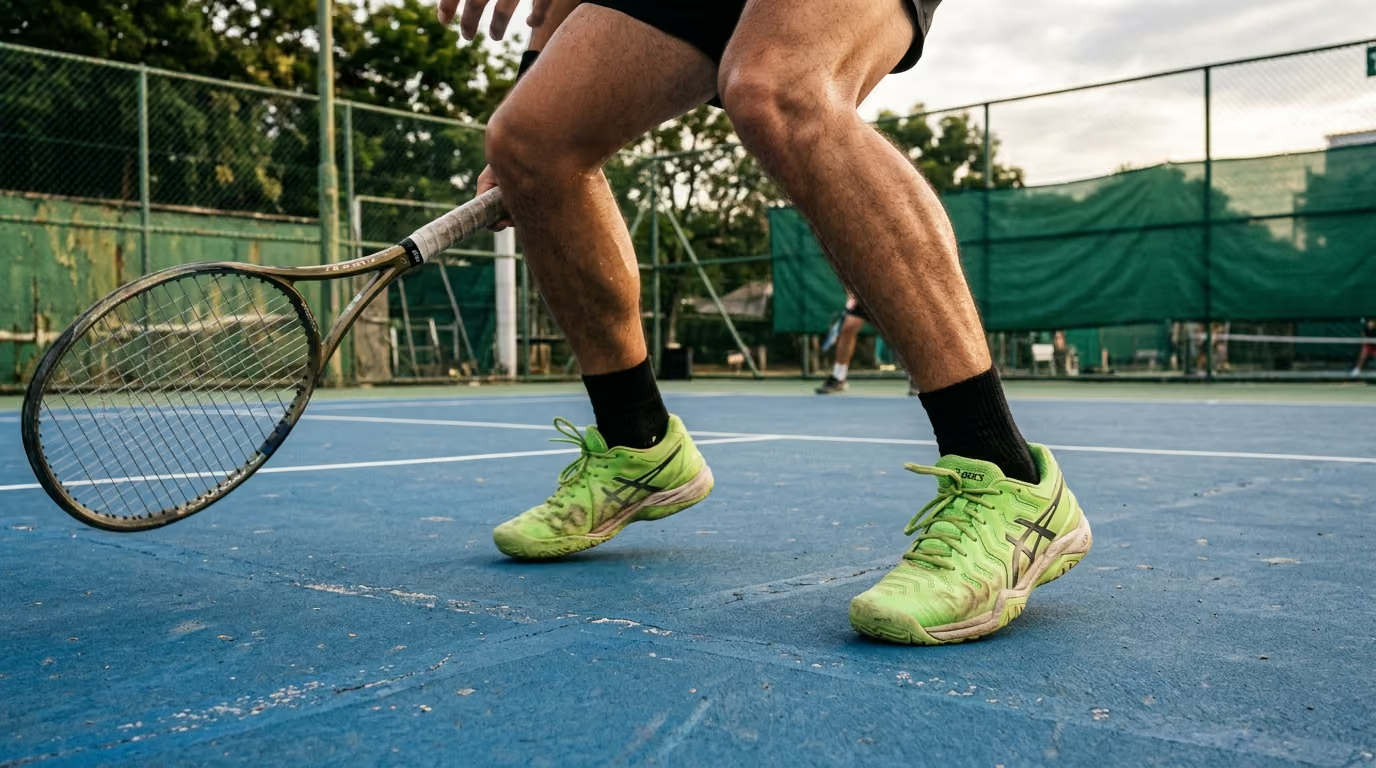
While many assume padel overheads are all about power, selecting the right shot from bandeja, vibora, and smash depends on court position and strategy.




You step back to track a high, drifting lob. Your partner shifts to cover the middle of the court. You feel the temptation to strike the ball with maximum power. You swing hard, but the contact point is slightly behind your head. The ball flies directly into the back glass. The opportunity is gone, and you have given away a cheap point.
To select the correct padel overhead, players must read the depth, height, and speed of the opponent's lob while evaluating their own court position. The bandeja prioritizes control and net retention on deep lobs, the víbora applies aggressive lateral slice when moderately balanced, and the smash finishes the point on short, high balls. Making this decision based on court position rather than raw power ensures your pair maintains tactical dominance.
This detailed guide will compare these three critical overhead strokes. It will help you make better decisions on the court. It will also help you protect your joints for long term athletic longevity.
According to systematic reviews of padel performance analysis, overhead strokes are among the most effective tools for controlling a rally. The research shows that players use different overheads to solve specific tactical problems. In professional observations, only about 7.2 percent to 8.6 percent of bandejas result in immediate winning shots. In contrast, flat smashes achieve a winning percentage of 33.3 percent to 51.8 percent under the same observational criteria.
These statistics do not mean the bandeja is an inferior shot. The bandeja is designed to sustain the attacking phase rather than end it. A 2025 comparison of main-draw and qualifying-draw players shows that higher-level competitors use complex tactical patterns. These players rely heavily on no-bounce shots to keep their opponents pinned deep. The study also revealed that the smash accounted for approximately 45 percent of winners in professional men's matches. In women's professional matches, the smash accounted for 25 percent of winners.
Another critical study examined how the presence of opponents affects performance. Researchers measured smash velocity in both semi-professional and amateur players. The results showed that the physical presence of opponents reduced ball speed. Semi-professional smash velocity fell from 133.1 km/h to 120.72 km/h when opponents defended. Amateur smash velocity dropped even more sharply, falling from 124.6 km/h to 104.5 km/h. This shows that practice-court power rarely translates directly to match play.
Furthermore, longitudinal analysis of elite padel has shown that the game is changing. Between 2011 and 2016, researchers recorded a 116 percent increase in unforced errors from the bandeja and víbora. This change occurred as professional padel evolved toward faster rallies and shorter points. Modern players must manage their risk carefully. Selecting the wrong overhead under pressure now carries a much higher penalty than it did a decade ago. Learn more about performance metrics on the Evercourts homepage.
The bandeja is the primary overhead stroke played on the dominant side in padel. The term translates to "tray" in Spanish. This name refers to the open, flat racket position used during the preparation phase. It is an offensive overhead struck without a bounce. The systematic-review literature describes the bandeja as a slice-based overhead. The player opens the racket face upward before impact and applies an underspin effect.
In our experience at Evercourts, players who master the bandeja dramatically increase their court longevity. It is not a defensive smash. It is better understood as a controlled attacking reset. The primary goal is to re-establish or preserve the net position. When a deep lob forces you backward, the bandeja allows you to hit a reliable ball and run back to the volley line.
The bandeja requires specific technical mechanics. You must contact the ball to the side of your body. The ideal contact height is around head level. You should avoid a maximum-power swing. Instead, focus on a controlled downward and forward path. This path creates a low, skidding bounce that prevents your opponents from attacking.
By focusing on depth rather than speed, you reduce the probability of making an unforced error. The bandeja keeps the ball deep in the opponents' court. This positioning forces them to play a defensive groundstroke from behind the service line. It gives you and your partner precious seconds to regain your attacking formation. You can read more about these tactical principles in our padel articles.
The víbora represents the aggressive middle ground between the bandeja and the smash. The word "víbora" means "viper" in Spanish. This name reflects the lateral, snake-like movement of the ball after it bounces. Unlike the bandeja, the víbora uses lateral sidespin to create a faster and more penetrating trajectory. It is designed to apply intense pressure without abandoning the net.
The key technical difference lies in the contact point and the spin application. You contact the víbora higher and more in front of your body than a bandeja. However, it is not struck directly above the head. You brush diagonally across the outside of the ball. This lateral brushing action imparts heavy sidespin. A useful cue is to imagine cutting around the outer edge of the ball.
The follow-through for a víbora is distinct. The racket path wraps across your upper body. Some coaches describe this as a "scarf" finish because the arm finishes around the neck. This compact finish allows you to recover your balance quickly. It prepares you to move forward immediately after the stroke.
The víbora carries a medium risk profile. It is faster than a bandeja, but offers more control than a forced power smash. It is highly effective when directed toward the side wall or the corners. The sidespin causes the ball to drop quickly after hitting the glass. This low bounce makes it incredibly difficult for opponents to counterattack.
The smash, or remate, is the ultimate attacking weapon in padel. It is selected when the player can contact the ball at maximum height. This shot requires excellent balance and forward momentum. The primary objective is to end the rally directly. A successful smash forces an unrecoverable rebound or an immediate opponent error.
We must distinguish between a flat power smash and a kick smash. The flat smash relies on maximum racket speed and a vertical contact point. It is designed to hit the court and bounce over the four-meter wall. The kick smash uses topspin to make the ball jump high off the back glass. This trajectory can bring the ball back to your side of the net.
Professional match-analysis research highlights the role of the recovery smash. This specialized shot occurs when a player retreats to hit a high lob. Instead of a defensive reset, they strike a high-quality, aggressive smash. This sequence is highly effective in elite competition. In fact, the lob followed by a recovery smash is one of the most successful two-shot patterns in professional data.
However, the smash carries the highest risk profile of all three overheads. If you attempt it from poor balance, the results can be disastrous. The opponents can easily retrieve a weak smash. If the ball does not bounce high enough, they will counterattack. You can learn more about managing these high-injury-risk motions in our injury prevention articles.
Making the right decision in real time is the secret to consistent padel play. You must follow a structured decision tree on every lob. This process begins the instant your opponent contacts the ball. You cannot wait for the ball to reach its apex. Early reading is essential for maintaining your physical balance.
First, read the lob immediately. Make an early shoulder turn and raise your non-dominant arm. Track the ball with your eyes while moving side-on. A late turn forces you to backpedal with your chest facing the net. This error ruins your balance and causes the contact point to drift behind your head.
Second, classify the lob using five distinct variables:
Third, apply the minimum-risk rule. This rule states that you should smash only when the ball is a clear put-away. In all other cases, choose the shot that preserves the net. This approach is supported by modern coaching manuals. Defaulting to the bandeja keeps your pair in an attacking formation. It prevents you from giving away cheap points due to ego or impatience.
Regardless of the overhead you choose, proper preparation is non-negotiable. It protects your body and ensures consistent contact. The foundation of all three overheads rests on an early shoulder turn. Your non-dominant shoulder must point toward the incoming ball. This position allows your torso to rotate efficiently during the swing.
Next, prepare your racket early. Do not wait until the last split second to pull your arm back. Your elbow should be raised to shoulder height. Your racket should sit behind your head in a loaded position. Keep your movements compact and controlled to save energy.
Your footwork must support this preparation. Use side steps or crossover steps to move backward. Avoid running backward in a straight line with your chest open. Side-on movement allows you to keep both the ball and your opponents in your field of vision. It also ensures you can transition forward into contact.
Finally, use your non-dominant arm actively. It should point up toward the ball to track its flight. This action is not merely cosmetic. It stabilizes your shoulders and prevents your head from dropping early. If your non-dominant arm drops too soon, your contact point will fall, leading to a netted shot.
In padel, an overhead stroke is incomplete until you recover your position. You must always ask yourself where you will be when the opponents hit the next ball. A beautiful shot is useless if it leaves you stranded at the back of the court. The ultimate goal of any overhead is to help you hold the net line.
This recovery requires close coordination between partners. Padel is a doubles game, and your movement must be synchronized. When one player moves back to hit a bandeja, the partner must adjust. They should slide slightly back or prepare to cover the middle. Once the overhead is struck, both players must recover toward the net together. This movement preserves your defensive wall and closes any central gaps.
I remember finishing a tough two hour padel match on a cold Tuesday night and waking up the next morning feeling like my lower back was locked in concrete. For a long time, I just accepted this as the price of playing hard in my forties. But once I started spending just ten minutes on targeted hip mobility before heading to the club, the stiffness almost completely vanished. It taught me that we do not have to accept pain as a default state of aging.
Your lower back stiffness often stems from poor overhead rotation. If your hips are tight, your spine must hyperextend to reach the ball. This hyperextension puts immense pressure on your lumbar discs. By improving your hip mobility and recovery footwork, you protect your back. You can find targeted routines in our mobility and movement guides.
It is helpful to compare how overhead decisions differ across racquet sports. In tennis, the overhead smash is almost always a terminal shot. Tennis courts are larger, and there is no back wall to return the ball. A tennis player can strike an overhead with flat power from almost anywhere. The risk of the ball being returned is relatively low.
In pickleball, the overhead smash is performed at the non-volley zone line. Lobs are less common in high-level pickleball. When they do occur, the player uses a quick wrist snap rather than a full service motion. The paddle is solid, and the ball is light plastic. The primary goal is to hit the ball down into the kitchen or at the opponent's feet.
Padel is entirely unique because of the glass walls. If you hit a smash with pure power, the ball will hit the back glass and rebound high. Experienced opponents will wait for this rebound and play an easy counterattack. Therefore, padel requires you to use spin and direction to keep the ball low. The presence of the walls makes the bandeja and víbora essential, whereas they do not exist in tennis or pickleball.
The first major mistake is believing that the hardest shot is always the best shot. As the research shows, the presence of opponents reduces smash velocity. A powerful shot that lacks placement is easily defended. You must prioritize accuracy and court position over raw speed.
The second mistake is treating every high lob as a smash opportunity. Many players suffer from smash ego. They attempt a power smash from deep in the court. This decision usually ends in an unforced error or an easy counterattack for the opponents. You must learn to love the bandeja as your primary building block.
The third mistake is confusing the víbora with a hard bandeja. They are technically different strokes. The bandeja uses underspin to control depth and keep the ball low. The víbora uses sidespin to create a lateral, unpredictable bounce off the walls. Using the wrong spin for the situation will ruin your tactical plan.
The fourth mistake is practicing without realistic opposition. Hitting overheads from a comfortable basket feed does not prepare you for match play. Without opponents moving in front of you, you cannot practice real decision-making. You must train with defenders present to develop a reliable match-day smash. Check out more common errors on our Evercourts blog.
Padel overheads place unique physical demands on your body. Biomechanical studies show that overhead strokes require complex trunk and shoulder coordination. During the loading phase, your spine undergoes extension and lateral flexion. Your trunk then rotates rapidly to release stored elastic energy into the ball.
This high range of motion can increase your risk of shoulder injuries. Research indicates that repetitive overhead loading can lead to SLAP lesions and shoulder impingement. It can also cause glenohumeral internal-rotation deficit. This condition occurs when the shoulder loses its internal rotation range of motion over time.
To protect your shoulders, you must focus on scapular control. Your upper back muscles must stabilize your shoulder joint during the swing. You must also develop adequate thoracic spine rotation. If your mid-back cannot rotate, your shoulder joint will overcompensate. This overcompensation leads to tendonitis and joint wear.
Correct execution is your best defense against injury. You should avoid contacting the ball behind your head. This position forces your shoulder into extreme external rotation under load. It also strains your lower back. Consistently choosing the bandeja over a forced smash reduces the physical load on your joints, supporting your overall player health resources.
Let us look at six specific case patterns you will encounter on the court. These scenarios will help you apply this knowledge in real time.
To improve your overhead decisions, you must practice with intent. We recommend a progressive training framework. This progression moves from isolated technical work to real-time decision drills. It ensures your skills hold up under match pressure.
Start by practicing your side-on movement without a ball. Focus on turning your shoulders immediately. Practice stepping backward using crossover steps. Hold your racket in the loaded position and point with your non-dominant arm. Repeat this movement until it feels natural.
Have a partner or coach feed you consistent lobs from a basket. Practice ten bandejas in a row, focusing on depth. Then, practice ten víboras, focusing on lateral spin and hitting the side wall. Finally, hit ten smashes from short feeds. Focus on clean contact rather than maximum speed.
This is where you build real match skills. Have your partner feed lobs of varying heights and depths. You must read the ball and call out your shot before you hit it. Call "bandeja" for deep lobs, "víbora" for medium lobs, and "smash" for short lobs. This drill trains your brain to connect ball tracking with shot selection.
Play practice sets with a unique scoring system. You win normal points, but you also earn bonus points for good decisions. For example, earn a bonus point every time you hit a deep bandeja and successfully recover the net. Lose a point if you attempt a power smash from behind the service line. This scoring system reinforces smart risk management.
While improving your technique will prevent many issues, you must listen to your body. Do not try to play through persistent shoulder or elbow pain. If you experience sharp pain during the loading or contact phase of your overhead, stop playing immediately. This pain can indicate a rotator cuff tear or a labral issue.
You should consult a qualified healthcare provider if you experience:
A physiotherapist can evaluate your shoulder joint mechanics and provide targeted exercises. They can help you build the dynamic stability required for safe overhead play. Protecting your joints ensures you can continue enjoying racquet sports for years to come.
We recommend revisiting this guide whenever you feel your overheads are losing their depth or causing you physical discomfort. Check your preparation mechanics and decision-making habits every few months to keep your game sharp. At Evercourts, we believe that smart play is the key to athletic longevity.
By mastering the bandeja, víbora, and smash decision tree, you protect both your body and your position at the net.
Follow Evercourts for practical insights on tennis, pickleball and padel performance, movement, recovery and healthy ageing. Stay connected for new articles, research-led guidance and ideas to help you play well and keep playing for years.


Read practical guidance for better movement, smarter preparation and a game that keeps working for you.
explore the Blog