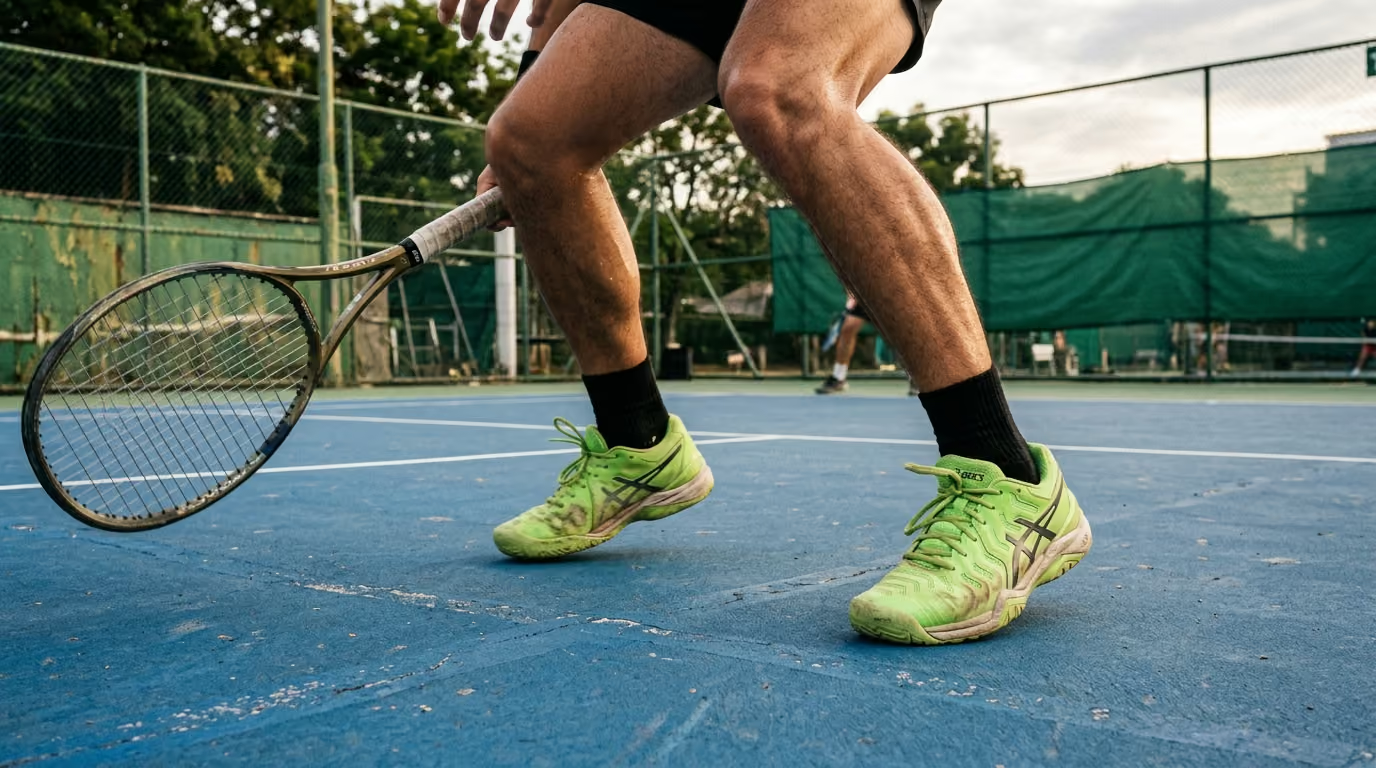
While many players consider footwork to be merely running to the ball, effective pivoting involves a complex sequence of deceleration, rotation, and realignment.




Pivoting on the court is not a single, isolated movement. It is a highly organized sequence of deceleration, structural rotation, and physical re-alignment. Many recreational players view footwork as merely running to the ball, but the real challenge lies in how you reorganize your body after you make contact.
A functional pivot allows you to transition smoothly from defensive stretching to active recovery. This article explains the exact physical mechanics of turning and changing direction. It shows how these movement patterns operate across tennis, pickleball, and padel. It also provides practical training tools to support your athletic longevity and performance.
Pivoting on the court is an active sequence of deceleration, pelvic orientation, and re-acceleration. To do this well, a player must manage braking forces and align their feet relative to their target. Efficient pivoting allows a player to recover quickly without placing excessive rotational stress on the knees and lower back.
To move efficiently, you must first understand what a pivot actually is. In racquet sports, a pivot is a change of body orientation around a relatively stable contact point. This movement requires coordinated rotation through the foot, ankle, knee, hip, and trunk. It is not a simple, careless spin on the ball of your foot.
A functional pivot can occur at several different moments during a single rally. You may pivot before contact to organize your stroke. You might pivot during contact to transfer your weight and generate power. Frequently, you will pivot immediately after contact to initiate your recovery back to the center of play.
Every successful pivot relies on specific physical phases. First, you must execute a controlled braking action to manage your momentum. Second, you must establish a stable base of support with your feet. Third, you must rotate your pelvis and trunk toward your target. Finally, you must take a purposeful first recovery step that matches your next tactical location.
To help analyze these movements, sports biomechanists identify specific roles for each leg. During most changes of direction, your legs perform three distinct functions:
By training these distinct leg roles, you can improve your general court agility. For more details on building this physical foundation, read our strength and conditioning guidelines.
Current sports science research reveals that court movement is highly demanding and repetitive. In tennis, tracking data provides a clear picture of these physical requirements. According to a study of professional play at the Australian Open, players execute an average of 1.6 changes of direction per point.
During these exchanges, players cover approximately 4.8 meters per change of direction. They also execute roughly 1.3 to 1.4 shots between each turn. Interestingly, about two-thirds of these movement changes involve an angle greater than 105 degrees. This means players are not just making shallow cuts, but are frequently reversing their direction of travel.
In pickleball, the movement profile is different but equally intense. A study published in the Journal of Strength and Conditioning Research examined recreational pickleball players and movement patterns. The researchers found that nearly half of the surveyed players reported a pickleball-related fall.
The study identified lunging and backward movement as the leading causes of these falls. Players who fell were generally slower on change-of-direction tests and had weaker hip-abductor muscles. This highlights the importance of specific leg strength for lateral stability.
Padel movement research shows another set of interesting physical metrics. A systematic review published in the International Journal of Environmental Research and Public Health described padel as an intermittent sport. Players perform repeated accelerations, decelerations, and changes of direction.
According to tracking data, padel players cover between 8 and 12 meters per point. This adds up to 2,500 to 3,500 meters of total movement per game. Another study compared professional winners and losers, showing that winners travel more total distance per hour. Winners covered about 2,518 meters per hour, while losers covered 2,339 meters.
Furthermore, elite padel research reveals that 80 percent of accelerations and decelerations occur within a very short distance. Most of these adjustments take place within one to two meters. This data indicates that short-range braking is a critical skill for padel success.
Stances should not be viewed as rigid technical rules. Instead, they are flexible movement solutions along a physical continuum. The way you position your feet depends on your court position, your physical speed, and the incoming ball.
In a fully open stance, your feet and hips remain relatively parallel to the net. This stance is highly effective when you are stretched wide or running out of time.
The main movement advantage of an open stance is speed of recovery. Because your hips remain facing the court, you can immediately push off your outside leg. This eliminates the need to turn your body around before running back.
However, the open stance has clear mechanical limitations. It makes it harder to transfer your body weight forward into the ball. If you use it when you are too upright, you may strain your lower back.
The semi-open stance is a hybrid position that sits between open and square alignments. It is one of the most common footwork patterns in modern racquet sports.
This position allows you to rotate your shoulders while keeping your hips slightly open. It provides a stable base of support for your trunk. It also makes it easy to transition from forward running to lateral recovery.
Coaches often recommend the semi-open stance for neutral rally shots. It gives you the power of body rotation without trapping your feet.
A neutral stance occurs when your feet are positioned approximately perpendicular to the net. Your body is turned side-on to the incoming ball.
This stance is ideal when you have plenty of time to set up. It allows for a classic linear weight transfer from your back foot to your front foot.
The primary drawback is that it requires more preparation time. If the opponent hits a fast shot, you may struggle to get side-on.
In a closed stance, your front foot steps across your body, pointing away from your recovery target. This represents the extreme end of the stance continuum.
A closed stance is highly useful when you are running forward to reach a short ball. It helps you stabilize your body at the end of a long sprint.
The major risk of a closed stance is getting stuck. Because your body is turned completely away from the court, you must perform an extra pivot to recover. If you do not execute this pivot, you will leave a large open space for your opponent.
Understanding these stances is a core part of developing your overall court movement principles.
While all racquet sports require agility, each sport has its own unique physical signature. The court size, ball speed, and rules dictate how you must pivot.
Tennis features the largest court and the longest running distances. A tennis player must regularly sprint six meters or more to reach a wide ball.
Because of these large distances, tennis movement requires significant braking power. Players must slide or plant their outside foot with great force to stop their momentum.
As a result, tennis players rely heavily on open and semi-open stances on the baseline. These positions help them absorb high-speed forces and return to the center of the court.
Pickleball is played on a much smaller court, which compresses your reaction time. Most movement occurs near the non-volley zone, often called the kitchen line.
In this tight space, you do not have time for large running steps. Instead, you must use tiny, lateral adjustment steps.
Pivoting in pickleball is more about maintaining a low center of mass. You must be able to lung laterally and recover instantly. Because backward movement is a common source of falls, learning to drop-step and turn is essential.
Padel introduces the unique challenge of glass walls and mesh fences. You cannot simply watch the ball fly past you. You must track its trajectory, predict the bounce off the wall, and position your body accordingly.
This means padel players must pivot in circles. You will often turn your back to the net, run toward the wall, and pivot around the rebounding ball.
Perceptual research in padel shows that elite players read visual cues early. They look at the opponent's hand height and heel position to anticipate the ball direction. This spatial awareness is vital for coordinate play with your doubles partner.
To explore more about managing your body during these sport-specific demands, view our athletic longevity on the court resources.
Many recreational players develop movement habits that reduce their efficiency. These errors can increase joint stress and slow down court coverage.
Many players believe they should use an open stance for every single shot. They watch professional players slide on clay and try to copy the look.
However, an open stance is only fast if you can load your hips correctly. If you plant your foot without bending your knee, you cannot push off. You will end up reaching for the ball with your upper body, which ruins your balance.
If you are moving forward, a neutral or closed stance is usually much more efficient. It allows you to use your forward momentum to generate shot depth.
Running straight backward is one of the most dangerous movements on a court. When you backpedal, your center of mass shifts behind your heels. This position makes it incredibly easy to trip, lose your balance, or fall.
Instead of running backward, you should use a drop step. Turn your hips to the side, pivot on your front foot, and run diagonally or laterally.
This technique keeps your head stable so you can track the ball. It also keeps your feet active under your hips, which reduces your risk of falling.
Some players try to recover so quickly that they spin their shoulders before they finish their swing. This timing error causes several immediate problems.
First, it pulls the racket face offline, leading to an inaccurate shot. Second, it forces the lower back to twist under high rotational load.
Always complete your stroke and secure your balance before you initiate your recovery pivot. Good movement is about timing, not just raw speed.
Every time you change direction, your muscles and joints must absorb several times your body weight. This eccentric stress is highly fatiguing.
Deceleration is the most demanding part of court movement. To stop, your quadriceps and gluteal muscles must contract while they are lengthening. This type of contraction creates microscopic tears in the muscle fibers, which is normal but requires recovery time.
If your movement mechanics are poor, these forces will bypass your muscles and travel directly into your joints. For example, stopping with a straight leg places immense stress on the patellar tendon and the knee joint.
Fatigue also alters your pivoting mechanics. As your legs tire during a long match, you will naturally stop bending your knees. This causes you to take wider, stiffer steps, which increases the torque on your ankle and lower back.
To protect your tissues, you must prioritize proper recovery between sessions. This includes active mobility work and adequate rest. You can read more about managing joint fatigue in our guide on recovery science principles.
To improve your pivoting, you should train your movement in systematic layers. Do not just play matches and hope your footwork gets better. Use this structured approach to build lasting movement quality.
Start by practicing basic stances without a ball. Stand in your living room or on a court and move your feet into open, semi-open, and closed positions.
Focus on how your hips rotate in each stance. Keep your weight centered over the balls of your feet. Make sure your knees are slightly bent and your spine is neutral.
Practice holding each position for two seconds to build muscle memory. Your goal is to feel stable and balanced in every stance.
Once you understand the basic positions, you must train your ability to stop. Run forward for three meters, then try to stop within two steps.
Focus on lowering your hips as you prepare to brake. Keep your feet wider than your shoulders to create a stable base.
Repeat this drill moving laterally and diagonally. Always check that your knees are aligned over your toes when you stop.
Now, combine your stop with an active recovery step. Run to a marker, plant your outside foot, shadow swing, and pivot back toward your starting point.
Pay close attention to your first step after the pivot. It should be a strong, explosive push-off from your stabilizing leg.
Keep your upper body quiet during the turn. Do not let your shoulders sway from side on.
The final step is to add unpredictable cues. Have a partner stand across from you and feed balls or point in random directions.
This forces your brain to process information before you move. It mimics the chaotic nature of a real match.
Start slowly, then gradually increase the speed of the feeds as your balance improves. You can find more structured workouts for court longevity in our court injury prevention strategies resource.
While physical training can improve your movement, you must listen to your body's warning signs. Serious structural issues require professional medical assessment.
You should consult a physical therapist or sports medicine physician if you experience any of the following symptoms:
Never try to play through joint pain by taking painkillers. This behavior can turn a minor strain into a chronic condition. A qualified healthcare professional can identify the root cause of your pain and design a safe rehab program.
No, running shoes are designed almost exclusively for forward movement. They have high soles that lack lateral stability, which increases your risk of rolling your ankle during a pivot. Always wear court-specific shoes designed for lateral movement.
Yes, back pain is often a sign of poor hip rotation. If your hips are tight or your stance is too narrow, your lower back must twist to compensate. Improving your hip mobility and using a semi-open stance can help reduce this rotational stress.
Sliding should only be done if you have the physical strength and correct footwear to control the movement. To stop sliding, focus on taking smaller adjustment steps as you approach the ball. This allows you to plant your feet firmly and stay in control of your center of mass.
No, returning to the geometric center is a common mistake. You should recover to the position that best covers your opponent's most likely reply. In doubles sports, this location is also determined by your partner's position on the court.
Follow Evercourts for practical insights on tennis, pickleball and padel performance, movement, recovery and healthy ageing. Stay connected for new articles, research-led guidance and ideas to help you play well and keep playing for years.


Read practical guidance for better movement, smarter preparation and a game that keeps working for you.
explore the Blog