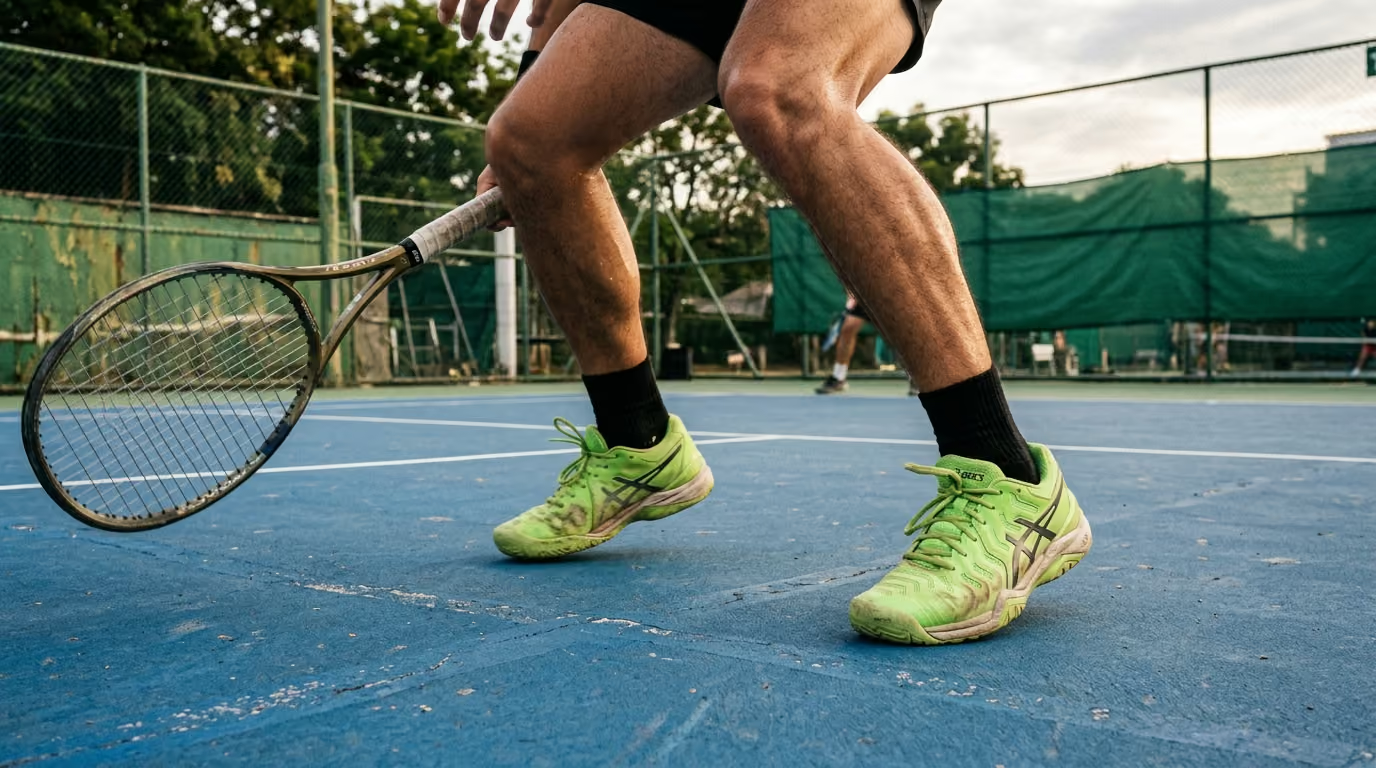
Many players assume defensive play is merely about surviving until an opponent's error, but it is actually a strategic launching pad for transitioning to offense.




Many players believe that defensive play is a desperate act of survival where you must simply hang on until your opponents make an unforced error. In reality, the back court is not a passive refuge but a launching pad for transition. Defensive court craft means using the walls, spacing, and high-margin lobs to change the geometry of the point, buy time, and eventually reclaim the net.
Whether you are recovering from a deep drive or trying to handle an awkward deflection, your primary objective remains tactical progression. By learning to read the court, coordinate with your partner, and use the glass to your advantage, you can turn a defensive position into a strong offensive opportunity. This comprehensive guide outlines the science, strategies, and physical skills required to master play from the back of the court.
To play effectively from the back court, you must first change how you view defense. A strong back-court player is not simply trying to keep the ball in play until an error occurs. The real goal is to absorb pressure, create time, alter the opponents’ net position, and regain attacking territory.
A standard doubles court is 20 meters long and 10 meters wide, with a net 0.88 meters high at the center and 0.92 meters at the posts. In this defined space, the pair that controls the net area holds a distinct statistical advantage. Winning pairs produce 41.2 percent of their shots in offensive areas compared to just 35.3 percent for losing pairs. Most winners come from smashes and trays executed near the net. Therefore, defending is not about staying at the baseline forever.
According to performance analysis, the primary goal of the defensive pair is to transition forward. In professional matches, the defensive pair successfully reached offensive positions in 70.4 percent of analyzed cases. This transition is rarely an act of brute force. Instead, it is a calculated rebuilding of the point.
We must think of defense as a progression of positioning, shot selection, and recovery. In our experience, players who treat the back court as a launching area experience immediate tactical improvement. By shifting your goal from hitting winners to altering the opponents’ net position, you reduce unforced errors and control the pace. This grounded approach is central to the Evercourts philosophy of sustainable, intelligent play.
The back-court zone is often treated as a single strip along the rear glass. However, teaching and executing proper court craft requires breaking this space down into functional sub-zones. A baseline area is visually located approximately four meters from the net. We can divide this defensive half into four distinct sub-zones to improve your spatial awareness.
This is the area between the baseline and the net. It is often called no-man's land because it is tactically unstable. Here, players are moving forward or backward, making it difficult to establish a balanced stance. In this zone, you are too far forward to defend comfortably off the glass, but too far back to volley effectively. Your main goal here is to pass through as quickly as possible, either recovering to the back or advancing to the net.
This is the area near the back glass. In this zone, players have the opportunity to let the ball rebound off the wall. You must judge whether to take the ball early or let it hit the back glass. This decision dictates your contact quality and your recovery time. Having the patience to let the ball pass you is the foundation of good defensive play.
The corner is where the side wall and back glass meet. It is a highly complex zone because balls arrive with varying speeds, spins, and angles. You must quickly read whether the ball will bounce off the back glass, the side wall, or both. Proper footwork here is essential to avoid being pinned against the glass. Mastering the corners requires early racket preparation and lateral agility.
While many defensive shots are directed toward the corners, the middle remains highly vulnerable. Research indicates that baseline players tend to hit closer to the corners, leaving more space in the center. This leaves a defensive gap that your opponents will look to exploit. Maintaining an optimal position relative to your partner is the only way to cover this corridor.
The walls are the defining feature of enclosed court sports. To play effectively from the back, you must understand how different surfaces behave. A ball remains in play if it bounces once on the court and then contacts the back glass or cage.
The materials on the court behave differently. Glass produces a highly predictable rebound because of its smooth, uniform surface. The wire mesh cage produces irregular deflections that are difficult to anticipate. While a ball contacting the cage after a bounce remains live during a rally, a served ball that hits the cage after bouncing is a fault. In general, you should seek out the glass and avoid the cage when retrieving deep balls.
To simplify your decisions, use a strict wall hierarchy. The goal is always to find the most predictable contact.
Letting the ball hit the back glass often gives you more time than striking it on the rise. More than 80 percent of back-wall strokes in professional play use just one wall. This statistics-backed approach is highly covered in our court performance resources.
Before letting the ball pass you, run through these four questions:
If the rebound promises a balanced contact, let it hit the glass. If the ball will die close to the wall, take it early.
The lob is not a desperate defensive heave. It is a highly effective tool for controlling court position and reclaiming the net. In a study of professional matches, the lob accounted for 85.4 percent of baseline actions. It allowed the defensive pair to reach offensive positions in over 70 percent of cases.
A good lob must have a specific purpose. Consider these four distinct objectives to keep your opponents off balance:
Professional players do not wait for an emergency to lob. They commonly use the lob between the second and sixth stroke of a point. This suggests the lob is a tool for early point construction.
In men's professional play, the lob represents approximately 50 percent of all back-court shots. This frequency highlights its status as a cornerstone of smart padel play. Using the lob systematically allows you to dictate the physical demands of the match.
Back-court play is a collaborative effort. You and your partner must move as a single unit to protect the court. This is a primary focus of mobility and movement training.
The defensive triangle describes the relationship between the ball, your partner, and yourself. When the ball moves toward the left corner, the left player moves to defend it. The right player must shift toward the center to protect the recovery corridor.
If you stand too far apart, your opponents will easily find the gap. If you stand too close, the outer walls are exposed. The partner must always move in relation to the ball, but the pair's spacing is governed by the most dangerous open space.
Your recovery positioning depends on the shot you just played:
Do not advance automatically after every lob. If your lob is short, your opponents will hit an aggressive overhead. In that scenario, you must remain deep and prepare to defend.
The ultimate goal of baseline defense is to reclaim the net. You must recognize the precise triggers that permit you to move forward. Advancing too early or too late will destroy your court position.
You have permission to advance when:
When these conditions are met, move forward with determination. Establish your new net position quickly, stopping just before your opponent strikes the ball.
You must delay your advance when:
Transitioning is a shared decision. If one partner rushes forward while the other is stuck deep, the team is easily disconnected. This split leaves wide open spaces that are impossible to defend.
While back-court defense is a universal concept, its execution varies greatly between tennis, pickleball, and padel. Understanding these differences is crucial for multi-sport athletes. Each game demands a distinct physical and tactical approach to the baseline.
In tennis, the court is large and lacks physical boundaries. Defending from the back court requires deep, heavy groundstrokes with heavy topspin to push opponents away from the baseline. You rely on lateral speed, sliding, and open-stance hitting to cover wide angles. The lob is typically an emergency shot rather than a primary method of taking the net. Physical endurance and court coverage are the primary demands here.
In pickleball, the back court is a temporary holding zone. Because of the non-volley zone, players cannot easily win points from the baseline. Defensive play involves hitting deep return drives or third-shot drops to allow transition. The lob is rarely used because the small court size makes it easy to punish. Instead, soft drop shots are used to crawl forward to the kitchen line.
Padel is unique because the walls allow you to play the ball after it passes you. This changes the entire defensive dynamic. You do not have to strike the ball on the run; you can let it pass, turn with it, and use the glass to generate power. The lob is your primary weapon for transition, accounting for a massive share of baseline shots. The focus is on patience, wall reads, and physical recovery.
Even experienced players fall into predictable defensive traps. Recognizing these mistakes is the first step to correcting them and protecting your athletic longevity.
The most common beginner error is rushing to strike the ball before it hits the glass. While it is physically possible to reach the ball, doing so often results in a weak, off-balance reply. Letting the ball hit the back glass buys you time.
It allows you to set your feet and play a controlled, high-margin shot. Only take the ball early if the rebound is guaranteed to be extremely low or awkward. Trusting the glass is the first major milestone of a skilled court player.
Many players try to hit down-the-line passing shots when they are under pressure. However, research shows that cross-court shots are far safer and more effective. Winning pairs play 65.3 percent of their shots cross-court.
Cross-court strokes have an 8 percent higher chance of winning and a much lower error risk than down-the-line shots. The line is a tempting target, but it changes the geometry and exposes you to a heavy counterattack. Only go down the line when you have perfect balance and a clear opening.
Defending the back court is physically exhausting. It involves constant lateral movement, sudden deceleration, and quick changes of direction. This constant physical stress can lead to severe muscle fatigue and joint stiffness if not managed properly.
I remember finishing a tough two hour padel match on a cold Tuesday night and waking up the next morning feeling like my lower back was locked in concrete. For a long time, I just accepted this as the price of playing hard in my forties. But once I started spending just ten minutes on targeted hip mobility before heading to the club, the stiffness almost completely vanished. It taught me that we do not have to accept pain as a default state of physical decline as we age.
Research shows that players cover approximately 3,000 meters per game, with about half of that distance occurring while the ball is in play. Advanced players move more efficiently but still cover significant ground, averaging 11.77 meters per point. This physical load requires dedicated attention to recovery science and tissue health.
Maintaining player health means focusing on eccentric leg strength, hip mobility, and core stability. These physical attributes allow you to handle the constant low-stance work required in the back court.
While soreness is a normal part of training, certain symptoms require professional attention. You should consult a qualified healthcare provider if you experience:
A physiotherapist or sports medicine physician can help diagnose underlying issues. They can design a targeted recovery plan to support your athletic longevity, keeping you on the court for years to come. Do not ignore persistent warning signs in the pursuit of playing through pain.
To build these skills, you must practice them in controlled environments. Use these six practical scenarios to train your defensive court craft.
Patience is not the absence of action; it is the calculated delay of risk. In match-play studies, winning pairs hit 86.9 percent of their shots as continuity shots. This means that the vast majority of your play from the back court should be focused on maintaining the rally, rather than going for low-percentage winners.
By focusing on high-margin, deep lobs and stable cross-court groundstrokes, you force your opponents to work harder. You gradually wear down their positioning, waiting for the precise moment to strike. When you commit to patient construction, defensive play becomes a dominant tactical weapon rather than a desperate struggle.
With the right tactical approach and consistent practice, you can transform your defensive game into a highly organized, point-winning strategy.
Follow Evercourts for practical insights on tennis, pickleball and padel performance, movement, recovery and healthy ageing. Stay connected for new articles, research-led guidance and ideas to help you play well and keep playing for years.


Read practical guidance for better movement, smarter preparation and a game that keeps working for you.
explore the Blog