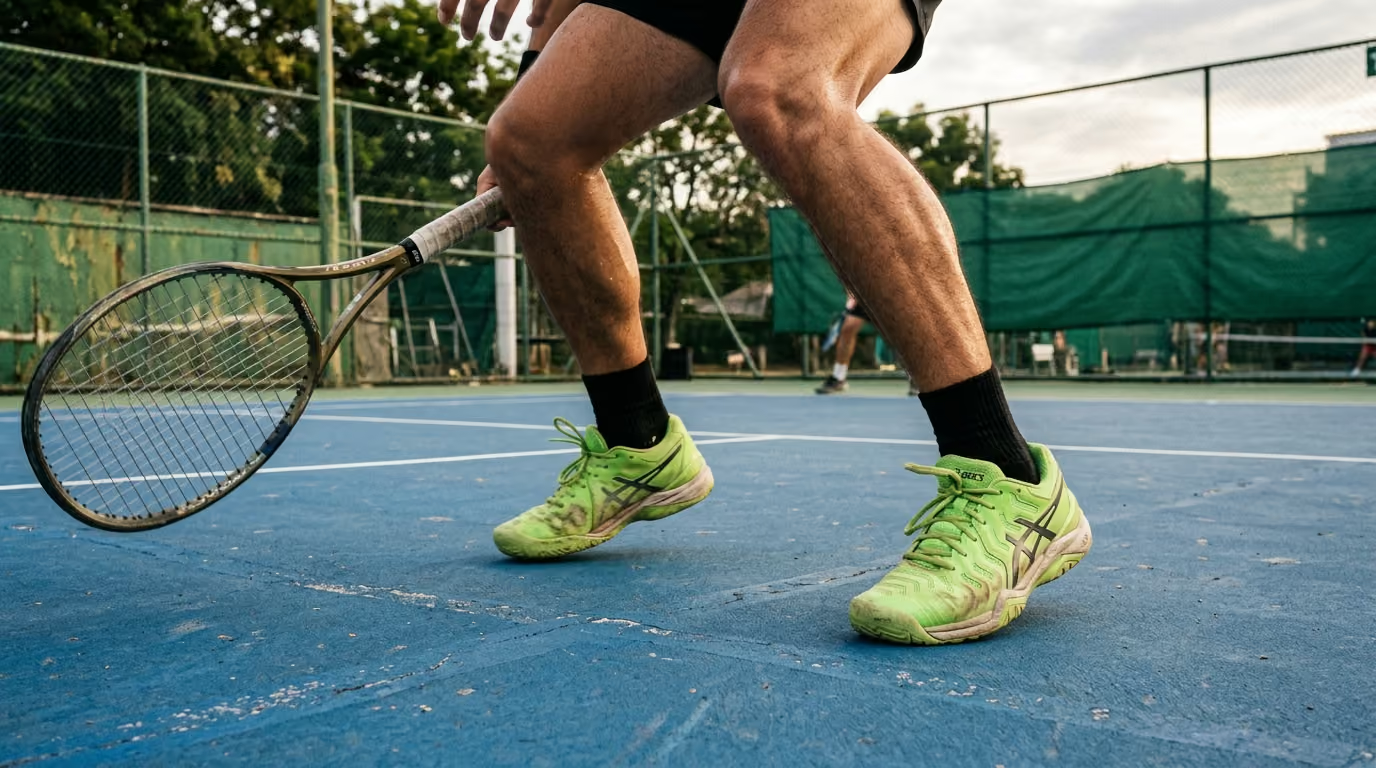
Fatigue in racquet sports is a complex physical and mental state that alters movement, thought, and ball striking, often leading to a measurable drop in performance.




Playing well under fatigue requires a deliberate shift from trying to maintain fresh mechanics to executing a high-margin, simplified strategy. Instead of abandoning technical standards, players must protect early preparation, stable contact spacing, and clean recovery movement. By selecting larger targets, slowing the tempo between points, and accepting a more compact swing, you can remain highly competitive even when your physical reserves are low.
Fatigue on the court is not a simple matter of running out of breath. It is a complex physical and mental state that alters how you move, think, and strike the ball. Many players believe that being tired means they can no longer hit the ball hard. In reality, your ability to generate force often remains intact long after your precision, balance, and decision-making have started to decay. This guide explains how to recognize these changes early and adapt your game to maintain your performance.
Physiological fatigue is far more complex than a simple loss of energy. It is a broad decline in physical capacity caused by the intense demands of court play. Research on the mechanisms of fatigue and tennis performance published in PubMed highlights how these combined factors degrade basic motor skills. This decline involves a reduction in central nervous system activation, altered sensory feedback from your muscles, and changes in spinal loop behavior. The result is not just a tired feeling, but a measurable drop in how efficiently your brain communicates with your limbs.
Neuromuscular fatigue specifically impairs your ability to coordinate complex movements. When you are fresh, your legs, hips, trunk, and shoulders work together in a smooth kinetic chain. Under fatigue, this chain begins to break down. Your legs may fail to drive with the same force, which forces your shoulder and arm to compensate. This localized compensation leads to late hits, mistimed contact, and an increased risk of muscle strains.
At the same time, mental fatigue quietly compromises your decision-making and reaction times. A systematic review of mental fatigue in racket sports found that sustained attention demands lead to slower response times. In fast-paced court environments, a delay of just 50 milliseconds can prevent you from hitting a clean shot. When mental energy declines, you become slower to recognize your opponent's intentions. This delayed processing often leads to early guessing, which leaves you vulnerable to simple changes of direction.
We must also distinguish between physical exhaustion and mental exhaustion. In our experience, players can have normal heart rates and stable hydration levels but still suffer from severe decision-making fatigue. This is especially true after a long day of work followed by a competitive night match. Research shows that mental fatigue increases the perceived rate of exertion. This means the game feels much harder, even if your muscles are technically capable of performing.
Fatigue does not affect performance in a steady, predictable line. Instead, it behaves like a cascading series of events that eventually triggers a breakdown in shot quality. The cascade typically starts with subtle delays in footwork efficiency. Because the first step is slightly slower, you arrive at the ball with less preparation time. This late arrival forces a shorter, more hurried swing that lacks natural balance.
This cascade is supported by a systematic review and meta-analysis of fatigue in tennis players, which analysed 18 trials. The researchers found that fatigue had a large negative effect on physiological and fitness markers, but a slightly smaller effect on immediate stroke performance. This indicates that highly skilled players can often mask internal strain for a short period. However, once a specific fatigue threshold is crossed, accuracy and consistency drop off rapidly.
To manage this cascade, we can organize our physical state into three distinct zones. The Green Zone represents manageable fatigue, where breathing is elevated but controlled, and mechanics remain precise. In this zone, you can still execute complex, high-risk tactics with confidence. You should enjoy this phase but remain aware that your physical reserves are steadily draining.
The Amber Zone is the transition state, where recovery between points takes longer, and late contact happens occasionally. This is where you must adjust your target sizes and simplify your shot selection. The Red Zone represents a complete breakdown of execution and safety. In this zone, players experience repeated stumbles, severe late contact, and an inability to recover after routine movements. When you enter the Red Zone, the focus must shift from tactical adaptation to safety.
One of the most surprising findings in sports science is the dissociation between power and precision under fatigue. A systematic review of elite tennis studies reported that serve velocity changed very little under fatigue, showing declines of less than three percent. However, serve accuracy in those same high-intensity protocols fell by as much as 41 percent. Groundstroke accuracy suffered even more, dropping by up to 69 percent in some trials.
This pattern is not unique to tennis. In a controlled experiment on badminton smash performance, researchers found that smash speed decreased by only 3.3 percent under muscle fatigue. Meanwhile, precision fell by 10.3 percent. These statistics show that your ability to swing hard is remarkably resilient. Your ability to guide the ball or shuttle to a precise target, however, is highly sensitive to fatigue.
This power-precision dissociation explains why trying to hit your way out of trouble rarely works. When a tired player gets frustrated, the natural instinct is to swing harder to end points quickly. Because the motor control system is compromised, this extra force is applied without the necessary timing. The result is a dramatic increase in unforced errors. Recognizing that precision declines first allows you to make smarter tactical adjustments before the scoreboard gets away from you.
Understanding this dissociation helps you focus on what really matters during a tough match. When your legs feel heavy, do not worry about losing ball speed. Your natural swing path will still generate sufficient pace. Instead, focus entirely on your target size and net clearance. Your primary goal is to manage the decline in precision by using smarter, more conservative court targets.
When you are fatigued, some technical compromises are inevitable, but others must be defended at all costs. The first non-negotiable habit is maintaining a stable contact distance from the ball. When players get tired, they often stop moving their feet and allow the ball to get too close to the body. This jams the swing, limits shoulder rotation, and forces the wrist to make late adjustments. Keep your distance by taking small adjustment steps as the ball approaches.
The second essential habit is early, compact preparation. You do not need a massive, looping backswing to create pace when you are tired. In fact, a large backswing requires perfect timing, which is the first thing to fail under fatigue. Instead, focus on turning your shoulders early and setting your racket back in a shorter, simpler motion. This early preparation gives you more time to read the ball and ensures a cleaner contact point.
Balance through the hitting zone is the third technical pillar that cannot be sacrificed. A tired player often falls backward or sideways while executing a stroke, which destroys control. Focus on keeping your head quiet and your core stable during the swing. Even if you arrive late, a balanced swing with a short follow-through is far better than a wild, off-balance swipe. This stability ensures that the force you do generate is directed toward the target.
Finally, you must protect your pre-point routines, especially before serving and returning. When physical fatigue sets in, the temptation is to rush the next point to get it over with. This rushing is often a sign of cognitive fatigue, which directly hurts second-serve accuracy. Force yourself to take three deep breaths, bounce the ball a consistent number of times, and visualize your target. This small investment of time resets your focus and prevents a rapid cascade of unforced errors.
Smart point construction under fatigue is about reducing the physical and cognitive cost of every rally. You can achieve this by simplifying your tactical decisions and relying on highly repeatable patterns. Instead of trying to read every situation as a unique puzzle, use predetermined plays that require minimal thinking. For example, focus on hitting your returns deep and cross-court, or direct your first groundstroke back to the middle of the court.
To make this practical, we can break point construction into four distinct phases. Phase one is the start, where you prioritize a high-margin serve or return to establish neutral positioning. Phase two is the stabilization phase, where you use height and depth to keep the opponent back while you recover your court position. In phase three, you look to create a predictable weakness by hitting repeatedly to the opponent's weaker side. Phase four is the selective finish, where you only attack when you are perfectly balanced and have a clear, short ball.
An excellent tactical adjustment is the "one extra ball" strategy. When tired, our brain wants to end the point immediately, which often leads to low-percentage, aggressive shots from deep in the court. The "one extra ball" approach requires you to hit one more high-quality, deep, neutral shot instead of going for a risky winner. This forces your opponent to make the difficult decisions and run the extra distance. In many cases, this patience leads to an unforced error from your opponent, saving you from a grueling defensive run.
We also need to consider our pacing strategy throughout the entire match. Research on pacing in five-set tennis matches reveals that winners are better at maintaining or increasing their serve speed in the final set compared to losers. This does not mean you should sprint from the first point, but rather that you must conserve energy during low-leverage situations. Save your maximal physical efforts for critical moments, such as break points or the first two shots of your service games. Use the permitted time between points to lower your heart rate and reset your mind.
While fatigue affects all racquet sports, the specific physical demands differ significantly between tennis, pickleball, and padel. Understanding these nuances helps you adapt your strategy to the specific court environment. For a deeper look at general game dynamics, you can read our court performance resources. Each sport has unique movement patterns, court dimensions, and recovery profiles that dictate how you should manage your energy.
In tennis, the court is large, and the physical demands are dominated by high-speed lateral movement and explosive braking. Fatigue in tennis quickly shows up as an inability to cover the wide angles of the court, leaving you vulnerable to deep, penetrating shots. To adapt, tennis players should focus on increasing the height and spin of their groundstrokes. Hitting with more net clearance gives you valuable recovery time to get back to the baseline center. You should also favor deep cross-court shots, which reduce the angles your opponent can create.
Pickleball is played on a much smaller court, but it requires incredible reaction speed and rapid, low-amplitude movements. The primary fatigue challenge in pickleball is maintaining the low athletic stance required for effective dinking at the non-volley zone line. When pickleball players get tired, they tend to stand upright, which causes them to hit down on the ball or make late contact. To play well under fatigue in pickleball, prioritize a soft, high-margin third-shot drop to get yourself to the net safely. Once at the line, focus on quiet hand movements and early paddle preparation rather than big, aggressive swings.
Padel combines elements of both sports on an enclosed court, requiring constant rotation and play off the walls. I remember finishing a tough two hour padel match on a cold Tuesday night and waking up the next morning feeling like my lower back was locked in concrete. For a long time, I just accepted this as the price of playing hard in my forties. But once I started spending just ten minutes on targeted hip mobility before heading to the club, the stiffness almost completely vanished. It taught me that we do not have to accept pain as a default state of aging. For targeted routines to address this, you can check out our mobility and movement exercises. In padel, fatigue often compromises your positioning relative to the glass, making you reach backward instead of moving with the ball. To survive a long match, use the lob frequently to push your opponents back, which buys you time to reclaim the net.
The first major pitfall is confusing physical effort with movement quality. When players feel themselves slowing down, they often try to move with frantic, chaotic energy. They might bounce excessively or take too many small, unnecessary steps before the ball arrives. This wasteful movement consumes precious energy without actually improving the contact position. A more effective approach is to focus on a well-timed split-step and efficient, direct lines to the ball.
Another frequent error is assuming that playing safer means hitting the ball soft and short. Hitting a soft, short ball simply invites your opponent to step forward and attack, putting you under even greater physical pressure. A truly safe shot under fatigue is one that has high net clearance and lands deep in the opponent's court. This depth keeps the opponent behind their baseline and prevents them from dictating the point. You should aim to use spin and height to control depth, rather than reducing your swing speed to a passive float.
Many players also make the mistake of standing still immediately after they strike the ball. They watch their shot to see where it lands, waiting to see if it was successful before they begin to move. This delay forces them to make a desperate, high-energy sprint when the opponent returns the ball. Force yourself to take a recovery step the instant the ball leaves your strings. This immediate recovery, even if it is slow, keeps your momentum moving and makes the next step much easier.
We must also address the misconception that elite technique makes you immune to fatigue-related performance drops. While skilled players have more efficient movement, research shows they still experience a 40 percent drop in accuracy under high-intensity fatigue. Believing you can simply technique your way through exhaustion without changing your tactical risk profile is a recipe for frustration. Accept that your precision is compromised, and actively make your targets larger as the match goes on.
Managing fatigue on the court is not just about winning the match, it is also about protecting your long-term athletic longevity. For more information on maintaining your body over time, visit our healthy aging and athletic longevity guides. When you play through deep fatigue, the micro-damage to your muscle fibers and connective tissues is significantly higher. This increased stress requires a more deliberate recovery plan to prevent chronic stiffness and overuse injuries.
After a grueling session, your first priority should be restoring fluid and electrolyte balance. A standard recommendation from sports nutrition research is to consume between 1.0 and 1.5 liters of sodium-containing fluid for every kilogram of body mass lost during play. This is especially important in hot or humid environments where sweat rates are high. Plain water is often insufficient for rapid rehydration, as the body needs sodium to retain the fluid and restore cellular balance.
If you have another match or practice session scheduled within eight hours, nutritional timing becomes critical. Research suggests consuming 1.0 to 1.2 grams of carbohydrates per kilogram of body weight immediately after playing, and repeating this hourly for up to four hours. This rapid intake helps replenish depleted glycogen stores in your muscles and liver. Skipping this recovery window leaves your neuromuscular system under-prepared for the next session, increasing your risk of injury.
Finally, we must recognize the role of cognitive recovery. Mental fatigue from an intense match can linger long after your heart rate has returned to normal. Give your brain a break by avoiding highly stimulating activities immediately after a tough match. Engaging in gentle, non-cognitive activities like a slow walk or structured breathing can help transition your nervous system from a stressed state to a restorative state. To explore more about maintaining your general health as a court athlete, check out our player health articles.
While feeling tired after a long match is completely normal, there are times when fatigue crosses the line from physical strain into a medical concern. It is vital to recognize these warning signs so you can protect your health and seek professional advice. If you experience sudden, sharp pain in your joints or muscles during play, this is not ordinary fatigue. You should stop playing immediately and consult a qualified healthcare provider.
You should also pay close attention to any system-wide symptoms that do not resolve with rest and hydration. These include persistent dizziness, lightheadedness, nausea, or a racing heart rate that stays elevated long after you have stopped running. Extreme hot or cold flashes, chills, or a sudden loss of physical coordination are also major red flags. These symptoms can indicate heat illness, severe dehydration, or cardiovascular strain that requires immediate medical evaluation.
Additionally, if you find that you are constantly exhausted even after several days of rest, it may be a sign of overtraining or an underlying metabolic issue. A qualified medical professional can run blood work to check for nutrient deficiencies, hormonal imbalances, or other chronic conditions. Do not ignore persistent, deep fatigue that leaves you feeling drained day after day. Taking a proactive approach to your health ensures you can continue playing the sports you love for many years to come.
Building resilience to on-court fatigue requires a smart, structured training plan that separates technical learning from fatigue exposure. A common mistake is trying to learn complex new skills while you are completely exhausted. The 2025 tennis meta-analysis suggests that the best time to develop new mechanics is when you are fresh and mentally alert. This ensures your brain can form clean, efficient movement patterns without the interference of fatigue.
To build fatigue transfer, you should use a two-stage training model. In stage one, focus on technical robustness while fresh, perfecting your swing path, footwork, and balance. Once these patterns are deeply ingrained, transition to stage two, where you intentionally introduce controlled fatigue. During this stage, practice executing your shots under physical pressure, requiring yourself to maintain targets even when your breathing is heavy. This teaches your nervous system how to preserve biomechanical efficiency during prolonged play.
You can also use specific constraints in your practice matches to train your mind and body. For example, play a practice set where you are only allowed to attack when you are perfectly balanced inside the baseline. If you hit an off-balance shot, you must play a high, deep, neutral ball to a safe target. Another excellent drill is the "one extra ball" game, where players must execute at least three deep groundstrokes before they are allowed to hit a drop shot or volley. These games build the mental discipline required to make smart, low-risk decisions when tired.
Finally, make sure you are monitoring more than just your heart rate during training. Since cognitive fatigue can degrade your performance without changing your heart rate, look at other indicators of strain. Track your unforced error rate, your double faults, and how quickly you make decisions on the court. If you notice your reaction times slowing down or your target accuracy dropping, it is a sign that your brain is fatigued. Use these insights to adjust your training volume and ensure you are recovering as hard as you are playing.
If you frequently find yourself struggling to depth-control the ball late in matches, adjusting your string tension can help. Lowering your tension by two to three pounds can provide easier depth with less physical effort, which is helpful when your legs are tired. However, this adjustment should not replace proper movement mechanics and tactical target selection.
Yes, mental fatigue can occur independently of physical tiredness. Long hours of focused work, high stress, or lack of sleep can exhaust your attentional control. This mental drain slows your reaction time and impairs your shot selection, even if your muscles are physically capable of explosive movement.
When facing a powerful server while tired, shorten your return preparation and take a slightly deeper starting position. This extra distance gives you more time to read the ball, while a compact swing reduces the chance of late contact. Focus entirely on getting the return deep to a large central target rather than trying to hit aggressive winners.
Active recovery, such as a light walk, swimming, or dynamic mobility work, is often superior to complete inactivity. Gentle movement promotes blood flow, which helps deliver nutrients to damaged muscle tissues and clears metabolic waste. However, if you are experiencing joint pain or extreme systemic exhaustion, a full rest day is highly recommended.
Follow Evercourts for practical insights on tennis, pickleball and padel performance, movement, recovery and healthy ageing. Stay connected for new articles, research-led guidance and ideas to help you play well and keep playing for years.


Read practical guidance for better movement, smarter preparation and a game that keeps working for you.
explore the Blog