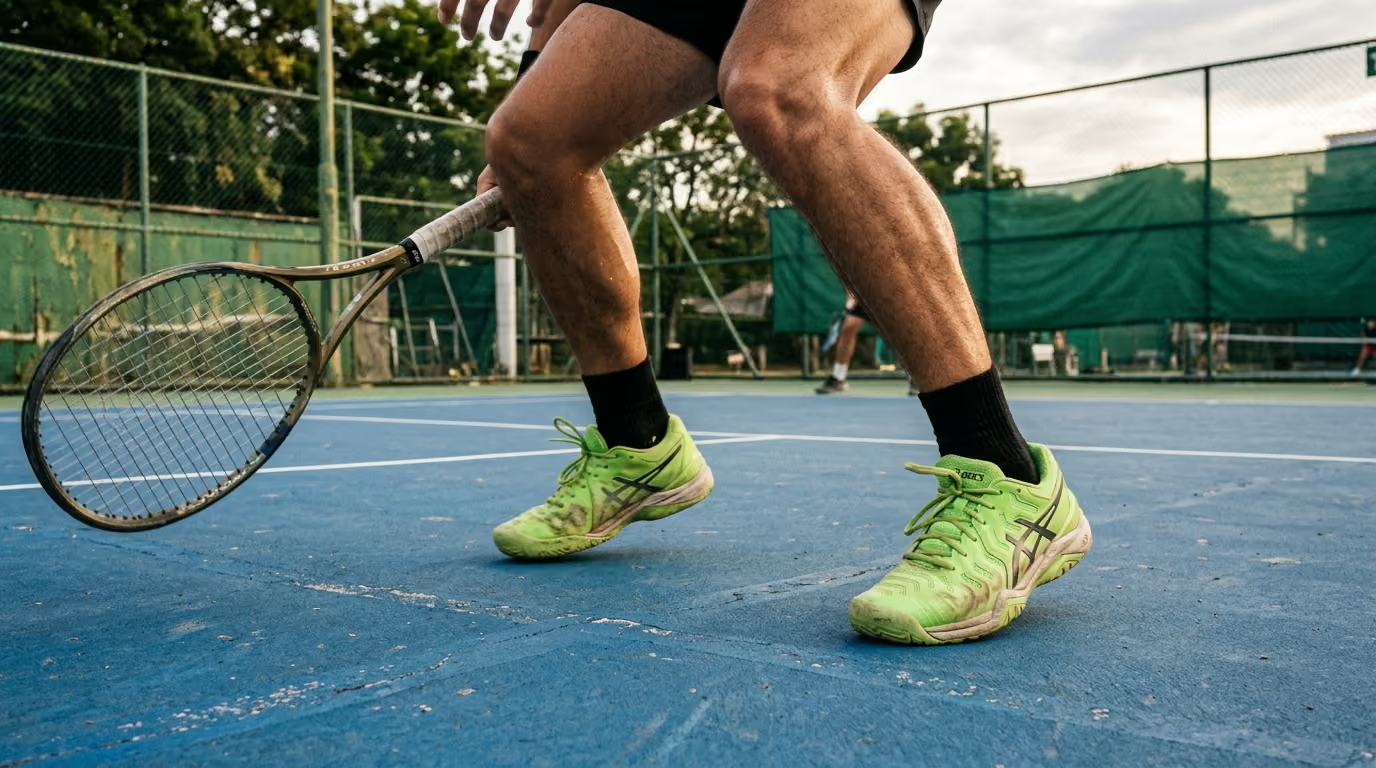
While many assume more match play is always better, balancing practice and competition is crucial for long-term athletic development and enjoyment in racquet sports.




Many racquet sports players find themselves stuck at a frustrating performance plateau. They play multiple competitive matches every week but their technical errors never seem to improve. Other players spend hours performing predictable drills but struggle to win points when the score is close.
To maximize athletic longevity and improve your skills, you must balance your court time based on your immediate developmental goals rather than habit. Practice is the primary tool for isolating technical mechanics, changing movement habits, and increasing repetitions safely. Match play is the ultimate test of whether those habits survive real decision-making, pressure, and physical fatigue.
Understanding how to balance these two environments is essential for healthy aging and long-term enjoyment of court sports. Both practice and competition impose unique physical and mental demands on your body. By structuring your court schedule deliberately, you can continue playing tennis, pickleball, or padel for decades.
To build an effective court schedule, we must first look at what scientific research says about skill acquisition. For many years, sports scientists believed that sheer hours of practice were the only predictor of athletic success. Newer research paints a more complex picture of how athletes develop.
A major meta-analysis on sports performance analyzed the relationship between structured practice and athletic success. The researchers found that deliberate practice explained approximately 18% of the variance in sports performance. Among elite performers, the contribution of deliberate practice dropped to just 1%.
This finding does not mean that practicing is a waste of time. Instead, it shows that athletic success depends on a wide range of factors. These factors include physical conditioning, perceptual skills, decision-making, emotional regulation, and how well you recover. Relying solely on repetitive drills will only develop a small portion of your overall game.
To bridge the gap between practice and match play, sports scientists use a concept called Representative Learning Design. This theory suggests that practice tasks should preserve the key information and movement demands of competition. If your practice sessions are too simplified, the skills you learn will not transfer to your matches.
Research on junior tennis players highlights this concept clearly. Researchers compared players who practiced serving in highly realistic situations against those who practiced in sterile environments. During real match play, the players who used realistic practice prioritized smart tactical ball placement. The players from the low-relevance practice groups prioritized raw speed over placement, which led to poorer match outcomes.
Competition changes how your brain and body function. An analysis of 8,280 professional tennis matches investigated how pressure affects performance. The researchers discovered that male players consistently experienced a drop in performance during high-pressure moments. Specifically, a standard increase in pressure raised the probability of a player losing their service game by 4.9 percentage points.
This drop occurs because pressure changes your focus of attention. When you feel anxious, you often try to consciously control movements that should be automatic. This conscious control disrupts your natural timing and mechanics. Therefore, you must learn to manage pressure through representative training rather than expecting your practice strokes to work automatically in a match.
Drills are highly valuable, but they cannot replicate the chaotic nature of a real match. Match play serves as a unique training stimulus that challenges your brain and body in ways that a practice basket cannot.
In a structured drill, a partner or coach often feeds the ball to a predictable location. Your brain does not have to search for clues about where the ball is going. In a real match, you must constantly read your opponent.
You must observe their body positioning, their racket face, and their preparation. Your brain uses this information to anticipate the ball before it is struck. Match play preserves this natural connection between seeing and moving. Without regular match play, your anticipation skills will quickly decline.
A drill tells you exactly what shot to hit and where to hit it. A match forces you to make decisions with real consequences in milliseconds. You must assess the wind, the court surface, the score, and your own physical fatigue.
Match play teaches you how to select the right option when several choices are available. It forces you to manage risk and adapt when your opponent counters your initial plan. If you only practice structured drills, you may develop beautiful strokes but struggle with tactical awareness.
A real match carries social and psychological consequences. Your performance is evaluated by your peers, and your position on a ladder or ranking list may change. This environment triggers a physiological stress response.
Competing regularly teaches you how to manage your arousal levels under stress. You learn to handle bad line calls, unexpected mistakes, and shifting momentum. These emotional coping strategies cannot be replicated during a casual hitting session.
A match is not a continuous sequence of play. It is a series of short, intense actions separated by brief periods of rest. What you do during those rest periods dictates how you perform on the next point.
Match play gives you the opportunity to refine your between-point routines. You learn how to use deep breathing to lower your heart rate. You practice shifting your focus back to controllable targets rather than dwelling on past mistakes.
While match play is highly valuable, it is an inefficient tool for fixing fundamental errors. If you only play matches, your development will eventually stall. Dedicated practice sessions allow you to isolate and improve specific areas of your game.
In a typical competitive match, you may only hit a handful of low-backhand volleys. If that stroke is a weakness, you will not get enough opportunities to correct it during play. Your opponents will quickly learn to exploit this gap in your game.
A targeted practice session allows you to hit fifty or sixty low-backhand volleys in a short period. This high volume of repetition is necessary to build new muscle memory. It allows you to refine your mechanics before testing them under pressure.
When you make an error in a match, you cannot stop the game to analyze what went wrong. You must immediately move on to the next point. This pressure makes it very difficult to correct mechanical faults.
In a practice environment, a coach or training partner can manipulate single variables. They can slow down the ball, feed it to a predictable zone, or offer immediate feedback. This controlled setting allows you to identify whether your error is technical, physical, or perceptual.
To improve, you must occasionally try new shots and strategies that feel uncomfortable. In a competitive match, the fear of losing often prevents you from experimenting. You will naturally revert to your most comfortable habits, even if those habits limit your potential.
Practice provides a safe, low-consequence environment to fail. You can try a new slice backhand, a spin serve, or an aggressive poaching pattern without worrying about the score. This freedom is essential for expanding your tactical toolkit.
Competitive matches feature unpredictable movements, sudden stops, and rapid changes of direction. This chaotic movement can place high stress on your joints, tendons, and muscles. If your body is not physically prepared for these forces, you face a higher risk of injury.
Dedicated training allows you to build physical tolerance progressively. You can use targeted strength and conditioning to prepare your tissues for the specific demands of court play. For comprehensive training resources, you can explore our curated collection of strength and conditioning resources designed for court athletes.
You should not choose between practice and match play based on what you feel like doing that day. Instead, you should use a logical framework to guide your training schedule. Ask yourself what adaptation your body and mind need next.
Look closely at your recent performances and identify what is holding you back.
Look at your current practice drills and assess how close they are to real competition. If your practice consists solely of standing in one place and hitting feeds, your transfer distance is too high. You need to bridge the gap by adding variable elements.
You can lower the transfer distance by adding a live returner, introducing simple point scoring, or starting points with a serve. This structure ensures that your practice sessions prepare you for the realities of match play.
Are you trying to install a new movement pattern, or are you trying to see if your current patterns hold up?
Use practice when you need to learn. Learning requires low pressure, high feedback, and room for error. Use match play when you need to test. Testing requires realistic pressure, no external feedback, and clear consequences.
Do not schedule competitive matches when your body is highly fatigued. Matches demand high physical and mental energy. If you compete while exhausted, you will reinforce poor movement habits and increase your risk of injury.
If you are carrying minor aches or feeling systemically tired, shift your schedule toward low-load technical practice. This adjustment keeps you on the court without overloading your joints. You can learn more about managing physical stress by reviewing our guides on injury prevention resources.
An effective weekly schedule should balance physical load, skill acquisition, and competitive testing. The ideal mix depends on whether you are preparing for a tournament or focusing on long-term development.
This template is ideal for recreational players who want to maintain their physical health while steadily improving their skills. It provides a balanced mix of training, match play, and recovery.
Use this template during the seven days leading up to a competitive event. The goal is to maximize physical freshness and tactical clarity.
While the principles of motor learning apply to all court sports, the physical and tactical demands of tennis, pickleball, and padel differ. You must adapt your training ratio to match the specific characteristics of your sport.
Tennis features a very large court, high ball speeds, and significant physical impact. A single match can last over two hours and require hundreds of explosive lateral sprints. This high physical demand means that tennis players must be cautious about over-competing.
If you play too many tennis matches without dedicated physical preparation, your tissues will break down. Tennis players should maintain a higher ratio of physical training and technical practice to match play. This balance ensures your shoulders, knees, and lower back can withstand the high forces of the sport.
Pickleball features a smaller court, lighter paddles, and a plastic ball. The physical load per point is lower than in tennis, but the reaction times are incredibly fast. Points are often decided by rapid volley exchanges at the kitchen line.
Because the physical strain is lower, pickleball players can tolerate a higher frequency of match play. However, many players fall into the trap of only playing matches. This habit leads to sloppy dinking technique and poor transition play. Pickleball players need dedicated drilling sessions to maintain precise paddle angles and soft-touch mechanics.
Padel is played in an enclosed glass cage and features constant changes of direction, wall rebounds, and overhead smashes. The physical rotational demands on your torso and hips are incredibly high.
I remember finishing a tough two hour padel match on a cold Tuesday night and waking up the next morning feeling like my lower back was locked in concrete. For a long time, I just accepted this as the price of playing hard in my forties. But once I started spending just ten minutes on targeted hip mobility before heading to the club, the stiffness almost completely vanished. It taught me that we do not have to accept pain as a default state of aging.
Because padel involves complex wall play, match play is highly necessary to learn how to read the rebounds. However, you must supplement these matches with targeted mobility and strength work. If you only play matches, the constant rotation and hard lunging will eventually overload your lower back and knees. For practical advice on integrating these healthy habits, explore our resources on competition and court lifestyle.
To get the most out of your court time, you must avoid several common scheduling errors. These mistakes often lead to performance plateaus, frustration, and avoidable injuries.
One of the most common errors is entering a competitive match to "work on" a new technical change. When the score becomes close, your brain will naturally prioritize winning over learning. You will instinctively revert to your old, comfortable stroke mechanics to avoid making errors.
If you try to force a technical change under match pressure, you will often experience frustration and movement tension. Keep your technical development in the practice environment. Only bring a new stroke into competitive play once it feels automatic during high-repetition drills.
Many recreational players judge the quality of their training plan solely by whether they won or lost their weekend match. This perspective is highly flawed. A win can occur despite poor play if your opponent has an off day. A loss can occur even when you play exceptionally well if your opponent is highly skilled.
Instead of looking only at the score, track process-oriented metrics. Did you execute your targeted tactical patterns? Did your serve mechanics remain stable under pressure? Did you maintain your between-point routine after making a mistake? These indicators provide a much more accurate picture of your development.
To maintain athletic longevity, you must view your court schedule through the lens of workload management. Every match and practice session adds to your cumulative physical stress. If your workload exceeds your body's ability to adapt, you will experience declining performance and tissue breakdown.
A simple way to manage your physical stress is to track your Session Rating of Perceived Exertion. After every session on the court, rate how physically hard the session felt on a scale of 1 to 10. Multiply this rating by the duration of the session in minutes.
For example, a 60-minute technical practice that felt like a 4 out of 10 represents a load of 240 units. A 90-minute competitive match that felt like an 8 out of 10 represents a load of 720 units. Keeping track of these numbers helps you identify when your physical load is spiking too quickly.
The scientific literature on sports injuries shows a strong link between sudden training spikes and joint or tendon pain. Your body is highly adaptable, but it needs time to adjust to increased physical demands. If you suddenly double your playing hours from one week to the next, your tissues cannot recover fast enough to prevent micro-trauma.
Aim to increase your weekly court time by no more than 10% to 15% each week. This conservative progression is especially important as we age. It allows your tendons and joints to adapt safely, helping you maintain your court lifestyle for the long term.
While structured planning can prevent many common physical issues, you must know when to seek assistance from a professional. Ignoring physical warning signs can turn a minor strain into a chronic condition that keeps you off the court for months.
You should consult a qualified physical therapist, sports physician, or healthcare provider if you experience any of the following signs:
A qualified professional can identify the underlying cause of your discomfort. They can design a customized rehabilitation program and help you adjust your court schedule to maintain your long-term athletic health.
To apply these principles to your own game this week, follow this simple checklist:
By taking control of your training schedule, you can break through your performance plateaus and protect your joints from unnecessary wear. Balancing practice and competition is the most reliable path to athletic longevity on the court.
Follow Evercourts for practical insights on tennis, pickleball and padel performance, movement, recovery and healthy ageing. Stay connected for new articles, research-led guidance and ideas to help you play well and keep playing for years.


Read practical guidance for better movement, smarter preparation and a game that keeps working for you.
explore the Blog