
A safer and more effective pre-session routine for racquet sports combines temperature elevation, low-fatigue resistance, dynamic mobility, and sport-specific movements.




A complete pre-session routine combines temperature elevation, low-fatigue resistance exercises, dynamic mobility, and sport-specific movement rehearsals. When done correctly, this preparation primes neuromuscular control and increases joint awareness before you hit a single ball. It aims to reduce the risk of acute and overuse injuries while optimizing your physical readiness for high-intensity play.
Many recreational players assume that a warm-up consists of a light jog or a few static stretches. This approach is incomplete because it ignores the high forces, rapid lateral braking, and rotational demands of court sports. True pre-session preparation is not about testing your limits or reaching exhaustion. Instead, it is a systematic method of waking up the nervous system and preparing muscle groups to absorb and produce force.
By focusing on movement quality, you can prepare your body for the physical stress of fast-paced rallies. Practicing these injury prevention principles for court athletes is a cornerstone of long-term health. This guide outlines how to construct a practical pre-play routine based on current sports science. It provides templates for regular training days, quick court sessions, and high-stakes matches.
A traditional warm-up often relies on low-intensity jogging around the court. While this raises core temperature, it does not prepare your joints for sudden multi-directional changes. Racquet play requires explosive acceleration, sudden lateral braking, and powerful rotational forces. Running in a straight line does not train the nervous system to coordinate these actions under match conditions.
To prepare the body effectively, we must distinguish between several overlapping physical objectives:
A general warm-up raises body temperature and increases circulation. This phase uses low-impact, continuous activities like light jogging, side shuffling, or skipping. The International Tennis Federation suggests starting with low-impact movements and gradually increasing velocity. The main goal is to prepare tissues for the faster movements that follow.
Dynamic mobility involves moving joints through their functional ranges of motion. Unlike static stretching, you do not hold these positions for long periods. Instead, you perform controlled movements like leg swings, lunges, and arm circles. These exercises lubricate the joint surfaces and prepare the surrounding muscles for active play.
Static stretching involves holding a muscle under tension for fifteen to thirty seconds. While it can temporarily improve flexibility, it does not prepare your muscles to absorb force. Research indicates that stretching alone does not lower injury rates. It should not serve as the primary foundation of your court preparation.
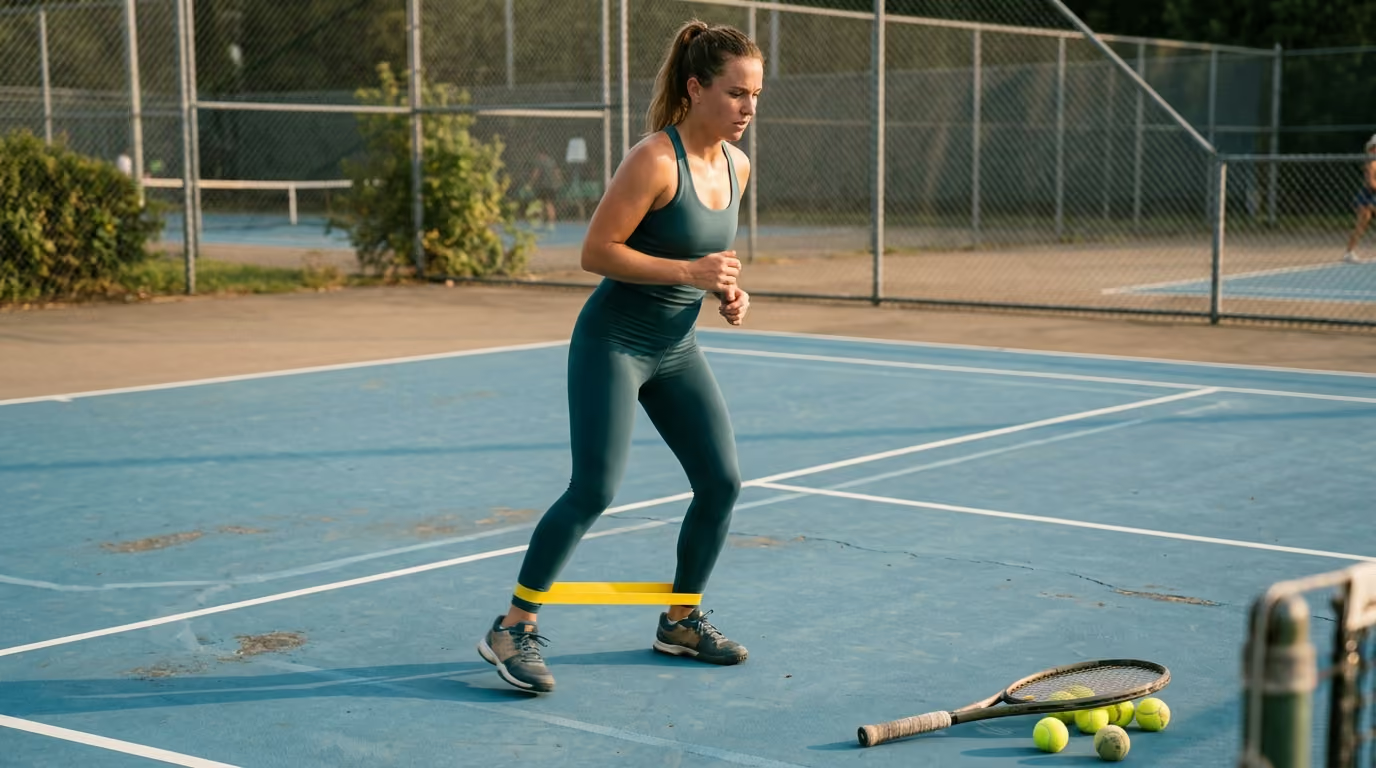
Activation uses low-load resistance exercises to improve neuromuscular communication. This process does not "turn on" sleeping muscles in a literal sense. Instead, it rehearses movement coordination and increases your physical awareness of specific areas. Examples include mini-band steps, glute bridges, and controlled scapular movements.
This phase targets balance, joint stability, and coordinated force absorption. It teaches your nervous system to stabilize your ankles, knees, and trunk during unexpected court movements. Since many acute injuries occur during rapid deceleration, this preparation is vital for court sports.
Potentiation uses short, explosive movements to prime your nervous system for power. This step is an advanced option that helps players feel sharp and responsive. However, it requires careful execution to avoid premature muscle fatigue.
The final stage of preparation transitions from general exercises to actual court play. This includes shadow swings, progressive serves, and easy cooperative rallies. The goal is to build movement complexity until you match the speed of a competitive game.
Current sports medicine research strongly supports structured neuromuscular warm-ups over simple stretching. A landmark systematic review by Lauersen and colleagues analyzed different injury-prevention methods. They discovered that stretching alone had no significant effect on injury rates. In contrast, strength training reduced sports injuries to less than one-third and nearly halved overuse injuries.
These findings suggest that pre-session strength exercises are highly valuable. While the primary strength-building occurs during dedicated gym sessions, low-intensity pre-play resistance prepares those capacities for immediate action.
Scientific studies on warm-ups also highlight the following points:
Research specifically targeting tennis players has revealed mixed results. The TennisReady program was designed as a ten-minute, tennis-specific injury-prevention routine. A large randomized trial evaluated this program in adult recreational tennis players. The trial analyzed 579 participants, split between an intervention group and a control group.
Surprisingly, the study found no meaningful difference in overall injury rates between the two groups. The authors noted that the program was unsupervised, which likely led to inconsistent technique and low adherence. A similar study on the Tennis 10+ program showed that high compliance did not reduce overall injury rates, though it did lower overuse injuries at twelve months.
These studies demonstrate that a written list of exercises is not enough. To get real benefits, players must focus on execution quality, consistent adherence, and sensible load management. Using court-specific strength and conditioning routines can help bridge the gap between theory and practical court performance.
A logical way to organize your warm-up is the RAMP framework. This method organizes your preparation into four progressive phases: Raise, Activate, Mobilize, and Potentiate. By following this sequence, you can transition smoothly from a resting state to high-intensity competitive play.
The first step is to increase your heart rate, deep muscle temperature, and joint fluid circulation. This is achieved through easy locomotion across the court. You can start with a forward jog, progress to backward pedaling, and introduce gentle side-to-side shuffles. Keep the intensity low to avoid early fatigue.
Next, target the key muscle groups that support your joints during racquet play. This phase focuses on the hips, trunk, calves, and shoulder girdle. You will use light resistance bands or bodyweight exercises to stimulate these areas. The goal is to build movement awareness without causing muscle burn.
In this phase, you move your joints through the specific ranges of motion required by your sport. Focus on dynamic movements like walking lunges, thoracic rotations, and controlled leg swings. The International Tennis Federation recommends performing eight to twelve repetitions of these exercises. Stop each movement before reaching your absolute physical limit.
The final phase prepares your nervous system for explosive speed and rapid reactions. Here, you will introduce split-step rehearsals, short accelerations, and controlled deceleration drills. This phase must match the demands of your specific racquet sport. For example, tennis players will practice lateral recovery, while badminton players focus on rapid vertical recovery.
Always move from low complexity to high complexity. Do not attempt fast, explosive movements or deep lunges until your body is warm and active.
To get the most out of your warm-up, focus on targeted exercises for key areas of the body. These movements do not require heavy gym equipment. You can easily perform them on or next to the court using bodyweight and light resistance bands.
Racquet sports require constant, rapid footwork on hard surfaces. Your ankles must absorb significant impact during every split step and sudden stop.
Stand facing a wall with one foot forward. Keep your heel flat on the ground and gently push your knee toward the wall. Hold the end range for a brief second, then return. Perform eight to ten repetitions per side to improve ankle dorsiflexion.
Stand tall with your feet hip-width apart. Slowly raise up onto your toes, hold for a moment, and lower down with control. Perform ten repetitions with straight knees, then ten with slightly bent knees to target the deeper soleus muscle. Progress to single-leg raises as your balance improves.
Walk forward in a straight line by stepping on your heels, rolling through the foot, and finishing high on your toes. This simple movement prepares the muscles surrounding your shins and ankles for rapid court movement.
The hips and knees must manage high lateral forces during deep lunges and wide court recoveries.
Take a large step forward into a split stance. Lower your hips vertically until your back knee is just above the ground. Push back up using your front leg, focusing on keeping your knee aligned with your middle toe. Perform six to eight repetitions per side.
Stand with your feet wide apart. Shift your weight to one side, bending your knee and pushing your hips back as if sitting in a chair. Keep your opposite leg straight and your torso relatively upright. Perform six to eight repetitions on each leg to prepare for wide baseline defense.
Place a light resistance band around your ankles or just above your knees. Step to the side with controlled, deliberate strides while keeping your hips level and feet pointing forward. Perform ten steps in each direction to fire the hip abductors.
Your hamstrings are highly active during sprinting, lunging, and sudden braking actions.
Step forward with one foot, keeping your heel down and toes pointing up. Hinge at your hips with a straight back, sweeping your hands downward past your foot. Step forward and repeat on the opposite leg, performing eight sweeps per side.
Lie on your back with your knees bent and feet flat on the court. Squeeze your glutes and push through your heels to raise your hips until your body forms a straight line. Lower down with control, performing eight to ten repetitions to prime hip extension.
Stand on one leg with a soft bend in your knee. Hinge forward at your hips, extending your opposite leg straight behind you to maintain balance. Keep your back flat and return to the starting position using your hamstrings and glutes. Perform five controlled repetitions on each side.
Your core serves as the link that transfers force from your lower body to your racket arm.
Start on your hands and knees. Extend your right arm forward while simultaneously pushing your left leg straight back. Keep your torso completely stable, return to the start, and alternate sides for six repetitions per side.
Lie on your side, supporting your weight on your forearm and the sides of your feet. Raise your hips to create a straight line from your head to your heels. Hold this position for fifteen to twenty seconds on each side to prepare your lateral core stabilizers.
Anchor a light resistance band to a net post at chest height. Hold the band with both hands and step away until you feel light tension. Press the band straight out in front of you, resisting the pull of the band, then return to your chest. Perform eight controlled repetitions per side.
Repeated serves, overhead hits, and high-velocity volleys put significant stress on your shoulder joint.
Hold a light resistance band with both hands, elbows bent at ninety degrees and tucked against your ribs. Keep your forearms parallel to the ground as you rotate your hands outward. Perform ten to twelve controlled repetitions to warm up the rotator cuff.
Hold a band in front of your chest with straight arms. Pull your shoulder blades together and downward, stretching the band slightly. Focus on using your mid-back muscles rather than your arms, performing ten repetitions.
Hold your racket and perform several slow, exaggerated serve motions. Focus on a smooth kinetic chain, moving from your legs, through your trunk, and finishing with a relaxed shoulder follow-through.
Repetitive impact from hitting balls can strain the tendons in your forearm and elbow.
Extend your arm forward. Use your opposite hand to gently pull your fingers downward, then upward, holding each position for a few seconds. This increases tissue tolerance in your forearm flexors and extensors.
Hold your racket near the bottom of the grip. Slowly rotate your wrist inward and outward, controlling the weight of the frame. Perform ten controlled rotations to prepare the wrist for spin generation and off-center hits.
In our experience, taking just a few minutes to complete these targeted drills makes a profound difference in court comfort. I remember finishing a tough two hour padel match on a cold Tuesday night and waking up the next morning feeling like my lower back was locked in concrete. For a long time, I just accepted this as the price of playing hard in my forties. But once I started spending just ten minutes on targeted hip mobility before heading to the club, the stiffness almost completely vanished. It taught me that we do not have to accept pain as a default state of aging.
By focusing on your specific physical needs, you can enjoy playing without constant physical limitations.
While the core principles of warm-ups remain constant, each racquet sport has its own unique physical demands. Tailoring your preparation to these differences helps you move more efficiently on court.
Tennis involves large court dimensions, which require long sprints and deep lateral slides. The hard court surface can also place high friction forces on your ankles and knees.
Your warm-up should emphasize:
Pickleball is played on a smaller court, but it requires players to stay in a low, athletic stance near the kitchen line. The action is fast, with rapid volley exchanges that demand quick hand-eye coordination.
Your warm-up should focus on:
Padel is played in an enclosed glass court, which requires constant rotation to track balls off the walls. The sport also features a high volume of overhead overheads, including the bandeja and vibora.
Your warm-up should highlight:
Using targeted padel court movement strategies can help you move smoothly around the court and avoid unnecessary joint strain.
Your pre-play routine should adapt to the amount of preparation time you have available. Use these four practical templates to guide your pre-session movement.
Use this fast routine when you are running late for court time. Do not treat this short sequence as a replacement for a full warm-up, but use it to safely prepare your body for play.
Note: Play at about seventy percent intensity for the first ten minutes of your match to allow your body to fully adapt.
This is our standard recommendation for regular club play and competitive practice sessions.
Use this comprehensive warm-up before important tournament matches when you have ample preparation time.
Warning: Avoid introducing any new band exercises or unfamiliar movements on competition day.
Use this routine when returning to the court after injury, illness, travel, or a long layout.
Even well-meaning court athletes can make errors during their warm-up that limit its effectiveness. Avoid these common pitfalls to keep your joints healthy and your movement sharp.
Holding deep stretches before playing can temporarily lower your muscle power and reaction speed. While static stretching has its place in long-term flexibility work, it does not prepare your body for rapid court movements. Focus on dynamic mobility and muscle activation instead.
A warm-up should prepare your body, not leave you tired. If your shoulders are burning or your legs are trembling before you start playing, you have overdone it. Keep your repetitions low and your focus on smooth, effortless coordination.
A routine designed for runners or football players may not address the unique demands of racquet play. Your warm-up must include rotational trunk movements, lateral footwork, and upper-body preparation. Use sport-specific drills that match your on-court movements.
Trying a new band exercise or a complex coordination drill right before a match can disrupt your focus and cause muscle soreness. Stick to familiar movements that you have practiced during regular training.
Performing your warm-up exercises with sloppy technique defeats their purpose. If your knees collapse during lateral lunges or your back arches during glute bridges, you are reinforcing poor movement patterns. Focus on alignment, control, and precision with every repetition.
A structured warm-up does more than protect your joints during play. It also has a positive effect on how your body recovers after a tough match. When you activate your core and hip muscles first, you distribute the physical stress of play more evenly.
This balanced loading prevents specific joints, like your lower back or knees, from taking on too much force. For example, active glutes reduce the load on your lumbar spine during deep lunges. Similarly, strong scapular control protects your shoulder joint during high-speed overhead hits.
By distributing forces across your entire body, you can minimize micro-trauma in your muscles and tendons. This reduces the severity of post-match muscle soreness and helps you return to the court sooner. For more tips on managing post-play soreness, refer to our sports recovery science guides.
While a structured warm-up can improve your comfort, it is not a cure for underlying injuries. If you experience persistent pain on the court, you should consult a qualified healthcare professional.
Do not ignore the following warning signs:
A physical therapist or sports medicine specialist can help identify the root cause of your discomfort. They can provide targeted exercises to address physical limitations and help you maintain your long-term health. If you have questions about our resources, feel free to contact us for more information.
Yes. In cold environments, your muscles and tendons are naturally stiffer. Spend more time on the continuous movement phase to raise your core temperature. Keep your warm-up layers on until your body feels warm and responsive.
Heavy activation can be useful for experienced athletes who are familiar with post-activation performance enhancement. However, it can cause early fatigue in recreational players. If you want to try heavy resistance drills, test them during practice sessions first.
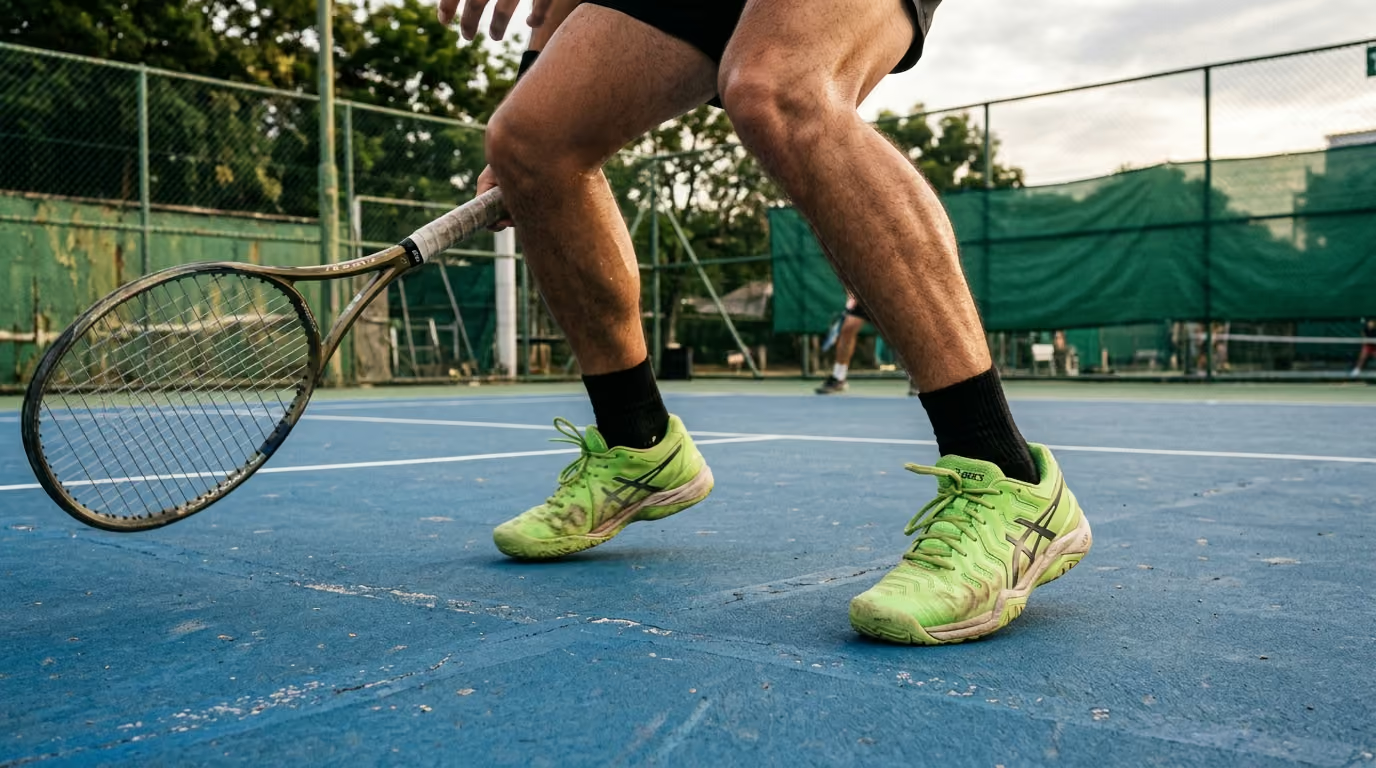
No. Your warm-up cannot make up for lack of traction or poor heel support. Worn-out shoes increase your slip risk and place unnecessary stress on your feet and knees. Always pair your warm-up routine with proper, well-fitting court shoes.
Stop the exercise immediately. A warm-up should feel smooth and comfortable, not painful. If a specific movement causes joint discomfort, modify the range of motion or skip it entirely for that session.
Follow Evercourts for practical insights on tennis, pickleball and padel performance, movement, recovery and healthy ageing. Stay connected for new articles, research-led guidance and ideas to help you play well and keep playing for years.


Read practical guidance for better movement, smarter preparation and a game that keeps working for you.
explore the Blog