
Racquet sport players gain strength and athletic longevity by applying progressive overload, a gradual increase of training stress over time through various methods.




To continue gaining strength and building athletic longevity, racquet players must apply progressive overload, which is the gradual increase of training stress over time. While lifting heavier weights is one method, players can also progress by adjusting repetitions, increasing range of motion, controlling movement tempo, adding pauses, and using more challenging body positions. This multidimensional approach builds court-specific power and tissue resilience without overloading sensitive joints.
Progressive overload is the systematic increase of physical demands on your muscles, connective tissues, and cardiovascular system. It is not a simple command to lift heavier weights every single week. For a racquet athlete, overloading a movement pattern means making that pattern slightly more challenging in a controlled, measurable way. If you perform the same exercises with the same weights, reps, and rest periods indefinitely, your body will stop adapting.
To understand this concept, it is helpful to clarify what progressive overload is not. It is not an invitation to train to absolute exhaustion or to ignore technical form in pursuit of a heavier barbell. Rather, it is a structured strategy to improve physical performance while keeping you active on the court. In the context of racquet sports, strength is useful only if it can be applied during a match.
We must view this training challenge as a performance management tool. Your body adapts to the specific stresses you impose on it. If you only focus on adding weight, you might miss out on building the specific qualities needed for quick court changes. By manipulating other variables, you can build a more balanced, resilient body that stands up to the demands of matches.
Many players believe they have hit a plateau when they can no longer add weight to a barbell. This is a common misconception that often leads to frustration or injury. In reality, you have many tools at your disposal to increase training stress. These tools allow you to continue progressing, even when using modest gym equipment or training while traveling.
The scientific consensus on progressive overload highlights several pathways to adaptation. According to the American College of Sports Medicine, progressive resistance training is essential for developing muscular strength, power, and local endurance. The ACSM position stand recommends increasing training loads by two to ten percent when you can perform one or two repetitions beyond your target on consecutive sessions. This guideline provides a safe, predictable framework for increasing external resistance.
However, current research also shows that adding weight is not the only way to stimulate muscle growth and strength. A study published in 2024 demonstrated that progressing through either load or repetitions can promote comparable gains in both strength and muscle size during the early stages of training. This finding is particularly valuable for racquet sports players who may not have access to heavy weights or who prefer to avoid high joint stress. It suggests that doing more repetitions with a constant load is a scientifically valid way to build strength.
The science of movement quality also emphasizes the importance of range of motion. A systematic review of resistance training research found that training through a full range of motion generally produces superior strength adaptations and lower-limb muscle growth compared to partial movements. Moving a joint through its complete, controlled range stimulates more muscle fibers and strengthens tissues at vulnerable angles. For players who must lunge low or reach wide, this full-range strength is critical.
There is also the question of proximity to failure, which is often measured by repetitions in reserve, or RIR. A systematic review published in 2023 found no clear evidence that training to complete muscular failure is superior for building muscle. Another meta-analysis in 2024 showed that while muscle growth improves when sets are terminated closer to failure, strength gains are similar across a wide range of effort levels. This means you do not need to push every set to total exhaustion to get stronger.
Lastly, we must consider the role of repetition tempo and time under tension. Research indicates that muscle growth can occur across a wide variety of repetition durations, ranging from half a second to eight seconds per repetition. Extremely slow repetitions, such as those lasting longer than ten seconds, may actually be less effective for building strength and size. For power development, the consensus is clear. The concentric, or lifting, phase should be performed with maximum speed to train the nervous system for rapid force expression.
To design a comprehensive program, you must understand the ten distinct variables you can manipulate. Each variable offers a different way to challenge your body without simply putting more weight on the bar.
External load is the most familiar variable. This refers to the physical weight you lift, whether it is a dumbbell, a kettlebell, or a resistance band. While it is highly effective for building maximal strength, it also places the highest stress on your joints and recovery systems.
Increasing repetitions means doing more work with the same weight. If you did eight repetitions of a split squat last week and nine this week, you have successfully overloaded the movement. This is an excellent method for building local muscular endurance and tissue tolerance.
Adding sets increases the total volume of your workout. If you perform three sets of an exercise instead of two, you increase the total physical work your muscles perform. This is a powerful driver of muscle growth, but it must be managed carefully to avoid excessive fatigue.
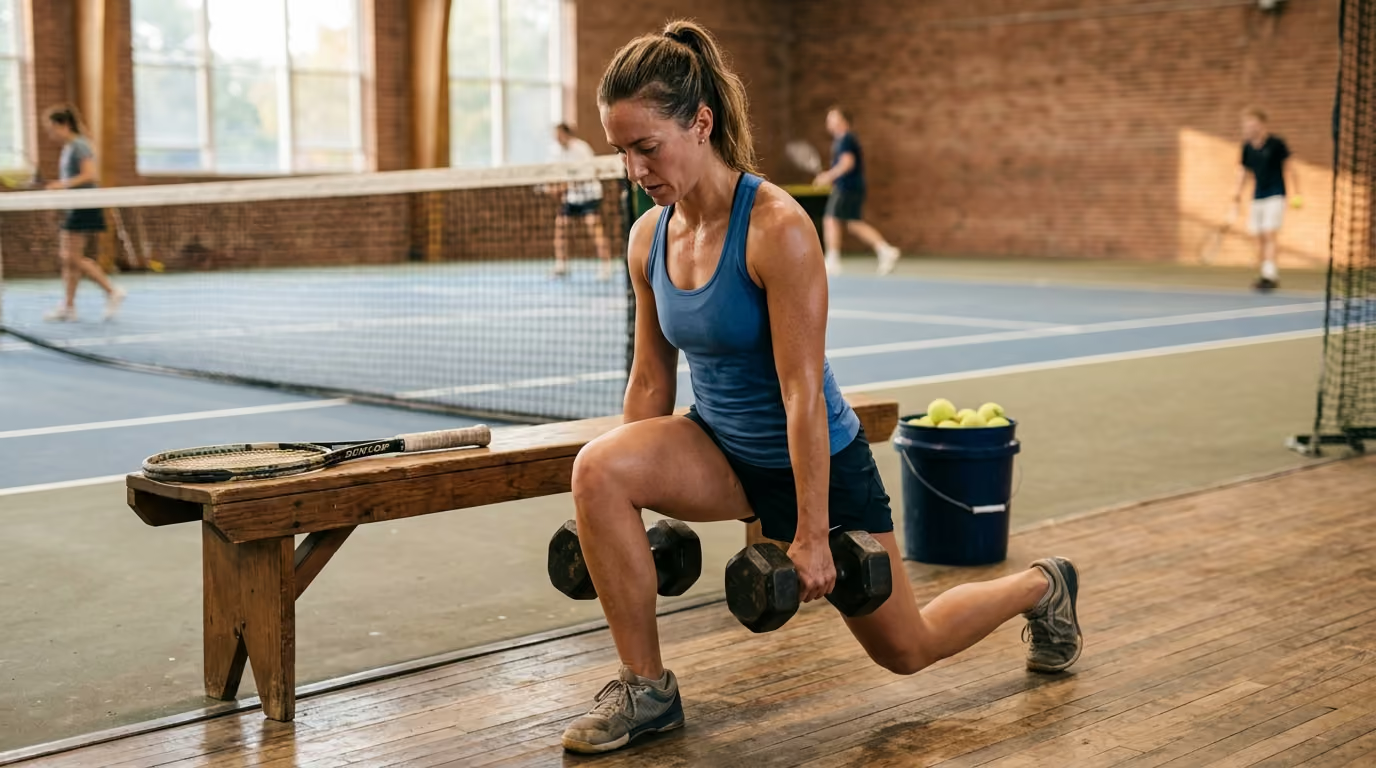
Range of motion refers to the distance a joint moves during an exercise. Progressing from a shallow split squat to a deep, back-thigh-grazing split squat increases the demand on your quadriceps and glutes. It challenges your muscles in stretched positions, which is highly relevant for court movement.
Tempo describes how fast you perform each phase of a lift. By slowing down the lowering phase, you increase the time your muscles spend under tension. This builds control, improves joint stability, and teaches your nervous system to manage forces smoothly.
Adding a pause at the most difficult point of an exercise removes momentum. When you pause at the bottom of a squat, you cannot rely on the stretch reflex to help you push back up. This forces your muscles to produce force from a dead stop, which directly translates to court acceleration.
Leverage involves changing your body position to make an exercise mechanically harder. For example, moving from a standard push-up to a push-up with your feet elevated shifts more body weight to your upper body. It requires no extra equipment but significantly increases the challenge.
Stability progressions involve reducing your base of support or introducing controlled balance challenges. This forces your core and stabilizing muscles to work harder to maintain alignment. It is highly useful for racquet players who must hit shots from unstable, dynamic positions.
Complexity refers to the coordination required to perform a movement. Moving from a stationary lateral lunge to a lateral lunge with an added trunk rotation increases the coordination demand. This teaches your body to coordinate different muscle groups, mimicking the demands of real play.
Density is the amount of work you perform in a given time frame. If you complete your three sets of squats in eight minutes instead of ten, you have increased your training density. This challenges your cardiovascular system and improves your ability to recover quickly between points.
To apply these variables safely, you need a systematic framework. It is best to think of your training as a series of steps that build upon each other. This structured approach ensures you only increase difficulty when your body is truly ready. For an organized plan, you can refer to our strength and conditioning resources to see how these fit into a yearly cycle.
Before you change any variable, you must be able to perform the exercise with perfect form. Your movement should be repeatable, controlled, and completely free of joint pain. If your technique breaks down at the end of a set, you should not increase the difficulty. For racquet players, technical consistency is the foundation of long-term health and athletic longevity.
The double-progression model is one of the safest ways to build strength. You select a target repetition range, such as eight to twelve repetitions. You start with a weight you can lift for eight reps with good form. Over the following weeks, you try to increase the repetitions until you can perform twelve reps on all sets. Only when you reach the top of the range do you increase the weight and return to eight repetitions.
If you want to make an exercise harder without adding weight, try to move through a larger range of motion. For example, if you are performing a split squat, focus on lowering your hips deeper toward the floor each week. Ensure your knee stays aligned and your lower back does not arch excessively. Once you reach your maximum safe range, you can look to other progression methods.
Once your range of motion is maximized, you can use tempo to increase the challenge. Try lowering the weight over a slow, three-second count. Add a one-second pause at the bottom of the movement before returning to the start. This builds incredible positional strength and eliminates the habit of rushing through difficult portions of an exercise.
If you train at home or travel frequently, leverage is your best friend. You can transition from a bilateral movement, like a standard squat, to a unilateral movement, like a split squat. This immediately doubles the load on each leg without requiring a single extra plate. You can also reduce your stability by stepping into a split stance or performing single-arm exercises.
Let us look at how to apply these progression strategies to specific exercises that benefit racquet players. These pathways show how to increase difficulty without always reaching for heavier weights.
The split squat is a fundamental movement for building leg strength, hip stability, and braking capacity on the court. It targets the quadriceps, glutes, and hamstrings in a unilateral stance, which mimics the positions you experience during a match.
By the time you reach Level 5, you will have significantly increased the strength demands on your legs. You have done this without adding any external weight to your spine.
This exercise is critical for developing posterior chain strength, hip control, and balance. It strengthens the hamstrings and glutes, which are the main muscles responsible for acceleration and deceleration on the court.
This progression pathway helps protect the hamstrings from the sudden strains that can occur when lunging for a low ball. For more mobility ideas, check out our mobility and movement resources.
This exercise, often called the Pallof press, builds the core strength needed to transfer force from your legs to your racket. It teaches your trunk to resist unwanted rotation, which protects your lower back during high-velocity swings.
This progression prepares your core to handle the rapid, unpredictable twisting movements common in racquet sports.
The push-up is an excellent exercise for upper-body pressing strength and core stability. It allows your shoulder blades to move freely, which is much healthier for racquet players than being pinned against a bench.
This pathway builds shoulder strength and chest endurance, which are vital for a powerful serve and clean volleys.
Once you have built a foundation of strength, you must learn to express that force quickly. This pathway transitions your strength into sport-specific power and rotational velocity.
These power exercises should be performed when you are fresh, with long rest periods between sets. Stop the set immediately if you notice a drop in throw velocity or movement quality.
Racquet sports involve constant jumping, landing, and changing direction, which places massive stress on the lower legs. Building progressive strength in your calves and feet is essential for preventing common injuries like plantar fasciitis and Achilles tendinopathy.
This sequence builds the necessary stiffness and capacity in the lower leg tendons, helping you glide across the court with confidence.
While the principles of progressive overload apply to all athletes, the specific application must match the unique demands of your sport. Tennis, pickleball, and padel place distinct stresses on your body. To learn more about sport-specific training, explore our court performance resources for tailored advice.
Tennis is played on a large court, requiring long sprints, heavy braking, and explosive rotational forces. Tennis players need high levels of maximum strength and rate of force development to cover the court and hit powerful groundstrokes. Progression for tennis should emphasize deep ranges of motion in the split squat and lateral lunge. This prepares the legs to tolerate the deep, wide positions of hard-court sliding and recovery.
Additionally, the serving motion in tennis places immense stress on the shoulder and upper back. Overloading upper-body exercises should focus on overhead stability and posterior shoulder strength. Tennis players should prioritize slow eccentric tempos on rowing and external rotation movements. This builds the deceleration capacity needed to slow the arm down safely after a high-speed serve. You can find more detail on this in our dedicated tennis articles.
Pickleball is played on a much smaller court, which changes the movement profile. The game is characterized by rapid, short-step transitions, constant lateral shuffling, and a sustained low athletic stance. Because players spend so much time in a deep squat position near the kitchen line, knee and quad endurance are paramount. Progression for pickleball players should focus on isometric holds and high-repetition endurance in the squat and split squat.
The speed of the ball in pickleball requires lightning-fast hand-eye coordination and compact upper-body movements. Progression for the upper body should emphasize stability and rotational control rather than heavy pressing. Exercises like the Pallof press and single-arm cable rows should be progressed by narrowing the stance or adding a single-leg balance element. This reflects the quick, off-balance reaches common in fast kitchen rallies. Our collection of pickleball articles covers these court dynamics in depth.
Padel is a fast-paced game played within glass walls, requiring constant directional changes and frequent overhead shots. Padel players must constantly adjust to unpredictable bounces off the glass, which demands excellent rotational mobility and single-leg balance. Progression for padel should emphasize lateral movement and rotational control. Rotational cable exercises and lateral lunges should be progressed by adding controlled speed and reactive elements.
The high volume of overhead smashes and high volleys in padel also means the shoulders require exceptional endurance. Progression for padel players should focus on overhead press variations and stability exercises. For example, a landmine press can be progressed to a standing split-stance landmine press. This mimics the coordinated force transfer from the lower body through the trunk and into the shoulder. Read more about these strategies in our padel articles.
One of the biggest challenges for racquet players is balancing strength training with court time. If you lift weights too close to a match, you might perform poorly due to fatigue. If you do not train hard enough, your body will not adapt.
To manage your energy, you should organize your week so your hardest strength sessions are separated from your most important match days. It is often best to perform your heavy or complex strength workouts on a day when you already have a hard court session, followed by a dedicated recovery day. This concentrates your high-stress training into specific windows, leaving plenty of time for rest.
During the off-season, you can increase your gym volume and intensity, as you will have fewer matches to recover from. When the competitive season begins, your priority shifts to maintaining your strength and power while minimizing muscle soreness. You can achieve this by reducing your gym volume by half but keeping the intensity of your exercises moderate to high.
Before each strength session, you should assess your physical state to decide if you should progress, maintain, or scale back. This is called autoregulation. You can track simple markers like your morning muscle soreness, joint stiffness, and general energy levels. If you feel exceptionally fatigued, it is wise to hold off on adding repetitions or weight.
If you are recovering from a hard match or a series of intensive practice sessions, you can use tempo and pauses instead of heavy loads. This keeps your movement quality high and provides a useful training stimulus without overloading your nervous system. Remember that a successful program is one that keeps you consistently performing well on the court over several months.
The most frequent error racquet players make is assuming that progressive overload only means adding weight to the bar. This narrow view often leads to players lifting weights that are too heavy for their current technical capacity. When you sacrifice form for a heavier weight, your risk of injury increases, and the target muscles do not receive the intended stimulus. For example, arching your lower back to complete a heavy bicep curl or row shifts the stress away from your upper body.
Another common mistake is trying to progress multiple variables at the same time. If you increase the weight, add repetitions, and shorten your rest periods in a single week, you will likely overwhelm your recovery capacity. This sudden spike in training stress can lead to chronic fatigue and joint soreness, which will negatively impact your performance on the court. To avoid this, change only one variable at a time, allowing your body to adapt before making another change. For a deeper understanding of these programming errors, you can read about injury prevention resources on our site.
Many players also fall into the trap of trying to make every gym exercise look exactly like a sport stroke. While specific training is valuable, using heavy weights to mimic a tennis serve or a pickleball drive can alter your natural mechanics and place unnatural stress on your joints. It is far better to build general force capacity with stable, foundational movements in the gym. Once you have built that capacity, you can naturally express it on the court through your regular sports practice.
Lastly, players often ignore their non-dominant side in an attempt to correct sport-induced asymmetries too aggressively. Racquet sports are inherently asymmetrical, and your dominant side will naturally be stronger and more skilled. You should not try to force perfect symmetry by overloading your non-dominant side with excessive corrective exercises. Instead, focus on building adequate, functional strength on both sides to support balanced movement and joint health.
Every time you increase the challenge of your strength training, you initiate a process of microscopic tissue breakdown. This breakdown is a necessary stimulus for adaptation, but it requires adequate recovery time to translate into actual strength. If you do not allow your muscles and tendons to repair, your performance will decline, and your risk of overuse issues will rise. This relationship between training stress and adaptation is a key focus of our recovery science resources.
Tendons and connective tissues adapt much more slowly than muscle fibers. While your muscles might feel ready for a heavier weight after a week, your tendons may need several weeks to adapt to the new load. This is why gradual progression models, like range of motion and tempo changes, are so beneficial for racquet athletes. They allow you to challenge your muscles while giving your joints and tendons the time they need to build structural capacity.
As you consistently apply progressive overload, your tissues become more resilient to the repetitive impacts of court play. Your bones become denser, your ligaments strengthen, and your tendons improve their ability to store and release elastic energy. This increased tissue capacity is what allows you to play longer, recover faster between matches, and maintain your physical capabilities as you age.
While progressive strength training is highly effective for building athletic longevity, you must listen to your body’s warning signs. Persistent pain that does not improve with rest is a clear signal that something is wrong. If you experience sharp joint pain, swelling, or numbness during or after an exercise, you should stop that movement immediately. These symptoms can indicate a structural issue that requires professional assessment.
You should also seek professional guidance if a movement limitation prevents you from progressing safely. If you cannot perform a basic split squat or shoulder press through a functional range of motion without discomfort, a physical therapist can help. They can identify any mobility restrictions or muscle imbalances and provide targeted exercises to address them. For more information about our mission to support healthy movement, visit the About Evercourts page.
Here are some common questions racquet players have when implementing progressive overload in their routines.
Yes, bodyweight training can absolutely be progressed using several of the variables discussed in this guide. You can increase the range of motion, slow down the tempo, add pauses, or modify the leverage. For example, transitioning from a regular push-up to a single-leg push-up increases the stability and core strength requirements. You can also increase the density of your workout by reducing the rest time between your bodyweight exercises.
The best indicator is your technical consistency and perceived effort. If you can complete all your prescribed sets and repetitions with perfect form and still feel like you could do two more reps, it is time to progress. This is known as having two repetitions in reserve, or RIR. If your technique is shaky or you are struggling to complete the final reps, keep the parameters the same for another week.
No, building significant muscle bulk requires a high volume of training combined with a substantial caloric surplus. For most racquet athletes, strength training improves neural drive and muscle recruitment, making you stronger and faster without adding excess body mass. This is often referred to as improving your relative strength. It helps you produce more force relative to your body weight, which directly improves court speed.
During a tournament week, your primary goal is to perform well on the court, which means minimizing training fatigue. You should reduce your overall training volume by fifty percent or more while keeping the intensity moderate. Avoid introducing any new exercises, deep range of motion progressions, or slow eccentrics, as these are highly likely to cause muscle soreness. Focus instead on maintaining your movement quality and preserving your energy for your matches.
Follow Evercourts for practical insights on tennis, pickleball and padel performance, movement, recovery and healthy ageing. Stay connected for new articles, research-led guidance and ideas to help you play well and keep playing for years.


Read practical guidance for better movement, smarter preparation and a game that keeps working for you.
explore the Blog