
Racquet and paddle setup for injury prevention involves systematically managing physical loads on joints by balancing weight, tension, and fit to reduce stress.




Equipment setup is a systematic approach to managing the physical loads on your joints during play, rather than a magical shield against injury. By balancing weight, tension, and fit, you can reduce unnecessary physical stress on your hand, wrist, forearm, elbow, and shoulder. This guide examines how to optimize your racquet or paddle to support your athletic longevity on the court.
Choosing the right gear is only one part of staying healthy. Your technique, playing volume, and physical strength also play major roles in how your body feels. However, an optimized setup ensures that you do not force your muscles to work harder than necessary. Let us look at what the latest sports science and biomechanical research say about customizing your equipment.
To understand how gear affects your body, you must look at how forces move through your equipment. When a ball hits your racquet or paddle, a complex physical event occurs. Energy is generated, transmitted, and absorbed. We can break this down into five key physical variables.
First is impact generation, which is the total amount of force and vibration created at the moment of contact. Second is impact transmission, which describes how much of that force travels past the frame and into your hand. Third is swing demand, or the muscle work needed to start and stop your swing. Fourth is stability, which is how well your gear resists twisting when you hit the ball off-center. Finally, player adaptation is your body's ability to adjust to these physical demands over time.
Research highlights that equipment is not the only factor in court-related injuries. A 2025 study of 253 recreational pickleball players published in the journal Medicine found that 41 percent reported at least one upper-extremity injury. Within this group, 10 percent suffered acute injuries, while 37.5 percent dealt with chronic overuse issues. The researchers discovered that injury risk rose significantly for those who played longer sessions, played on consecutive days, or maintained a tight baseline grip.
This means your equipment is a single component within a larger risk-management system. You cannot use a specialized racquet or paddle to fully offset the effects of overplaying. To build a sustainable routine, you must combine gear adjustments with smart load management and proper physical conditioning. For more information on physical conditioning, you can check our resources on strength and conditioning on the court.
When selecting a racquet or paddle, players often look at static weight first. Static weight is the simple measurement of your gear on a scale. While static weight is easy to measure, it does not tell the whole story of how the equipment feels in motion. Two racquets can weigh the exact same on a scale but feel completely different when you swing them.
This difference is due to swingweight, which is the resistance of an object to being accelerated or rotated. Swingweight is determined by how mass is distributed across the length of the frame. If a racquet has more mass positioned toward the head, it will have a higher swingweight. If more mass is positioned toward the handle, it will feel much easier to swing.
The location of this mass is referred to as the balance of the equipment. We can classify balance into three categories:
The Lawn Tennis Association notes that head-heavy racquets help generate power with minimal swing effort. Conversely, head-light designs focus on maneuverability and control. If you have shoulder issues, a head-heavy racquet might increase your discomfort. This is because your shoulder muscles must work harder to raise, swing, and decelerate a heavy frame.
However, choosing an extremely light racquet is not a perfect solution. A light frame has less mass to absorb the force of a fast-moving ball. When you hit a heavy ball with a light racquet, the frame is more likely to twist in your hand. This forces your forearm muscles to squeeze harder to keep the racquet stable, which can lead to elbow irritation. The ideal choice is the lightest equipment that remains stable against your typical ball speeds.
Your grip is the only physical connection between your body and your racquet or paddle. If your grip does not fit your hand, your forearm muscles must compensate. This compensation usually comes in the form of increased grip pressure, which can lead to localized fatigue. Over time, this extra tension can contribute to tendon irritation at the elbow.
To check your grip size, you can use two simple methods. The American Academy of Pediatrics recommends measuring the distance from the tip of your ring finger to the last palmar crease of your hand. This measurement represents your ideal grip circumference. Another quick test is to hold your racquet with a normal continental grip. You should be able to slide the index finger of your other hand comfortably between your ring finger and your palm.
If your grip is too small, you will find yourself squeezing the handle tightly to prevent twisting. If your grip is too large, you will struggle to snap your wrist comfortably during serves and overheads. If you are between sizes, the general recommendation is to select the smaller size. You can then use a thin overgrip to customize the feel.
It is important to note that grip size alone is not a direct cause of lateral epicondylitis, commonly known as tennis elbow. A 2006 study published in the American Journal of Sports Medicine concluded that playing with an incorrect grip size did not directly cause tennis elbow. Instead, grip size is a contributing factor to muscle fatigue and grip force. Keeping a fresh, high-traction overgrip on your handle is highly beneficial. The United States Tennis Association recommends changing your overgrip regularly to prevent slipping and blisters. If you want to read more about hand health, visit our player health articles.
For tennis players, your strings are the primary shock absorbers of your racquet. String tension is one of the most adjustable variables for managing arm discomfort. When you string a racquet at a high tension, the string bed becomes stiff and unyielding. This setup offers excellent control, but it transmits more impact shock to your wrist and elbow.
Scientific studies support the link between string tension and joint acceleration. A study published in the Journal of Sports Sciences measured elbow acceleration during tennis strokes. The researchers found that peak elbow acceleration was 5.58 meters per second squared when using a tension of 200 Newtons. Acceleration rose to 6.83 meters per second squared at 222 Newtons, and reached 7.45 meters per second squared at 245 Newtons. The lowest tension setup produced the least amount of physical acceleration at the joint.
A systematic review of racquet properties also suggests that lowering string tension is a practical way to manage the risk of developing tennis elbow. Lower string tension increases the trampoline effect of the string bed. This longer dwell time allows the strings to absorb more energy, which reduces peak impact shock. It also makes it easier to hit deep shots without swinging with maximum physical effort.
String material and thickness, known as gauge, are also highly important. Softer materials like natural gut or multifilament nylon stretch easily on impact. Stiff materials like polyester or co-polyester do not stretch as much, which transfers more shock to your arm. If you are experiencing arm discomfort, switching to a softer string and lowering your tension by three to five pounds can make a noticeable difference.
Pickleball and padel have grown rapidly, and they require a different approach to equipment setup. These sports use solid paddles rather than stringed racquets. Because there are no strings to absorb shock, the physical impact of the ball is transferred directly to the paddle face and core.
The rise in popularity of these sports has led to an increase in clinical visits. A 2025 national study of emergency department data showed that pickleball injuries grew from 1,313 cases in 2014 to 24,461 cases in 2023. Most of these injuries occurred in players between the ages of 60 and 79. A separate review of pickleball and paddleball injuries noted that the shoulder, elbow, wrist, and hand are the most common areas for upper-extremity strains and tendinitis.
To protect your joints in paddle sports, you must evaluate several key paddle characteristics:
The 2025 recreational pickleball study found that players who maintained a tight baseline grip had an acute injury risk 2.67 times higher than those with a relaxed grip. Playing sessions longer than two hours increased acute injury risk by 2.38 times. To manage these risks, choose a paddle that allows you to maintain relaxed grip pressure. Keep your overgrip tacky so you do not have to squeeze the handle to maintain control. For more tips on playing safely, see our injury prevention resources.
To find your optimal equipment setup, you should follow a structured, step-by-step process. Changing multiple gear variables at once makes it impossible to know which adjustment actually helped your arm. Follow this seven-step protocol to isolate variables and track your progress.
Before making any changes, document your current setup. Write down your racquet or paddle model, its total weight, and your grip size. If you play tennis, record your current string type, gauge, and tension. Note how often you play, how long your sessions last, and when you typically feel joint discomfort.
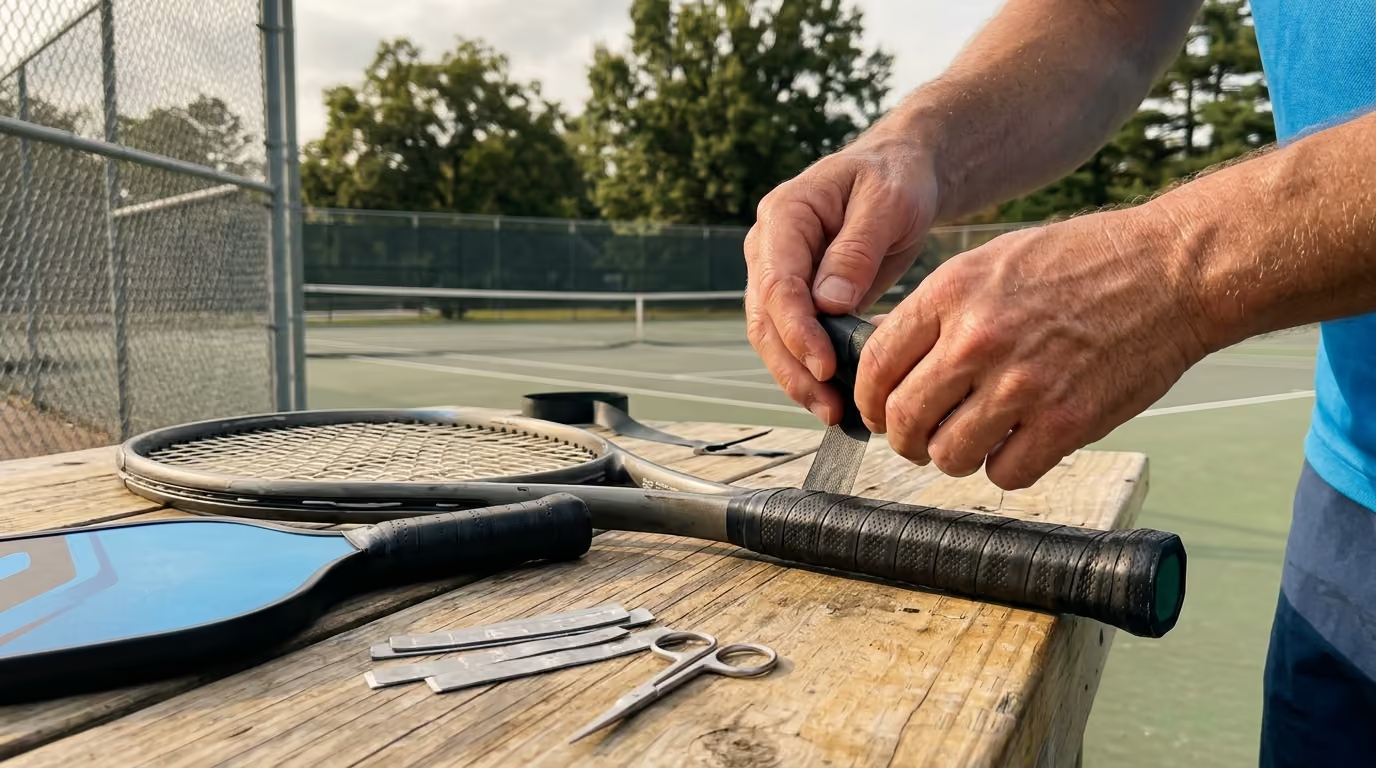
Check the condition of your handle. If your overgrip is worn, smooth, or dirty, replace it immediately. Measure your grip size using the ring-finger-to-palmar-crease method to confirm you are using the correct handle circumference.
Pay close attention to how tightly you hold your racquet or paddle during play. Rate your grip pressure on a simple three-level scale during your next practice session:
If you find yourself constantly in the tight category, your grip size may be too small, or your paddle may be too light.
During your next hitting session, pay attention to what happens when you miss the sweet spot. Does the frame twist violently in your hand? Do you feel a harsh vibration run up your forearm? If so, your equipment may lack the stability needed for your style of play.
If you decide to modify your setup, change only one variable at a time. For a tennis player, the first step should be lowering your string tension by three to five pounds. For a pickleball or padel player, the first step should be adding a fresh, thick overgrip to improve handle traction and diameter. Test this single change for at least three playing sessions before making another adjustment.
Your body needs time to adjust to any equipment change. Even if your new racquet or paddle is designed to be arm-friendly, it will alter your swing timing and contact point. Limit your first session with new gear to thirty minutes of light hitting. Gradually increase your playing time over two weeks to avoid acute muscle strains.
Keep a simple training log to track how your joints feel after making a change. Rate your physical comfort immediately after playing, three hours later, and the following morning. Delayed muscle soreness is normal, but persistent joint aching or morning stiffness suggests your body is still struggling with the physical workload. If you want to read more about managing your weekly playing volume, visit the Evercourts blog.
Many players make simple errors when trying to customize their equipment for comfort. These mistakes can accidentally increase the physical strain on your joints. Let us look at two of the most common pitfalls.
Many players buy the lightest racquet or paddle available because they believe it will protect their arm. While a light frame is easy to swing, it lacks the physical mass to plow through the ball. When you hit a fast shot, a light frame will decelerate rapidly on impact. This sudden deceleration transmits high-frequency shock directly into your hand and wrist.
Furthermore, light frames are highly unstable on off-center hits. If you do not hit the sweet spot perfectly, a light racquet will twist easily. To stop this twisting, you must squeeze the handle with maximum force. This chronic squeezing can lead to muscle fatigue and tendon issues in your forearm. To protect your arm, you should play with the heaviest frame you can comfortably swing for a full match without fatigue.
A very common sight on tennis courts is a small rubber insert placed in the string bed. Many players refer to these accessories as vibration dampeners and believe they protect against tennis elbow. This is a common misconception.
Biomechanical studies show that rubber dampeners only reduce the vibration of the strings themselves. They do not reduce the heavy frame shock that travels into your hand and arm after impact. A dampener changes the sound of the hit from a high-pitched ping to a dull thud. This quieter sound can make the racquet feel more comfortable, but the physical force reaching your joints remains exactly the same. Do not rely on a dampener as a substitute for proper string tension or a flexible frame.
Your choice of equipment directly affects how much recovery time you need between playing sessions. When you play with a setup that is poorly matched to your body, your muscles must work harder to control the frame. This extra effort leads to micro-tearing in your muscle fibers and tendon attachments.
If your gear transmits high levels of impact shock, your soft tissues must absorb that energy. Over time, this constant physical stress can exhaust your body's ability to repair itself. This can lead to chronic tendinitis, which takes a long time to heal. By optimizing your equipment, you can reduce this micro-trauma and maintain your tissue health.
An optimized setup allows you to recover faster after a hard match. You will experience less muscle soreness and joint stiffness the next morning. This faster recovery is essential for athletic longevity, allowing you to play more frequently as you age. If you want to learn more about the science of recovery, read our articles on recovery science resources.
While adjusting your equipment can help manage physical stress, it is not a replacement for medical care. If you are experiencing persistent pain, you should consult a qualified healthcare professional. Do not try to play through pain by simply changing your gear.
You should seek professional medical advice if you experience any of the following warning signs:
A physical therapist or sports medicine physician can assess your biomechanics and physical strength. They can identify any muscle imbalances that may be contributing to your discomfort. For more information about our educational mission, you can visit the About Evercourts page.
Yes, lead tape is an excellent and inexpensive tool for customizing your racquet. If your racquet twists too much on off-center hits, you can add small strips of lead tape to the sides of the frame. Placing tape at the three and nine o'clock positions on the racquet head increases the frame's resistance to twisting. This simple adjustment can improve stability and reduce the grip pressure needed to control the racquet. However, you should add weight in very small increments to avoid making the racquet too heavy to swing comfortably.
Tennis strings lose their elasticity over time, even if you do not play very often. When strings lose their tension, they become stiff and lose their trampoline effect. This state is commonly referred to as dead strings. You can identify dead strings if you notice you have to swing much harder to get the ball deep into the court. If your arm feels unusually sore after a session, or if the racquet makes a harsh metallic sound on impact, it is time to restring. A good general rule is to restring your racquet as many times per year as you play per week.
Yes, paddle thickness plays a major role in shock absorption. Thicker paddles, usually sixteen millimeters or thicker, generally absorb more impact energy than thin paddles. The extra core material helps disperse the force of the ball, which reduces the vibration that travels down the handle. Thin paddles, often around thirteen millimeters, tend to feel stiffer and transmit more vibration to the wrist and elbow. If you struggle with arm fatigue or joint discomfort, a thicker paddle core is a very sensible choice.
As we age, our muscles and tendons naturally lose some of their elasticity and strength. To support your healthy aging, it is wise to adjust your equipment setup over time. You might consider transitioning to a slightly lighter racquet with a lower swingweight to reduce the load on your shoulder. Tennis players can benefit from switching to softer multifilament strings and lowering their tension to maintain deep shots with less physical effort. Making these proactive adjustments can help you continue playing the sports you love for years to come. If you want to learn more about playing comfortably as you age, see our resources on healthy aging and athletic longevity.
Follow Evercourts for practical insights on tennis, pickleball and padel performance, movement, recovery and healthy ageing. Stay connected for new articles, research-led guidance and ideas to help you play well and keep playing for years.


Read practical guidance for better movement, smarter preparation and a game that keeps working for you.
explore the Blog