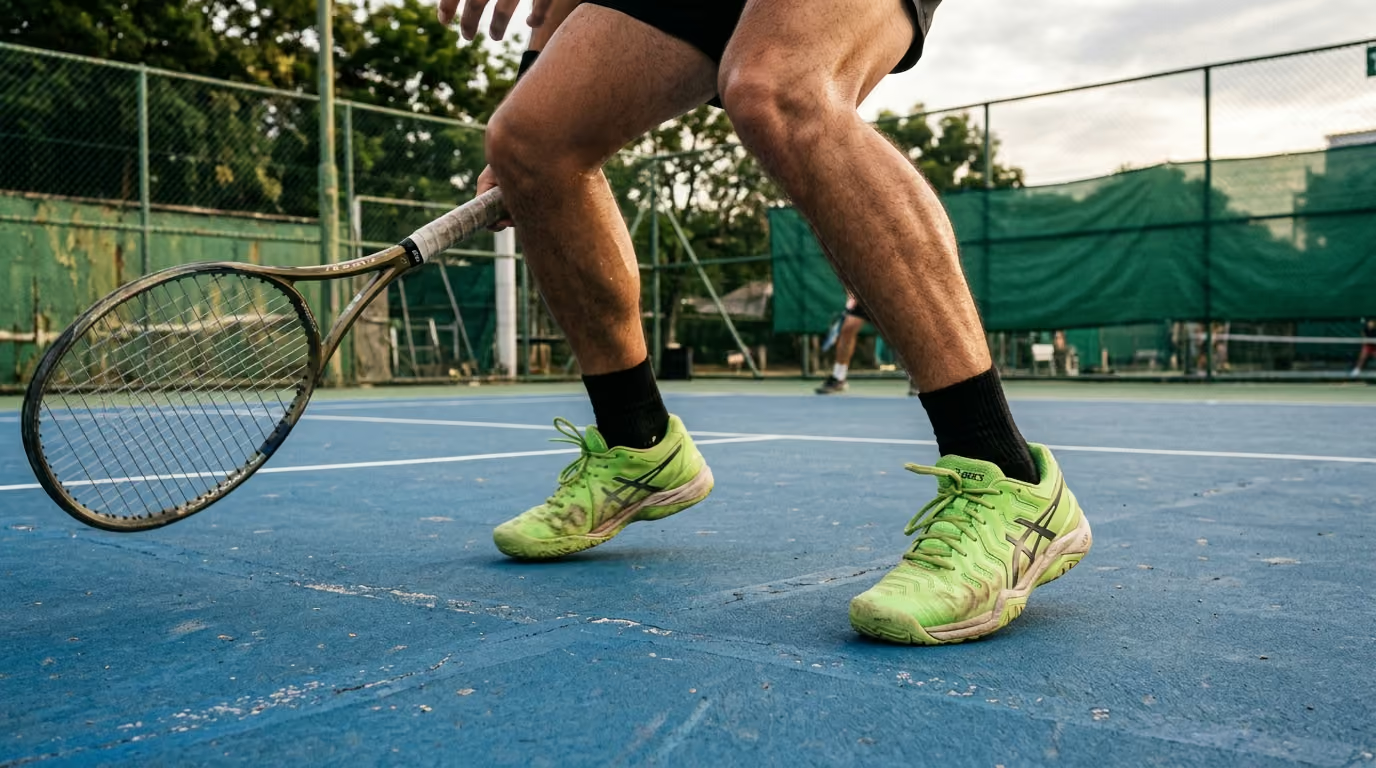
Racquet sports decision-making involves a framework for better shot selection, emphasizing logical, high-probability choices over spectacular, low-percentage shots.




Shot selection in racquet sports is often misunderstood. It is not simply the act of copying professional highlight reels. It is not about hitting the ball with maximum power on every single exchange.
Instead, true shot selection is a dynamic calculation of spatial relationships, physical balance, and time. It is the mental process of matching your physical capabilities to the immediate demands of the ball, the court, and the opponent. To play highly effective racquet sports, you must shift your focus from hitting spectacular shots to making logical, high-probability choices.
Better shot selection relies on reading the exact amount of time, balance, and court space available before striking the ball. By classifying every situation into one of five tactical states, players can choose high-probability targets instead of defaulting to high-risk shots. This structured approach directly preserves energy, limits unforced errors, and builds a sustainable style of play.
Many players spend years refining their physical swings. They take lessons, practice on ball machines, and record their form to build a clean stroke. Yet, these same players often struggle to win competitive matches. The reason is a disconnect between stroke quality and decision quality.
Stroke quality refers to your mechanical ability to strike the ball. It involves your grip, your backswing, your footwork, and your follow-through. Decision quality is the mental process that determines where, when, and how you use that stroke. A player with mechanically flawed strokes who makes excellent decisions will often beat a player with perfect strokes who makes terrible choices.
To understand decision quality, you must look at every shot through the lens of expected value. In simple terms, expected value is a mental formula. It weighs the probability of a favorable outcome against the probability and cost of an error.
A high-speed shot aimed directly down the line may look impressive when it lands. However, if that shot has only a twenty percent chance of landing in, its expected value is negative. Over the course of a match, relying on low-probability shots will cause you to lose. Conversely, a deep, cross-court rally ball has a very high completion rate. It keeps you in the point and slowly builds pressure on your opponent, making its expected value highly positive.
Risk is not the same as difficulty. A shot can be technically demanding but tactically correct if the situation permits it. For example, if your opponent is caught far out of court, hitting a soft angle is the correct tactical choice. The target is large, and the reward is high.
To manage this on the court, you should use a personal risk budget. Your risk budget divides your shots into four distinct categories:
These are your bread-and-butter shots. They include deep baseline drives, high-margin cross-court balls, and conservative returns. They form eighty percent of your play.
These shots are used to press an advantage. They include taking the ball early, hitting slightly closer to the lines, or approaching the net.
These are low-percentage shots aimed at winning the point immediately. They include sharp angles, drops, and fast direction changes. You should only use them when you are completely balanced and have plenty of time.
These are desperation shots. You hit them because your opponent has put you in a position where survival is unlikely. In these moments, a high-risk lob or block is your only option.
Sports science shows that elite players do not simply possess faster physical reflexes than club players. Instead, their advantage lies in visual processing and anticipation.
Research on expert tennis players shows that experts consistently make more appropriate tactical decisions. They select responses that put pressure on their opponents rather than just returning the ball. This decision-making advantage is built on specific visual-search behaviors.
According to eye-tracking studies, experts display fewer visual fixations, but those fixations are of longer duration. They also exhibit a phenomenon known as the quiet-eye period. This is a crucial window of cognitive focus right before a movement is initiated.
Instead of staring randomly at the ball, elite players scan their opponent's physical preparation. They look at the hips, the shoulders, the racket-face angle, and the court position. This allows them to predict where the ball will go before it is even hit.
In professional tennis, researchers have identified a clear transition point between reaction and anticipation. This transition occurs approximately 140 to 160 milliseconds after the opponent contacts the ball. True anticipation occurs in up to thirteen percent of professional rally situations.
Anticipation is a probability-based commitment. It is not a blind guess. It is an early physical adjustment based on rich visual cues. To improve your anticipation, you must learn to read the opponent's body language.
A squash study analyzing player awareness found that players group their court situations into distinct cognitive clusters. The study identified six situation-awareness clusters. These ranged from pure defensive survival to aggressive winner attempts.
This research confirms that your brain must process the tactical state of the court before you select a physical movement. If you try to execute an aggressive winner while your brain is actually in a defensive survival state, a mechanical error is highly likely. For more structured tools on visual training and court awareness, you can review our court performance resources.
To simplify your decision-making under pressure, you should organize every moment of a point into five distinct tactical states.
You enter the attack state when you have a clear physical advantage. This occurs when you are balanced, inside the court, and have plenty of time to prepare. Your opponent is usually running or out of position. Your goal is to reduce your opponent's recovery time and force an error or a weak reply.
You enter the defensive state when your opponent has put you under pressure. You are running, stretched to your physical limit, or jammed by a fast ball. Your primary goal is survival. You must hit a high-margin shot to buy yourself enough time to recover your position.
The reset is a deliberate transition shot. You use it when you cannot attack, but you want to take away your opponent's attacking advantage. It involves absorbing pace and placing the ball in a zone that prevents another hard attack.
The rally state is neutral. Neither player has a clear advantage. Your goal is to maintain depth and court position while waiting for a weak ball. You must avoid unnecessary risks and focus on hitting high-margin targets.
Changing direction is a highly tactical decision. It involves hitting the ball to a different side of the court than the previous exchange. You should only change direction when you are balanced and your opponent is recovering from a displaced position.
To navigate these states, you can use the advantage ladder. The ladder consists of six progressive levels:
Never try to skip levels on this ladder. If you are on the survival step, do not try to hit a conversion winner. You must first neutralize the point before you can build an attack.
You can test your permission to climb the ladder using the Time-Space-Balance test. Ask yourself three brief questions as the ball approaches:
If you have plenty of time, open space, and perfect balance, you have full permission to attack. If you lack any of these three elements, you must defend, reset, or rally.
Applying this framework during a fast match requires simple, automated mental habits. Under pressure, your brain cannot process complex mathematical equations. You must translate the five tactical states into simple on-court actions.
First, implement the silent-call technique during practice matches. Right before you strike the ball, say the tactical state out loud or in your head. Say "Rally," "Defend," "Reset," or "Attack."
This simple exercise forces your brain to recognize your physical situation. If you find yourself screaming "Attack" while running backward and hitting off your back foot, you will immediately realize your tactical error. This builds a strong connection between your physical balance and your shot selection.
Second, apply the two-ball direction rule. When you want to change the direction of the ball, commit to a two-shot sequence.
The first shot must be a deep, high-margin ball to move your opponent. Do not try to hit a winner on this shot. Simply force them to move laterally.
The second shot is your direction change. You only execute it if your first shot succeeded in displacing your opponent and you are balanced. This rule prevents you from changing direction too early in a rally, which is a major cause of unforced errors.
Third, adjust your target margins based on the score. When the score is low-leverage, such as fifteen-love, you can afford to test aggressive lines.
When the score is high-leverage, such as a break point, your target margins must expand. Move your targets two to three feet inside the court lines. This does not mean playing passively. It means choosing larger targets to guarantee the ball stays in play under physical and mental stress.
Finally, establish a strict between-point routine. Use the five seconds after a point to evaluate your decision, not just the physical outcome.
Ask yourself if you selected the correct tactical state. If you made a great decision but missed the shot due to a mechanical error, do not get frustrated. A good decision that misses is acceptable. A terrible decision that somehow lands in is a habit that will eventually hurt your game.
While the core principles of decision-making apply to all racquet sports, the practical application changes based on the dimensions, equipment, and rules of each game. Understanding these differences is vital for a versatile racquet sports player health profile and physical longevity.
In tennis, the court is large, the ball is lively, and the physical spaces are vast. This means that recovery distance is a major factor in every decision.
If you change direction and hit down the line in tennis, you open up a massive cross-court angle for your opponent. If your shot lacks sufficient depth or power, you will be forced to run a very long distance to reach the next ball. Therefore, the default rally state in tennis is almost always deep and cross-court.
You must prioritize height over the net and heavy topspin to keep the ball deep. Only attack when the ball lands short of the service line, allowing you to move forward and strike the ball above net height.
In pickleball, the court is small, the paddle is solid, and the non-volley zone, known as the kitchen, dominates the strategy. Because the ball does not bounce high and has no strings to generate heavy topspin, power is easily punished at the net.
The reset is the most critical shot in pickleball. If your opponent hits a hard drive at your body while you are transitionally moving forward, you cannot hit a hard counter-attack safely.
You must use a soft, loose grip to absorb the speed. Your goal is to drop the ball gently into the kitchen. This forces your opponent to hit upward, taking away their attacking advantage and allowing you to establish a strong position at the kitchen line.
Padel is played in an enclosed glass cage, and it is almost always played as a doubles game. This completely changes the concept of open space.
You cannot easily hit winners past two positioned opponents because they can use the back and side walls to keep the ball in play. The lob is the most important tactical shot in padel.
In tennis, a lob is a defensive desperation shot. In padel, a high, deep lob is an offensive weapon. It forces your opponents to run backward, relinquish the net, and play a difficult ball off the glass.
Padel requires extreme patience. You must spend the majority of the rally hitting safe, low-pace shots, waiting for the opponents to make a positional mistake before you attempt an aggressive smash.
To protect your athletic longevity and reduce frustrating errors, you must recognize the common cognitive traps that lead to poor shot selection on the court.
The most frequent mistake is assuming that the hardest shot is always the best shot. Amateur players often hit the ball as hard as possible, regardless of their court position or physical balance.
Power reduces your own recovery time. If you hit a very fast ball that lands short, the ball will return to your side of the court even faster. This leaves you completely unprepared for the next exchange.
When a player sees a short ball, they often experience an immediate rush of adrenaline. They feel they must hit an outright winner.
However, if that short ball is spinning heavily or sitting very low to the ground, hitting a flat, high-speed winner is mechanically low-percentage. A low short ball requires a controlled approach shot or a heavy slice. Your goal should be to build pressure and move to the net, not to finish the point with one swing.
Many players change the direction of the ball simply because they are tired of hitting cross-court. They change direction from a defensive position, hitting off their back foot while retreating.
This is a statistically disastrous decision. Changing the direction of a fast, deep ball requires precise timing. If you are late, the ball will fly wide or land directly in the net.
This is a mental error where a player judges the quality of a decision solely by its immediate physical result.
If you hit a wild, eyes-closed overhead from behind your own baseline and it somehow paints the line, you might think it was a great shot. It was not. It was a terrible decision that succeeded purely by luck.
If you continue to make that decision, you will lose the vast majority of those points. You must evaluate your shot selection based on the probability of success, not the occasional lucky outcome.
There is a direct connection between tactical intelligence and physical health. Players who make poor decisions on the court subject their bodies to immense physical stress.
Every time you hit a low-percentage shot that leaves you out of position, you force yourself to make an emergency recovery run. This involves sudden, violent deceleration, deep lunges, and rapid changes of direction. These high-force movements place extreme stress on your knees, ankles, and lower back.
By utilizing proper shot selection, you can drastically reduce the number of emergency movements you must perform during a match. When you hit high-margin, deep rally balls, you give yourself ample time to glide back to the center of the court. You can maintain a balanced, athletic posture, which distributes impact forces evenly across your major muscle groups.
Furthermore, hitting the ball while off-balance places a heavy burden on your upper body. When your legs are not set, you cannot use your hips and torso to generate power.
You are forced to use your shoulder, elbow, and wrist to muscle the ball over the net. This repetitive, localized strain is a primary cause of lateral epicondylitis, commonly known as tennis elbow, as well as rotator cuff irritation.
Implementing structured injury prevention guidelines is not just about stretching after your match. It is about playing a style of game that minimizes mechanical strain in the first place. Smart shot selection is a highly effective form of joint preservation.
Sometimes, poor shot selection is not a mental failure. It is a physical compensation.
If a player has restricted hip mobility, they will struggle to turn and run backward to chase a deep lob. To avoid this painful movement, they may choose to hit a highly risky, off-balance overhead from the mid-court.
Similarly, a player with chronic knee stiffness may choose to hit low-percentage, high-speed winners because they know they cannot survive a long, physical rally. If you find yourself consistently selecting high-risk shots because you want to avoid running, you must address the underlying physical limitations.
You should consult a qualified physical therapist or sports medicine specialist if you experience any of the following physical red flags:
A professional can help you identify structural restrictions and design a targeted program to restore your functional movement. Integrating sound strength and conditioning concepts will allow you to execute the correct tactical decisions with physical ease and comfort.
To turn this decision-making framework into an automatic physical habit, you must design your practice sessions around tactical constraints. Repetitive, non-competitive hitting drills will not improve your decision speed. You must practice making choices under pressure.
Play a standard practice set with a partner. However, right before you hit the ball, you must call out your physical balance state.
Call "Red" if you are off-balance and defensive. Call "Yellow" if you are neutral and rallying. Call "Green" if you are balanced and attacking.
If you call "Red," you are restricted to hitting a high, deep defensive ball. If you call "Green," you have permission to attack. This constraint forces you to build immediate awareness of your physical state before you select a target.
Place two physical targets, such as cones or towels, three feet inside the baseline and three feet from the singles lines. Play a competitive tiebreaker where you can only win points if you hit a target first.
Any ball that lands short of the service line is an automatic loss of point, even if your opponent misses it. This drill trains your brain to value depth and high-margin rally balls over short, risky winner attempts.
In pickleball or tennis, start one player at the baseline and one player at the net. The baseline player must hit three consecutive reset shots into a designated target zone before they are allowed to advance to the net.
If they hit a hard drive before completing the three resets, they lose the point. This teaches patience and prevents players from rushing forward behind low-quality, attackable balls.
Record your matches from a high angle behind the court. When reviewing the footage, pause the video at the exact moment your racket begins its forward swing.
Assess your physical state at that split second. Look at your footwork, your hip rotation, and your opponent's position.
Write down whether your shot choice matched the physical reality of that moment. This exercise removes outcome bias and helps you build an objective view of your tactical decision quality.
Yes. A low-percentage shot can be tactically correct when the expected value of the alternative is even lower. For example, if your opponent has moved you completely out of court and is waiting at the net to hit an easy smash, a high-margin rally ball will result in an immediate loss of the point. In this extreme emergency state, attempting a high-risk, low-percentage passing shot or a precise lob is your only logical choice.
Overthinking happens when you have too many choices. You can eliminate mental hesitation by pre-selecting your default patterns before the point begins. For example, commit to hitting every return of serve deep and down the middle. This reduces your mental menu from ten possible shots to one clear action, allowing you to react with speed and confidence.
Absolutely. A heavier racket or a more powerful paddle will alter your physical margins. If you switch to a highly powerful frame, your ball will naturally travel deeper and faster with the same physical swing. You must adjust your risk budget to account for this change, often by aiming further inside the court lines until you adapt to the new equipment.
Unpredictable opponents often rely on high-risk, chaotic play to disrupt your rhythm. Do not try to match their chaos with your own risky shots. Focus on hitting deep, heavy, high-margin ball patterns directly down the center of the court. This takes away their ability to generate extreme angles and forces them to hit low-probability shots from deep, uncomfortable positions.
Follow Evercourts for practical insights on tennis, pickleball and padel performance, movement, recovery and healthy ageing. Stay connected for new articles, research-led guidance and ideas to help you play well and keep playing for years.


Read practical guidance for better movement, smarter preparation and a game that keeps working for you.
explore the Blog