
When your racquet sport practice efforts don't translate to match results, a complete goal-setting framework can help you achieve measurable improvement.




The sun has gone down, and the club parking lot is quiet. You sit in your car, staring at the steering wheel, replaying the third-set tiebreak in your head. You spent hours drilling your forehand this week, yet it broke down when the match became tight. This disconnect between practice effort and match results is one of the most frustrating experiences in racquet sports.
Measurable improvement in racquet sports comes from shifting your primary focus from uncontrollable outcomes like rankings and match wins to highly controllable process and performance goals. By anchoring your training to daily technical, tactical, and behavioral metrics, you build a reliable platform that naturally drives better competitive results over time. This structured approach helps you build skill, protect your joints, and keep playing the sports you love for years.
To transform your game, you need to understand how goals actually influence athletic human behavior. Let's look at what the current sports science says about setting targets that translate to the court.
Many players establish goals based on what they want to achieve, such as winning a club tournament or reaching a specific rating. While these targets are exciting, sports psychology research suggests they are highly inefficient when used in isolation. Researchers categorize goals into three distinct tiers. Understanding these tiers is the first step toward structured development.
Outcome goals focus on the final result of a competition or season. Examples include winning a league championship, qualifying for a regional tournament, or moving up a ranking band. These goals are useful for establishing long-term direction, but they are highly uncontrollable. Your opponent, the weather, court conditions, and officiating all influence the outcome.
Performance goals define your personal standards of execution, independent of other competitors. Examples include hitting 65% of your first serves in play or winning 55% of your service points. These are more controllable than match wins, but they still measure the result of an action rather than the action itself.
Process goals target the precise behaviors, technical movements, or mental routines you execute during play. Examples include split-stepping as the server strikes the ball, or using a specific recovery step after a wide forehand.
According to a systematic review and meta-analysis published in the Journal of Human Sport and Exercise, process goals yield the most powerful effect on athletic performance. The researchers reported a large performance effect size of 1.36 for process goals. In contrast, performance goals showed a moderate effect size of 0.44, while outcome goals demonstrated a negligible effect size of just 0.09.
Focusing on the physical process of hitting a ball or moving your feet has a much greater impact on your skill level than focusing on winning. By mastering process goals, you build the foundation for long-term improvement. For more on structuring your training program, you can read our free performance resources designed for court athletes.
The power of a goal depends on two primary elements: controllability and proximity. Controllability is the direct influence you have over the target. Proximity is how close the goal is to your immediate action.
A seasonal ranking target is distal and low in control. A target to exhale during contact on your next shot is proximal and high in control. A meta-analytic review of goal-setting studies in competitive sports showed that short-term goals are highly effective. Combining short-term process targets with long-term outcome direction produces much better results than setting long-term goals alone.
The same research identified personalization and feedback as critical elements. If you do not have a system to measure your behavior, your goals remain wishes. Deliberate practice requires focused skill development, repetition, and immediate, correctable feedback.
We can look to professional data to see what metrics correlate with successful play. Research on Olympic tennis players shows that match winners consistently register higher values for first-serve percentage, points won on first and second serves, and break points won. In contrast, losers commit more double faults and unforced errors.
A 2024 study on hard-court performance in the ATP and WTA tours identified baseline points won and points won in short rallies of zero to four shots as major success indicators. Additionally, a study on elite men's tennis showed that starting a point with a second serve reduces your probability of winning that point by approximately 14.6% on clay, 21% on grass, and 17% on hard courts.
These statistics represent descriptive evidence from specific elite samples. Your personal target should reflect your playing style, surface, and competitive level. However, this data highlights that successful players focus on specific, highly structured performance variables rather than vague ideas of playing well.
Before you can set realistic goals, you must understand your current level of play. Establishing a baseline prevents you from selecting targets that are too easy or too difficult. To build a clear picture of your game, track your performance across three to five matches or practice sessions. You can learn more about managing this process in our court performance guidelines.
In our experience, tracking your play reveals hidden patterns you might miss in the heat of competition. I remember finishing a tough two hour padel match on a cold Tuesday night and waking up the next morning feeling like my lower back was locked in concrete. For a long time, I just accepted this as the price of playing hard in my forties. But once I started spending just ten minutes on targeted hip mobility before heading to the club, the stiffness almost completely vanished. It taught me that we do not have to accept pain as a default state of aging.
This physical realization changed how our team approached court performance. Your physical condition directly limits your technical and tactical options on the court. To establish an accurate baseline, divide your evaluation into five key domains.
Your technical baseline measures your execution of specific stroke mechanics. Avoid aesthetic judgments about how your shots look. Focus on the consistency, depth, and placement of your contacts.
Track your first-serve percentage by counting your successful first serves over three sets. Note the number of double faults you commit per service game. For groundstrokes, record the number of unforced errors you commit from your forehand and backhand wings during deep baseline exchanges. Note whether your errors land in the net, which is a technical and margin error, or long, which is often a depth control issue.
Your tactical baseline measures the quality of your decision-making. This determines whether you select the correct shot for the situation.
Count how often you win the point when you successfully execute your preferred serve-plus-one pattern. Track your return depth by noting what percentage of your returns land past the service line or kitchen line. Assess your shot selection on short balls. Note whether you attack with high-margin spin or risk low-percentage winners.
Your movement baseline measures your footwork, positioning, and physical recovery. This is a crucial element for long-term joint health.
Track your split-step timing by checking if you land just after your opponent contacts the ball. Count how many times you are forced to reach for a ball because you failed to take small adjustment steps. Assess your recovery by noting how often you return to the center of the court before your opponent strikes their next shot. For lateral movement, observe if you maintain your balance through contact or if you are falling away from the ball.
Your mental baseline evaluates your emotional regulation, attention, and routine consistency.
Note if you use a consistent pre-serve routine before both first and second serves. Track how many points it takes you to recover focus after committing an unforced error or receiving a bad line call. Write down your dominant self-talk during tight moments. Note if it is instructional, such as "bend your knees," or self-critical, such as "how did you miss that."
Your match-execution baseline tracks your tactical adherence under competitive pressure.
Calculate your winning percentage on high-leverage points like break points or sudden-death deuces. Note if you maintain your planned tactics when trailing in a set, or if you abandon your game plan in frustration. Track your performance during the first four shots of each rally. This phase accounts for the vast majority of points in court sports.
Once you have gathered your baseline data, you can build your goal ladder. A goal ladder connects your long-term desires to your daily on-court behaviors. This ensures every practice session serves a clear purpose.
To build a goal ladder, select one priority area that limits your performance. Then, write down four connected tiers.
This is your target competitive result. It answers the question: "Where do I want this training to take me?" Keep this goal realistic but challenging.
This is the personal standard that makes your outcome possible. It answers the question: "What personal metrics do I need to achieve to reach my target?"
This is the exact behavior that produces your performance metric. It answers the question: "What must I physically do on court to hit that standard?"
This is the specific drill or session structure you will use to practice the behavior. It answers the question: "How will I train this behavior under realistic constraints?"
This ladder is designed for a player who struggles against fast, aggressive servers.
This ladder is designed for a player who gets stranded in the corners of the court.
This ladder is designed for a player who performs well in practice but tightens up during matches.
You cannot improve what you do not measure. To keep your goal setting honest, you need a balanced scorecard that tracks different types of indicators. This helps you avoid the trap of judging your progress solely by the final score. You can read more about tracking physical and mental performance in our player health articles.
A complete scorecard uses three types of metrics to monitor your development.
Leading indicators are behaviors that contribute to future growth. Examples include completing three mobility sessions per week, attending your scheduled practice blocks, or reviewing match video. You have complete control over these metrics.
Intermediate indicators show that your skills are developing, even if you are not winning every match yet. Examples include a rising first-serve percentage, fewer unforced errors under movement, or a more consistent return depth.
Lagging indicators are your final competitive outcomes. Examples include your national rating, your tournament win-loss record, or your league position. These take time to reflect your hard work.
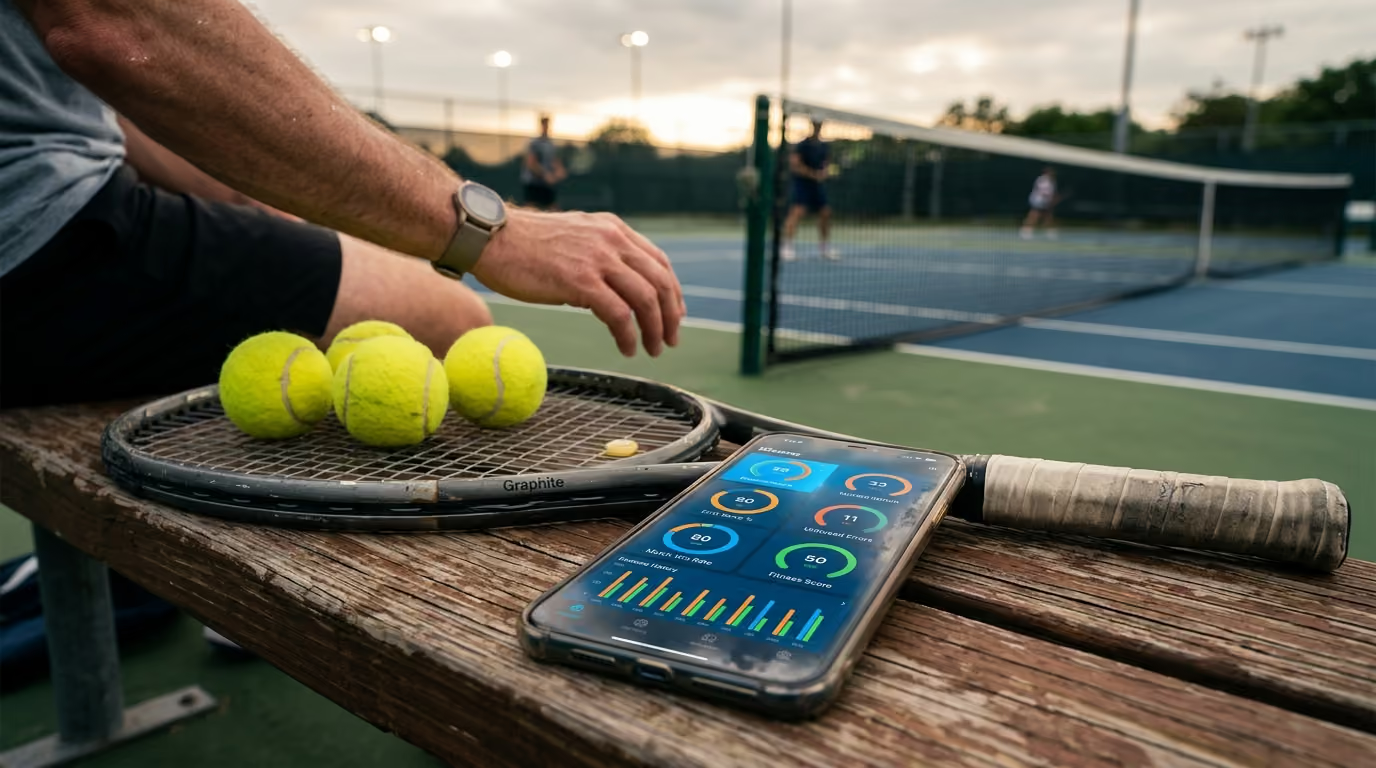
To track your development, use this text-based scorecard structure. You can copy this template into a notebook or a digital document to evaluate your sessions.
A single match is highly variable. Your opponent might play the match of their life, or the wind might disrupt your timing.
To get an accurate picture, track your metrics using rolling five-match averages. This smooths out the noise and highlights actual performance trends. If your rolling average is improving, your training is working, regardless of individual match wins or losses.
While the principles of sports psychology apply to all court athletes, the physical and tactical demands of individual sports require different targets. Let's look at how to tailor your goal setting for tennis, pickleball, and padel.
Tennis is played on a large court with high physical movement demands. Point construction is heavily influenced by the service and return phases.
If you are a tennis specialist, you can find tailored advice in our tennis articles.
Pickleball is played on a compact court with a non-volley zone. This design emphasizes fast reflexes, low-impact agility, and patient tactical play.
For more resources on mastering these compact court dynamics, explore our pickleball articles.
Padel is a fast-growing, highly tactical sport played inside a glass-and-mesh cage. It requires constant spatial awareness and partner coordination.
To dive deeper into the unique physical and tactical requirements of the court cage, read our padel articles.
Even motivated players can fall into common goal-setting traps that stall progress and cause frustration. Identifying these pitfalls early helps protect your motivation and physical health.
The most common mistake is attempting to fix everything at once. A player might step onto the court trying to improve their serve toss, change their return grip, recover faster, and manage their temper.
This causes cognitive overload. Your brain cannot process that many instructions while a ball is flying toward you at high speed.
Instead, apply the 1-1-1 rule. Choose one process goal for your stroke technique, one tactical cue for shot selection, and one reset routine for between points. This keeps your mind clear and your actions focused.
Many players focus on metrics that look impressive but do not help them win matches. Examples include hitting your first serve as hard as possible, or aiming for lines on your groundstrokes.
An elite ATP player study showed that forced errors, rather than clean winners, are highly correlated with match success. Hitting a heavy, deep ball with high net clearance is far more effective than trying to paint the lines. Avoid the trap of chasing speed at the expense of court position, margin, and physical longevity.
When a shot misses, players often assume their technique is broken. They immediately try to adjust their swing or grip.
However, many errors are actually caused by poor movement or bad decision-making. If you run to a ball and contact it late while off-balance, your stroke mechanics are not to blame. Your footwork and split-step timing caused the error.
Before you adjust your technique, analyze your miss. Determine if it was an error of decision, an error of movement, or an error of execution.
Your goal-setting framework does not just improve your performance. It also plays a key role in your physical recovery and athletic longevity. By setting structured goals, you protect your body from unnecessary wear and tear. You can explore this connection in depth through our athletic longevity training resources.
Playing racquet sports with vague, outcome-focused goals is mentally exhausting. When you judge every point by whether you won or lost, your brain experiences constant stress.
Shifting your focus to process goals reduces this cognitive load. You can control whether you executed your pre-serve routine or hit a high-margin crosscourt ball. This sense of control reduces performance anxiety, preserves your mental energy, and prevents burnout.
Tactical and movement goals directly influence your physical loading on court. A player with poor tactical positioning must sprint, stop, and change direction constantly. This places immense shear stress on your knees, hips, and ankles.
When you set goals to improve your baseline recovery and anticipation, you run less. You arrive at the ball early, in balance, and set up to strike. This efficient movement protects your joints from the hard decelerations that cause long-term wear and tear. You can find more targeted exercises for court preparation in our movement and mobility resources.
Do not limit your goals to on-court play. You can also apply process goals to your physical preparation and recovery.
Set a goal to spend ten minutes on a dynamic warm-up before every session. Make it a rule to complete a five-minute static stretching routine after your matches. These physical habits improve tissue health, reduce muscle soreness, and ensure you can return to the court tomorrow without pain.
A structured self-coaching framework is highly effective, but there are times when you need professional guidance to progress safely. Knowing when to seek expert help is essential for your athletic longevity.
If you experience persistent physical pain during or after play, consult a qualified healthcare provider, such as a sports physical therapist or orthopedic specialist. Do not attempt to play through sharp pain, joint swelling, or radiating discomfort. A professional can diagnose structural issues and design a rehabilitation program to return you to the court safely.
If you struggle with chronic developmental plateaus despite structured practice, consider hiring a certified professional coach. A qualified coach can provide immediate, correctable feedback and help you refine your technical baseline.
Additionally, if you experience severe performance anxiety or mental burnout that ruins your enjoyment of the sport, a licensed sports psychologist can help. They can supply advanced cognitive behavioral strategies to help you manage pressure and regain your competitive confidence.
You should return to this goal-setting framework whenever you experience a major change in your playing life. Re-read this guide at the start of a new competitive season, when returning from an injury, or when you feel your developmental progress has stalled. Reviewing these principles regularly will keep your training aligned with measurable, healthy improvement.
With a structured framework, you can take control of your development, protect your physical health, and continue playing the sports you love at your highest level.
Follow Evercourts for practical insights on tennis, pickleball and padel performance, movement, recovery and healthy ageing. Stay connected for new articles, research-led guidance and ideas to help you play well and keep playing for years.


Read practical guidance for better movement, smarter preparation and a game that keeps working for you.
explore the Blog