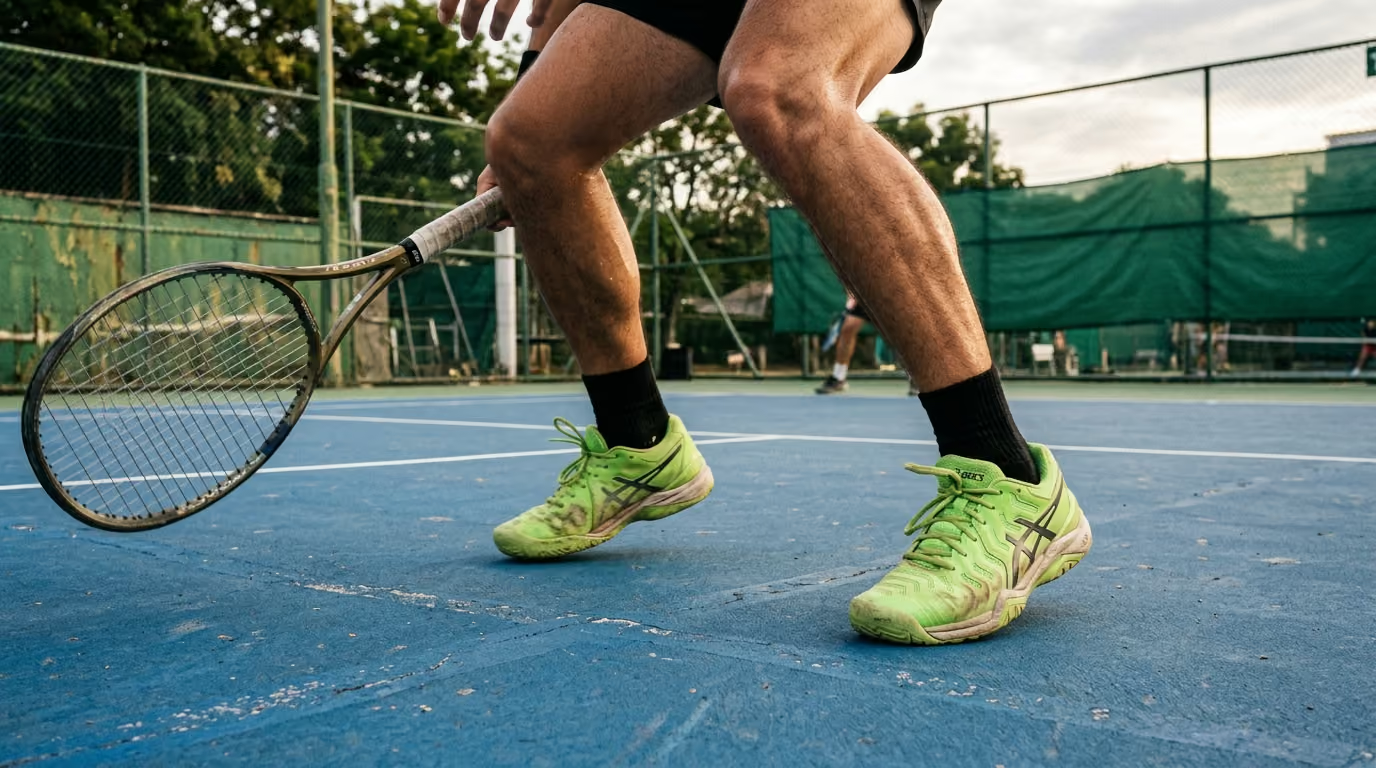
A 2024 study analyzing 182 professional singles matches at the Australian Open found players perform approximately 1.6 changes of direction per point.




I remember finishing a tough two hour padel match on a cold Tuesday night and waking up the next morning feeling like my lower back was locked in concrete. For a long time, I just accepted this as the price of playing hard in my forties. But once I started spending just ten minutes on targeted hip mobility before heading to the club, the stiffness almost completely vanished. It taught me that we do not have to accept pain as a default state of aging.
Many players believe that getting faster on the court requires endless sprint training or high-intensity interval drills. However, true court coverage is not about raw sprinting speed. To improve your overall court performance, you must master the art of deceleration, clean footwork transitions, and tactical positioning. Moving efficiently is the single best way to protect your joints, save energy, and hit more consistent shots.
To improve how you move, you must first understand what movement quality actually means. In racquet sports, movement quality is the ability to read the play, initiate movement, decelerate under control, strike from a stable base, and recover quickly. It is a repeatable cycle that preserves your energy and keeps you balanced. Excellent court movement is not about looking flashy or running at maximum speed.
Many training programs focus solely on change of direction speed. This is typically measured in pre-planned tests where you know exactly when and where to turn. While this is useful for assessing raw physical capacity, it lacks the chaotic nature of a real match. Real court coverage requires reactive agility, which combines physical speed with visual perception and decision-making.
You cannot separate movement from the tactical demands of the game. A step that gets you to the ball but leaves you off-balance is not an efficient step. High-quality movement allows you to arrive early enough to execute your shot with a stable posture. It also ensures you can immediately transition into your recovery phase. By focusing on these components, you support your player health and extend your playing years.
Recent sports science has changed how we look at court movement. A landmark 2024 study analyzed 182 professional singles matches at the Australian Open using Hawk-Eye tracking technology. The researchers tracked more than 120,000 medium-intensity and high-intensity changes of direction. The data revealed that players change direction far more often than previously thought, but rarely at absolute maximum sprint speed.
The study showed that players perform approximately 1.6 changes of direction per point. Each of these movements covers an average of 4.8 meters. Furthermore, players changed direction every 2.7 seconds in men's matches and every 3.1 seconds in women's matches. Crucially, between 88% and 94% of all tracked direction changes were categorized as medium intensity rather than maximum effort.
Another important finding was that approximately two-thirds of all direction changes involved a turn greater than 105 degrees. These sharp turns require significant braking forces and rapid redirection of momentum. This research proves that match play is dominated by repeated, moderate-intensity braking and reacceleration. Training solely with linear sprints does not prepare your body for these specific lateral demands.
This scientific reality is supported by a 2025 analysis of lateral end-range movement at the Australian Open. The study compared peak speeds, average deceleration, and average reacceleration across different ranking groups. The researchers found that elite players did not just have higher peak speeds. They also possessed vastly superior deceleration and reacceleration capacities at the very edges of the court.
The top-ten players showed a peak speed of 5.92 meters per second, with an average deceleration of minus 9.04 meters per second squared. Players ranked outside the top fifty moved at a peak speed of 5.48 meters per second, with a deceleration of minus 8.24 meters per second squared. This data highlights that the ability to brake hard and push off immediately is what separates elite movers from recreational players. Deceleration is the true foundation of elite movement.
To build better court movement, we must break down each exchange into a sequence of linked actions. In our experience, breaking the movement cycle into distinct phases makes it easier to identify and correct errors. If you only focus on the hitting phase, you miss the preparation errors that caused you to be late.
The movement cycle begins before you ever take a step. Your brain must gather visual information from your opponent’s body language, racket face angle, and ball flight. If you fail to read these cues, your first step will be late, forcing you to sprint in a panic. You must observe the opponent's shoulder rotation, contact height, and physical balance to anticipate the shot direction.
Once you perceive the ball’s path, you must initiate movement with a well-timed split-step. This light, loaded hop should be executed just as your opponent makes contact with the ball. As you land, your feet should be slightly wider than shoulder-width, with your weight on the balls of your feet. This stores elastic energy in your tendons, allowing you to push off dynamically in any direction.
After pushing off, you must choose the most efficient footwork pattern for the distance you need to cover. For short distances, a rapid lateral shuffle keeps your body facing the net. For moderate distances, a crossover step allows you to cover more ground quickly. For long, defensive runs, you must transition into a full sprint to reach the ball in time.
As you approach the ball, you must organize your torso and hips to prepare for the strike. This means lowering your center of mass and aligning your shoulders with the target. If you arrive with your body upright and stiff, you will struggle to transfer rotational force into your shot. Proper body organization links your footwork directly to your stroke mechanics.
Deceleration is the phase where most recreational players struggle. You must absorb your forward and lateral momentum by spreading the braking forces across multiple steps. The penultimate step, which is the second-to-last step before hitting, should do the majority of this braking work. This prevents you from crashing onto your final plant foot, protecting your knee joints from excessive shear stress.
To hit a clean, controlled shot, you must establish a stable base of support. Your feet must be anchored to the court, and your trunk must remain relatively upright. Striking the ball while falling backward or leaning sideways reduces accuracy and increases injury risk. A usable base allows you to use your legs and hips to generate power rather than relying solely on your arm.
Your movement is not finished when the ball leaves your strings. You must immediately transition into your recovery phase to prepare for the next shot. The first step of your recovery is usually a powerful crossover step with your outside leg. This step covers the maximum amount of lateral ground in the shortest possible time.
The final phase involves returning to a tactically appropriate position on the court. This is not always the exact middle of the baseline or the center of the kitchen line. Your recovery position must reflect where your opponent is likely to hit their next shot. Once you reach this target, you must quickly reorganize your feet and prepare for the next split-step.
Applying these movement phases requires practicing specific footwork patterns. These five patterns cover the vast majority of situations you will encounter during a match. Practicing these sequences slowly will help you build muscle memory and improve your mobility and movement efficiency.
This pattern is ideal when you only need to move one to two meters to either side. It is highly common during baseline rallies or net exchanges where the ball is hit relatively close to you.
This pattern keeps your hips square to the net, which is essential for rapid reactions.
Use this pattern when you must cover three to five meters of lateral ground. It is the workhorse movement of singles baseline play and doubles court coverage.
The crossover step allows you to cover large distances much faster than shuffling.
This is a defensive pattern used when you are pulled completely outside the singles sideline. The primary goal here is to survive the shot and return to the court before your opponent can exploit the open space.
This sequence is physically demanding and highlights why eccentric strength is essential for injury prevention.
This pattern is used when you must charge forward to hit a short ball and then immediately backpedal to avoid a lob.
Running backward in a straight line is slow and dangerous. The diagonal drop-step keeps you balanced and safe.
This pattern is your last resort when you are completely stretched out and cannot set up a stable hitting base.
Because this pattern places extreme stress on your quadriceps and patellar tendons, it should be reserved for true emergency situations.
While the fundamentals of movement quality apply to all racquet sports, the practical execution differs based on the game you play. The court size, equipment weight, and presence of walls all alter your movement strategies.
Tennis features the largest court, the heaviest racket, and the fastest ball speeds. This combination means that tennis players must cover significant distances and experience high-velocity deceleration. On clay courts, movement quality involves mastering the controlled slide, where you begin your slide before hitting the ball. On hard courts, you must rely on high-friction stopping mechanics, which place substantial demand on your tendons and muscles.
Because the tennis court is so large, you will use running steps and crossover steps far more frequently than in smaller court sports. You also have more time between shots, which allows for longer, more planned recovery sequences.
Pickleball is played on a much smaller court, which dramatically changes the movement profile. The defining feature of pickleball is the non-volley zone, commonly known as the kitchen line. Movement in pickleball is highly lateral, compact, and reactive. You rarely sprint for long distances, but you must perform hundreds of micro-adjustments per game.
At the kitchen line, your movement must be incredibly quiet and controlled. You will use short shuffle steps to stay low and maintain a square orientation to your opponents. Crossover steps are rarely used at the kitchen line because they rotate your hips, leaving you vulnerable to fast, central shots. First-step reaction time and rapid split-steps are the keys to successful pickleball movement.
Padel occupies a middle ground in terms of court size, but introduces a major variable, which is the surrounding glass and metal walls. Padel movement requires unique spatial awareness and footwork patterns. You must learn to run backward with the ball as it bounces off the glass, which involves rotating your hips and using drop-steps.
The court surface is synthetic turf topped with sand, which offers less traction than a tennis hard court. This means you must be careful when decelerating to avoid slipping. Padel also features a high volume of overhead shots and lobs, requiring frequent vertical adjustments and rapid transitions from defense to offense. You must learn to move in curved paths rather than straight lines to negotiate the corners of the court.
To build repeatable, efficient court coverage, you must train your body in a structured progression. This framework moves from building physical capacity to mastering sport-specific reactive agility. This progressive approach is designed to protect your healthy aging and athletic longevity.
Before you practice high-speed footwork, you must prepare your muscles and joints to handle the forces of deceleration. This stage focuses on building eccentric strength, single-leg stability, and tendon stiffness.
Spend four weeks in this stage to build a solid foundation of tissue tolerance.
Once you have the physical strength, you can start practicing specific movement patterns at a controlled speed. The goal here is technical precision, not cardiovascular fatigue.
Perform these drills for ten to fifteen minutes as part of your warm-up routine before playing.
Now that your technique is clean, you can introduce different movement distances and turning angles. This teaches your body how to adjust its braking strategy based on speed.
This stage teaches your nervous system how to manage different velocities and momentum shifts.
This is the most critical stage for court performance. Here, you transition from pre-planned movement to reactive, real-world movement.
By linking your movement to a visual stimulus, you train your brain and body to work as a unified system.
The final stage teaches you to maintain your movement quality even when you are physically tired. This is what prevents late-match performance drops and reduces your risk of injury.
Even experienced players make footwork errors that drain their energy and strain their joints. Recognizing these common pitfalls is the first step toward correcting them.
Many players sprint toward the ball and try to stop completely on their very last step. This places massive shear forces on the knee, ankle, and hip of your outside leg. It also makes it very difficult to hit a stable shot because your body is still moving forward during the swing.
The Fix: Start your braking process one step earlier. Use your penultimate step to absorb about 60% of your momentum. This allows your final plant foot to simply anchor your stance, giving you a rock-solid base to hit from.
Some players jump high into the air for their split-step, landing heavily on flat feet. Others split-step too early, meaning they are completely stationary by the time the opponent hits the ball. Both errors defeat the purpose of the split-step.
The Fix: Your split-step should be a light, low hop that timed so you land just after the opponent's contact. Ensure you land on the balls of your feet with your knees slightly bent. This keeps your muscles and tendons pre-loaded and ready to spring in any direction.
The crossover step is a fantastic tool for covering distance, but it is highly inefficient for small adjustments. Crossing your legs when you only need to move half a meter rotates your hips unnecessarily. This makes it harder to set up your shot and leaves you vulnerable if the ball takes an unexpected bounce.
The Fix: Use lateral shuffle steps for any movement under two meters. Shuffling keeps your hips and shoulders facing the net, allowing you to react quickly to late changes in ball flight.
How you move on the court directly impacts how your body feels the next day. Inefficient movement patterns subject your joints and muscles to unnecessary, high-impact forces. Over time, these forces accumulate, leading to chronic stiffness, tendon pain, and muscle fatigue.
When you decelerate poorly, your quadriceps and patellar tendons must absorb excessive load. This type of high-velocity, eccentric stress is a major cause of patellar tendinopathy and knee pain. By mastering the penultimate step and spreading the braking force across multiple steps, you significantly reduce the peak load placed on any single joint.
Furthermore, taking unnecessary steps on the court dramatically increases your overall physical workload. A player who moves inefficiently might take 30% more steps per match than an efficient mover. Over a two-hour match, this translates to thousands of extra muscle contractions, leading to premature fatigue. When you are fatigued, your reaction time slows down, your balance worsens, and your risk of acute injury rises.
Improving your movement quality is essentially a form of active recovery. By moving with better mechanical efficiency, you preserve your energy, reduce muscle damage, and shorten your recovery time between sessions. This allows you to play more frequently and maintain a high level of performance as you age.
While improving your footwork can resolve many court-related aches, it is important to know when to seek professional help. If you experience any of the following signs, you should consult a physical therapist, sports physician, or qualified healthcare provider:
A qualified professional can assess your movement mechanics, identify specific muscle weaknesses, and design a customized rehabilitation program to keep you playing safely.
To keep this guide practical, here is a quick summary of the core principles of efficient court coverage:
You should bookmark this guide and return to it whenever you feel your court movement is becoming sluggish or painful. It is particularly useful to review these principles at the start of a new season, when transitioning to a different court surface, or when recovering from a period of inactivity. Taking just a few minutes to refresh your understanding of deceleration mechanics and footwork patterns can make a massive difference in your next match.
Focusing on the quality of your movement, rather than just your speed, is the key to playing better and enjoying racquet sports for years to come.
Follow Evercourts for practical insights on tennis, pickleball and padel performance, movement, recovery and healthy ageing. Stay connected for new articles, research-led guidance and ideas to help you play well and keep playing for years.


Read practical guidance for better movement, smarter preparation and a game that keeps working for you.
explore the Blog