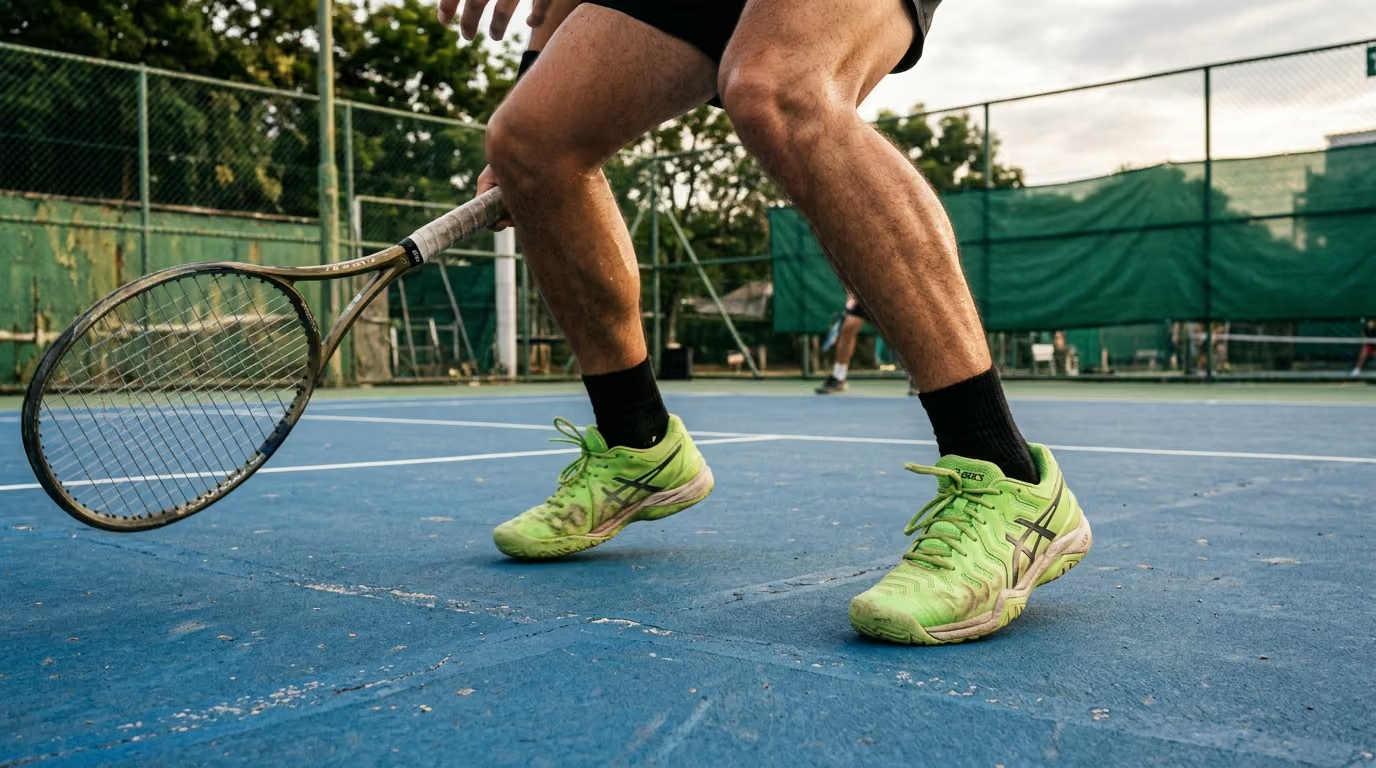
While many assume avoiding intense activity prolongs a racquet sports career, true longevity actually stems from a layered training system.




Athletic longevity in court sports is often misunderstood. It is not simply about avoiding intense activity or playing with a fear of movement. True longevity is the ability to maintain physical capacity, tissue tolerance, and movement control to continue playing for decades.
Long-term court performance relies on a layered system that uses progressive resistance training as its primary foundation. This structural base must be combined with active mobility work to preserve usable joint range, and sport-specific conditioning to prepare for live-court movement. While isolated training methods offer specific benefits, a multimodal approach supports healthy physical function and keeps you playing consistently as you age.
Understanding how to balance these training methods can mean the difference between a thriving court career and chronic physical setbacks. In this guide, we compare five major training approaches. We analyze the scientific evidence, detail practical court applications, and help you build a personalized plan for athletic longevity in court sports that keeps you performing at your best.
The scientific literature on athletic longevity paints a clear picture. Sustained athletic participation relies on building a physical reserve. This reserve allows your muscles, tendons, and joints to tolerate the repetitive impacts of court play.
A key concept in sports science is the training paradox. Research led by sports scientists like Tim Gabbett shows that high training loads can actually protect against injury if they are built up progressively. Sudden spikes in training volume, rather than high volume itself, are the primary culprit behind soft-tissue issues. According to the International Olympic Committee consensus statement on training load, monitoring physical demands is vital to protect player health.
The evidence base for general resistance training is exceptionally strong. An overview of 11 systematic reviews representing 364 primary studies and 382,627 unique participants associated resistance training with lower mortality, improved physical functioning, and better cardiovascular health. These findings show that lifting weights is not just for performance. It is a fundamental requirement for healthy aging and preserving physical function.
For sports injury prevention specifically, the data is equally compelling. A landmark systematic review and meta-analysis by Lauersen and colleagues evaluated various prevention interventions. The researchers reported a relative risk of 0.338 for strength-training programs, indicating that structured resistance work reduced sports injuries to less than one-third. The analysis also showed that a 10 percent increase in strength-training volume was associated with a reduction in injury risk of more than four percentage points.
While general physical capacity is crucial, tennis-specific research suggests that isolated methods are less effective than combined programs. A meta-analysis examining physical preparation for tennis players found that core training alone did not significantly improve serve speed. In contrast, resistance training produced a small significant improvement, and multimodal training, which combined resistance, power, and movement work, produced a moderate significant improvement. This demonstrates that a layered, diverse approach is ideal for transferring gym capacity to actual court performance.
To build an effective training program, you must understand the distinction between general physical preparation and sport-specific preparation. Both play essential roles, but they target different physical adaptations.
General physical preparation focuses on building foundational physical qualities. These qualities include absolute strength, aerobic capacity, joint range of motion, and tissue tolerance. General preparation exercises do not need to mimic the movements of tennis, pickleball, or padel.
A squat, for example, does not look like a tennis stroke. However, it builds the quadriceps and gluteal strength required to execute a deep lunge on the court. General physical preparation constructs a larger engine and a more resilient chassis. It ensures that the basic structural components of your body can tolerate high forces.
For those looking to build a structured routine, consulting strength and conditioning programs can help integrate these foundational movements.
Sport-specific preparation transitions general physical capacities into court performance. It involves drills that reproduce the timing, direction changes, stroke patterns, and work-to-rest structure of actual matches. Examples include shadow swinging, lateral shuffle drills, and rapid split-step reactions.
Sport-specific training ensures that your nervous system can coordinate your strength under match-like pressure. It refines your movement economy, helping you glide across the court with minimal wasted energy. Without sport-specific work, raw gym strength may not translate into faster reaction times or more powerful shots.
Court sports are characterized by repeated high-intensity efforts. A typical rally lasts between 5 and 20 seconds, followed by periods of lower-intensity recovery. Between points, players generally have 20 seconds of rest, with 90 to 120 seconds of rest during changeovers.
Applied physiology research recommends that conditioning drills mimic these intervals. Training should focus on work-to-rest ratios of 1:3 to 1:5. For example, a player might perform a high-intensity court movement drill for 10 seconds, followed by 40 seconds of active recovery. This structure trains your aerobic system to rapidly replenish your anaerobic energy stores between rallies.
Traditional strength training is the most defensible foundation for long-term athletic capacity. It uses externally loaded or bodyweight exercises performed with a deliberate, controlled structure.
A well-rounded program for court athletes should include:
The primary benefit of traditional lifting is its ability to combat sarcopenia, which is the age-related loss of muscle mass and strength. After age 30, physical capacity naturally begins to decline. Progressive resistance training is the most effective tool available to slow and reverse this process.
Furthermore, lifting strengthens bones, tendons, and ligaments. When you lift a heavy weight, your muscles pull on your bones. This mechanical tension stimulates bone-remodeling cells, increasing bone mineral density. It also stimulates collagen synthesis in your tendons, making them more resilient to the explosive elastic demands of sprinting and jumping.
This structural reinforcement is why resistance training is central to modern sports injury prevention strategies.
While traditional strength training is indispensable, it has clear limitations. It does not train split-second reaction times, and it does not teach your brain how to coordinate movements in an unpredictable, open-skill environment. A player can have a massive squat but still move poorly if they lack spatial awareness and split-step coordination.
Additionally, heavy lifting can induce significant fatigue. If a player performs a high-volume lower-body workout immediately before a competitive match, their technical movement quality will likely deteriorate. This temporary loss of control can increase injury risk during play.
The solution is not to avoid lifting. Instead, you must manage your training dose and coordinate your schedule. Perform heavy lifting sessions on non-court days, or space them at least 24 hours apart from intense match play.
Functional training has gained significant popularity, but its definition remains fluid. It generally refers to multi-joint exercises designed to improve movement patterns, balance, trunk control, and coordination.
Functional training routines often utilize cables, medicine balls, and single-leg positions. Common examples include:
Functional training acts as a bridge between absolute gym strength and the chaotic demands of a live match. It trains the kinetic chain, which is the sequential transfer of force from your feet, through your trunk, and out through your arm.
A systematic review of functional training in athletes reported that interventions lasting 12 to 16 weeks consistently improved functional movement screen scores. It also enhanced dynamic balance and jumping coordination. For younger cohorts, research indicates that functional and plyometric work improves agility and speed on the court.
These exercises are highly valuable for refining movement quality. They teach your body to decelerate safely, absorbing forces through your muscles rather than your joints.
The primary pitfall of functional training is the temptation to prioritize novelty over progressive overload. Many programs use excessively light weights on unstable surfaces, such as standing on a Bosu ball while performing light bicep curls.
While these exercises challenge your balance, they do not provide enough mechanical tension to stimulate muscle growth or bone density. You cannot build a resilient skeleton or strong tendons using tiny resistance bands alone.
Functional training should not replace basic strength progression. It is best used as a supplement. Use traditional lifting to build raw force capacity, and use functional exercises to integrate that capacity into athletic, multi-directional patterns.
Many court players mistake flexibility for mobility. Flexibility is passive muscle length, which is demonstrated when you hold a static stretch on the floor. Mobility is the ability to actively control your joints through a full range of motion during athletic tasks.
Racquet sports do not require extreme, gymnastics-level flexibility. Instead, players need sufficient, controllable range in several key areas. These include thoracic spine rotation, hip rotation, ankle dorsiflexion, and shoulder internal rotation.
Static stretching has traditionally been used as a primary injury-prevention tool. However, the scientific evidence does not support passive static stretching immediately before explosive activity.
A comprehensive review of flexibility and sports injuries reported that dynamic warm-ups and active-range exercises are more effective for injury prevention than passive static stretching. Prolonged static holds before a match can actually reduce your muscles' ability to produce force quickly.
Static stretching is not inherently bad. It is simply context-dependent. If you have a specific joint restriction, performing static stretches in the evening or after a match can help restore length. Before play, however, prioritize dynamic mobility.
A standard dynamic mobility routine before stepping on the court should take 5 to 10 minutes:
Circuit training organizes a sequence of exercises performed with limited rest between stations. Circuits can be designed to target cardiovascular fitness, local muscular endurance, or a combination of both.
Circuit resistance training is incredibly time-efficient. For busy adult players, finding time for separate strength and aerobic sessions can be difficult. A circuit allows you to stimulate multiple physical qualities simultaneously.
In older populations, the research supporting circuit training is robust. A systematic review and meta-analysis of circuit resistance training in older adults found significant positive outcomes. The programs led to reductions in body fat and body weight, alongside substantial increases in lean muscle mass, limb strength, and walking endurance.
For middle-aged and older women, circuit training has been shown to improve cardiorespiratory fitness, walking capacity, and functional strength. Furthermore, adherence rates in these studies are remarkably high, often ranging from 73 to 95 percent. The variety and fast-paced nature of circuits make them highly engaging and sustainable for recreational athletes.
Because rest periods are short, your cardiovascular system becomes the primary limiting factor during a circuit. This means you will not be able to lift heavy weights. If you are breathing heavily and your heart rate is near its maximum, you cannot generate the high force outputs required to build maximal strength.
Additionally, performing complex movements under high fatigue can degrade your technical execution. If you are rushing through a circuit, your squat or lunge mechanics may break down, increasing joint stress.
Circuits are highly useful for general conditioning, off-season preparation, and time-restricted players. However, they should be supplemented with dedicated, low-fatigue strength work if your goal is to build absolute force production or dynamic power.
Sport-specific conditioning is the final piece of the athletic puzzle. It involves drills that use the exact movement patterns and energetic demands of court play.
To perform well late in a third set, you must train your energy systems to recover quickly. While steady-state running builds a basic aerobic base, it does not prepare your body for the physical toll of sprinting, stopping, and turning.
Court-based conditioning drills are highly effective because they build "movement economy." Your brain learns how to position your feet efficiently, reducing the energy cost of every step.
A systematic review of competitive tennis players confirmed that combining tennis-specific technical drills with muscle-building workouts was highly effective for improving overall strength and speed. This integrated approach ensures that your athletic capacities translate directly to better court coverage.
The primary danger of sport-specific training is over-exposure. Because playing your favorite sport is fun, it is easy to accumulate massive training volumes without realizing it. Every serve, overhead smash, and lateral sprint adds stress to your tendons and joints.
To protect your overall player health, you must manage your total court exposure. The International Olympic Committee consensus notes that sharp increases in weekly training volume are closely linked to overuse injuries.
Track your weekly court time, match count, and subjective rating of perceived exertion. If your weekly court volume increases by more than 10 to 15 percent, reduce your gym volume temporarily to allow your body to adapt.
While all racquet sports share common physical demands, the specific joint stresses and movement profiles differ. Tailoring your training to your specific sport is essential for preventing common injuries.
Tennis features the largest court dimensions, which requires long-distance sprints and high-velocity deceleration. Groundstrokes are hit with extreme rotational velocity, creating significant shearing forces across the spine.
Pickleball is played on a smaller court, which reduces the need for long-distance sprinting. However, the game demands rapid-fire reaction times, constant low-to-high paddle strikes, and frequent lateral steps near the kitchen.
Padel is played on an enclosed glass court, featuring highly physical, multi-directional movements. The ball bounces off the walls, requiring players to perform rapid turns and constant overhead smashes.
Even highly dedicated players can fall victim to training errors that limit their longevity. Identifying these mistakes is the first step toward building a more resilient body.
Many players believe that static stretching before a match is the best way to protect their joints. They spend 15 minutes holding passive positions on the sideline, assuming this prepares them for explosive movement.
As the research shows, static stretching does not build the tissue tolerance or muscular control needed for rapid changes of direction. It can temporarily decrease your muscle power, leaving your joints less stable. Replace pre-match static stretching with a dynamic mobility warm-up that increases blood flow and activates your muscles.
Many players play matches five or six days a week but perform zero strength or conditioning work off the court. They assume that playing the sport is enough conditioning.
While court play builds sport-specific endurance, it also subjects your joints to highly repetitive, asymmetrical stresses. Without a general physical base, your muscles eventually fatigue, and those repetitive forces are transferred directly to your tendons, cartilage, and ligaments. This is a primary driver of chronic conditions like patellar tendinopathy, tennis elbow, and rotator cuff wear.
To keep playing for years, you must treat your body like an athletic machine. Dedicate at least one or two sessions a week to building a physical reserve in the gym.
Every training session applies a stimulus that requires recovery. Understanding how different methods affect your body helps you schedule workouts without causing chronic exhaustion.
To find more detailed strategies on managing fatigue, you can read our specialized recovery science resources.
Heavy strength training creates microscopic tears in your muscle fibers. This damage stimulates muscle protein synthesis, leading to increased strength and size. However, this process requires 48 to 72 hours of recovery.
Furthermore, lifting heavy weights challenges your central nervous system. If you perform heavy deadlifts or squats, your brain and nerves need time to recover their full communication capacity. Scheduling back-to-back heavy lifting days can lead to systemic fatigue and decreased coordination on the court.
Unlike muscles, tendons have a highly limited blood supply. This means they adapt and recover much more slowly than muscle tissue.
When you perform high-volume sport-specific training, such as serving hundreds of balls or hitting repeated overheads, your tendons experience significant mechanical strain. If you do not allow sufficient recovery time between high-impact court sessions, these tendons can enter a state of chronic degradation.
Low-intensity mobility work and light functional movement circuits have the opposite effect. Because they use minimal external load, they do not damage muscle tissue or stress your tendons. Instead, they increase local blood flow, which delivers oxygen and nutrients to healing tissues. These gentle sessions can be performed daily and actually accelerate your recovery.
While physical conditioning builds resilience, players must listen to their bodies. Distinguishing between normal training soreness and an developing injury is a key skill for longevity.
Normal delayed onset muscle soreness is bilateral, feels like a dull ache, and typically peaks 24 to 48 hours after a new workout. It should resolve gradually with light movement.
You should seek professional medical advice from a qualified physiotherapist or sports medicine physician if you experience any of the following symptoms:
Many recreational players ignore minor aches, hoping they will disappear. This often turns an easily treatable acute strain into a chronic, long-term tendon issue that requires months of rehabilitation.
An early assessment by a professional can identify movement restrictions, joint instability, or technical errors before they lead to structural damage. They can provide targeted exercises to restore function, keeping you on the court and active.
For further insights on keeping your body aligned and functional, we provide practical tips in our research-led guidance for court athletes.
To help you apply these concepts, here are five practical programming patterns. Choose the pattern that best aligns with your current goals and health status.
Goal: Play two to three times weekly while maintaining strength and avoiding joint issues.
This pattern provides a balanced mix of general physical preparation, functional work, and court play, with ample recovery time between high-load days.
Goal: Safely restore physical capacity without triggering joint irritation or tendon flares.
Goal: Maximize athletic performance, speed, and serve power while controlling cumulative load.
Goal: Build local tissue capacity in the upper limb while managing total hitting volume.
Goal: Train the specific quick-burst demands of doubles play.
When designing your long-term plan, avoid copying professional player routines. Instead, use this simple decision framework, guiding your choices with five practical questions.
If you struggle to generate ball speed, prioritize progressive resistance training to build absolute strength. If you move slowly or struggle to change direction, focus on unilateral leg strength and plyometric power. If you feel exhausted late in matches, add sport-specific interval training to improve your recovery capacity.
If you suffer from recurring tendon issues, focus on progressive tendon loading and volume management. If you feel stiff and find it difficult to reach low volleys, implement a daily active mobility routine. If you are losing muscle mass or general functional capacity as you age, make traditional strength training your non-negotiable anchor.
Do not try to perform the maximum amount of training you can tolerate. Instead, find the smallest amount of training that produces progress. For most recreational court players, two weekly strength sessions and brief daily mobility work provide a massive longevity benefit without causing excessive fatigue.
Before adding new conditioning workouts, list your total weekly physical demands. Include matches, practice sessions, private lessons, gym workouts, and daily walking. If your current exposure is high, you must remove or reduce one activity before adding another to protect your joints from overloading.
An ideal training plan must be adjusted for your age, injury history, sleep quality, and daily stress levels. If you feel constantly sore, sleep poorly, or notice your court performance declining, your current plan is exceeding your recovery capacity. Reduce your training volume or intensity until your energy levels and joint comfort return to baseline.
Yes, but you must coordinate the timing. If you perform a heavy lower-body workout immediately before playing, your muscles will be fatigued, which can alter your court mechanics and increase joint stress. If possible, separate the sessions by at least six hours, or perform your court session first when your nervous system is fresh.
Bodyweight training is a valuable starting point, particularly for lunging, balancing, and core control. However, to continually stimulate bone density and muscle mass as you age, your body requires progressive overload. Eventually, bodyweight resistance is no longer enough to trigger these adaptations, and you will need to utilize external loads like dumbbells, kettlebells, or cable machines.
During a competitive tournament, your primary goal is performance and recovery, not building new physical capacity. Reduce your gym volume by 50 to 75 percent, and eliminate heavy, fatiguing lifts. Focus on light dynamic mobility, rotator cuff stability, and gentle active recovery to keep your joints moving freely.
Doubles play features shorter court sprints and less total running volume than singles, which reduces overall cardiorespiratory demands. However, it still requires rapid reactions, sudden lateral split-steps, and repetitive overhead hitting. While you may need less steady-state cardiovascular conditioning, you still require consistent strength and mobility training to protect your shoulders, elbows, and Achilles tendons from these fast, explosive forces.
Follow Evercourts for practical insights on tennis, pickleball and padel performance, movement, recovery and healthy ageing. Stay connected for new articles, research-led guidance and ideas to help you play well and keep playing for years.


Read practical guidance for better movement, smarter preparation and a game that keeps working for you.
explore the Blog