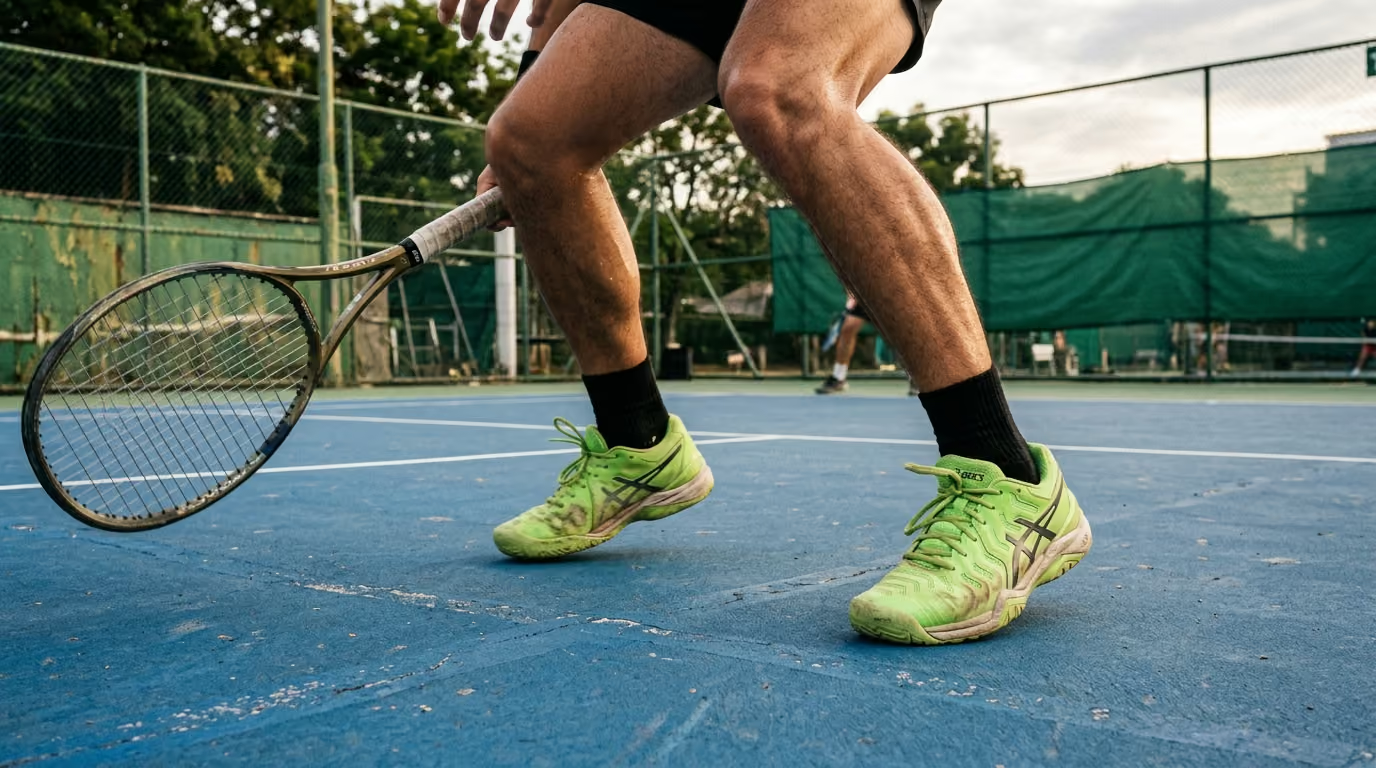
Athletes can effectively combine court practice, competitive matches, and strength training into a cohesive program that enhances performance and reduces injury risk.




You step off the court after a grueling three-set match. Your legs feel heavy, and your lower back aches from deep lunges. Instead of resting, you head straight to the gym for a scheduled lower-body strength session. Halfway through your first set of squats, you realize your coordination is off and your power is gone.
This scenario is incredibly common among dedicated racquet sports players. Balancing court practice, competitive matches, strength training, and conditioning is a complex puzzle. If you arrange these pieces poorly, your performance drops and your risk of injury increases. This guide provides a scientific framework to help you organize your weekly training. It will help you build physical capacity while keeping your court play sharp and enjoyable.
To successfully balance court play and gym work, you must organize your week to protect the quality of your most important sessions while minimizing physical overlap. This is achieved by separating high-intensity lifting and hard court sessions by at least six to twenty-four hours, prioritizing strength before conditioning when completed on the same day, and choosing low-impact conditioning tools to preserve your joints. Managing your total workload prevents local muscle exhaustion and allows your tissues to adapt, ensuring you build strength without sacrificing your performance on the court.
Concurrent training is the combination of resistance exercises and endurance work within the same broader program. For a court athlete, this is not just about adding more physical work. The objective is to organize different stressors so that strength, power, aerobic fitness, and technical skill can coexist.
Historically, sports scientists believed that training for strength and endurance at the same time was counterproductive. This concept is known as the interference effect. It suggests that the biological adaptations for endurance can block the pathways needed to build muscle and strength.
However, modern research shows that this interference is not an absolute law. A comprehensive umbrella review published in Sports Medicine examined 17 meta-analyses and 144 individual studies on healthy adults. The researchers found that concurrent training improved aerobic capacity just as well as endurance training alone. It also produced greater strength adaptations than endurance training on its own.
The interference effect is best understood as a programming risk rather than a certainty. The risk of interference increases when training volume is excessively high. It also rises when the same lower-limb muscles are repeatedly stressed without rest, or when you train while under-fueled. By understanding the underlying biology, you can design a program that minimizes these risks.
To understand how the body responds to concurrent training, we must look at cellular signals. Resistance training activates a molecular pathway centered around a protein called mTOR. This pathway is responsible for muscle protein synthesis, which helps rebuild and strengthen muscle fibers.
In contrast, endurance training activates a pathway known as AMPK. This pathway is responsible for mitochondrial development, which improves how your muscles use oxygen. Early laboratory models suggested that AMPK activation directly inhibits mTOR signaling. This led to the belief that conditioning would wash away your gym gains.
More recent human studies show that this molecular conflict is highly oversimplified. A review in the Journal of Applied Physiology concluded that acute concurrent exercise does not consistently demonstrate this molecular blockage. Your body is highly capable of adapting to both stimuli if they are programmed with adequate spacing.
For recreational and competitive players, real-world interference is rarely molecular. Instead, it is driven by mechanical wear, nervous system fatigue, and energy depletion. Focusing on these practical factors will have a far greater impact on your athletic longevity.
The physical toll of court sports comes from rapid multi-directional movement. Sprints, sudden stops, lateral cuts, and jumps require intense eccentric muscle contractions. During an eccentric contraction, your muscles must lengthen under tension to slow your body down.
This eccentric loading causes micro-tears in the muscle fibers, resulting in muscle soreness. If you perform heavy gym work like squats or lunges immediately after a hard court session, you compound this tissue damage. This local mechanical overlap can significantly delay your recovery.
A meta-analysis in Sports Medicine demonstrated that combining resistance training with running caused significant drops in strength and hypertrophy. However, combining resistance training with cycling did not produce these decrements. Cycling minimizes high-impact eccentric loading, which reduces the mechanical wear on your joints and muscles.
Neuromuscular fatigue is another critical factor to consider. Expressing explosive power and speed requires a fully recovered nervous system. If your brain cannot send strong, fast electrical signals to your muscles, your reaction times and movement speeds will suffer.
A recent review in the Journal of Strength and Conditioning Research found that performing resistance training before endurance work is more favorable for neuromuscular power. Performing your explosive work when you are fresh preserves your movement quality. This sequence ensures you do not train your nervous system to move slowly.
A practical way to manage concurrent training is the stress bucket model. Think of your body as a bucket that can hold a limited amount of physical stress. Court play, gym sessions, work stress, and poor sleep all pour water into this bucket. If the bucket overflows, your performance drops and your risk of injury rises.
To prevent your bucket from overflowing, you must categorize your weekly sessions by the specific stress they create. This allows you to space them logically across the week. You can find detailed strategies on this in our recovery science resources.
These sessions demand maximum output from your central nervous system. They require high force production, rapid coordination, and sharp mental focus. Examples include maximal sprinting, plyometric jumps, heavy low-repetition lifting, and competitive singles matches. These sessions must be performed when you are fully fresh.
These sessions place significant mechanical stress on your joints, tendons, and muscles. Examples include full-court drills, extensive change-of-direction work, and high-volume unilateral lower-body exercises. These sessions require sufficient recovery time to allow your connective tissues to repair.
These sessions are designed to challenge your cardiovascular system and deplete your energy stores. Examples include high-intensity interval training, repeated-sprint conditioning, and high-repetition gym circuits. They drain muscle glycogen and cause systemic fatigue.
These sessions promote recovery and blood flow without adding meaningful stress to your bucket. Examples include easy stationary cycling, walking, light technical shooting, and gentle range-of-motion work. These sessions can be placed between hard workouts to aid circulation and ease stiffness.
When you must combine strength work and conditioning, your sequencing choices are highly important. The most effective default approach is to perform your resistance or power work before your conditioning. This ensures you are fresh for heavy lifts, which maintains technical safety and preserves force production.
If you must perform conditioning first, keep the intensity low or focus on upper-body work. This prevents lower-body fatigue from compromising your lifting mechanics. Ideally, you should separate your strength and court sessions by at least six to twenty-four hours.
This spacing allows your nervous system to recover and replenishes your immediate energy stores. If you must train back-to-back, reduce the total volume of your second workout. Focus on high-quality movement rather than training to absolute failure.
Using non-impact conditioning tools like stationary bikes or rowers is an excellent way to build fitness during busy playing weeks. This allows you to challenge your heart and lungs without overloading your joints. Managing these variables is key to long-term performance and joint health.
To help you apply these principles, we have designed four weekly training templates. These templates show how to organize your court play and gym work for different athletic goals. They are built to protect your joints and support your athletic longevity.
This schedule is ideal for players who want to build maximum strength and power while preparing for a single competitive match on the weekend.
When playing multiple matches a week, your gym work must shift from building strength to maintaining it. Research in basketball players shows that reducing training volume during congested play preserves well-being and prevents chronic fatigue.
This option is for athletes who spend substantial time in the gym but still need excellent court stamina. For more ideas on structuring these gym blocks, check our strength and conditioning programs.
During the peak of your playing season, the gym serves to support your court performance and protect your joints from repetitive stress.
While all racquet sports share common elements, they place different physical demands on your body. Understanding these differences allows you to customize your concurrent training program. This ensures your gym work directly supports your sport of choice.
Tennis is played on a large court, which requires significant displacement. You must sprint long distances, slide on clay, or plant your foot hard on concrete. This creates extreme eccentric forces on your quadriceps, hamstrings, and patellar tendons.
In the gym, tennis players must focus on building eccentric strength to handle these braking forces. Exercises like Romanian deadlifts and step-downs prepare your lower limbs for these demands. Because of the long distances run, tennis players also need a highly developed aerobic base. Using a stationary bike or elliptical machine for your conditioning can build this base without adding to the joint stress of hard court surfaces.
Pickleball is played on a smaller court, meaning you run shorter total distances. However, the game requires you to stay in a constant, low, semi-squat position near the kitchen line. This position creates high isometric and endurance demands on your quadriceps, glutes, and lower back.
Pickleball players should focus on building endurance in these deep positions. Exercises like goblet squats, wall sits, and lateral band walks are highly beneficial. Since lateral movement is frequent but short, your conditioning should focus on short, sharp lateral drills. This prepares your feet for quick steps without requiring long-distance running.
Padel is played inside a glass-walled court and is characterized by rapid, continuous rallies. The sport involves constant turning, pivoting, and high-volume overhead smashing. This puts massive rotational stress on your thoracic spine, hips, and shoulders.
Padel players need to focus on rotational power and shoulder integrity in the gym. Incorporating half-kneeling cable chops, medicine ball rotational throws, and face-pulls will help support these demands. Your conditioning should mimic the high-energy, repeated-sprint nature of padel play. Short, high-intensity intervals on a rower or assault bike can build this specific fitness while sparing your knees.
When you are balancing court play with strength training, your gym exercises must be selected carefully. You cannot simply follow a generic bodybuilding routine. Your gym work should fill the gaps left by your court play and build your body's resilience.
First, balance unilateral and bilateral exercises. Unilateral movements, like split squats and single-leg Romanian deadlifts, build balance and address strength discrepancies between your legs. Bilateral movements, like trap bar deadlifts, allow you to train maximum strength with lower coordination demands when you are tired.
Second, manage your eccentric loading during busy court weeks. If your knees are feeling sore from concrete tennis courts, temporarily replace heavy lunges with sled pushes or step-ups. Sled training provides concentric loading without the eccentric drop, which minimizes muscle soreness.
Third, use isometric exercises to support tendon health. Holding a single-leg split squat for thirty to forty-five seconds can help manage patellar tendon discomfort. Isometrics stimulate tendon remodeling and provide a mild analgesic effect, making them an excellent choice for busy playing seasons.
Finally, choose non-impact conditioning tools when your court volume is high. If you are already running ten miles a week on the court, do not run on the treadmill for your conditioning. Use a stationary bike, rower, or swimming pool to build your cardiovascular fitness. This keeps your cardiovascular system challenged while giving your joints a break.
To maximize the benefits of your concurrent training, you must support your body with proper nutrition and hydration. Heavy lifting increases muscle protein synthesis, with research showing elevations of up to 109% at twenty-four hours post-exercise. This muscle-building response remains sensitive to protein intake for up to forty-eight hours.
To support this process, distribute your protein intake evenly throughout the day, aiming for high-quality sources every three to four hours. This consistent supply of amino acids is far more effective than relying on a narrow post-workout window.
Carbohydrates are equally critical for the concurrent athlete. Both high-intensity court play and heavy lifting draw heavily on your muscle glycogen stores. If you train twice a day, consuming 1 to 1.5 grams of carbohydrates per kilogram of body weight in the hours between sessions is essential for replenishing glycogen.
Finally, individualize your hydration based on your sweat rate and playing environment. A practical guideline from sports nutrition consensus statements is to drink approximately 450 to 675 milliliters of fluid for every half-kilogram of body weight lost during exercise. This ensures you maintain cellular hydration, joint lubrication, and optimal cognitive function during your matches.
Many players struggle with concurrent training because they fall into common programming traps. Recognizing these mistakes can save you from injury and chronic fatigue.
Many players think that if they run out of breath on the court, they simply need to do more running. This often leads to overtraining and chronic fatigue. The issue is usually not a lack of fitness, but rather a lack of recovery between your hard sessions.
Adding more high-intensity intervals to an already packed week will only empty your energy stores further. It reduces your speed, timing, and coordination on the court. Focus instead on improving the quality of your sleep, nutrition, and court play.
Some athletes avoid the gym entirely because they fear lifting weights will make them bulky or slow. This is a misunderstanding of concurrent training research. When structured correctly, strength training actually improves your running economy, court speed, and joint resilience.
You do not need to choose between being strong or being fast. By separating your lifting and court sessions, you can successfully build both qualities. Discover more on how to construct balanced weeks in our athletic longevity strategies.
Many players use running as their default conditioning tool because it feels most specific to court play. However, as the research shows, running causes significantly more muscle damage and strength loss than cycling when combined with lifting.
If you are struggling to recover from your gym workouts, switch your conditioning to a stationary bike. This simple change can dramatically reduce your lower-body muscle soreness and improve your lifting quality.
Many athletes believe that if their muscles do not feel sore, they are fully recovered. This is a mistake because central nervous system fatigue does not cause muscle pain. You can feel completely pain-free but still experience a significant drop in your vertical jump height or reaction time.
Instead of relying on soreness, monitor your performance metrics and general well-being. If your shots are consistently falling short or your feet feel heavy, your nervous system likely needs rest.
Proper concurrent programming has a profound impact on your long-term athletic health and recovery times. When you manage your training sequence and spacing, you optimize your muscle protein synthesis kinetics. This allows your muscles to repair efficiently, returning to baseline strength within twenty-four to forty-eight hours.
It also protects your connective tissues, such as tendons and ligaments, which recover more slowly than muscle tissue. Stacking high-impact sessions without adequate recovery leads to chronic tendon irritation and micro-tears. By spacing your intense workouts, you allow your collagen structures to remodel and strengthen.
This reduces your risk of developing overuse conditions like patellar tendinopathy or Achilles soreness, keeping you on the court for years to come. Managing this long-term balance is essential for maintaining your physical capabilities as you age.
While mild muscle soreness is a normal part of training, you must know when to seek professional help. If you experience sharp, localized pain during movement, persistent joint swelling, or a loss of normal range of motion, do not try to stretch or train through it. These are signs of a structural issue that requires a medical diagnosis.
Additionally, if you experience chronic fatigue, poor sleep quality, or a prolonged drop in performance that does not improve after a week of rest, consult a qualified healthcare provider. They can assess your overall health, rule out underlying deficiencies, and help you adjust your training volume safely. Protecting your court player health should always be your top priority.
When to revisit this resource: Revisit this guide whenever you transition between playing seasons, change your training frequency, or notice a persistent drop in your court performance.
Balancing the demands of the court and the gym is a dynamic process that requires listening to your body, managing weekly training volume, and prioritizing high-quality recovery.
Follow Evercourts for practical insights on tennis, pickleball and padel performance, movement, recovery and healthy ageing. Stay connected for new articles, research-led guidance and ideas to help you play well and keep playing for years.


Read practical guidance for better movement, smarter preparation and a game that keeps working for you.
explore the Blog