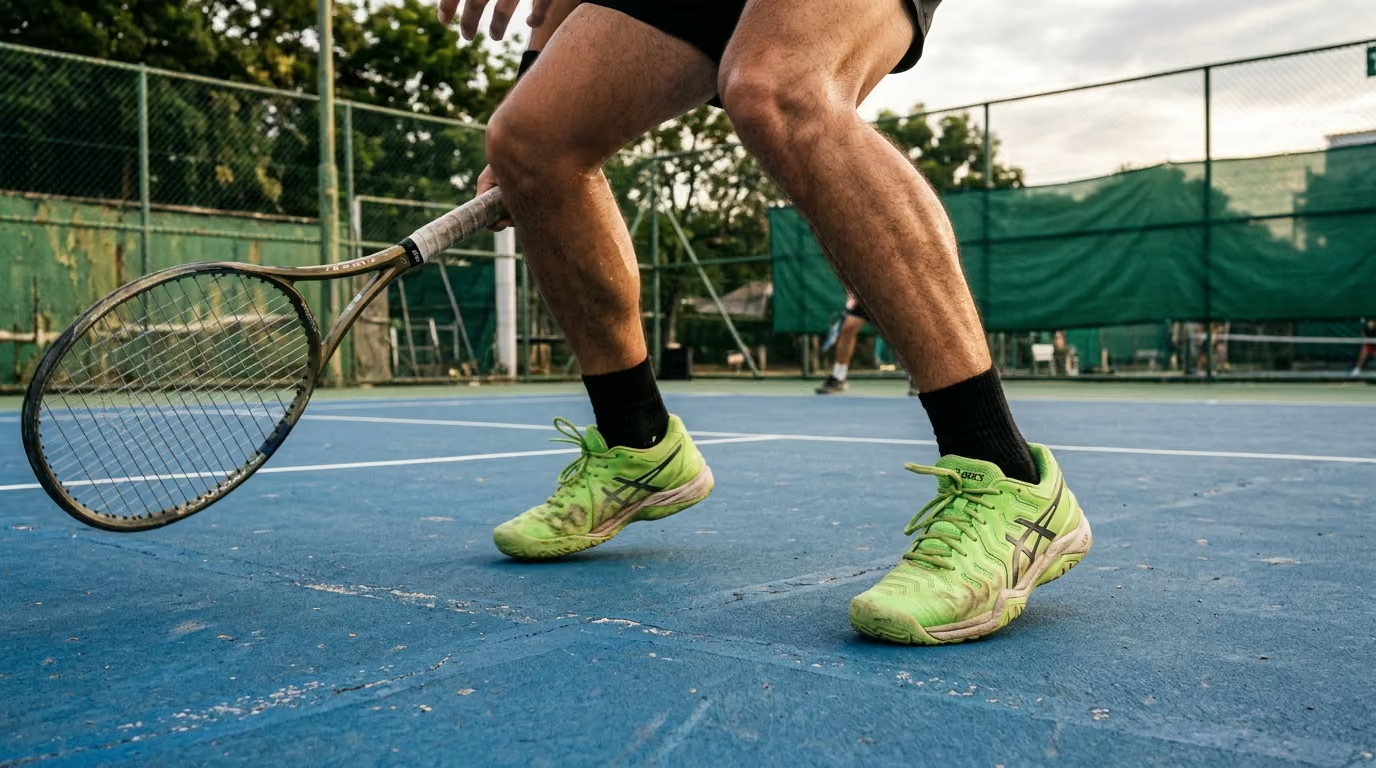
Racquet sports players can maintain peak performance throughout an entire match by developing their repeat-sprint ability through targeted high-intensity conditioning.




Many racquet sports players find themselves struggling during the later stages of a match. You might notice your feet moving slower, your reactions lagging, or your shots sailing wide. This physical decline is rarely a lack of raw talent. Instead, it is a deficit in your ability to repeat high-intensity efforts over time.
To improve your ability to repeat explosive points without losing footwork or decision quality, you must train your repeat-sprint ability. This is accomplished through structured high-intensity interval training that mimics the specific work-to-rest profiles of your sport. By combining brief, maximal efforts with complete or partial recovery, you train your body to regenerate energy rapidly between points.
Improving this physical quality allows you to maintain tactical focus when the score is close. You will no longer make desperate, low-percentage shots just to end a point early. This guide outlines the physiology of court conditioning and provides a practical framework to build your stamina.
Racquet sports are classified as intermittent, high-intensity activities. Players perform brief bursts of maximum acceleration, deceleration, and change of direction. These explosive movements are separated by short periods of active or passive rest. Understanding the energy systems that power these actions is the first step toward better training.
During the first few seconds of an explosive movement, your body relies on the ATP-PC system. This phosphagen system provides immediate, powerful energy without using oxygen. However, these stored fuel sources are depleted in about six to ten seconds of maximal effort. If a rally continues past this mark, your body must find another way to produce energy.
This is where the glycolytic system becomes more active. This system breaks down stored carbohydrates to produce energy quickly, but it generates metabolic byproducts. When these byproducts accumulate, your muscles experience that familiar burning sensation. Your movement slows, and your muscles lose their contractile efficiency.
The aerobic system is the quiet engine that runs throughout your entire match. While it cannot produce energy fast enough for a sudden sprint, it is responsible for replenishing your explosive energy stores during rest. Research from sports scientists demonstrates that a highly developed aerobic system allows players to recover faster between points. A stronger aerobic engine means you can start the next point with fully recharged muscles.
To optimize this recovery, your mitochondria must work efficiently. Mitochondria are the cellular powerplants that use oxygen to rebuild your phosphagen stores. High-intensity conditioning increases both the size and number of these powerplants. This adaptation directly improves your ability to sprint, recover, and sprint again.
Therefore, effective conditioning is not about jogging long distances at a slow pace. You must train your body to produce power quickly and recover that power during brief pauses. This dual requirement is the core of repeat-sprint ability.
Physical exhaustion does not just affect your limbs. It also takes a significant toll on your brain. When you are tired, your decision-making abilities decline rapidly. You might choose the wrong shot, misjudge the ball speed, or fail to notice your opponent's positioning.
Sports science research indicates that high heart rates and metabolic accumulation directly impact cognitive function. As fatigue sets in, the brain struggles to process spatial information. Your reaction time slows by fractions of a second. On a fast court, those fractions of a second are the difference between a clean return and a missed hit.
Additionally, motor control degrades under physical stress. Your brain struggles to send precise signals to your feet and hands. This leads to poor positioning, lazy footwork, and improper swing paths. By training your physical endurance, you are also protecting your mental clarity.
Keeping your mind sharp under pressure is a hallmark of highly conditioned players. When your cardiorespiratory system is efficient, your brain receives a steady supply of oxygen. This allows you to stay calm, analyze the play, and execute your strategy. Conditioning is just as much about mental endurance as it is about physical stamina.
During long matches, players often experience a phenomenon called central nervous system fatigue. This occurs when the brain reduces the neural drive to your working muscles to protect them from damage. Your muscles are physically capable of moving, but your brain cannot activate them with the same speed or power.
Repeat-sprint training helps delay this central fatigue. It trains your nervous system to remain highly active even when your body is experiencing metabolic stress. This mental and physical resilience is what separates average players from competitors who dominate the final set.
To design a functional conditioning program, you must analyze the temporal structure of your chosen sport. Every racquet sport has a distinct rhythm. Copying a training program designed for a different sport can lead to suboptimal results on your specific court.
In tennis, the average rally lasts between four and ten seconds. The rest period between points is regulated by rules, usually lasting around twenty to twenty-five seconds. This creates a natural work-to-rest ratio of roughly 1:2 to 1:5. A hard point is followed by a relatively generous recovery window.
Padel matches feature longer rallies due to the surrounding glass walls keeping the ball in play. Rallies often last ten to fifteen seconds, sometimes longer. The transition time between points remains similar to tennis. This yields a tighter work-to-rest ratio, typically around 1:2 or 1:3, demanding higher muscular endurance.
Pickleball presents a different challenge altogether. The court is smaller, but the pace of play is fast and continuous. Rallies are short but highly explosive, featuring rapid lateral shifts. The rest between points is often very brief, leading to work-to-rest ratios of 1:1 or 1:2.
Your training sessions should reflect these specific demands. If your sport features short, sharp bursts with quick turnarounds, your intervals must match. Training with inappropriate rest times will not prepare you for the unique physiological demands of your game.
Furthermore, the overall volume of a match must be considered. A typical tennis match can last over two hours, while a pickleball match might be finished in forty-five minutes. Your conditioning volume should scale to reflect these durations. Tennis players require more total sets of intervals, while pickleball players require high-speed density within shorter sessions.
By matching your training intervals to these real-match demands, you create highly specific adaptations. Your body becomes exceptionally efficient at clearing waste products during the exact rest windows you experience during competition.
Off-court conditioning is an excellent way to build your gas tank without adding wear and tear to your joints from court surfaces. It allows you to focus purely on physiological adaptations. You can use a running track, an air bike, a rowing machine, or a slide board.
To improve your repeat-sprint ability, you must focus on two primary types of interval training. The first is repeat-sprint training, which uses short, maximal efforts. The second is high-intensity interval training, which uses slightly longer efforts at a sub-maximal pace. Both methods are valuable for building a complete athletic profile.
You can access structured training advice through our structured strength and conditioning resources to help organize your week. Let us look at how to structure these two distinct conditioning protocols.
The goal of this protocol is to maintain maximum power output across multiple efforts. If your speed drops by more than ten percent from your first sprint to your last, the session is too demanding.
This protocol focuses on replenishing your phosphagen stores. The long rest period allows your muscles to recover enough energy to make the next sprint just as fast. If you cut the rest short, your power output will drop, and you will train endurance rather than speed.
For intermediate players, you can progress this by adding one repetition per set. Advanced players can reduce the rest period to thirty seconds, but only if they can maintain their sprint speed. Always prioritize quality of movement over sheer exhaustion.
This protocol is designed to improve your aerobic capacity and lactate clearance. It is highly effective for building the stamina needed for long, grueling matches.
During the active recovery phase, keep moving at a very slow pace. This keeps your heart rate elevated and encourages blood flow to clear metabolic waste from your muscles. If you must stop completely, reduce the intensity of your work intervals slightly.
To progress this protocol, you can increase the work duration to forty seconds while keeping the rest at thirty seconds. Alternatively, you can increase the total number of repetitions to twenty. This training helps your body adapt to the mental discomfort of high cardiorespiratory demand.
While off-court training builds your physical engine, on-court training teaches your body how to use that engine. On-court drills are highly specific because they involve racquet sport movement patterns. They train your deceleration, lateral shuffling, and backpedaling.
When performing these drills, technical precision must be your main priority. Do not let your footwork become sloppy just to finish a repetition. If you train with bad form, you will play with bad form when you are tired.
Always perform a thorough dynamic warm-up before starting these drills. You can learn more about warming up and recovering by reading our validated recovery science protocols. Here are four highly effective on-court conditioning drills.
This drill is excellent for tennis and padel players who must cover large areas of the court. It targets multi-directional acceleration and deceleration.
This drill emphasizes quick footwork transitions in tight spaces, making it perfect for pickleball players.
This drill targets the lateral endurance needed for baseline rallies.
This drill helps players develop smooth movement transitions and footwork fluidity around a central point.
The physical demands of court sports are not identical. A tennis player needs different physical qualities than a pickleball or padel player. Understanding these differences allows you to customize your training for maximum efficiency.
Tennis requires immense power and broad court coverage. You must cover large distances quickly, often sliding or lunging at the end of a sprint. Your conditioning should include longer sprint distances, typically ten to twenty meters. The focus should be on explosive first-step quickness and deep lateral deceleration.
Because tennis matches can last several hours, your conditioning must also build structural tolerance. This means your lower body must be prepared for thousands of impacts on hard court surfaces. Incorporating longer, sub-maximal interval sessions once a week will help build this physical resilience.
Pickleball demands rapid, short-distance reactions. Because the court is small, you rarely sprint more than five meters. Instead, you need exceptional lateral quickness at the kitchen line and quick vertical jumps. Your conditioning should emphasize rapid foot transitions, short shuffles, and split-step reactivity.
The density of play in pickleball is exceptionally high. You have very little time between points to recover. Therefore, your training should use shorter rest intervals, such as a 1:1 or 1:2 ratio. This teaches your cardiorespiratory system to recover while you are still moving.
Padel is a game of continuous movement and constant changes of direction. The presence of walls means the ball can return from unexpected angles. You must be prepared for frequent turning, backpedaling, and vertical overhead movements. Padel conditioning should incorporate rotational stability, rapid changes from forward running to backward shuffling, and multi-directional agility drills.
The rallies in padel are often the longest of any racquet sport. This requires a high level of muscular endurance in the quadriceps and glutes. To train this, include isometric holds or low-squat shuffles within your agility drills to simulate long, defensive points.
By adjusting your drills to match your sport, you ensure that your training hours translate directly to better match play. This specific approach is key to improving performance and protecting your healthy aging goals.
Many recreational and competitive players make mistakes that limit their progress or lead to injury. Identifying these errors early can save you time and frustration.
The first common mistake is relying solely on playing matches to build your fitness. While playing is helpful, matches do not provide the structured progression needed to improve your physical limits. Points can be short, errors can end rallies quickly, and you may spend too much time standing still. To truly build your engine, you need dedicated, structured conditioning sessions outside of regular play.
The second error is neglecting the rest intervals during high-intensity training. Many players believe that cutting rest short will make them fitter. In reality, short rest turns a speed session into a slow endurance session. If your muscles do not recover, you cannot produce the maximal power needed to train your explosive systems.
Another common error is performing static stretching immediately before a high-intensity session. Research has shown that static stretching can reduce muscle power and sprint speed. Instead, use a dynamic warm-up that increases your heart rate and prepares your nervous system for explosive movements. Save static stretching for your cool-down after the workout is complete.
Adding too much conditioning volume too quickly is another major mistake. This can lead to chronic fatigue and joint pain. To avoid these issues, refer to our long-term player health strategies for sustainable training advice. Progressive overload should be gradual, systematic, and respectful of your body's recovery limits.
High-intensity conditioning is a powerful tool, but it places a significant demand on your body. Sprints and quick changes of direction subject your muscles and tendons to intense forces. Without adequate recovery, this training can lead to overuse injuries.
Your tendons are particularly vulnerable during explosive movements. The Achilles tendon and patellar tendon act like springs, storing and releasing energy. These structures require time to adapt to the stress of rapid deceleration. If you train too frequently, these tendons can become painful and stiff.
Your central nervous system also requires rest after high-intensity sessions. Maximal efforts tax your brain's ability to coordinate muscle movements. If you feel sluggish, uncoordinated, or mentally drained, your nervous system may still be recovering from a previous workout.
To maintain tissue health, always schedule at least one full day of rest between high-intensity sessions. Focus on quality sleep, adequate hydration, and proper nutrition to support muscle repair. You can check our curated athletic resources to find tools and advice for optimizing your weekly recovery routine.
Another useful tool for tracking recovery is monitoring your resting heart rate. A sudden increase in your morning resting heart rate can indicate that your body is still under stress. If this occurs, consider reducing the intensity of your training session that day. Listening to these subtle signals is essential for long-term athletic longevity.
Remember that adaptation happens during rest, not during the workout itself. The workout is simply the stimulus that tells your body to grow stronger. If you do not provide the rest needed for that growth, you will eventually experience a plateau or a decline in performance.
While some muscle soreness is normal after hard training, pain is a signal that should not be ignored. Knowing when to seek professional help can prevent a minor issue from becoming a long-term injury.
If you experience sharp, localized pain in your joints or tendons during or after training, stop immediately. Persistent stiffness that does not improve after a thorough warm-up is another warning sign. These symptoms often indicate tendonitis or joint strain, which require professional assessment.
You should also seek advice if you experience extreme fatigue that lasts for several days. This can be a sign of overtraining, which can harm your immune system and overall health. A qualified healthcare provider, such as a physiotherapist or sports physician, can help you diagnose the issue and design a safe return-to-play plan.
Additionally, if you have a pre-existing medical condition or are returning to exercise after a long break, consult a doctor before starting a high-intensity program. They can help you determine a safe starting point and establish appropriate heart rate zones. Your safety is always the most important factor in any training plan.
We invite you to learn more About Evercourts editorial standards and our commitment to providing safe, evidence-led physical guidance. Your health and longevity on the court are our top priorities.
To help you implement this conditioning framework, here is a practical checklist of actions you can take this week. Do not try to do everything at once. Start small and build consistency over time.
By committing to a structured approach to your conditioning, you will build the physical and mental stamina needed to perform at your best. Consistency is the key to lasting change. Start today, protect your health, and enjoy the benefits of a stronger, more resilient body on the court.
Follow Evercourts for practical insights on tennis, pickleball and padel performance, movement, recovery and healthy ageing. Stay connected for new articles, research-led guidance and ideas to help you play well and keep playing for years.


Read practical guidance for better movement, smarter preparation and a game that keeps working for you.
explore the Blog