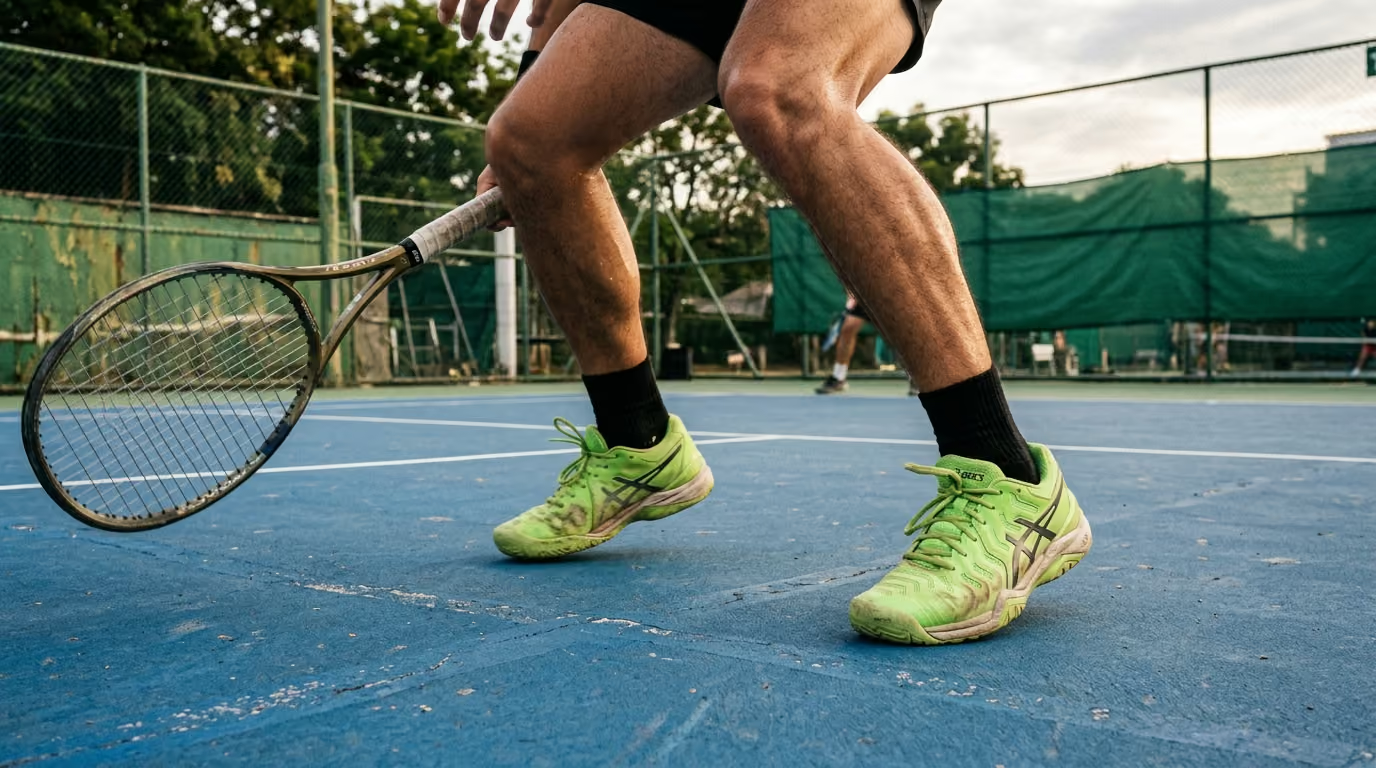
While many believe returning to competition after injury is a single event, it is actually a progressive continuum requiring a structured, criteria-based approach.




You stand at the baseline, bounce the ball three times, and prepare to serve for the first time in six weeks. Physically, your doctor cleared you to play, and you felt fine jogging on a straight treadmill. However, as you toss the ball and arch your back, a familiar wave of hesitation slows your swing. You realize that your body is physically present on the court, but your mind is still protecting your healing limb. Rushing this transition is one of the most common reasons court athletes find themselves back on the sidelines with a recurring strain.
To safely return to competition after an injury, you must transition through a criteria-based progression rather than relying on a calendar date. This process requires moving systematically from modified, controlled hitting to reactive training, full practice, and eventual match play under professional guidance. By monitoring your immediate and next-day symptom responses, you can progressively build the physical capacity and psychological confidence needed to withstand competitive match demands.
Returning to the court is not a single decision made on a specific calendar date. Modern sports medicine view recovery as a fluid, continuous process rather than a binary switch. According to a landmark international consensus statement published in the British Journal of Sports Medicine, returning to activity is a progressive continuum. This model ensures that you do not jump from basic physical therapy straight into a highly competitive match.
The progression consists of three distinct milestones that you must cross sequentially:
The first milestone is the return to participation. At this stage, you resume modified sports activities in a highly structured environment. This may include light hitting, controlled feeding drills, or reduced-volume shadow swings on the court. You are active, but you are not yet playing actual matches.
The second milestone is the return to sport. This occurs when you resume normal, unrestricted training and competition at your previous level. You can practice with your usual partners and play points without artificial constraints. However, you may not yet feel like your old self on the court.
The third milestone is the return to performance. This final stage is reached when you regain your preinjury standard of movement, tactical execution, and competitive effectiveness. You play without fear, move with fluid efficiency, and tolerate consecutive days of high-intensity play. This milestone represents a successful return to your preferred lifestyle.
A key guiding principle for any racquet player navigating this continuum is straightforward. Being able to perform an isolated movement is not the same as being prepared to repeat that movement unpredictably, under fatigue, while making tactical decisions, across the duration of a match. Recognizing this distinction helps you avoid premature competitive exposure. It shifts your focus toward building comprehensive court capacity before testing yourself in a tournament environment.
When deciding whether to progress to the next step of your recovery, you should use a structured decision-making framework. This framework, adapted from sports medicine research by Dr. Ian Shrier, removes guesswork and emotional pressure. It evaluates three independent areas to ensure that every progression is safe, logical, and agreed upon by your care team.
The first stage of this framework examines your objective health status. Your physical therapist or medical provider will evaluate your current symptoms at rest and during activity. They will assess your range of motion, local tissue strength, and neuromuscular control. This stage asks a simple question: Has the injured tissue healed sufficiently to tolerate the physical stress of the next step?
The second stage analyzes the specific participation risk of your target activity. Not all court sessions are created equal. A controlled doubles practice with cooperative partners carries much less risk than a competitive singles tournament match. You must evaluate variables like court surface friction, expected match duration, and the need to cover open space.
The third stage focuses on risk tolerance and shared decision-making. This process involves balancing your personal goals, tournament schedules, and long-term athletic longevity. It requires honest communication between you, your coach, and your healthcare provider. A collaborative approach helps expose personal blind spots, such as an athlete hiding mild pain just to play a weekend final.
This three-stage model rejects two common but problematic approaches to recovery. It rejects the idea that an athlete is ready simply because they feel motivated to play. It also rejects the outdated model where a doctor dictates a timeline without considering the player's specific lifestyle goals. Instead, it promotes a collaborative, step-by-step assessment that protects your body while respecting your competitive drive.
For many years, players relied on the calendar to decide when they could return to the court. A player with a minor calf strain might wait four weeks, assume they were healed, and immediately sign up for a local tournament. However, sports science research strongly recommends abandoning purely time-based decisions. While tissue healing requires a minimum biological window, elapsed time alone does not prove that you are physically ready for the demands of competition.
A criteria-based progression requires you to hit specific physical milestones before moving forward. This approach ensures that your muscles, tendons, and nervous system can actually handle the forces of racquet sports. You must prove your readiness through objective tests rather than relying on a calendar date. These milestones provide a transparent, logical roadmap for your recovery.
A comprehensive criteria-based assessment looks at several critical physical qualities:
The consensus statement on return to sport specifically recommends incorporating direction changes and reactive agility into your testing. This is highly relevant for racquet sports, where you rarely run in a straight line. You must constantly adjust your steps based on the unpredictable flight of a ball or shuttlecock. If you cannot change directions quickly in a controlled test, you are not ready for a match.
It is important to remember that physical test results are not simple pass or fail indicators. They are valuable pieces of clinical evidence that require professional interpretation. A physical therapist will look at your overall movement quality, your psychological confidence, and your specific sport demands. Using these criteria ensures you build a foundation that supports long-term athletic longevity.
When you are ready to transition back to the court, you should follow a structured, multi-stage roadmap. This framework helps you safely increase physical demands without overloading healing tissues. This progression is highly adaptable, allowing you to move at your own pace under professional guidance. It ensures that every step you take builds directly on the previous one.
In this initial phase, your goal is to resume ordinary daily activities and build basic physical capacity. You will focus on non-impact cardiovascular work, structured mobility drills, and targeted strength exercises prescribed by your physical therapist. These activities must not reproduce your concerning clinical symptoms. The primary objective is to prove that your body can handle basic movement without inflammation or pain.
Once you have established basic physical capacity, you can step back onto the court for highly controlled sessions. You will start with shadow swings without hitting a ball, focusing on smooth, pain-free movement. Next, you can progress to hitting stationary groundstrokes from soft hand feeds. Keep these sessions short, limit your court coverage, and ensure you take long, complete rest intervals.
This stage reintroduces the dynamic footwork patterns that define racquet sports. You will practice the split-step, lateral shuffles, gentle forward lunges, and controlled recovery steps. These drills should be completely predictable at first, allowing you to focus on your biomechanical technique. These structured patterns help prepare your joints for the high-impact forces of real match play.
Now you can begin testing your physical capacity under realistic training conditions. You will participate in multi-ball drills, random coach feeds, and full-court movement patterns. This stage introduces physical fatigue, allowing you to see if your movement quality remains stable when you get tired. These demanding drills help bridge the gap between static rehabilitation and dynamic play.
In this stage, you will join your regular hitting partners for selected portions of their practice. You might play cooperative rallies, practice specific court patterns, or play points with modified rules. If appropriate for your sport, you should play doubles before singles to reduce your individual court coverage. Make sure your partners know your physical boundaries before you begin.
Before you enter a real match, you must demonstrate that you can complete full-intensity practice sessions without modification. You should be able to run, lunge, change directions, and swing at maximum effort. This stage tests your ability to recover between hard training sessions. It ensures that your body can tolerate the unpredictable workload of competitive play.
Your first competitive match should be treated as a controlled physical exposure rather than a high-stakes event. Consider playing a friendly doubles match, using a shorter scoring format, or playing against a cooperative opponent. Set a strict limit on your match duration and focus on your movement quality. Your goal is to execute your game plan and monitor how your body responds.
Once you tolerate modified competition without symptoms, you can return to full-intensity, unrestricted match play. You can participate in tournaments, play consecutive match days, and execute your entire tactical repertoire. This stage represents the successful restoration of your competitive lifestyle. You can now focus on improving your ranking and enjoying your sport for years to come.
This structured roadmap integrates naturally with long-term athletic development. To ensure your body is fully prepared for these stages, you can utilize structured strength and conditioning programs to rebuild muscle tissue. Additionally, incorporating targeted mobility and movement training will help restore the joint fluidity needed for advanced court play.
One of the biggest challenges of returning to the court is that your body can lie to you. During a fun session, the excitement of play and natural adrenaline can easily mask mild discomfort. You might feel completely fine while hitting, only to experience severe stiffness or swelling the next morning. Therefore, you must monitor both your immediate physical response and your delayed symptom response.
A simple daily training log is an excellent tool for tracking your physical recovery. You should record your symptoms before play, during the session, immediately afterward, and the following morning. You can also rate your session duration, perceived physical exertion, and overall mental confidence. Keeping this log simple ensures you will use it consistently throughout your progression.
To help guide your daily decision-making, you can use a simple traffic-light model:
The green light indicates that you completed your planned session without pain or loss of physical function. You experienced no next-day stiffness, and your care team agrees you are ready to progress. You can safely move to the next level of your training roadmap.
The yellow light indicates that you completed your session but experienced mild discomfort, unusual fatigue, or next-day soreness. This is a sign to hold your current workload steady, modify your drills, or take an extra rest day. Do not increase your training volume or intensity until these symptoms resolve completely.
The red light indicates that you experienced sharp pain, acute swelling, joint instability, or a marked loss of physical function. You must stop your activity immediately and contact your healthcare provider. This response shows that the physical demands of the session exceeded your current tissue capacity.
When progressing your training, you should always follow the "one variable at a time" principle. Do not increase your session duration, movement speed, and competitive intensity all in the same week. By changing only one training variable at a time, you can easily identify what triggered any flare-ups. This systematic approach protects your joints and keeps your recovery on track.
Understanding the difference between external, internal, and contextual load is also vital. External load is the physical work you perform, such as hitting one hundred groundstrokes or practicing for forty-five minutes. Internal load is your body's physiological and psychological response to that work, measured by your heart rate and perceived exertion. Contextual load includes environmental factors like extreme heat, a high-friction court surface, or travel fatigue. Balancing these three loads is a core concept in modern recovery science, helping you avoid overtraining.
Returning to the court after an injury is a psychological challenge as much as a physical one. It is completely normal to feel anxious about reinjuring yourself when you first return to play. You might find yourself hesitating before a deep lunge or holding back on your serve. Acknowledging these feelings is an essential part of a comprehensive recovery plan.
A systematic review of sports psychology literature found that psychological readiness is a strong predictor of return outcomes. Athletes with high motivation, high confidence, and low fear return to their previous level of play much faster. Conversely, high levels of anxiety can lead to stiff, awkward movements that actually increase your risk of reinjury. Building mental confidence is just as important as rebuilding muscle tissue.
To support your psychological recovery, you can focus on three basic human needs:
First, build your sense of competence by setting clear, achievable progression goals. Celebrating small victories, like completing a controlled hitting session without pain, helps rebuild your belief in your physical capabilities.
Second, support your autonomy by actively participating in your return-to-play decisions. Working closely with your care team to design your roadmap gives you a sense of control over your recovery.
Third, maintain your relatedness by staying connected to your local racquet sports community. Even if you cannot play, you can still visit the club, support your teammates, and participate in social activities.
You can also use practical psychological strategies like graded exposure and positive self-talk. Graded exposure involves gradually introducing the movements you fear, such as lateral lunges, in a safe environment. This systematic exposure helps convince your brain that these movements are safe and pain-free. If you find that anxiety continues to limit your play, consider consulting a qualified sports psychologist.
While tennis, pickleball, and padel share many common patterns, they place distinct physical demands on your body. Understanding these sport-specific nuances helps you tailor your return roadmap to your preferred game. It ensures that your rehabilitation matches the exact movement patterns you will face in competition.
A 2025 cross-sectional study of Olympic racquet athletes highlighted the heavy demands placed on the lower body. The research showed that 78% of the most common injuries across these sports involved the lower extremities. However, the study also noted that badminton players reported injuries more frequently than tennis and table tennis athletes. This highlights how different court sizes and equipment weights influence physical risk.
Tennis requires you to cover a large court area, placing a premium on lateral speed, deceleration, and rotational power. The long, heavy racquet increases the leverage forces acting on your shoulder, elbow, and wrist joints. A tennis player returning from a shoulder injury must pay close attention to their serving volume. Serving place extreme eccentric loads on the rotator cuff and shoulder girdle.
A comprehensive tennis progression should focus on:
To protect your body from these severe forces, you should incorporate targeted injury prevention strategies into your weekly routine.
Pickleball is played on a much smaller court, which reduces long-distance sprinting but increases short-burst agility. The game is characterized by rapid-fire volley rallies at the non-volley zone line, also known as the kitchen. This requires you to maintain a deep, low athletic stance for extended periods. This position places significant isometric demands on your quadriceps, knees, and lower back.
A comprehensive pickleball progression should focus on:
Focusing on these specific joint angles helps prevent common pickleball overuse injuries, such as knee tendinitis or lower back strains.
Padel is a fast-paced game played within an enclosed glass court, requiring three-dimensional movement and rapid transitions. You must constantly adjust your position to account for ball rebounds off the glass walls. Padel requires frequent overhead shots, such as the bandeja or smash, to maintain net position. This places a high demand on your shoulder stability, thoracic mobility, and vertical jumping capacity.
A comprehensive padel progression should focus on:
By tailoring your recovery to these unique demands, you can safely return to the fast, exciting rallies of padel.
The following table summarizes the primary biomechanical demands, common injury locations, and key progression priorities for each of these three racquet sports:
Even the most dedicated players can make mistakes when navigating their return to the court. These errors are often driven by a strong desire to play and a natural impatience with the rehabilitation process. Recognizing these common pitfalls can help you avoid unnecessary setbacks and protect your long-term health.
The first common mistake is assuming that the absence of pain means you are ready for match play. Pain is a subjective signal that often disappears long before your muscles and tendons have fully rebuilt their strength. If you return to competition based solely on a lack of resting pain, you risk overloading weak tissues. You must prove your readiness through objective movement and strength testing.
The second common mistake is hiding mild symptoms from your coach, partner, or physical therapist. You might downplay a slight ache in your elbow or a minor pull in your calf to avoid missing a weekend match. However, hiding these symptoms prevents your care team from making necessary adjustments to your training load. It often leads to secondary compensation injuries as you alter your movement to protect the painful area.
These mistakes often disrupt the natural biological tissue adaptation process. By rushing past essential progression steps, you prevent your body from building the structural resilience needed for court sports. Taking a patient, systematic approach is the best way to ensure your return is permanent and successful.
Every time you step onto the court, you subject your muscles, tendons, ligaments, and joints to significant mechanical stress. When recovering from an injury, these tissues require a carefully managed load to heal and adapt correctly. A gradual reload stimulates collagen synthesis, improves tendon stiffness, and helps restore normal muscle fiber alignment.
If you return to play too quickly, you risk entering a dangerous "boom-and-bust" cycle. This occurs when you play a hard match, experience a symptom flare-up, and are forced to rest for several weeks. This cycle keeps your tissues in a constant state of low-grade inflammation, delaying your ultimate recovery. A structured, gradual progression avoids these wild fluctuations and supports healthy tissue remodeling.
The first few weeks after you return to play require especially careful monitoring. Research on hamstring strains shows that recurrence rates range from 12% to 33%, with 59% of these recurrences occurring within the first month of returning to sport. This high rate of early reinjury highlights the vulnerability of healing tissue. By keeping your training volume low during this critical window, you protect your body when it is most vulnerable.
Similarly, research on ACL reconstructions reveals that while 87% of athletes return to sport, 18% experience a subsequent reinjury to either the graft or the opposite knee. Most of these reinjuries occur during high-risk, multi-directional sports. These statistics show that simple medical clearance to participate does not guarantee that your preinjury physical capacity is fully restored. A patient, disciplined progression is your best defense against chronic, recurring setbacks.
While a structured, self-guided progression is highly valuable, it should never replace qualified clinical oversight. You should work closely with a physical therapist, sports physician, or athletic trainer throughout your recovery. These professionals provide the objective testing, clinical feedback, and personalized adjustments needed to keep you safe.
You should consult a healthcare provider immediately if you experience any of the following warning signs:
It is also critical to understand that head injuries are non-negotiable. If you experience a fall, collision, or suspected concussion on the court, you must seek immediate medical evaluation. You should never attempt to self-manage a head injury or return to play without formal medical clearance.
The CDC HEADS UP program outlines a supervised, six-step return-to-sport progression for concussion recovery. This protocol requires you to complete each step for at least 24 hours under professional supervision. If any neurological symptoms return during this process, you must stop immediately and contact your doctor. Treating head injuries with this level of respect is vital for protecting your long-term health and athletic longevity.
You should return to this guide whenever you are preparing to transition to a new stage of your recovery. It is highly useful when you are ready to move from controlled drills to competitive practices, or when you are planning your first modified match. Re-reading these stages helps keep your expectations realistic and reminds you of the essential monitoring protocols.
You should also revisit this resource if you experience a minor setback or a plateau in your training. Reviewing the traffic-light decision model can help you safely adjust your training load. For more information on maintaining a healthy, active court lifestyle, visit the Evercourts Resources Page to view our full library of research-led player guides.
By taking a patient, systematic, and criteria-based approach, you can safely navigate your recovery and return to the court with absolute confidence.
Follow Evercourts for practical insights on tennis, pickleball and padel performance, movement, recovery and healthy ageing. Stay connected for new articles, research-led guidance and ideas to help you play well and keep playing for years.


Read practical guidance for better movement, smarter preparation and a game that keeps working for you.
explore the Blog