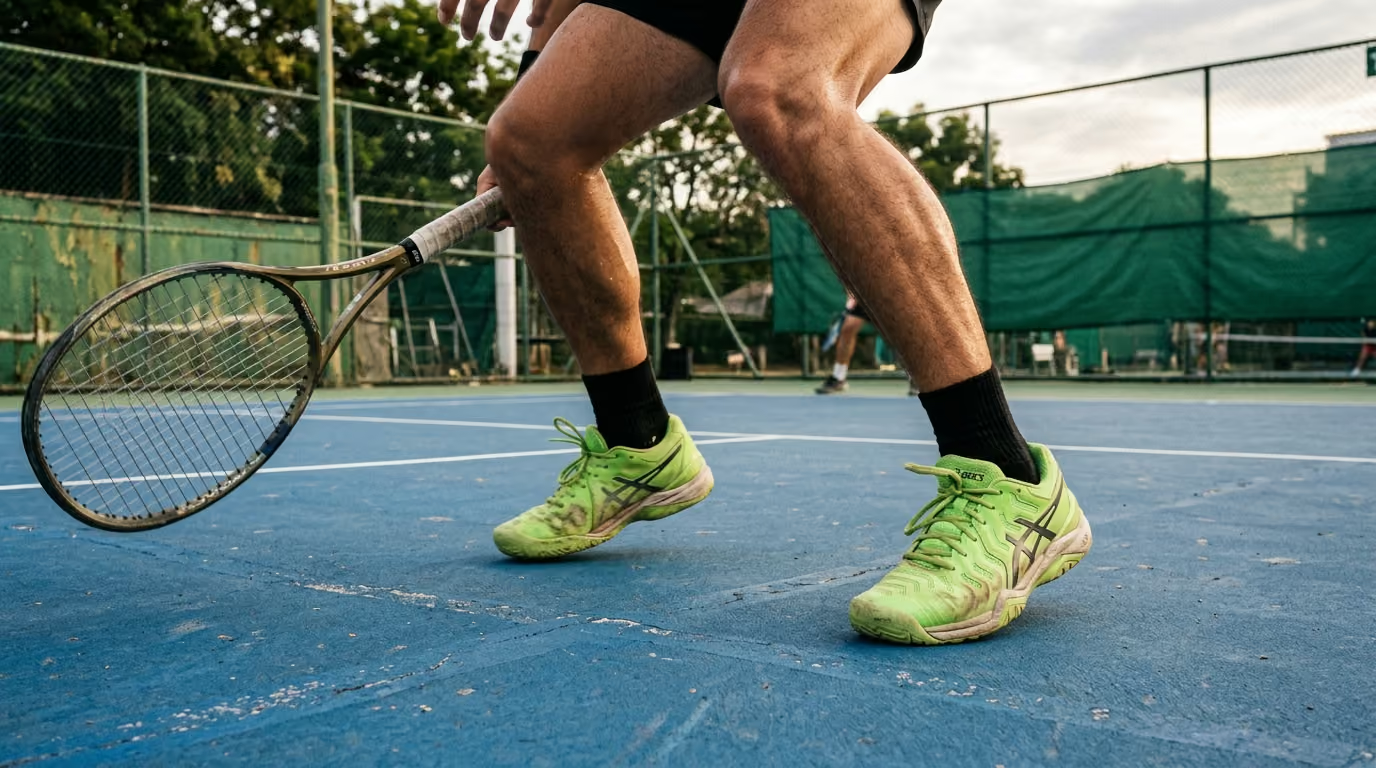

Players over 40 can achieve durable rotational power in racquet sports by integrating leg drive, hip mobility, and trunk control for powerful, injury-resistant play.




Many mature players find that their serves lose velocity and their forehands lack depth. They often try to fix this by swinging harder with their arm or twisting their lower back. This approach usually leads to sore shoulders, aching muscles, and frustration on the court.
Developing durable rotational power requires training the entire kinetic chain to coordinate, transfer, and absorb force rather than relying on isolated trunk twisting. After age 40, this means combining leg drive, hip mobility, and trunk control to produce controlled power while protecting vulnerable joints. This balanced approach helps preserve court performance and keeps you playing without interruption.
Rotational strength is not simply the ability to twist the torso or perform loaded abdominal exercises. It is the ability to create, transfer, resist, and decelerate force across the entire body. The kinetic chain connects your feet, legs, hips, pelvis, trunk, shoulder, arm, forearm, hand, and racquet. When these segments work in harmony, you produce smooth and repeatable power on the court.
For players over forty, the focus should be on controlled power. This means having enough force and speed to serve and hit effectively. It also means having enough strength, mobility, and balance to absorb repeated impact.
To understand rotational power, we must divide it into four distinct qualities. The first is rotational force production, which is the ability to create torque to turn the pelvis and trunk. The second is the rotational rate of force development, which means producing that torque quickly enough for match play. The third is anti-rotation and positional control, which prevents excessive trunk motion and keeps you balanced.
The fourth and most critical quality for athletic longevity is deceleration capacity. This is the ability to absorb force after you strike the ball, land from a jump, or complete a follow-through. A player can often accelerate a racquet faster than they can safely slow their arm and body down. This imbalance is why many injury-prevention guides focus on strengthening the decelerating muscles, including the upper back, hips, and rotator cuff.
Adult athletes are highly diverse, meaning forty looks different for everyone. A fifty-year-old recreational league player has different needs than a seventy-year-old lifelong competitor. Your training history, current court volume, and past injuries all shape your physical capacity.
As we age, power and speed tend to decline faster than maximal strength. This shift occurs because we lose fast-twitch muscle fibers if we do not train them. Fortunately, research shows that master athletes can preserve their muscle strength and physical function through targeted training. Engaging in structured healthy aging and athletic longevity resources can help you maintain high performance as the years pass.
To maintain power, older adults should include speed-oriented training in their weekly routines. The American College of Sports Medicine recommends using moderate loads for power development. Specifically, using thirty to seventy percent of your one-repetition maximum with a fast concentric phase is highly effective. This approach teaches your nervous system to fire quickly without overloaded joints.
A meta-analysis of forty-seven studies involving older adults showed that resistance exercise significantly improved multiple strength measures. These studies found that higher intensity programs yielded greater improvements, with strength increases ranging from twenty-four to thirty-three percent. Even the oldest adults can build muscle size and strength through progressive resistance work. By training with intent, you can preserve the physical qualities needed for sudden lateral movements and explosive overheads.
A successful racquet stroke starts at the ground and moves upward. When you push off the court, ground reaction forces travel through your lower body to your trunk. The trunk acts as a vital transfer station, amplifying and passing this energy to your shoulder and arm. If there is a weak link in this chain, your swing will lose speed and place extra stress on your upper limb.
To build an efficient swing, players must use structured strength and conditioning resources that target every link in the chain. Biomechanical models of the tennis serve reveal that more than fifty percent of the total force comes from the legs and trunk. Specifically, one review estimated that the lower body and trunk contribute fifty-four percent of the energy, while the elbow and wrist contribute only twenty-five percent. Another model estimated that the legs and trunk generate fifty-one to fifty-five percent of the kinetic energy delivered to the hand.
These percentages show that relying on your arm to generate power is a major mechanical error. When players use minimal leg drive, they must compensate by straining the shoulder and elbow. In biomechanical studies, servers with poor leg drive showed less knee flexion and greater anterior shoulder force. They also experienced higher stress on the inside of the elbow during the cocking phase of the serve.
To optimize force transfer, your body must follow a proximal-to-distal sequence. This means that larger, central segments like the hips and torso fire before smaller, outer segments like the arm and wrist. While professional players adapt this sequence depending on the shot, the general pattern remains highly connected. Protecting your joints means letting your large leg and hip muscles do the heavy lifting.
Every stroke on the court demands a unique pattern of rotation and control. The serve is the clearest example of whole-body power transfer. It combines a deep leg drive, hip rotation, trunk extension, shoulder movement, and rapid wrist action. Rebuilding a reliable serve requires a systematic progression: loading, driving, rotating, elevating, accelerating, and braking.
On groundstrokes like the forehand, the hips and pelvis must rotate while maintaining stability. Open-stance forehands require you to load and absorb force primarily through your outside leg and hip. A neutral or closed stance allows for a more linear transfer of weight toward your target. In both cases, the trunk must rotate without excessive arching in your lower back.
The backhand also relies heavily on rotational strength across both sides of the body. A study supported by the United States Tennis Association analyzed elite players and found that rotational strength was closely correlated with medicine-ball throw performance. The correlation was high, showing that balanced, bilateral rotational training is useful for groundstroke power. Developing equal strength on both sides helps prevent the muscle imbalances that often lead to chronic discomfort.
Volleys and overheads require a different blend of control and power. Volleys do not use a long backswing, meaning you must rely on stable shoulders, quick foot positioning, and a quiet trunk. Overheads resemble serves but are often hit while moving backward or jumping. This movement requires exceptional single-leg balance, thoracic mobility, and landing control to absorb the impact of the shot safely.
A durable rotational training program is built on six key pillars. These pillars are designed to improve your strength, coordination, and tissue tolerance over time.
The lower body is the foundation of your court speed and power. You must train your legs to both produce upward force and absorb downward landing loads. Useful exercises for this pillar include:
Squats are especially valuable because they are frequently recommended in injury-prevention protocols. You do not need to lift extremely heavy weights to benefit from these movements. Using dumbbells, kettlebells, or resistance bands allows you to challenge your muscles while keeping your joints comfortable.
Your hips must be able to rotate internally and externally while maintaining pelvis stability. If your hips are stiff, your lower back will twist excessively to compensate. Excellent exercises for hip rotation include:
These movements teach your hips to absorb the twisting forces of a hard forehand or backhand. By improving hip mobility, you reduce the strain placed on your lumbar spine.
Your core training should include both active rotational movements and anti-rotation exercises. Active rotation builds power, while anti-rotation teaches your body to resist unwanted twisting. Consider using these exercises in your routine:
Incorporating injury prevention resources that focus on these movements will make your core highly resilient. The goal is to build a trunk that can transfer force smoothly without collapsing under load.
The upper body must transmit and decelerate the force generated by your legs and trunk. If your shoulder blade does not move well, your shoulder joint will face excessive stress. Focus on these movements to build upper-body capacity:
A balanced program avoids excessive chest pressing and instead prioritizes pulling and rotating movements. This balance helps keep your shoulders healthy during repeated overhead serving.
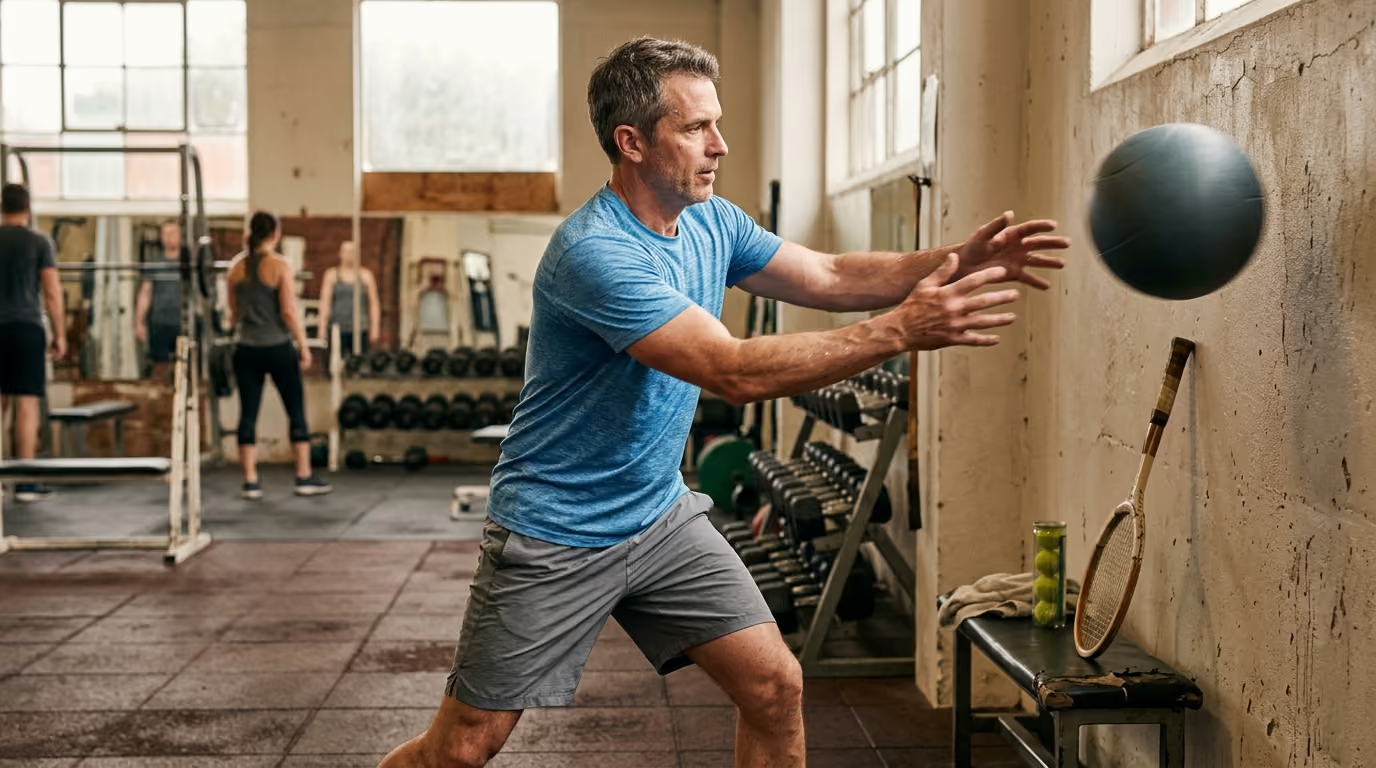
Power training teaches your nervous system to coordinate fast movements. This work should always be done when you are fresh, before heavy fatigue sets in. Try adding these power-focused exercises:
Keep your repetitions low and focus on maximum speed and perfect form. Stop the set immediately if you feel your coordination or balance start to slip.
To make your gym strength useful, you must practice transferring it to your sport. This step bridges the gap between general fitness and court-specific coordination. Use these drills to build that connection:
Integrating mobility and movement resources into your warm-up will help prepare your nervous system for these drills. Progression should always be gradual to avoid overwhelming your tissues.
To turn your physical preparation into better performance, you should perform specific movement drills on the court. These drills do not require a partner and can be done during a practice session or as part of an extended warm-up.
First, practice the split-step to rotation drill. Stand at the baseline, perform a light split-step, and immediately turn your hips and shoulders into a forehand or backhand position. Focus on keeping your feet wide and your knees slightly bent to absorb the movement. Perform three sets of ten repetitions, focusing on a smooth and balanced transition.
Second, use the progressive serve loader to build durable overhead power. Start by standing at the service line and hit ten serves at fifty percent intensity, focusing on your knee bend and balance. Move back to the baseline and hit ten serves at seventy percent intensity, ensuring your arm remains completely relaxed during the swing. Finish with five serves at eighty-five percent intensity, focusing on a balanced, single-leg landing. This progression allows your joints to warm up and adapt to the specific forces of the serve.
Third, practice the open-stance deceleration drill to improve your lateral recovery. Set up two cones five feet apart along the baseline. Move laterally to the outside cone, plant your outside foot, and perform a shadow forehand swing. Focus on holding that planted position for one full second before recovering back to the center cone. This drill teaches your hip and knee to absorb the force of your swing, which is essential for court longevity.
While tennis, pickleball, and padel all require rotational power, they place different physical demands on your body. Understanding these differences helps you tailor your training to your specific sport.
Tennis is characterized by a larger court, heavier racquets, and longer stroke paths. The high velocity of the incoming ball requires significant force absorption through the legs and trunk. You will frequently find yourself in wide, open-stance positions on the baseline.
This sport demands excellent single-leg deceleration and deep pelvic control. Serving in tennis also requires the greatest amount of trunk extension and overhead shoulder rotation. Your training should emphasize hamstring strength, hip mobility, and rotator cuff endurance to handle these large-amplitude movements.
Pickleball is played on a smaller court with a lighter paddle, leading to a much faster tempo of play. Most rallies are played near the non-volley zone line, where quick hand-speed is critical. You will spend less time in a deep backswing and more time in a low, athletic crouch.
In this sport, rotational power is less about massive swings and more about rapid, short-range pelvic adjustments. You must be able to stay low, rotate your trunk quickly to block a ball, and immediately return to balance. Your training should focus on quad endurance, lateral hip strength, and rapid anti-rotation control to keep your paddle stable during fast volleys.
Padel is played in an enclosed court and features constant rebounds off the glass walls. You must turn, track the ball behind you, and hit from unusual angles. This requires excellent thoracic rotation and spatial awareness.
Padel also features a very high number of overhead shots, such as the bandeja and the vibora. These shots are hit with a bent arm and require high-frequency shoulder and trunk rotation. Your training should emphasize upper back mobility and scapular strength to handle the constant, repetitive overhead volume.
When mature players lack rotational strength or joint mobility, their bodies instinctively compensate. These compensations often lead to predictable injury patterns that can sideline you for months.
One common pattern is the arm-dominant server. This player serves with stiff legs, generating all of their racquet speed by snapping their arm and shoulder. Because they lack leg drive, they place immense stress on their rotator cuff and the inside of their elbow. Rebuilding their serve requires restoring leg drive and improving thoracic extension, rather than simply doing more shoulder exercises.
Another classic compensation is the stiff thoracic spine with lumbar compensation. If a player cannot easily rotate their upper back, they will force their lower back to twist instead. The lumbar spine is designed for stability, not massive rotation. Twisting the lower back under load during a forehand or serve often leads to muscle strains or disc irritation.
An abrupt increase in training volume is another major risk factor for injuries. Research shows that sudden jumps in your acute-to-chronic workload ratio are strongly linked to injury risk. If you increase your playing frequency from once a week to four times a week, your tissues will not have time to adapt. This issue is why implementing recovery science resources is just as important as your gym work.
To keep your tissues healthy, your body needs adequate time to repair itself between sessions. Progressive muscle fatigue can alter your stroke mechanics, leading to subtle compensations that strain your joints. Monitoring your sleep, managing your playing volume, and taking rest days are essential strategies for long-term health.
While some muscle soreness is normal after a hard match, certain symptoms require attention from a healthcare provider. Do not attempt to push through persistent or worsening pain. You should consult a qualified physical therapist, sports physician, or orthopedic specialist if you experience any of the following warning signs:
A physical therapist can assess your movement, identify specific joint limitations, and design a customized rehabilitation plan. Seeking early help often prevents a minor irritation from turning into a chronic issue that keeps you off the court.
To begin building durable rotational power, use this simple checklist over the next week to safely integrate these concepts into your routine:
Follow Evercourts for practical insights on tennis, pickleball and padel performance, movement, recovery and healthy ageing. Stay connected for new articles, research-led guidance and ideas to help you play well and keep playing for years.


Read practical guidance for better movement, smarter preparation and a game that keeps working for you.
explore the Blog