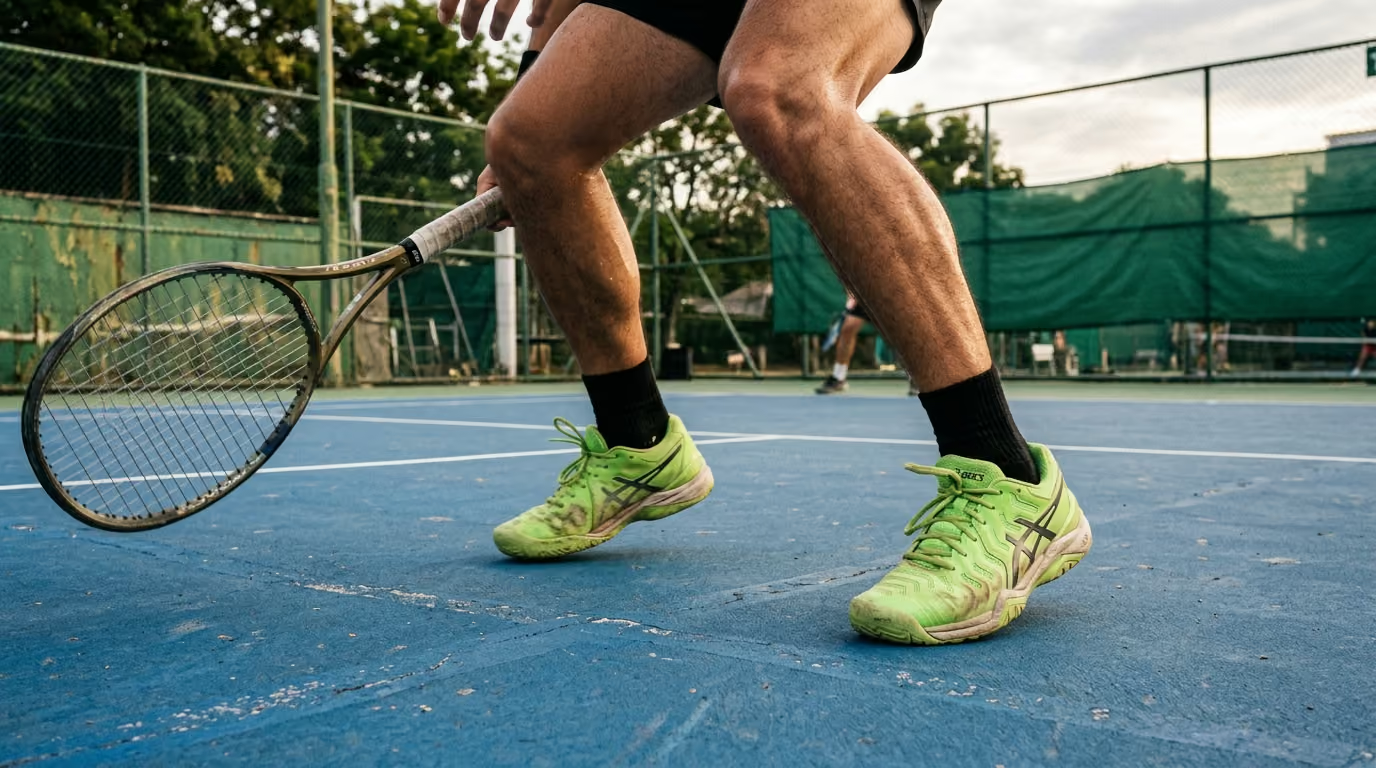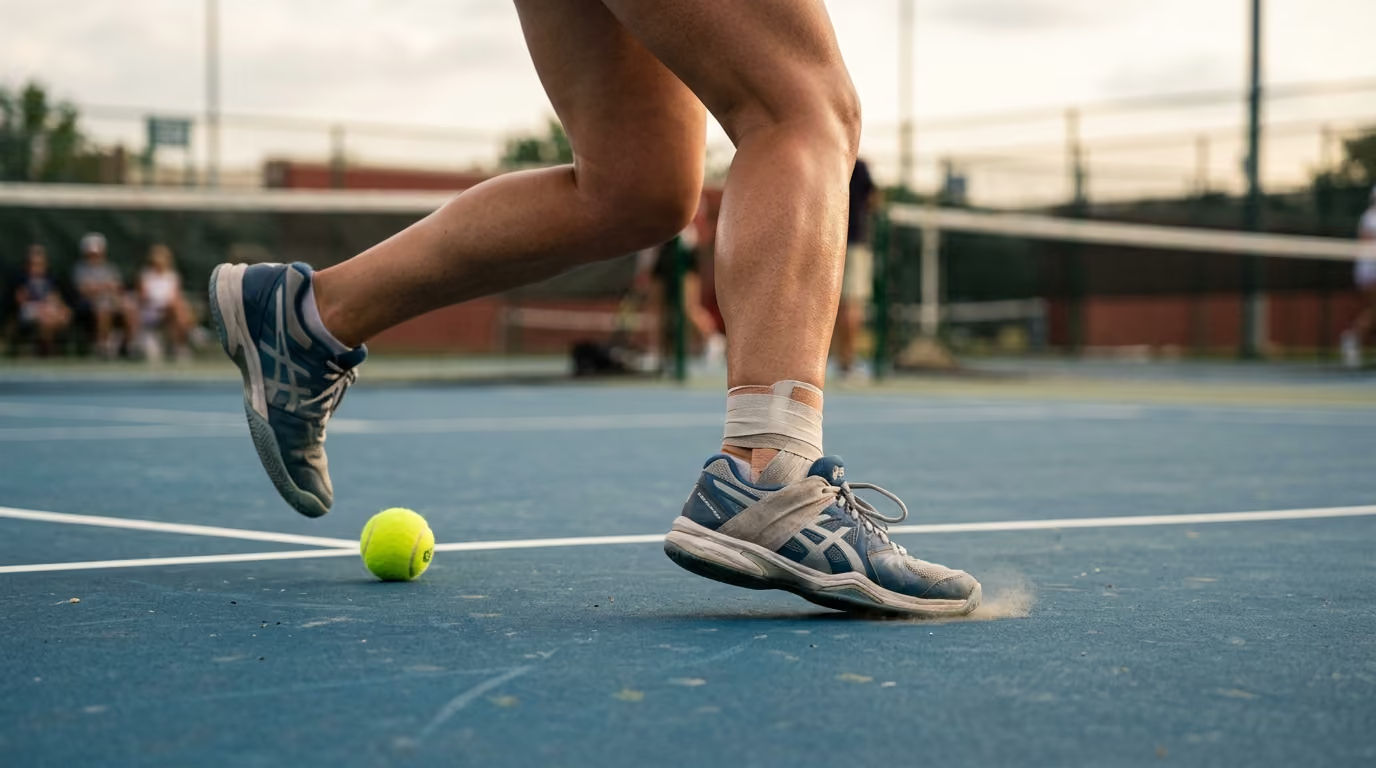

Effective court footwork minimizes mechanical stress on lower-body joints, helping athletes protect their knees and ankles while maintaining peak performance.




Have you ever searched the internet to find out why your knees or ankles ache after a long weekend of racquet sports? Many players assume that joint pain is an inevitable part of getting older.
Safer court footwork requires arriving at the ball under control, organizing your feet early, and using multiple short braking steps to decelerate before your final strike. By matching your movement patterns to the speed of the play, you can reduce the mechanical stress on your lower-body joints. This approach helps protect your knees and ankles while maintaining your performance on the court.
Understanding the physical demands of court sports requires a look at how injuries actually occur. In sports science, researchers track injury rates using a metric called athlete exposure. An athlete exposure represents one player participating in one practice or competition session. This measurement allows researchers to compare injury risks across different groups and playing environments. It also helps us understand that injury prevention is about reducing statistical risk over time.
Research consistently shows that the lower limb is the most vulnerable area for court athletes. In basketball, which shares many movement patterns with racquet sports, ankle sprains are the most common injury. An analysis of NCAA sports data found that ankle sprains represented 17.9 percent of all injuries for men and 16.6 percent for women. Over a ten-year period, collegiate basketball players experienced 1.49 ankle injuries per 1,000 athlete exposures. These numbers show that the repetitive demands of stopping, cutting, and landing place a heavy load on the lower joints.
Badminton research reveals a similar pattern of physical stress. A systematic review of badminton injuries found that lower-limb issues accounted for 52.15 percent of all reported injuries. Ankle injuries were the most common lower-limb problem. The research showed that sprains were the most prevalent injury type at 36.06 percent. Muscle injuries followed closely behind at 23.86 percent. This study highlights how the rapid changes of direction in racquet sports strain both skeletal joints and soft tissues.
We must also distinguish between acute injuries and overuse injuries. An acute injury happens during a single distinct event. This might involve slipping on a wet court, landing on an opponent's foot, or turning an ankle during a desperate cut. An overuse injury develops slowly over weeks or months. It occurs when repeated impact exceeds the tissue's ability to repair itself.
In badminton, overuse injuries account for 25 to 74 percent of all reported issues. This wide range suggests that playing volume, recovery habits, and movement efficiency play major roles in tissue health. Managing both types of injury requires a dual strategy. You must reduce the risk of sudden traumatic events while managing the cumulative load on your tendons and muscles.
This balance is especially clear when looking at knee health. Anterior cruciate ligament tears are highly disruptive injuries that often occur during noncontact cutting or landing. An NCAA study tracked ACL tears and found a rate of 0.86 tears per 10,000 athlete exposures. Interestingly, the rate of ACL tears during competition was 5.52 times higher than during practice. This difference indicates that the chaotic nature of competitive play increases physical risk.
The study also found that female athletes experienced higher rates of ACL tears in sex-comparable sports. In women's sports, these tears were more frequently attributed to noncontact mechanisms. In men's sports, contact with other players was a more common cause. This research emphasizes that movement patterns under pressure directly influence joint safety.
Fortunately, movement mechanics are not fixed. A randomized controlled trial evaluated a three-month, coach-supervised jump-landing program for basketball players. After the training, athletes landed with greater hip and knee flexion. This increased bending allowed them to absorb impact forces more efficiently. The female athletes in the program also showed a significant reduction in knee valgus, which is the inward collapse of the knee during movement.
Implementing structured training can prepare your body for these extreme forces. For instance, incorporating specific injury prevention resources into your routine can help you build the strength needed to resist joint collapse. By focusing on how you move, you can lower your risk of both acute sprains and long-term joint wear.
Many players spend their training time trying to get faster. They practice explosive starts, quick steps, and rapid acceleration. However, on a crowded court, speed is only half of the equation. If you cannot stop safely, your acceleration becomes a liability. Deceleration is the actual skill of reducing your horizontal speed while keeping your body in balance.
The fundamental rule of safe movement is to brake before your final step. When you wait too long to slow down, your final step must absorb all of your momentum. This puts immense pressure on your lead knee and ankle. It also forces your upper body to lean forward or spill sideways. To stop safely, you must distribute the braking force across multiple steps.
A safe stopping sequence follows a specific progression:
When you shorten your strides as you approach the ball, you keep your feet underneath your hips. This position allows your large hip muscles to absorb the impact of the stop. If you take a single giant stride to reach the ball, your front leg acts like a solid brake pad. The force travels straight up through your heel into your locked knee. This locked-knee position makes it very difficult to recover for the next shot.
Trunk control is another vital part of this process. Your upper body makes up a large portion of your total weight. If your trunk sways wildly when you stop, your hips and knees must work much harder to keep you upright. During a change of direction, you should turn your chest and pelvis toward your new target. This alignment reduces the twisting strain on your knees and helps you move more fluidly.
Selecting the right footwork pattern is not just a matter of style. It is a practical decision that determines how much physical stress your joints must endure. Different situations on the court require different movement solutions.
The lateral shuffle is your primary tool for short distances. It allows you to move side to side while keeping your hips square to the net. Because you do not cross your feet, you maintain a wide base of support at all times. This wide base means you can change direction instantly if the ball is deflected.
To shuffle safely, keep your feet parallel and avoid letting them click together. You should push off with the inside of your trailing foot and land lightly on your leading foot. Shuffling is highly efficient for minor adjustments along the baseline or kitchen line. However, if you try to shuffle across the entire width of the court, you will quickly tire yourself out.
When you must cover a larger distance quickly, the crossover step is much more efficient than the shuffle. In this movement, one foot crosses over the other to help you run laterally. The crossover allows you to cover several yards in a single stride.
The primary danger of the crossover is poor timing. If you cross your feet while your body is too upright, you can easily trip or lose balance. To perform a safe crossover, you must lower your hips and turn your pelvis toward the direction of travel. This rotation ensures that your hips, knees, and ankles remain aligned as you move across the court.
The drop step is essential when you must retreat quickly to chase a deep ball. Instead of backing up blindly, you open your hips by stepping backward and diagonally with one foot. This motion turns your body sideways, allowing you to run backward with normal forward strides.
The drop step prevents you from falling backward over your own heels. It also keeps your eyes on the ball as you retreat. When practicing the drop step, focus on rotating your hips smoothly. Your feet should follow the direction of your pelvis rather than fighting against it.
The lunge is the deepest, most physically demanding movement on the court. It occurs when you must reach for a low ball near the net or the side walls. A safe lunge requires landing with your front knee aligned directly over your middle toes.
You should avoid letting your knee cave inward or push forward past your toes. Your trailing leg should remain slightly bent to help you balance. As soon as you strike the ball, you must use your front leg to push yourself back to a neutral position. Training your body to recover immediately prevents you from getting stuck in a deep, vulnerable posture.
It is easy to think of footwork as a purely physical skill. However, your brain directs every step you take on the court. Your eyes must process the ball's trajectory, calculate your opponent's position, and select a destination. If your brain makes a late or incorrect decision, even perfect technique cannot protect your joints.
This link between seeing and moving is called perception-action coupling. On the court, you do not move in a vacuum. You move in response to visual cues. If you struggle to read the ball early, you will find yourself reacting late. This delay forces you to sprint at maximum speed and make emergency stops.
These emergency stops are highly stressful for your joints. When you run out of space, you are often forced to reach for the ball while still moving quickly. This combination of speed and reaching places your knee in a vulnerable, twisted position. In our experience, many recreational players hurt themselves not because of weak muscles, but because they committed to a ball they had already lost.
To reduce these risky situations, you must match your movement to your tactical reality. If your opponent hits an exceptionally deep, fast shot, chasing it at all costs may not be the wisest choice. Sometimes, the safest tactical decision is to concede a low-probability ball. This choice preserves your physical energy and protects your joints from a high-speed collision with the court or walls.
Communication is another powerful tool for preventing injuries. In doubles play, partners often collide because they both chase the same ball. These collisions can cause severe ankle sprains, bruises, and falls. You should establish clear verbal cues like "mine," "yours," or "switch." Calling for the ball early allows your partner to stop moving and clear the area, which eliminates the risk of an unexpected collision.
To move safely on the court, your body must possess the strength and balance to support your joints. You cannot expect your joints to handle the forces of competitive play if you do not prepare them during your off-court time. A complete preparation routine should target the muscles that stabilize your ankles, knees, and hips.
Your calves and ankles are your first line of defense. They absorb the initial impact every time your foot strikes the court. To build ankle stability, you should practice single-leg balance exercises. Standing on one foot while brushing your teeth or watching television is a simple way to challenge your balance. You can make this harder by closing your eyes or standing on a soft cushion.
Your thigh and hip muscles are responsible for controlling your knees during deep bends and sudden stops. Your hamstrings and quadriceps must work together to keep your knee stable. Squats, lunges, and step-ups are excellent movements for building this strength. When performing these exercises, focus on keeping your knees aligned with your toes. This practice teaches your muscles to resist the inward collapse that can damage your ligaments.
I remember finishing a tough two hour padel match on a cold Tuesday night and waking up the next morning feeling like my lower back was locked in concrete. For a long time, I just accepted this as the price of playing hard in my forties. But once I started spending just ten minutes on targeted hip mobility before heading to the club, the stiffness almost completely vanished. It taught me that we do not have to accept pain as a default state of aging.
Targeted preparation can keep you on the court for years to come. Focusing on structured mobility and movement training can make a massive difference in how your joints feel the day after a tough match. Developing your physical capacity is vital for maintaining athletic longevity as you continue to play the sports you love.
While tennis, pickleball, and padel all take place on a court, each sport places unique physical demands on your body. Understanding these differences allows you to tailor your footwork and preparation to your specific sport.
Tennis is played on a large court, which means you must cover significant distances. You will often find yourself sprinting at high speeds to chase down deep groundstrokes or wide angles. This high-speed running requires exceptional deceleration capacity. You must be able to brake hard, slide on clay, or plant your feet firmly on hard courts.
Because of the court size, tennis players use crossover steps more frequently than pickleball or padel players. You will also experience high-impact forces during serving and landing. To prepare for tennis, you should focus on building your eccentric leg strength. This type of strength helps your muscles absorb the force of high-speed stops. For more advice on managing these patterns, you can check out our tennis strategy guides.
Pickleball is played on a much smaller court, which changes your movement priorities. In pickleball, you rarely run long distances at maximum speed. Instead, the sport is characterized by short, rapid adjustments. You will spend a large portion of your time moving laterally along the non-volley zone line, also known as the kitchen line.
This constant side-to-side movement makes the lateral shuffle your most important footwork pattern. You will also find yourself in a constant squatting posture to reach low, soft shots. This low position can place a continuous load on your knees and lower back. To stay safe in pickleball, you should focus on hip mobility and quad endurance. You can read more about these specific adjustments in our guide to pickleball court movement.
Padel introduces a unique three-dimensional element because of the surrounding glass and mesh walls. You must learn to move backward to let the ball pass, watch it bounce off the wall, and then recover forward to make your shot. This back-and-forth movement requires frequent drop steps and rapid hip rotations.
The padel court is also smaller than a tennis court, which increases the density of play. You must react quickly to fast, unexpected rebounds off the glass. This fast pace requires excellent split-step timing and quick reflex steps. To protect your body in padel, you should prioritize rotational trunk stability and shoulder strength. For practical advice on mastering these wall transitions, look through our collection of padel court tips.
To help you see how these demands compare, let us look at the primary physical focus for each court type:
Many players fall into movement habits that feel natural but actually increase their risk of injury. Recognizing these patterns in your own play is the first step toward correcting them.
Coaches often tell players to "stay low" during rallies. While a lowered posture is helpful, staying in a deep, rigid squat for an entire match will quickly exhaust your thighs. When your muscles fatigue, they lose their ability to absorb impact.
As a result, the force of every stop travels directly into your knee joints. Instead of holding a constant squat, you should learn to move at a comfortable, semi-upright height. You should only sink into a deep position when you are preparing to strike the ball.
Some players are told to never cross their feet under any circumstances. This advice is well-meaning, but it can lead to inefficient movement over longer distances. If you try to cover a wide court using only shuffle steps, you will move too slowly and arrive late.
Crossing your feet is a safe and efficient way to cover space, provided you do it with control. The key is to turn your hips so your feet can move naturally. Do not try to cross your feet while keeping your hips rigidly square to the net.
You might have heard that you should always land as softly as possible after a jump. While bending your knees to absorb impact is good, an excessively soft, slow landing has a performance cost. If you sink too deeply into a landing, you will not be ready to react to the next shot.
The goal should be a controlled landing rather than an silent one. You want enough knee flexion to protect your joints, but enough muscle tension to remain springy and reactive.
In recent years, fitness media has focused heavily on knee valgus, which is the inward buckling of the knee. It is true that repeated, severe valgus under load can strain your ligaments. However, a brief, minor inward movement during a dynamic cut is a normal way the body redirects force.
You do not need to panic if your knee turns inward occasionally. You should only worry if your knee collapses inward consistently on every stop, especially when you are tired.
Many court athletes believe that if they can finish a match, their injury must be minor. This mindset can lead to chronic overuse issues. In collegiate sports, more than half of all reported injuries did not result in missed playing time.
However, continuing to load a painful or stiff joint can delay your recovery. It also forces your body to compensate by altering your movement patterns. This compensation often leads to a secondary injury in a different part of your body.
Safe footwork is not just about what you do during a match. It also depends on how well you recover between sessions. When your muscles are tired, your coordination declines. This fatigue makes it harder to use proper footwork, which increases your risk of a slip or a bad fall.
You can test your movement quality under fatigue by paying attention to how you stop at the end of a long session. If you find yourself taking long, clumsy strides instead of short braking steps, your body is telling you it is tired. When you reach this point, you should consider stepping off the court or slowing down the pace of your play. Continuing to push through extreme fatigue increases your risk of acute injury.
Managing your weekly playing volume is also essential for tissue health. Sudden spikes in how much you play can overwhelm your muscles and tendons. If you normally play once a week, suddenly playing four times in seven days is a massive increase in load. Your body needs time to adapt to new levels of physical stress.
To help your tissues recover, you should focus on simple strategies like getting quality sleep, staying hydrated, and performing light active recovery. Going for a gentle walk or doing some light stretching the day after a match can help ease muscle soreness. Understanding these recovery science principles will help you return to the court feeling fresh and ready to play.
While this manual is designed to help you move more safely, it is not a substitute for professional medical care. If you experience an injury, you must know when to step off the court and consult a healthcare provider.
You should seek immediate medical attention if you experience any of the following warning signs:
If you are returning to the court after an ankle sprain, you must progress through a gradual return-to-play protocol. Do not return to competitive matches as soon as you can jog in a straight line. You should first practice planned lateral movements, then progress to reactive cutting drills, and finally participate in practice sessions before playing a real match. A physical therapist can help you design a safe progression that rebuilds your confidence and protects your joints from reinjury.
To help you apply this knowledge, here is a practical checklist you can use this week to improve your court movement:
By focusing on controlled stops, early preparation, and smart decisions, you can enjoy your favorite racquet sports while keeping your body healthy. If you want to learn more about our approach to healthy movement on the court, please visit our about page or reach out to us directly through our contact page.
Follow Evercourts for practical insights on tennis, pickleball and padel performance, movement, recovery and healthy ageing. Stay connected for new articles, research-led guidance and ideas to help you play well and keep playing for years.


Read practical guidance for better movement, smarter preparation and a game that keeps working for you.
explore the Blog