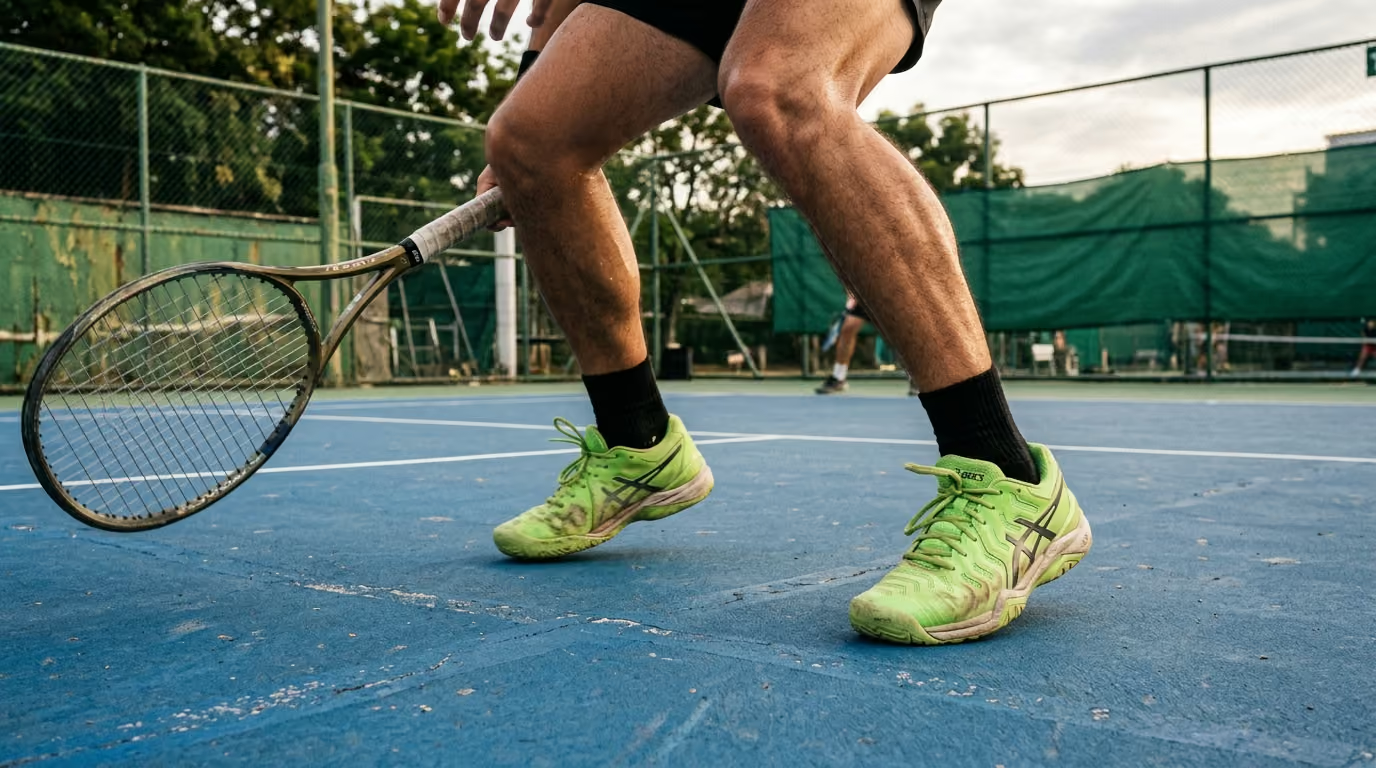
While many assume serve and overhead injury prevention is about avoiding shoulder rotation, it actually involves managing workloads and coordinating whole-body movement.




Preventing serve and overhead injuries is not about eliminating shoulder rotation. It is not about avoiding every minor muscle ache. Instead, injury prevention is a systematic process of managing workloads, coordinating whole-body movement, and respecting your physiological limits. This guide clarifies how to protect your upper limbs while maintaining power on the court.
To prevent serve and overhead injuries, players must distribute mechanical force across the entire body instead of relying solely on the shoulder. This requires maintaining a coordinated kinetic chain, progressively monitoring weekly serve volumes, and modifying technique when fatigue compromises movement patterns. By treating overhead actions as whole-body movements, you protect delicate joints and support your athletic longevity.
Overhead strokes are among the most physically demanding movements in racquet sports. The shoulder joint must produce rapid acceleration while maintaining stability in vulnerable positions. Understanding the relationship between movement quality and tissue capacity is the first step toward playing pain-free.
Sports science literature views overhead injuries as a balance between tissue capacity and physical load. According to the 2022 Bern Consensus Statement, managing injury risk depends on monitoring more than simple playing time. We must track the repetitions, the velocity of those repetitions, and the specific movements performed.
The shoulder is not designed to generate all the force required for a powerful serve or overhead smash. Instead, current research suggests the shoulder acts as a funnel that transmits and directs energy. This energy should be generated by the larger muscles of your legs, hips, and trunk. When the lower body or trunk fails to produce sufficient force, the smaller structures of the shoulder must overcompensate.
Epidemiological research reveals that upper-limb injuries represent a significant portion of racquet sports pathologies. One major study found that upper-limb issues account for approximately 28 percent of injuries in adult male players. For adult female tennis players, upper-limb injuries make up about 23 percent of reported cases. Across both groups, the shoulder is identified as the most common site of upper-extremity discomfort.
To build tissue capacity, evidence supports a structured approach to physical preparation. General exercise interventions are highly effective, with strength training demonstrating the most protective effect. You can learn more about structured physical preparation by exploring strength training programs designed for court athletes. Conversely, research shows that static stretching alone does not reduce injury rates or prepare joints for explosive overhead demands.
The kinetic chain is the coordinated system of body segments that generates and transfers force. During a serve or overhead smash, energy travels in a precise sequence from the ground to the ball. Biomechanical modeling indicates that approximately 54 percent of force development during a tennis serve comes from the legs and trunk. In contrast, the elbow and wrist contribute only about 25 percent of the total force.
A breakdown anywhere in this sequence increases the stress placed on your shoulder and elbow. We can analyze this transfer of energy by examining the five key phases of the serve.
The wind-up begins when you start your motion and ends when your knees reach maximum flexion. This phase prepares the lower body to contribute force by establishing balance and initiating trunk rotation. A rushed wind-up often leads to an upright posture, which forces the arm to work harder. Loading through your feet helps you store elastic energy in your thighs and hips.
Early cocking transitions your body into the classic trophy position. During this phase, your throwing arm moves upward and your scapula prepares for rotation. A common technical error is forcing the shoulder blades to remain rigidly pinned down and back. Coordinated overhead movement actually requires the scapula to rotate upward freely. Without this natural movement, the rotator cuff can become compressed against the bone.
Late cocking occurs when the shoulder reaches its point of maximum external rotation. This phase is highly demanding, as internal forces within the joint reach their peak. If your spine is excessively arched or tilted sideways, tissue stress increases. The racket should stay in a controlled path without drifting too far behind your torso.
Acceleration involves rapid internal rotation of the humerus to meet the ball at contact. Your legs and trunk must initiate this phase before your arm reaches maximum speed. Trying to muscle the ball by forcing the shoulder to accelerate independently leads to rapid fatigue. True acceleration feels effortless because it relies on the momentum built by the lower body.
The follow-through is a vital safety mechanism for your shoulder. After contact, your muscles must absorb high braking forces over a very short distance. An abbreviated or tense follow-through forces the rotator cuff to contract abruptly to stop the arm. A relaxed, long follow-through distributes these forces across your back and hips.
When overhead loading exceeds a player's physical capacity, specific tissues begin to break down. Understanding these common clinical patterns helps you identify early warning signs before they become chronic issues. You can find detailed overviews of these conditions in our targeted injury prevention resources.
The rotator cuff is a group of four muscles that stabilize the shoulder joint. These muscles work exceptionally hard during the acceleration and deceleration phases of the serve. Overuse can cause the tendons to become inflamed, swollen, and painful. This condition often presents as a dull ache deep in the shoulder after playing.
Internal impingement occurs when the rotator cuff tendons are pinched between the head of the arm bone and the shoulder socket. This contact typically happens during the late cocking phase when the arm is fully turned outward. Players with this issue usually feel sharp pain in the back of the shoulder during a serve. It is often linked to poor shoulder blade control or tightness in the back of the joint capsule.
The labrum is a ring of cartilage that deepens the shoulder socket and provides stability. Repetitive, high-force overhead movements can fray or tear this cartilage, especially at the top of the joint. This specific tear is known as a SLAP lesion, which stands for superior labrum anterior to posterior. Players often report a catching or clicking sensation accompanied by a sudden loss of serving power.
While the shoulder directs the serve, the elbow often absorbs the consequences of poor mechanics. Repetitive wrist snapping or excessive racket gripping can strain the tendons on either side of the elbow. Medial epicondylitis, often called golfer's elbow, affects the inside of the joint. Lateral epicondylitis, or tennis elbow, affects the outside and is often exacerbated by late off-center hits.
To get extra power or spin, players often arch their lower backs excessively during the serve toss. This hyperextension puts immense pressure on the lumbar vertebrae and the facet joints of the spine. It can also strain the abdominal wall, particularly the oblique muscles on the opposite side of the hitting arm. Over time, this mechanical compensation can lead to chronic lower back stiffness.
Applying biomechanical principles on the court requires mindful practice and structured routines. It is easy to understand the kinetic chain in theory, but executing it under match pressure is different. You must consciously train your body to share the load.
A few years ago, I realized my tennis serve speed was dropping, and my shoulder was constantly throbbing after matches. Instead of pushing through the pain, I took a month to rebuild my mechanics and focus on rotator cuff endurance. I stopped trying to hit flat aces and developed a much heavier kick serve. My win rate actually went up, and my shoulder stopped hurting. Sometimes longevity means outsmarting your own ego on the court.
A proper warm-up prepares your cardiovascular system, nerves, and muscles for high-velocity work. A random, two-minute shoulder stretch is not sufficient. A high-quality routine should take seven to ten minutes and progress from general movement to sport-specific actions.
First, raise your core temperature with light jogging or side-shuffling for two minutes. Next, mobilize your hips and thoracic spine with dynamic movements like lunges with a torso twist. Third, activate your rotator cuff and upper back using resistance bands, performing internal and external rotations. Finally, complete several shadow serves without a ball, focusing on a smooth, relaxed rhythm.
You can read more about designing effective preparation routines in our comprehensive court health guides. Remember that consistency with these routines is far more important than intensity.
To protect your shoulder, you must actively engage your lower body during every overhead shot. Focus on pushing through the balls of your feet during the knee bend phase. Drive your hips upward and forward toward the ball, rather than just jumping straight up. This movement creates a natural bow shape in your body that stores elastic energy.
Your landing is just as important as your takeoff. When returning to the court, always land on a flexed knee to absorb the impact. Try to land on the foot opposite your hitting arm, keeping your chest up and balanced. A stiff, straight-legged landing sends a jarring force up your spine and into your neck.
Not every player needs to jump high to hit a safe, effective serve. If you have knee pain, limited ankle mobility, or past joint issues, a high-jump serve may cause more harm than good. You can still use your lower body effectively without leaving the ground.
Focus on a deep, stable knee bend while keeping your heels in contact with the court. As you strike the ball, push upward through your legs to transfer energy into your torso. Keep your back foot anchored to provide a stable base of support. This modification reduces impact forces on your knees while still supporting the kinetic chain.
While the kinetic chain applies to all racquet sports, the specific demands of each game vary. Tennis, pickleball, and padel place different mechanical stresses on your upper body. Recognizing these differences allows you to tailor your training to your specific sport.
Tennis requires the most demanding overhead motion of the three sports. The serve is initiated from a static position, allowing players to swing with maximum force. This movement requires a large range of motion in both external and internal shoulder rotation. The high speed of the ball and the heavy weight of the racket increase deceleration demands.
Furthermore, tennis players must hit a wide variety of serves, including flat, slice, and kick serves. Kick serves require extreme lateral flexion of the spine to contact the ball behind the head. This motion increases joint stress in the lower back and shoulder. If you want to refine your technique, we offer detailed technical tennis analysis to help you minimize joint stress.
In pickleball, players serve underhand, which completely removes the high-velocity overhead serve from the game. However, players must still hit overhead smashes during fast rallies at the kitchen line. These smashes are often reactive and hit with minimal preparation time.
Because there is rarely time for a full wind-up, pickleball players cannot rely heavily on leg drive. The smash is often executed using only the shoulder, elbow, and wrist. The paddle is short and light, but the sudden, jerky nature of these shots can still stress the joints. Players must focus on keeping their shoulder blades stable during quick, reactive swings.
Padel is unique because overhead shots are a fundamental part of the game's tactical landscape. While the serve is hit underhand, players hit constant overheads like the bandeja and the vibora. These shots are hit from mid-court to maintain a dominant position at the net.
The bandeja and vibora are typically hit with slice or sidespin, rather than pure downward force. Players rarely jump high for these shots, focusing instead on control and court positioning. However, the sheer volume of overheads in a single padel match is exceptionally high. This high repetition makes padel players highly susceptible to gradual overuse injuries of the rotator cuff.
Even highly experienced athletes can fall into bad habits that compromise their joint health. Recognizing these common training errors allows you to make simple, protective changes to your routine.
Many players believe that stretching their shoulders before a match will prevent injury. In reality, static stretching can temporarily reduce muscle power and joint stability. Your shoulder needs active stability, which comes from strong, coordinated muscles, not just loose ligaments. Replacing static stretching with dynamic, muscle-activating movements is a safer choice.
The waiter's serve occurs when a player tosses the ball and hits it with an open racket face, similar to carrying a tray. This technical flaw removes forearm pronation and internal rotation from the kinetic chain. As a result, the player must force the shoulder into excessive abduction to create power. This pattern places highly concentrated stress on the front of the shoulder joint capsule.
The most common cause of tendon pain is a sudden increase in play or practice volume. Moving from playing once a week to participating in a multi-day tournament is a massive workload spike. Your tendons require time to adapt to increased demands. When you increase your playing frequency too quickly, tissue damage accumulates faster than your body can repair it.
Managing physical load is the most effective way to prevent overhead injuries over a long playing career. Monitoring how much you play and identifying early signs of fatigue can protect you from long-term damage.
To protect your joints, you should monitor more than just the total hours you spend on the court. Keep a simple log of your weekly matches, practice sessions, and overall physical effort. A practical method is to calculate your session load by multiplying your playing duration in minutes by your rate of perceived exertion on a scale of one to ten.
Additionally, try to estimate the total number of high-effort serves or overheads you hit each week. If you are returning from a break, limit your weekly volume increases to ten percent. Avoid hitting dozens of consecutive maximum-effort serves at the end of an intensive practice session. Tracking these details provides excellent athletic longevity advice for players of all ages.
When returning to play after a break or minor injury, use a step-by-step progression to rebuild your strength. Do not jump immediately into competitive matches. Instead, complete this six-stage progression over several weeks to safely prepare your tissues:
When muscles fatigue, your body naturally alters its movement patterns to maintain ball speed. These adjustments often increase the stress placed on your joints. Stop or modify your serving immediately if you notice any of the following warning signs:
While mild muscle soreness is common after a demanding session, true pain should never be ignored. Pushing through joint pain can turn a minor strain into a chronic, debilitating injury. Consult a qualified physical therapist or sports medicine physician if you experience any of the following symptoms:
Your return to the court should be guided by functional milestones, not just a calendar date. A professional can help you rebuild strength, refine your mechanics, and safely return to the game you love.
Yes, equipment modifications can alter the physical demands placed on your arm. A racket that is too heavy, stiff, or head-heavy increases the force your shoulder must absorb during deceleration. Similarly, tight polyester strings absorb less shock, transferring more vibration to your elbow and shoulder. Transitioning to a lighter, more flexible racket frame or lowering your string tension can reduce joint stress.
Muscle strains typically present as a dull, diffuse ache in the muscle belly, such as the back of the shoulder or upper arm. This soreness usually peaks 24 to 48 hours after playing and improves with light movement. In contrast, joint issues often cause sharp, localized pain deep inside the shoulder socket. This pain is frequently triggered by specific movements, like the late cocking phase, and may include clicking or popping.
A kick serve is not inherently dangerous, but it does place different mechanical demands on your body. To generate heavy topspin, you must arch your upper back and contact the ball slightly behind your head. This posture requires excellent thoracic mobility, core control, and hip flexibility. If you lack this mobility, your shoulder and lower back must overcompensate, which can increase your risk of injury.
Follow Evercourts for practical insights on tennis, pickleball and padel performance, movement, recovery and healthy ageing. Stay connected for new articles, research-led guidance and ideas to help you play well and keep playing for years.


Read practical guidance for better movement, smarter preparation and a game that keeps working for you.
explore the Blog