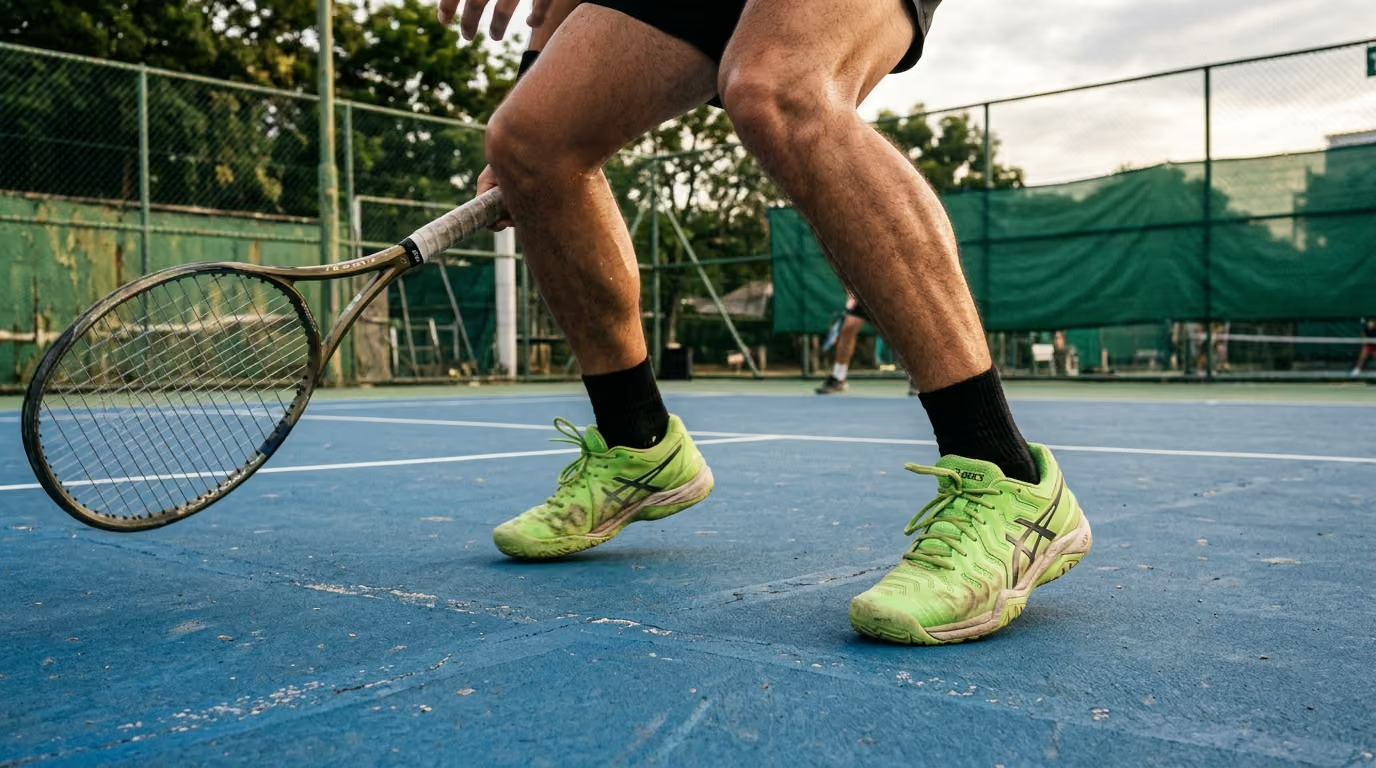
Racquet sport athletes can effectively optimize their strength training by understanding how to choose appropriate weights, sets, repetitions, and rest times.




A structured strength program for court athletes is not a generic fitness routine. It is a precise physical tool designed to build movement capacity while leaving you with enough energy for high-level court work. This guide provides a systematic approach to choosing weights, sets, repetitions, and rest times. By understanding these variables, you can avoid the random exhaustion often promoted by standard fitness routines.
For court athletes, strength training success relies on choosing weights that allow you to stop one to three repetitions short of failure on major exercises. This approach provides a sufficient stimulus to improve power and joint stability while preventing the severe soreness that degrades court movement. By managing sets, repetitions, and rest intervals, you can support athletic longevity without compromising your weekly practices.
Many athletic programs treat sets, repetitions, loads, and rest periods as isolated numbers. In reality, these variables interact to determine your physical adaptations and your daily recovery. Designing an effective routine requires balancing these factors to support your performance on the court.
Current sports science shows that resistance training can directly improve performance in racquet sports. Research has associated structured strength programs with improvements in serve speed, jumping height, lateral agility, and rapid direction changes. However, these benefits depend heavily on how you manage your training variables.
The American College of Sports Medicine (ACSM) provides a foundational framework for organizing these variables based on your specific training goals. To build maximal strength, the guidelines suggest using heavy loads that permit only one to six repetitions per set. For muscle growth, or hypertrophy, the recommended range expands to eight to twelve repetitions using moderate loads. Local muscular endurance is best targeted with lighter weights that allow fifteen or more repetitions.
These ranges are useful programming zones rather than rigid physiological boundaries. You can improve your strength and muscle mass across a wider spectrum of repetitions if your effort level is sufficiently high. For court athletes, the priority is to apply enough stress to stimulate adaptation without causing excessive exhaustion.
A common belief in fitness culture is that you must perform every set to absolute muscular failure. However, evidence comparing failure and non-failure training shows that reaching failure is not necessary for building strength or muscle size. Instead, training to failure generates high levels of neuromuscular fatigue that can linger for days.
A meta-analysis on resistance training to failure found no consistent advantage for reaching absolute failure. Researchers observed that training with a few repetitions left in reserve produced similar gains in strength and muscle mass. For a tennis or badminton player, avoiding failure on major lifts preserves the energy needed for high-quality court practice.
Furthermore, velocity loss research highlights how fatigue accumulates within a single set. When you lift a weight as fast as possible, your repetition speed decreases as your muscles tire. Measuring this speed reduction helps sport scientists understand the precise stimulus being delivered to the body.
Studies show that keeping velocity loss below twenty-five percent during a set produces excellent strength gains. In contrast, letting your speed drop by forty percent or more increases muscle growth but causes deep fatigue. One study compared a twenty percent velocity loss limit to a forty percent limit during squat training.
The group that stopped their sets at a twenty percent speed loss achieved similar strength gains. They also showed greater improvements in vertical jump performance while performing forty percent fewer total repetitions. For court players who rely on speed and jumping, stopping sets before your speed drops is highly beneficial.
This evidence supports using conservative effort levels for exercises that target speed, agility, and explosive power. You do not need to exhaust your muscles to make them faster or stronger. By utilizing strength and conditioning resources wisely, you can train your nervous system to produce high force without causing unnecessary soreness.
To apply these scientific principles, you need a practical way to measure your effort during each set. The Repetitions in Reserve (RIR) scale is an excellent tool for this purpose. It allows you to estimate how many more clean repetitions you could perform before reaching failure.
The RIR scale corresponds directly to a ten-point Rating of Perceived Exertion (RPE) system. An RPE of ten means you could not complete another repetition, representing zero RIR. An RPE of nine means you have one repetition left in reserve, while an RPE of eight means you have two. Using this scale helps you adjust your daily weights based on how your body feels.
A systematic review of thirty-one studies confirmed that the RIR scale is a highly feasible way to adjust training intensity. However, players must learn how to estimate their reserve repetitions accurately. Research indicates that many athletes, especially those new to training, tend to underestimate how many repetitions they have left.
To make the RIR scale useful, you must occasionally calibrate your perceptions. You can do this by safely taking a stable exercise, such as a leg press or lat pulldown, to actual failure. Count your repetitions and note how the movement feels when you are three, two, and one repetition away from stopping.
This practice calibration helps you develop an accurate mental map of your physical limits. You should only perform this calibration on highly stable, low-risk exercises. Do not test absolute failure on complex, high-risk movements like barbell squats, deadlifts, or overhead presses.
Once you can accurately estimate your RIR, you can use it to guide your weekly strength sessions. If your program calls for three sets of eight repetitions at a two RIR, you should select a weight that allows you to complete the eight repetitions with two clear, technically sound repetitions left in the tank. If you finish the set and feel you could have done four more, the weight is too light.
The greatest benefit of using RIR is its ability to adjust for daily changes in your physical readiness. Court athletes face many variables, including long matches, poor sleep, travel, and changing weather conditions. A fixed weight that felt easy last week might feel incredibly heavy today.
If you are fatigued, your repetitions will feel harder, and you will reach your target RIR with a lighter weight. This automatic adjustment is called autoregulation. It ensures that you always apply the correct level of physical stress to your body, regardless of external factors.
Using RIR helps you avoid the trap of forcing yourself to lift a predetermined weight when your body is exhausted. Forcing heavy lifts during periods of high fatigue increases your risk of injury. Adopting this approach supports long-term athletic development and protects your physical health.
While the core principles of strength training apply to all athletes, the specific demands of your sport should influence your training variables. Tennis, pickleball, and padel each place unique physical stresses on the body. Understanding these differences allows you to customize your strength program for maximum court carryover.
Tennis players must cover a large court, demanding rapid acceleration, heavy braking, and rotational power. A meta-analysis of strength interventions showed that structured resistance training significantly improves tennis serve speed. These programs typically used two to three sessions per week, featuring one to eight sets of three to ten repetitions.
To support these movements, tennis players should focus on building a strong lower body and a stable trunk. Useful lower-body options include back squats, trap-bar deadlifts, and Bulgarian split squats. To train these movements effectively, use three to five sets of three to six repetitions with a two to three RIR.
This rep range builds the maximal force capacity needed to change direction quickly on the court. It also improves your ability to transfer force from your legs through your trunk and into your racket. Pair these heavy exercises with explosive medicine-ball throws to translate your strength into court power.
Pickleball is played on a smaller court, placing a premium on short steps, low-profile stances, and rapid reactions. The frequent low lunges required in pickleball place significant stress on the knees, thighs, and lower back. To build endurance for these positions, pickleball players benefit from moderate-to-high repetition ranges.
A useful setup includes two to three sets of ten to fifteen repetitions on exercises like goblet squats and step-ups. Keep your effort level around a two to three RIR to avoid excessive muscle soreness. This approach builds the muscular endurance needed to maintain a low stance throughout long rallies.
Additionally, pickleball players should dedicate attention to wrist and forearm strength. The rapid paddle exchanges at the kitchen line require stable, quick wrists. Use two sets of fifteen to twenty controlled repetitions for forearm exercises to support tendon health without overloading the joints.
Padel players face a high volume of overhead shots, wall transitions, and continuous lateral shuffling. The constant overhead reaching demands excellent shoulder mobility and scapular endurance. To support these movements, padel players should use targeted accessory exercises alongside their main lower-body lifts.
For shoulder health, perform two to three sets of twelve to fifteen repetitions on exercises like face pulls and external rotations. These high-repetition sets build endurance in the rotator cuff and upper back. They help keep your shoulder joint stable during repeated smash attempts late in a match.
For lower-body power, padel players can utilize lateral lunges and split squats. Perform three sets of six to ten repetitions with a two RIR to prepare your hips for lateral movements. This balanced approach protects your upper body while keeping your lower body quick and responsive on the court.
Many court players make predictable mistakes when they begin a strength training program. These errors often stem from following generic fitness advice that does not account for the demands of racquet sports. Recognizing these pitfalls can help you protect your joints and keep your court movement sharp.
The most common error is performing every set of squats, deadlifts, or lunges to complete muscular failure. As established by scientific consensus, training to failure does not provide superior gains but significantly increases your recovery time. If you squat to failure on Monday, your lateral movement on the court on Tuesday will be slow and painful.
To preserve your court performance, keep a buffer of one to three repetitions on all major lifts. Save higher-effort sets for low-risk, single-joint isolation exercises like calf raises or bicep curls. This strategic approach keeps your legs fresh for practice while still stimulating strength gains in the gym.
Another common mistake is rushing through your rest periods to keep your heart rate high. While short rests are useful for cardiovascular conditioning, they are counterproductive when trying to build strength or power. If you only rest sixty seconds between heavy sets of split squats, your nervous system will not recover.
For heavy strength and power exercises, rest for three to five minutes between sets. This recovery time allows your muscles to rebuild their energy stores, ensuring you can lift with maximum force on the next set. Use shorter rest times only when performing local muscular endurance work or accessory circuits.
Many traditional strength programs require you to calculate your weights based on a one-repetition maximum (1RM). For example, a program might tell you to perform three sets of five squats at eighty percent of your 1RM. While this works well for competitive powerlifters, it is often too rigid for racquet athletes.
If you had a grueling two-hour match yesterday, your actual strength capacity today will be lower. Forcing yourself to lift a rigid percentage of your maximum can lead to poor technique and joint strain. Using the RIR scale to guide your weights allows your training to adapt to your daily physical state.
Understanding how strength variables affect your recovery is essential for maintaining a consistent playing schedule. Every set you perform in the gym places a demand on both your muscular system and your central nervous system. Managing this total demand is key to avoiding chronic fatigue and joint issues.
To manage your physical recovery effectively, you must understand the difference between peripheral muscle damage and central nervous system fatigue. Heavy, explosive movements with long rest periods primarily stress the nervous system. While this requires adequate rest, it typically does not cause the deep, lingering muscle soreness that disrupts court movement.
In contrast, high-volume training with short rest periods and high effort levels causes significant muscle damage. This damage leads to delayed onset muscle soreness (DOMS), which can impair your agility and coordination for several days. For active players, managing this type of fatigue is critical.
To support recovery science guidelines, keep your total training volume moderate during periods of heavy court play. A useful starting point is to perform two to three sets per exercise, rather than four or five. This lower volume provides a strong training stimulus while keeping your recovery time short.
Court sports involve repetitive jumping, lunging, and striking, which place high stress on your tendons. Your patellar tendon, Achilles tendon, and elbow tendons require adequate recovery time to adapt and strengthen. Overloading these tissues with excessive gym volume can lead to overuse issues like tendinitis.
To protect these joint attachments, avoid sudden increases in your total weekly training sets. Increase your training volume gradually, allowing your tendons time to adapt to the physical load. Utilizing structured injury prevention practices in your gym sessions will help keep your joints healthy for years to come.
Remember, the goal of strength training is to support your court play, not to compete with it. By keeping your gym volume moderate and your effort levels controlled, you can build physical capacity without sacrificing your court performance. This balance is the foundation of long-term athletic success.
To make continuous progress in the gym, you need a structured system for increasing your training load over time. Without a plan for progression, your body will eventually adapt to your current weights, and your strength gains will stall. For court athletes, this progression must be simple, reliable, and easy to manage.
A classic and highly effective progression method is the double-progression system. In this setup, you work within a target repetition range rather than aiming for a single, fixed number. You only increase the weight once you can perform the maximum number of repetitions on all of your scheduled sets.
Let us look at a practical example using a target of three sets of six to eight repetitions on the goblet squat.
This system is highly effective because it ensures you only increase the weight when your body is genuinely ready. It prevents you from moving to heavier weights before you have mastered the current load. This built-in safety mechanism is excellent for protecting your joints and supporting long-term athletic longevity.
Another valuable system is the RIR progression model, which focuses on gradually increasing your training effort over several weeks. This approach is particularly useful during preparation phases when you have fewer competitive matches.
This structured approach allows you to build strength systematically without overloading your body. It ensures you spend most of your training time in a safe, productive effort zone. By incorporating these athletic longevity principles, you can continue to build physical capacity safely.
To help you apply these concepts, let us look at four practical case patterns. These examples show how to organize your training variables based on different physical needs and playing schedules.
This player has two matches per week and wants to maintain their strength and power without creating muscle soreness.
This session focuses on maintaining physical strength and power while avoiding the deep muscle damage that causes soreness. Heavy compound lifts are kept short of failure, and the total volume is low to support recovery.
This player is in a training phase with fewer matches and wants to build lower-body force capacity and jumping power.
This off-season program uses higher set volumes and challenging weights to build physical capacity. The jumping exercises are performed when the athlete is fresh to maximize power output.
This player is returning from travel or a busy competitive schedule and needs a session that maintains joint health without overloading their system.
This routine provides a moderate training stimulus while respecting the body's need for recovery. It helps keep your muscles active and your joints lubricated without causing further physical fatigue.
This targeted program is designed to build endurance and stability in the shoulder joint, which is highly beneficial for overhead athletes.
These exercises are stable and relatively low risk, allowing you to train closer to failure. They build the muscular endurance needed to stabilize your shoulder during repeated striking. Incorporating these movements into your routine supports healthy, resilient shoulders on the court.
While a structured strength program can help you stay healthy, it is important to know when to seek professional medical advice. Pushing through physical pain in the gym or on the court can turn a minor strain into a chronic injury. Recognizing these signs early can protect your long-term athletic health.
If you experience sharp or localized pain during an exercise, stop immediately. Unlike the dull, general ache of muscle soreness, joint pain indicates that a structure is being overloaded. If this discomfort does not resolve within forty-eight hours, consult a physiotherapist or sports medicine physician.
Swelling in a joint, such as your knee, ankle, or elbow, is a clear sign of inflammation. Similarly, if a joint feels unstable or makes a painful clicking sound during movement, avoid loaded exercises. A healthcare professional can perform specific tests to evaluate your ligaments and joint structures.
Any sensation of numbness, tingling, or radiating pain down your arms or legs requires prompt medical attention. These symptoms often indicate nerve compression in your neck or lower back. Avoid heavy loading, especially spinal compression, until you have been evaluated by a qualified doctor.
By taking a proactive approach to your physical health, you can address minor issues before they become major injuries. Remember, a successful strength program is designed to keep you active and performing well on the court for years to come.
Yes, current sports science shows you can build muscle effectively without training to failure. Stopping your sets one to three repetitions short of failure provides a strong stimulus for muscle growth. This approach also reduces your recovery time, keeping you fresh for your court practices.
For heavy strength and power exercises, your rest period is long enough when your breathing has returned to normal and your muscles feel fully recovered. This typically takes three to five minutes. For lighter accessory work, a shorter rest of one to two minutes is usually sufficient.
Yes, you can lift heavy weights during tournament weeks if you keep your training volume very low. For example, performing just one or two sets of a heavy exercise can maintain your strength without causing fatigue. Focus on explosive, low-volume movements to keep your nervous system sharp.
It is normal to find RIR estimation challenging when you first start using the scale. To improve your accuracy, occasionally test your limits on a safe, stable machine exercise. Take a comfortable weight and count your repetitions until you cannot complete another one. This simple practice will help you calibrate your mental map of your physical limits.
Follow Evercourts for practical insights on tennis, pickleball and padel performance, movement, recovery and healthy ageing. Stay connected for new articles, research-led guidance and ideas to help you play well and keep playing for years.


Read practical guidance for better movement, smarter preparation and a game that keeps working for you.
explore the Blog